Category: Photographers/Photography

  • New York/Upper East Side


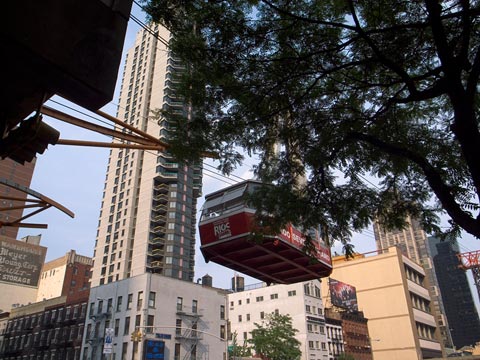
    Roosevelt Island Tram, 59th Street

    I have an assignment photographing 39 buildings around Manhattan. Spent most of the day in 90 degree heat schlepping around the Upper East Side scouting the buildings. As I walked down First Avenue under the Roosevelt Island tram station at the foot of the 59th Street Bridge I looked up as a cable car lifted skyward.

  • New York/Public Theater


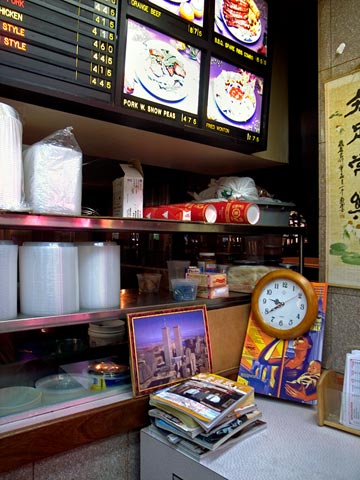
    Chinese take-out on Christopher Street

    Last night we went to the Public Theater to see Voices in Conflict, a play created and performed by the drama class of Wilton High School in Wilton, Connecticut. Voices is a dramatic compilation of the words of American soldiers in Iraq and Iraqi civilians. See earlier post here.

    The students’ production was banned from the school by principal Timothy Canty because, presumably, it was biased and controversial. But that was only the beginning of a story that eventually led to a triumphant performance of the play at the Public Theater, the pre-eminent Off Broadway showcase in New York. That triumph is muted, however, by several things. Bonnie Dickinson’s job as the drama teacher at Wilton remains in danger, and–the larger issue–freedom of expression in America’s schools is increasingly under threat.

    Voices in Conflict began as a drama class production, but over the months as interest in the press gathered steam, the play evolved into a much more serious and well crafted project. By the time it reached the Public–after several performances in Connecticut and New York– it transcended its high school origins and became a lightening rod for those seeking a dialogue concerning the war. A number of Iraqi veterans were in the audience last night, and participated in the discussion that took place after the play ended. They, at least those present, were supportive of the students’ efforts. Also participating were Chris Durang, the playwright/actor, and Martin Garbus, the prominent First Amendment lawyer.

    Unfortunately, the discussion that took place last night in New York has not been allowed to occur in Wilton High. The great dichotomy of the present is that while polls show a clear majority of Americans oppose further involvement in Iraq, those who question the war often find their patriotism impugned. What we saw last night was a demonstration of what patriotism is all about.

    http://www.voicesinconflict.com

    Update: Bonnie Dickinson, the drama teacher at Wilton High, has been cleared of all complaint charges. (June 21, 2007)

  • New York/Grand Army Plaza

    A few months ago I wrote about photographing Civil War monuments around Brooklyn for an exhibition in the fall. Well, it’s finally happening, and I’ve gotten out several times with my view camera to take pictures. If all goes well, my photographs will comprise a unified series of contemporary views of Brooklyn monuments, which will be juxtaposed against historical materials in an exhibition at the Brooklyn Public Library.


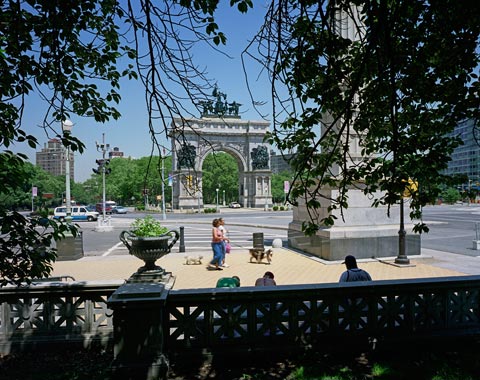
    Grand Army Plaza (4×5 film)

    The most important Civil War monument site in Brooklyn is Grand Army Plaza, which includes the Soldiers and Sailors Memorial Arch and adjacent statues. The arch was designed by John Duncan, and the main sculptural groupings were done by Frederick MacMonnies. MacMonnies did the wonderful Nathan Hale statue now standing in front of City Hall. Go here for my photograph of it.


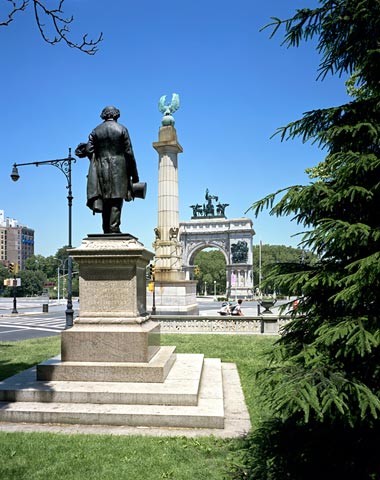
    Grand Army Plaza from Prospect Park (4×5 film)

    Grand Army Plaza is something of a mess today–Parisian Etoile it is not. The arch, though quite massive, can’t compete with the 12 lanes of traffic roaring around it. Pedestrians will find few crosswalks to the central oval island, so people routinely risk life and limb dashing across the acres of pavement. I did numerous pictures of the arch, from near and far, but am most satisfied with a couple of views from just within Prospect Park. In one, I stacked several monuments in a row: a sculpture of James S.T. Stranahan, the founder of Prospect Park, one of the four eagle-topped columns, and the arch.

  • New York/Greenwich Village


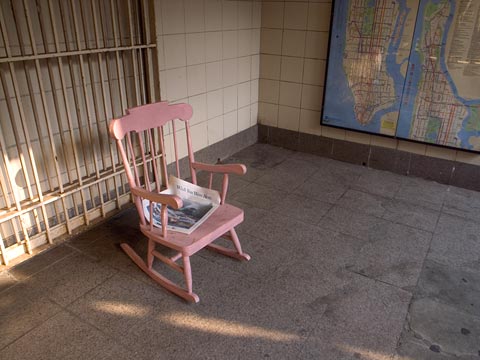
    Christopher Street/Sheridan Square subway station

    The headline said “Wish You Were Here.”


    Christopher Street

  • New York/Houston Street


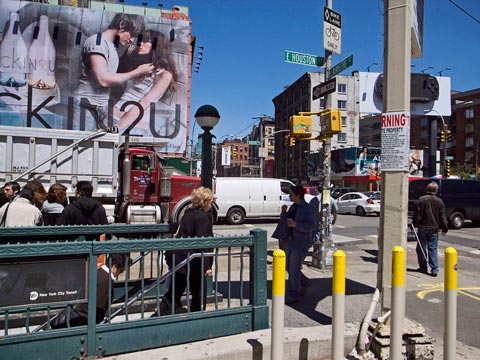
    Houston Street

    Another picture taken while walking on Houston Street between home and office.

  • New York/The Bronx


    Third Avenue, the Bronx

    Traveled up to the South Bronx to take a few photos for a column my wife (Renée Schoonbeek) writes for a Dutch planning magazine. She is interested in a new housing development to be built on a vacant piece of land near the Hub (Google map), a busy shopping area that has seen better days, but is obviously on the way back up. Lots of sneaker shops and fast food, but a new stretch of stores featuring national brands on Third Avenue as well. The proposed housing, designed by Grimshaw Architects, was the result of a design competition–common in Europe, but still an unusual way of working in New York.

    Just a block or two away from the Hub things can get pretty desolate, though there are lots of low rise townhouses of recent vintage, and almost none of the abandonment that characterized the South Bronx in the ’70s and ’80s. I photographed the vacant development site, but we decided to go with the picture above to give a sense of the local street scene.

  • New York/Chelsea Market

    More random New York images.


    Chelsea Market


    Chelsea Market

  • New York/Richard Serra


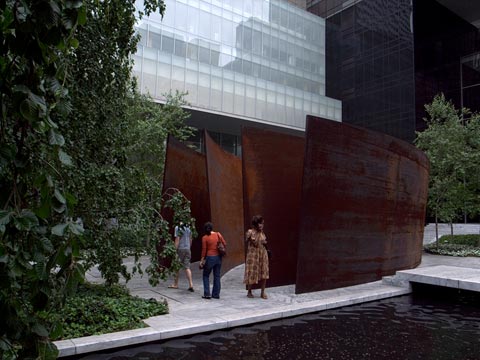
    Intersection II • Richard Serra

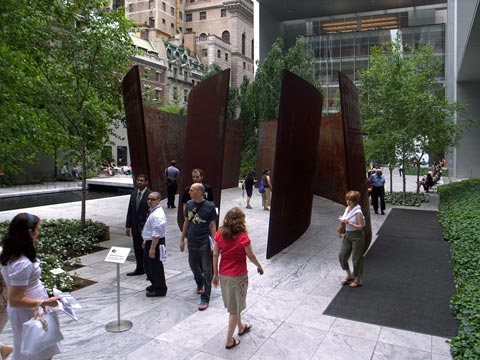
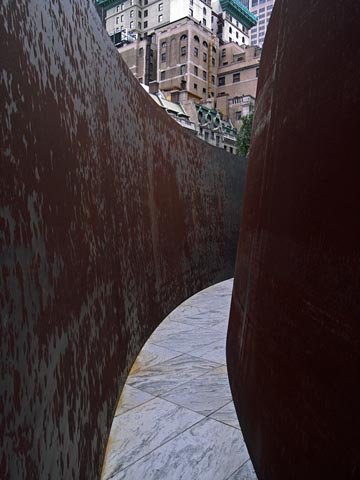
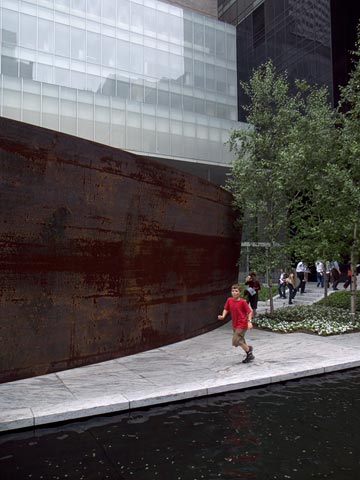
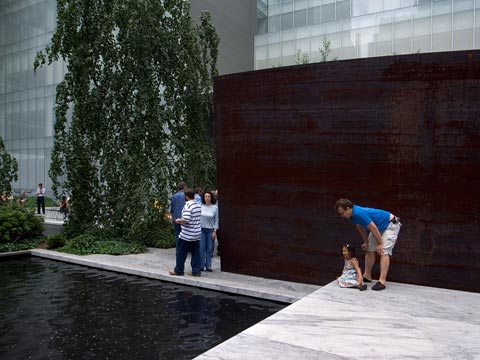
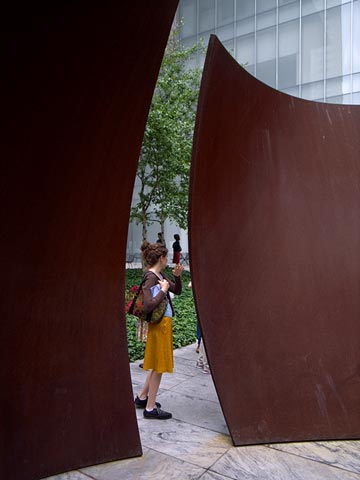
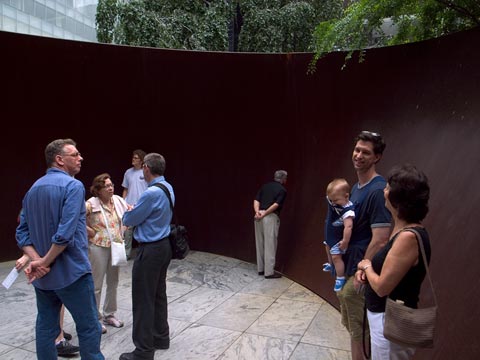
    A while ago I posted a comment about a series of photographs of Richard Serra’s sculpture made by Hiroshi Sugimoto. I objected to the fuzzy treatment–Sugimoto’s trademark–for this quintessentially hard-edged work. Here are a few of my images of two Serra pieces in the Museum of Modern Art garden, not offered as a rebuke to Sugimoto, but rather as quick takes while visiting with my son Brendan who streaked around the Serra arcs, a red blur.


    Intersection II • Richard Serra


    Brendan, my son, intersecting with Intersection II

    I have long regarded Serra as one of the giants of contemporary art, and I was eager to see the new installation of his work at the museum. I have seen Serra in various locations: the Dia Beacon and in Chelsea, and in many outdoor settings. Like any sculpture, but particularly with Serra’s, the work is dramatically changed by the context. Indoors, there is often a sense of great compression, the coiled quality of the steel seemingly ready to burst the confines of the surrounding walls. Outdoors, that tension is relaxed somewhat, the scale changed, although it depends on the siting. A willfully confrontational installation at the Federal Building in Lower Manhattan so irked the government workers who had to circumnavigate the piece that it was eventually dismantled. On the other hand, one of my favorite sitings was also in Lower Manhattan–St. John’s Rotary Arc was placed within the huge roundabout formed by the Holland Tunnel exit.


    Intersection II • Richard Serra


    Intersection II • Richard Serra

    At MoMA the two pieces on view in the sculpture garden work beautifully–on the one hand held in check by the relatively close quarters of the space–on the other hand free to the sky and juxtaposed against the gray-green trees and silver-black glass of the museum facade. Upstairs on the second floor, the completely neutral gallery spaces seemed less successful to me. Although the sculptures are impressively contained within walls, the warmish interior light and blank wall surfaces allow for less dialogue with the taut forms within. But by all means go and see–and interact.


    Torqued Ellipse IV • Richard Serra


    Torqued Ellipse IV • Richard Serra

    MoMA has recently been presenting wonderful virtual exhibits on their website. Some of the best stuff I’ve seen. Here is the Serra web presentation. I did not, by the way, get a chance to see the sixth floor galleries, but will do so next time.

  • New York/Grand Army Plaza


    Grand Army Plaza, Brooklyn

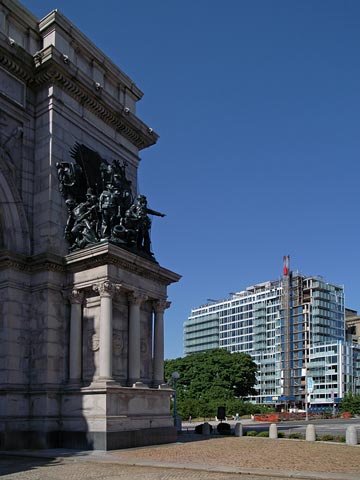
    As I wrote in an earlier post, I have been asked to make photographs of Civil War memorials around Brooklyn for an exhibit this fall at the Brooklyn Public Library. I just got started this past week with a series of pictures of several monuments and statues at Grand Army Plaza. Grand Army Plaza is marked most prominently by an arch based on the Arc de Triomphe in Paris and topped by a quadriga, not unlike the Brandenburg Gate in Berlin. I will comment some more when I have scans of the 4×5 film I shot. I did take a few pictures with my small camera including the view above of the arch and an apartment building designed by Richard Meier under construction nearby.

  • New York/Connecticut

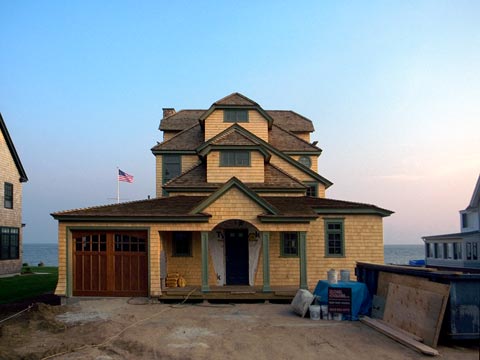
    A few random images from our trip up to Connecticut over the Memorial Day weekend.


    Wilton, Connecticut


    My Brooklyn Bridge fireworks image in good company,
    Wilton, Connecticut


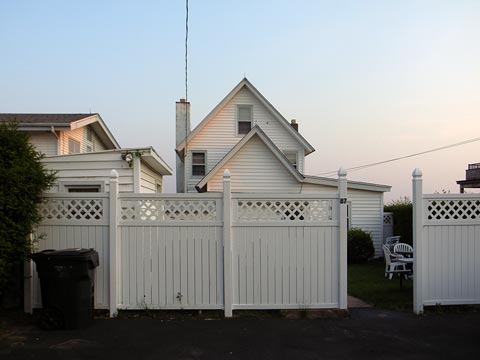
    Old house • Westbrook, Connecticut


    New house • Westbrook, Connecticut


    Westbrook, Connecticut


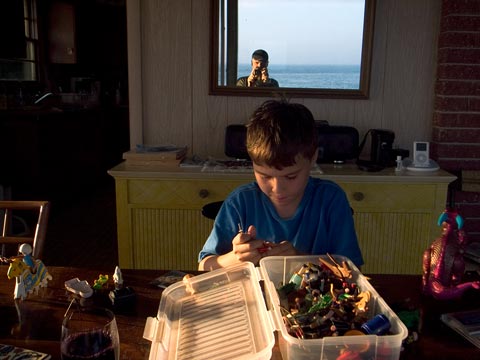
    Brendan and me, Westbrook, Connecticut

  • New York/Dutch Architecture


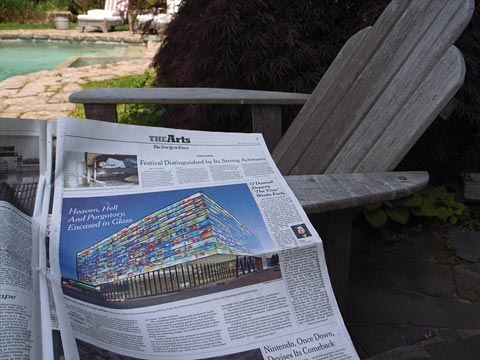
    Dutch architecture in the Saturday New York Times.

    One of the most prominent of the so-called baby Rems (Rem Koolhaas) is the firm of Willem Jan Neutelings and Michiel Riedijk. I first came across Neutelings’ work while photographing design models for a building on Mercatorplein, a public square, in Amsterdam. His proposal seemed a little cartoonish to me at the time. And some of the firm’s subsequent work edges along the line between goofball and sophisticated humor in a Robert Venturi kind of way. Whatever my ambivalence about their work, I’d love to see them do something in New York.

    But see for yourself on their very clear and easy to navigate website.

    The building in the Times looks gorgeous to me. The setting–the media center in Hilversum–is not so gorgeous, but you won’t see that in the pictures. Take it from me as a professional architectural photographer. You haven’t seen a building unless you’ve seen it person.

  • New York/Prince Street


    Prince Street

    Flip flop weather.

  • New York/Long Island City


    Long Island City

    I wasn’t familiar with the French designer/architect Jean Prouvé until several years ago when I photographed an auction house in New York that was selling some of his furniture. He is well-known in France, less so over here. When I read that his Maison Tropicale, a metal kit house, was on display in Queens, I organized a family outing, and off we went through the wilds of Long Island City.

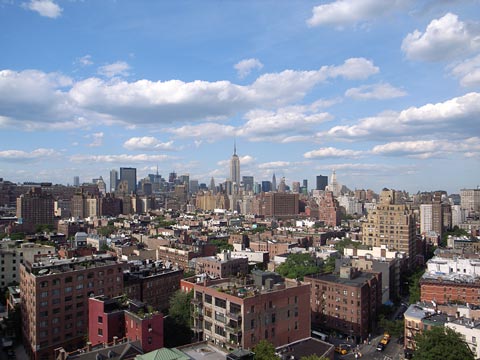
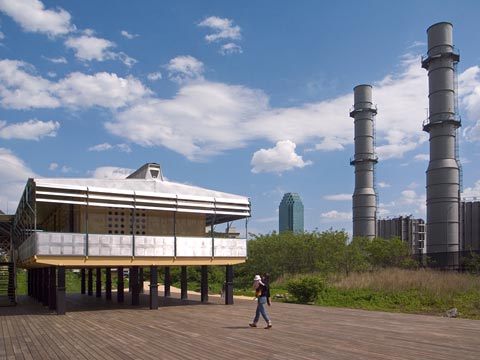
    Con Ed and Midtown skyline

    LIC is the neighborhood just across the East River from the United Nations. It’s a hodgepodge of factories, lofts, single family houses, and a new high rise enclave known as Queens West. PS 1, the former school turned modern museum is in LIC as is the Citigroup tower that pokes skyward above everything.


    Con Ed and 59th Street Bridge

    Bridge and hotel under construction

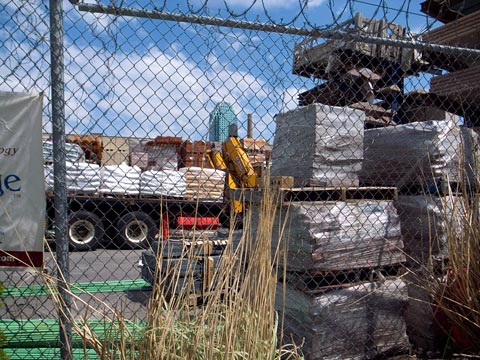
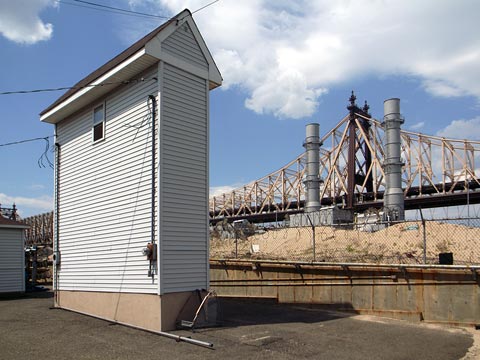
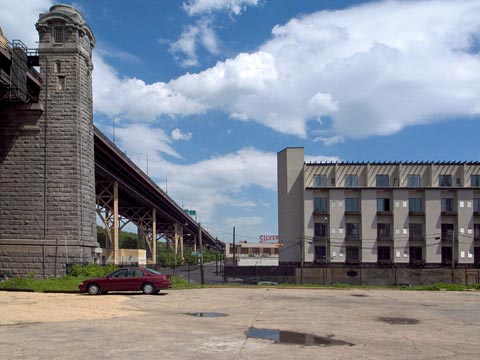
    We took the 7 train over and began walking north toward the 59th Street Bridge. I took lots of pictures of the crazy quilt landscape along the way. Chain link, slabs of concrete, poles, trucks, auto body shops. On the left was a Con Ed power plant with the Midtown skyline as backdrop. Some sort of electrical shed was disguised as a clapboard house complete with slanted roof and window. Just at the bridge, a hotel–looking like a ruin–was, apparently, nearing completion.


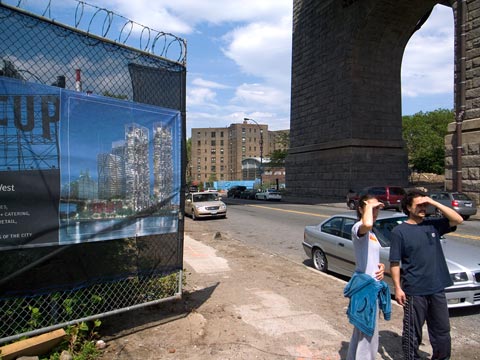
    Silvercup poster

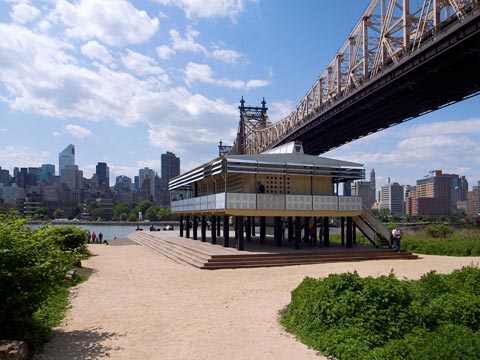
    As we entered the fenced in area where the Prouvé house was displayed, we passed a poster advertising the upcoming Silvercup development, designed by Richard Rodgers, soon to go up on the site. Just over a rise, toward the river, the little metal house stood beneath the towering stone and steel bridge.


    Maison Tropicale


    Maison Tropicale

    A steady stream of visitors found their way to the site by foot, car, and bicycle. It was a sophisticated looking bunch. Foreign languages. Everyone taking pictures. Inside the house, book were on sale, and the porthole windows in the sliding doors cast a blue glow. Christies is expecting 4 to 6 million for the house, but it could go higher. So says someone quoted in the paper. The house will undoubtedly be fabulous on someone’s estate, or in a museum courtyard, but it will never be seen better than here in Long Island City.


    Maison Tropicale

  • New York/Houston Street


    Houston and Broadway

    More randomness moving about town. New posts on the way.

  • New York/Williamsburg


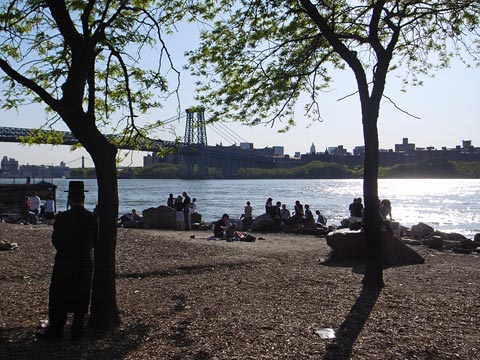
    Grand Ferry Park, the Williamsburg Bridge

    Took a long walk through Williamsburg the other day. It’s a neighborhood that, some years ago, supplanted the Lower East Side as a haven for creative newcomers to New York. Depending on your perspective, it is either already over, or it is just coming into its own. In any case, it is now seeing expensive condos and loft conversions amidst the urban grit.


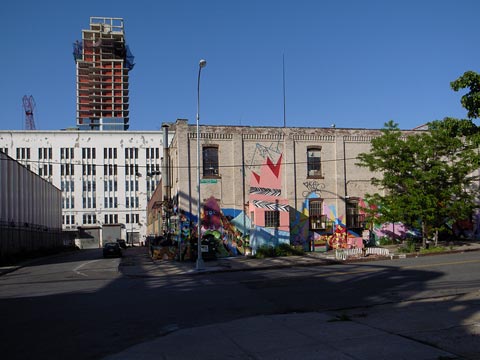
    Williamsburg with Toll Brothers luxury housing rising in the background


    Williamsburg

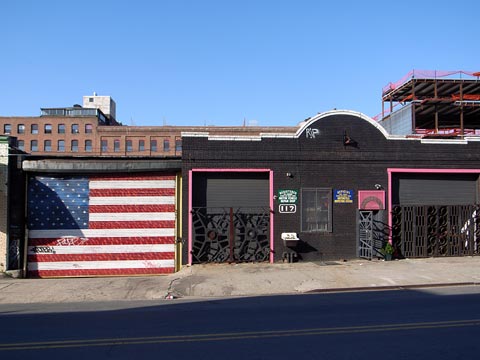
    There are loft buildings, row houses, vacant lots, and pockets of ongoing industrial use. To the north is Greenpoint with its Polish population and to the south just below the Williamsburg Bridge there are enclaves of orthodox Jews. As a Manhattanite, I still feel a little like a foreigner in Williamsburg. But it’s one of the parts of the city outside my precious island that I would consider living in.


    Williamsburg


    Williamsburg

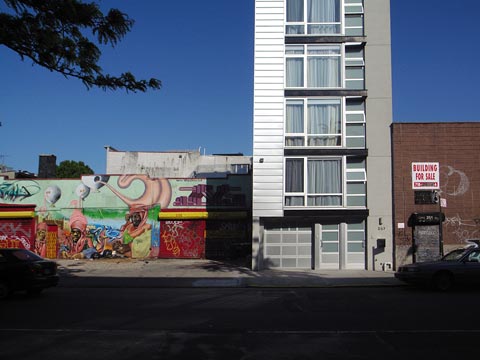
    Despite it’s hipster reputation, Williamsburg remains a largely low income neighborhood with a significant Latino community. To the east it blends into Bushwick, a mostly African American area. There are housing projects as well as lots of single family homes. It was traditionally a blue collar place, and that aspect of it has not all together disappeared.


    Williamsburg


    Williamsburg

  • New York/Lafayette Street


    Lafayette and Houston Streets

    Random New York street scene.

  • New York/LES

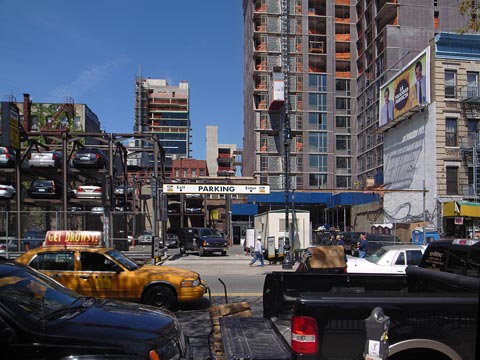
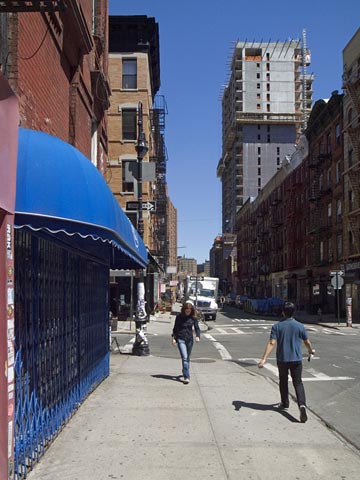
    On the Lower East Side along Houston Street there are numerous buildings going up. One is a real monster, designed by the ubiquitous Costas Kondylis, towering above Katz’s Deli. This is your basic bland Manhattan high rise, the kind of building occupied by people you never meet, planted in a neighborhood where funky and chic collide.


    Essex Street near Houston Street


    Norfolk and Stanton Streets

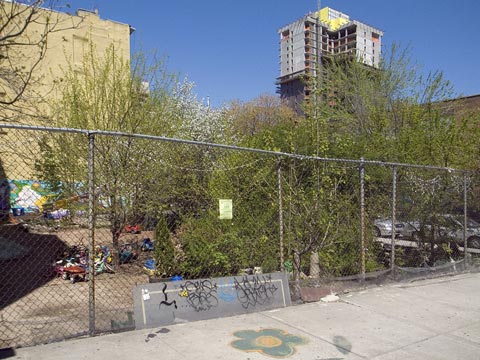
    I circled the scene of the crime with my view camera looking for views that included, but did not necessarily focus on the building. I looked across Allen Street toward a multi-layered hodgepodge of tenements, stacked cars, and new construction. From there I headed for Norfolk Street past a school playground ending up at the corner of Stanton Street where a fenced in vacant lot serves as a children’s play area. In the distance, The Ludlow, as it is called, looms above the trees and a painted flower on the sidewalk.


    Ludlow and Stanton Streets

  • New York/LES

    New photographs of the Lower East Side. I continue to work on this never-ending project, still looking for a venue for showing this–I think–extraordinary encapsulation of New York history. It is important for any number of reasons, not the least of which is that the Lower East Side is America’s quintessential immigrant neighborhood, a portal through which millions of people can trace their ancestry and arrival in the United States. It is now undergoing fundamental change, reflecting the rapid transformation of the city since 9/11.
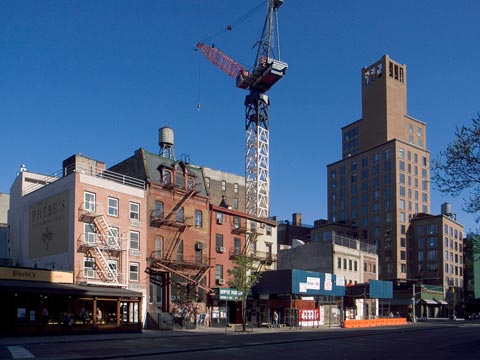

    The Bowery at East 4th Street

    I did a few new pictures of the Bowery/Third Avenue north of Houston Street adjacent to the East Village. There are numerous buildings new or under construction along this stretch. At the Bowery and East 4th Street I did a wide shot of a group of low structures–some quite old–with the ultra chic Bowery Hotel towering above. A crane stands in a small vacant lot suggesting a very tall, thin, building to come.

    Although there are some in the neighborhood who see the Bowery Hotel as out-of-scale–it replaces a grungy gas station that stood there for more than 25 years–it also replaces an earlier out-of-scale bank building. Across East 3rd is a Salvation Army shelter that once housed Jack Abbott, the writer of In the Belly of the Beast, a book about prison life championed by Norman Mailer. Here’s a bit from Wikipedia:

    In 1965, aged twenty-one, Jack Abbott was serving a sentence for forgery in a Utah prison when he stabbed a fellow inmate to death. He was given a sentence of three to twenty years for this offense, and in 1971 his sentence was increased by a further nineteen years after he escaped and committed a bank robbery in Colorado. Behind bars he was troublesome and often refused to obey guards’ orders. He spent a great deal of time in solitary confinement.

    In 1977 he read that author Norman Mailer was writing about convicted killer Gary Gilmore. Abbott wrote to Mailer and offered to write about his time behind bars and the conditions he was experiencing. Mailer agreed and helped to publish In the Belly of the Beast, a book on life in the prison system consisting of Abbott’s letters to Mailer.

    Mailer supported Abbott’s attempts to gain parole. Susan Sarandon’s son, Jack Henry Robbins, is named after Abbott. Abbott was released on parole in June 1981. He went to New York City and was the toast of the literary scene for a short while.

    On the morning of July 18 (1981), just six weeks after getting out of prison, Jack Abbott went to a small cafe called the Binibon in Manhattan. He clashed with 22-year-old Richard Adan, son-in-law of the restaurant’s owner, over Adan’s telling him the restroom was for staff only. The short-tempered Abbott stabbed Adan in the chest, killing him. The very next day, unaware of Abbott’s crime, the New York Times ran a positive review of In the Belly of the Beast.

    I lived around the corner on East 4th Sreet at the time, and ate in Binibon the day of the murder. I was unaware that anything had happened. Nowadays one would expect to find the crime scene taped off, people milling about pointing and murmering, and, perhaps, the beginnings of an informal memorial of flowers. In those days, it was just another murder on the Lower East Side, though once the connection to Mailer was made, the story became national news.


    Cooper Square with statue of Peter Cooper and site of new Cooper Union building

    Further up the Bowery, where it turns into Third Avenue, there’s another giant hotel going up, and beyond that, Cooper Union has demolished the former Hewitt building on Cooper Square to make way for a glass academic building designed by Thom Mayne of Morphosis. I made a photograph across the square with Peter Cooper in his columned memorial obliged to look on the homeless men who still occupy this bit of the shiny, new, Bowery. For me, it’s another little piece of personal history gone. I remember meeting Anamarie Michnevich, a fellow Cooper student, in the cafeteria of the Hewitt building. We remained friends, and years later she helped me with my Lost Border project and book. And ironically, in the row of townhouses to the left, is the office of my publisher, Princeton Architectural Press.