Category: Photographers/Photography

  • New York/Berlin Book


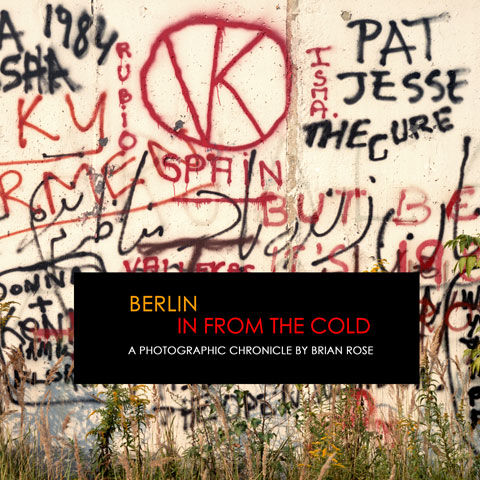
    Berlin: In From the Cold (click for book website)

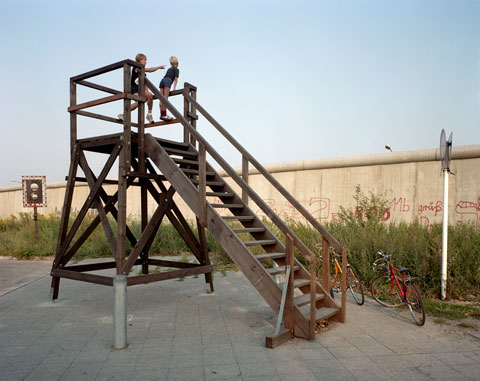
    This November being the 20th anniversary of the opening of the Berlin Wall, I have put together a new book focused exclusively on my pictures of Berlin. My earlier book, The Lost Border, included many photographs of the Wall, but its focus was not primarily on Berlin, a city I have returned to repeatedly over the years. There is some overlap between the two books, but 2/3 of the images are new.

    Before the Wall came down, I also made a number of images of East Berlin, which have never been seen. In from the Cold includes a dozen of these eerie images of a place seemingly frozen in time. After the Wall came down, I moved off of the border zone to some extent, photographing historical sites that resonated with the rest of my project.


    The Berlin Wall, 1985 — © Brian Rose

    This is a Blurb book, which means it will be printed only on demand. Perhaps, there will be a commercial version of the book eventually, but not for now. The entire book is viewable on the Blurb website, which you are invited to browse through. It’s an expensive book, but if you choose to purchase it, you will own a unique piece of history, and a very limited production book worth collecting.

    I have entered Berlin: In From the Cold in the Photography.Book.Now contest sponsored by Blurb. Please feel free to leave comments on the Blurb website, and click the vote button there to show your support.

  • New York/Alex Harsley

    Some people fall through the cracks–maybe lots of people fall through the cracks. It’s a fact that there are many extraordinary artists and musicians afoot who have not received the attention or accolades they deserve. I know a number of such people who remain neglected, but quite vital and alive, outside the gated community of the photo/art world.
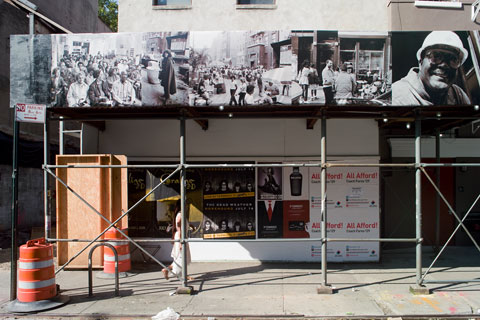

    Alex Harsley exhibition on East 4th Street — © Brian Rose

    No one is more hidden in plain sight than Alex Harsley, who maintains a small gallery on East 4th Street between Second and Third Avenues in the East Village, the block I lived on when I first came to New York–where I met my wife. I’ve written about Alex before–here and here.

    As I walked down East 4th Street the other day, I came across a selection of his photographs affixed to the sidewalk shed of a building under construction. It turns out the installation is a small project of FAB, Fourth Arts Block, the umbrella organization representing the theaters and other cultural institutions on East 4th Street.

    ArtUp, FAB’s public art program, is a rotating installation of artwork on the scaffolding bridge located on East 4th Street between Bowery & 2nd Avenue. With more than $16 million in renovations to the East 4th Street Cultural District underway, ArtUp seeks to transform the stodgy and dodgy look of construction sites and scaffolding into a streetside gallery.
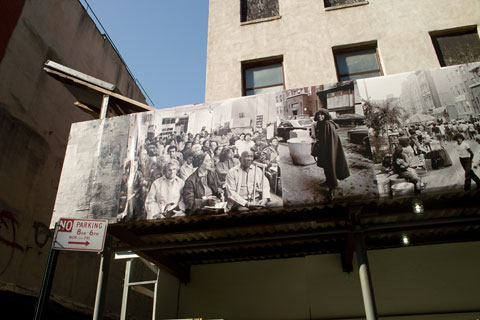

    Cooper Square meeting and Ellen Stewart of La Mama theater
    © Brian Rose

    Harsley’s photographs on the scaffolding feature people and events associated with the arts and politics of this colorful, and sometimes contentious, piece of New York. Harsley has been documenting this area for decades. To the left is a picture of a community meeting, one of hundreds held over the years, by the Cooper Square Committee, an advocate for affordable housing. To the right of that is Ellen Stewart, the founder and director of La Mama theater, one of the most important creative incubators in the city.
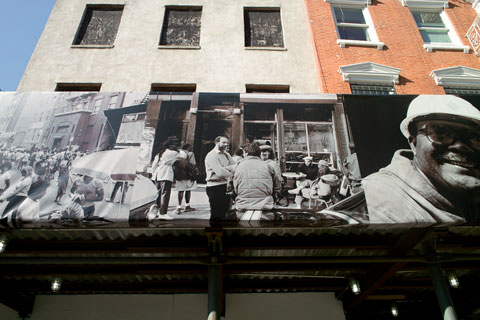

    Harsley photos with Dawoud Bey and Wilbert Tatum
    © Brian Rose

    In the center is a photo of block festival and then comes an image of people congregating in front of Alex’s gallery–the noted photographer Dawoud Bey sits at a round table next to Shirley Campbell, a local resident. And on the end, is a portrait of the late Wilbert Tatum, who lived around the block and was the editor and publisher of the Amsterdam News, one of the nation’s oldest continuously published black newspapers.
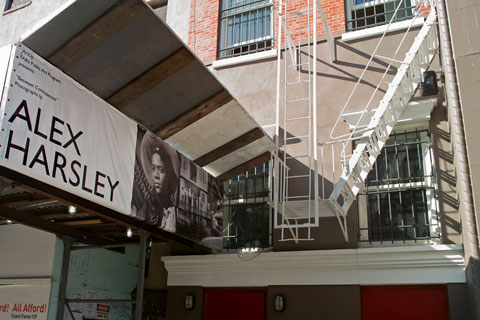

    Alex Harsley exhibition with portrait of Jean-Michel Basquiat
    © Brian Rose

    Around the corner of the scaffolding to the right of “Alex Harsley,” is a portrait of Jean-Michel Basquiat, lounging before a wall on 4th Street, one of the many artists who have inhabited this area of Manhattan. To the right of that is a street scene, kids playing in the spray of an open fire hydrant. It’s a brief, but vivid encapsulation of life and history on this most extraordinary of New York’s blocks.

    Alex is now 72 years old, a highly competitive bicycle racer, so I expect he’ll be around for a good while. I love the sidewalk shed, but I’m sore from craning my neck to see the pictures. Will someone please give this guy a major retrospective?

    Update:

    Meanwhile…from the Times, a lengthy profile of 27 year old Dash Snow–of the deMenil fortune–found dead in the next block on 4th Street:

    They encouraged Mr. Snow to exhibit his collages of newspaper headlines, many of them revealing his obsession with Saddam Hussein, and his photographs of oral sex, nude girls, lines of cocaine being snorted off body parts. It worked: His first solo show was in 2005, and his work was included in the 2006 Whitney Biennial.

    The art world was not yet settled on whether Mr. Snow was an important artist, a young talent with promise or a reckless pretender. Well-known collectors including Charles Saatchi have bought his pieces, generally at five-figure prices; Benjamin Godsill, a curatorial associate at the New Museum, said Mr. Snow’s work “captures this period bracketed by the fall of the World Trade Center and the fall of the financial system.”

    Jacob Lewis, the director of Pace Prints Chelsea, said, “Some people think of him as the Kurt Cobain of the art world. Other people think of him as the Paris Hilton.”

    Anyone interested in discovering a serious and important American artist can simply look a few doors down from the Lafayette Hotel and find Alex Harsley.
  • New York/Julius Shulman


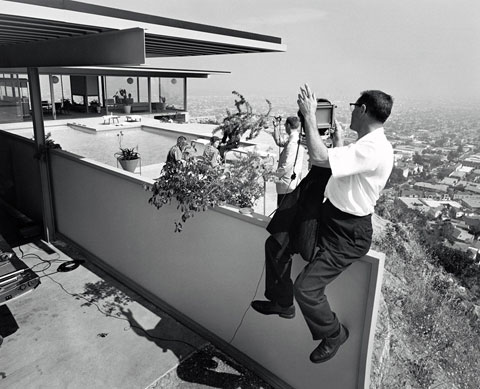
    Julius Shulman photographing Case Study house #22 by Pierre Koenig

    One of the pioneers in the field of architectural photography, Julius Shulman has died at 98. There are many things that make his work significant–enough for a lengthy essay–but for me, it was the idea of architectural photography as a staged event. The end result being a near seamless transformation of reality in which the building or interior is held in perfect equipoise.


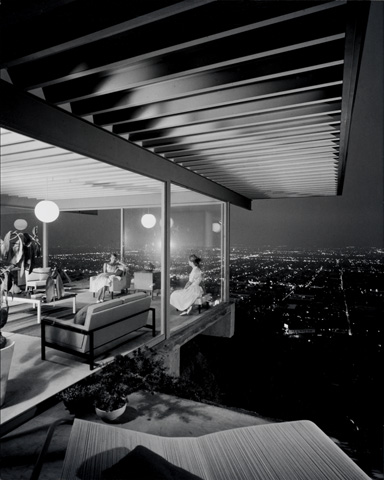
    Photograph by Julius Shulman

    I only own a few photographs–alas, I wish I could afford more–and one of those is the famous night time view of Case Study house #22 by Shulman in which two women in diaphanous gowns lounge in the glass living room floating out above the carpet of lights of Los Angeles.

  • New York/Pickup Basketball

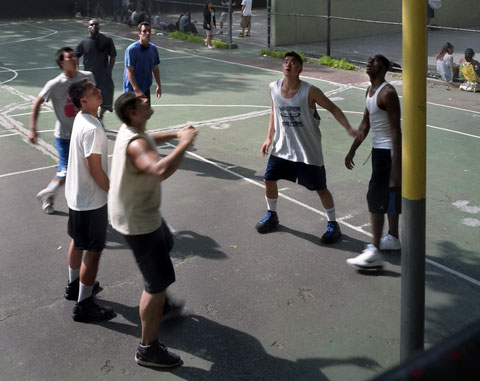
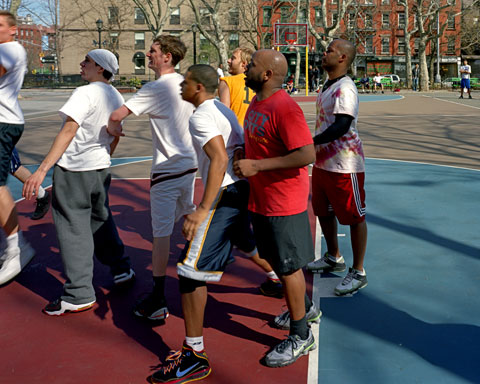
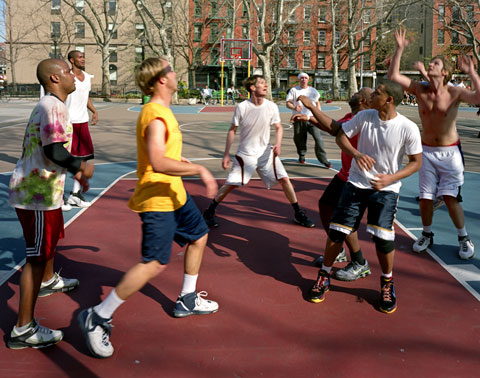
    A couple of months ago I put up some pictures of pickup basketball made with my digital camera–experimenting with the idea of of photographing in between moments of the game–for instance, when the ball is on the rim, and the players are jockeying for position or blocking out for a rebound.

    Rather than work with a fast nimble camera, I’m working with the 4×5 view camera, exploiting, in a sense, its awkwardness for the task–waiting for moments of relative stillness, players gazing upward, or poised for a play developing out of the frame. The 4×5 negatives can be scanned at high resolution and printed at large scale.

    I’ve played basketball most of my life, and know the street game well. There is a gritty poetry to the way it’s played in the city, the ex-college players, faded high school stars, and playground wannabes all jostling for the ball, struggling for fleeting moments of glory or the satisfaction of fitting in, keeping up, playing within oneself.

    Quality of play on the Lower East Side is mixed, but I’ve seen some really good players lately in Roosevelt Park just south of Houston Street. It’s a diverse group of all ethnicities, all shapes and sizes, decked out in equally varied clothing and foot gear.

    Click on the photos to get at least some sense of the detail of the 4×5 film.

  • Westbrook, Connecticut

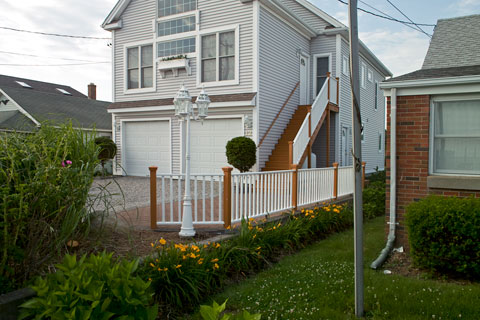
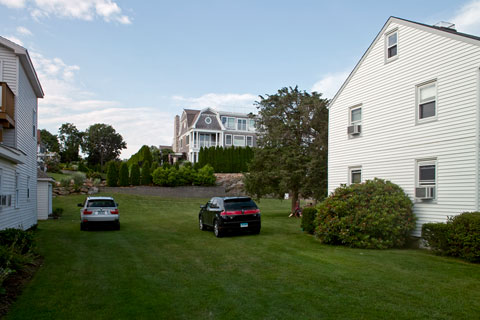
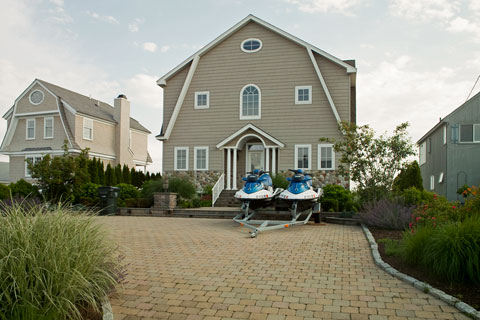
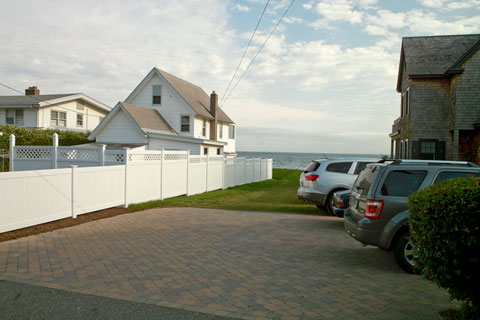
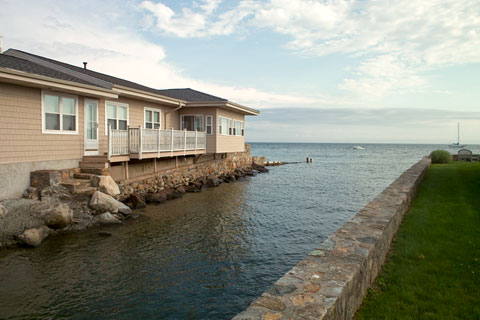
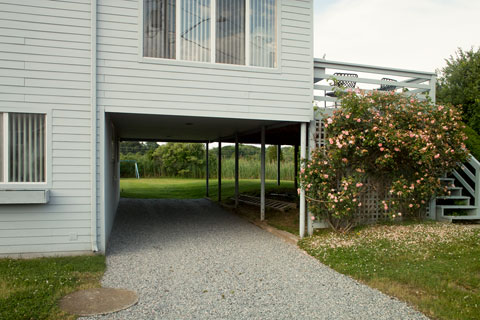
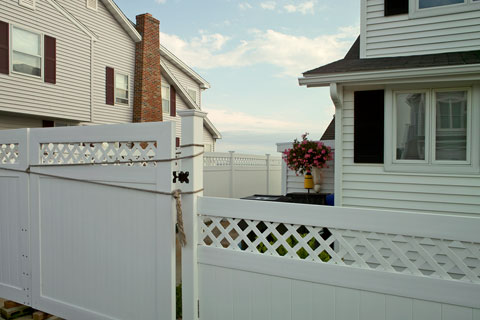
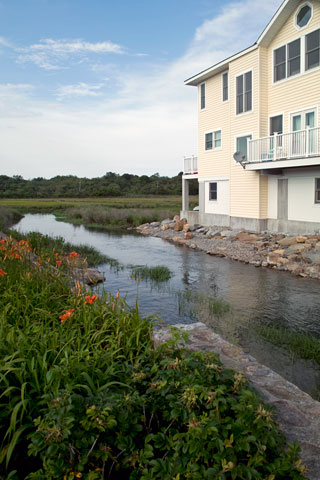
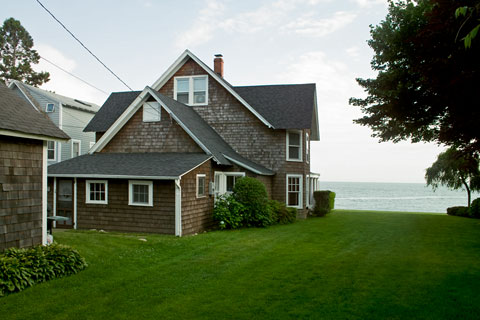
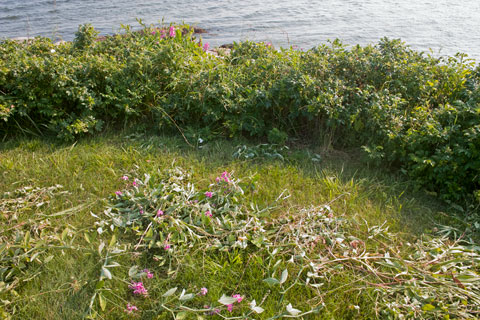
    The last of my pictures from our recent trip to Westbrook on the Long Island Sound. The beach is lined with houses, some old traditional shingle style, and others verging on suburban McMansion style. I took several walks through the streets with my digital camera.

    Here’s my mini-series:

  • New York/Connecticut


    Westbrook, Connecticut — © Brian Rose

    Visual note taking while vacationing on the Long Island Sound. Back in the city with lots to do after a sparse winter and spring.

  • South Norwalk, Connecticut


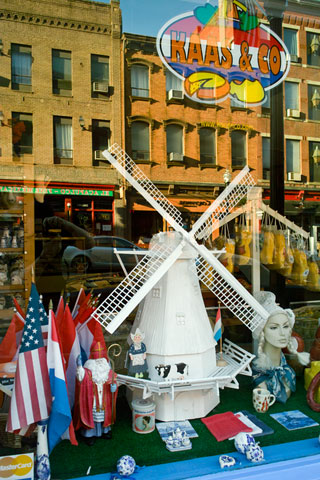
    A Taste of Holland, South Norwalk, Connecticut
    © Brian Rose

    Killing some time waiting for the train back to New York, we discovered the shop pictured above, which specializes in all things Dutch, especially food items like licorice (drop) and cheese (kaas). It also flogs the usual Dutch cliches such as windmills, wooden shoes, Delft Blue, and Sinter Klaas–all seen against a reflected backdrop of South Norwalk’s Washington Street.

    They’re on the web. Mmm. Might have to order some Borrelnootjes and Stroopwaffels.

  • Westbrook, Connecticut


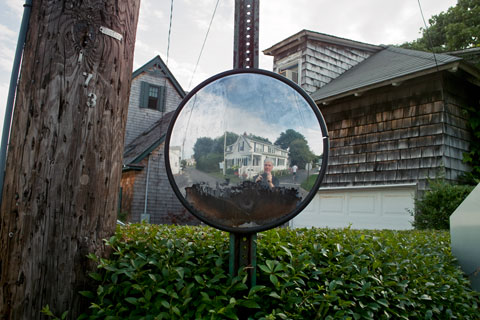
    Self-portrait in a convex mirror — © Brian Rose

    A few days out of the city on the Long Island Sound.

  • New York/Greenpoint


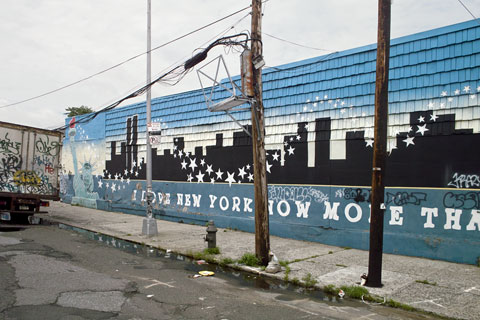
    Greenpoint, Brooklyn — © Brian Rose

    “I love New York more than ever.”

  • New York/Brooklyn Sky


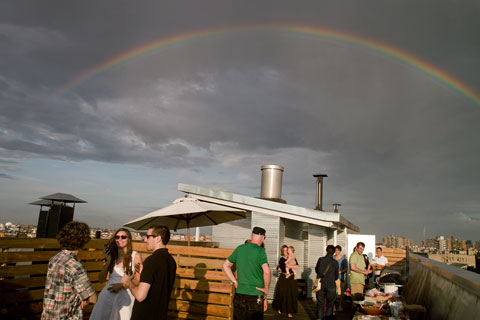
    Roof party in Brooklyn — © Brian Rose

    Did another round of pick up basketball pictures at some courts in Chinatown. Early in the evening a fierce, but brief, thunderstorm passed through leaving the air fresh and cool. Roof party in Brooklyn was interrupted, but resumed under a brilliant rainbow.

    This morning I got out with my view camera and did architectural photographs of our building–an assignment from the architect/developer. I wanted to do a photograph from the roof across the street, but assumed that would have to wait till I made arrangements with the owner. As I was shooting on the street, I spotted someone I thought might be the super–he was–and I ended up on the roof. Sometimes you get lucky.
  • New York/The Bronx


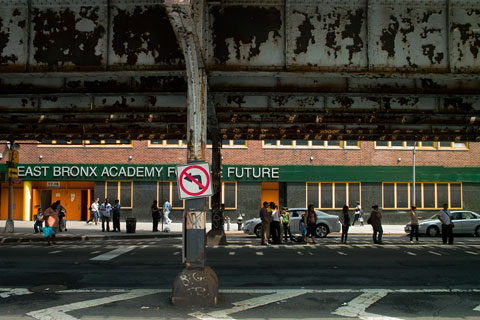
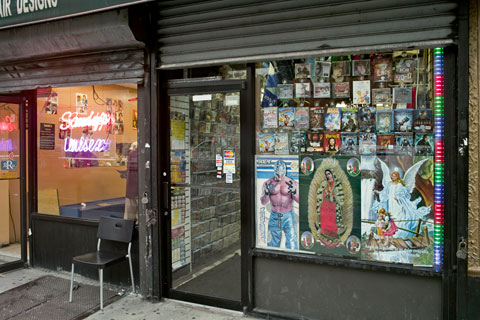
    Southern Boulevard, the Bronx — © Brian Rose

    I went up to the Bronx yesterday to scout a building for a client. It’s going to be tricky photographing it because it stands adjacent to an elevated subway line. The number 2 and 5 trains run along here, which in the ’70s and ’80s, was the scene of utter urban devastation. It’s a pretty vibrant area today, though not without its gritty aspects.
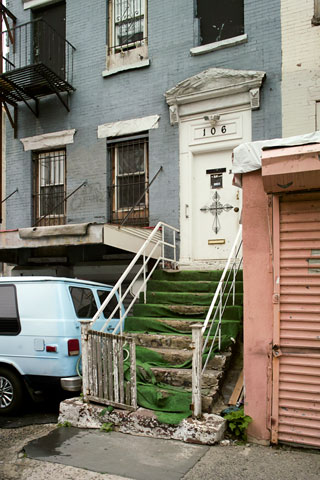

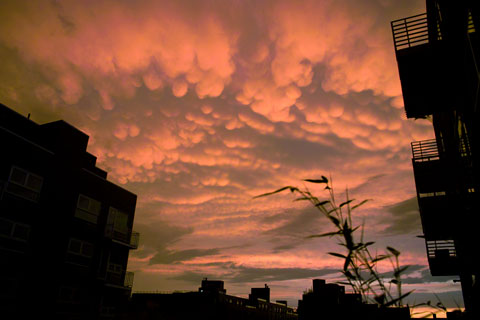
    Red sky over Brooklyn — © Brian Rose

    If you were watching the Yankees-Mets game on TV last night, delayed an hour by dramatic, but quickly passing, thunderstorms, you saw some shots of an improbably vibrant orange sky over the ballpark. Believe it–I could see the same sky from my balcony in Williamsburg, Brooklyn.

  • New York/Times Square


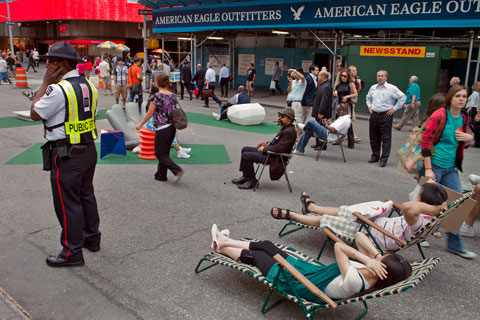
    Times Square — © Brian Rose

    Broadway closed to traffic in Times Square. Lawn chair city.

  • New York/Construction


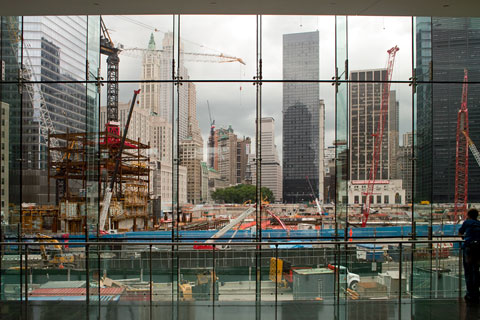
    WTC/Ground Zero — © Brian Rose


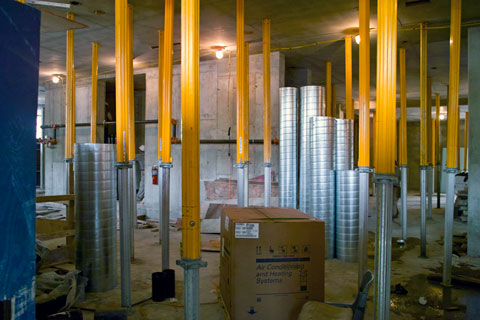
    Cooper Square/East 4th Street — © Brian Rose

    Without comment.

  • New York/The High Line


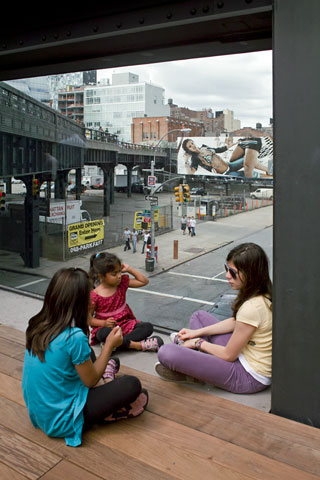
    Kids on the High Line — © Brian Rose

    Without comment.

  • New York/Dutch Seen


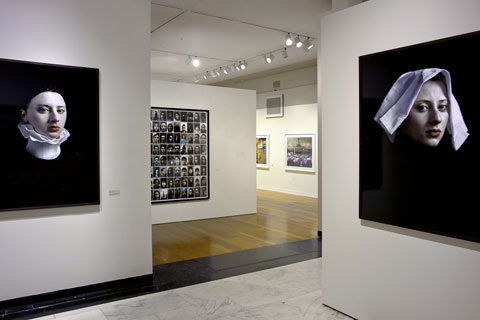
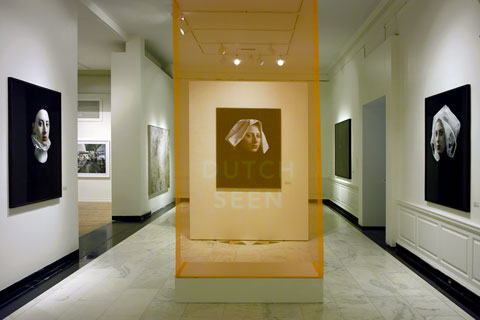
    Dutch Seen, the Museum of the City of New York — © Brian Rose

    The more I’ve thought about the Dutch Seen exhibition at the Museum of the City of New York, the more I’ve come to the conclusion that the city–the ostensible subject of the exhibit–is largely invisible. Yes, sure, there’s some street photography, some interiors of restaurants, and lots of multi-ethnic faces. But these are not the images that make the strongest impression.

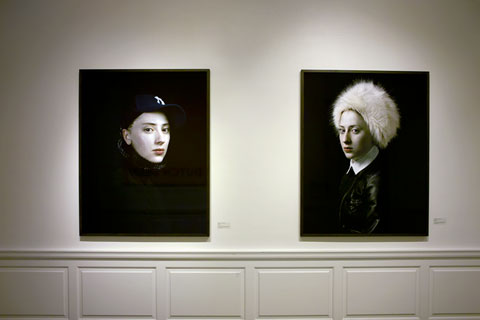
    Walking into the exhibition one is confronted first by Hendrik Kerstens’ stunning portraits of his daughter Paula, each a 3/4 view, mimicking 17th century portraits by Vermeer and Rembrandt and others of the Dutch Golden Age. Paula, is presented as a New Yorker, wearing various bits of costume–a plastic bag, a napkin, a Yankee cap, beaver fur. The various headgear are at once immediately recognizable for what they are, but unmistakably evocative of the hats seen in period paintings.


    Portraits by Hendrik Kerstens — © Brian Rose

    Like the original women of Golden Age paintings, Paula is depicted as both idealized and specific, self-assured and intelligent–lost in thought, a mysterious cipher. In these photographs we are taken back to the early days of Dutch settlement in New Amsterdam, when to a significant extent, the character of the city was formed. That’s the premise of Russell Shorto’s book Island at the Center of the World. Shorto also contributes a short elegantly written introduction to the exhibition catalogue.

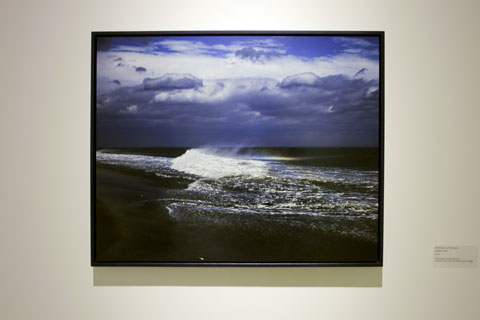
    Paula is a grand conceit, richly ironic and humorous. She is a Dutch cosmopolitan in a savage landscape, glimpsed obliquely just beyond in the next gallery in the photographs of Misha de Ridder. De Ridder searched for vestiges of the world Henry Hudson found when he sailed into New York harbor. He photographed thick tangles of forest undergrowth, a fallen tree trunk, a sweep of beach at Sandy Hook.


    Photography by Misha de Ridder — © Brian Rose

    In his beach scene, a wave crashes on shore as a shaft of sunlight breaks through a dark sky, caught momentarily in the salt spray, shimmering, iridescent. It is an expression of the chaotic wildness that confronted the Dutch when they arrived, which they sought to tame and exploit, as the Dutch tend to do even today. It is also the one moment of pure serendipity in the show–a miraculous discovery, if you will–the kind of thing photography has always been about.

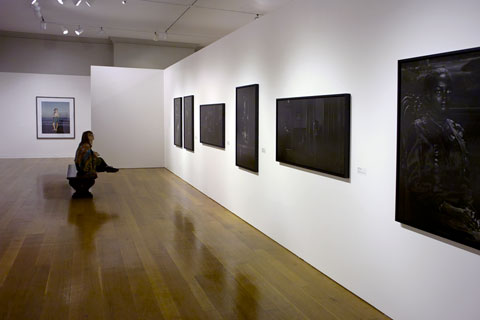
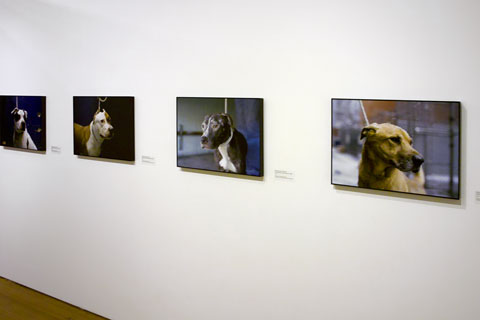
    There is much more substantial photography to take in beyond Kerstens and de Ridder, but in a way, it all seems beside the point. I loved Charlotte Dumas’ anthropomorphic portraits of New York shelter dogs, and I enjoyed the cutting glance of Danielle van Ark’s photos of art gallery openings. And I was mystified–in a sort of positive way–by Erwin Olaf’s black on black interiors of a fictional African American upper middle class home.


    Photos by Erwin Olaf — © Brian Rose


    Photos by Charlotte Dumas —

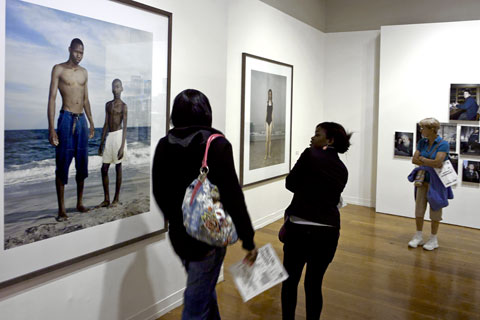
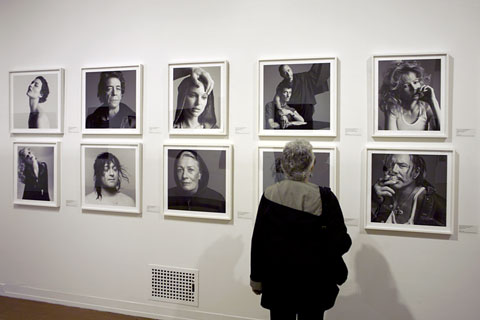
    The brilliant beach portraits of Rineke Dijkstra seem stranded here–they were, after all, made 10 or 15 years ago, and I can’t help but think they were included because of some obligatory nod to her reputation as an icon of recent photographic history. Likewise, Inez van Lamsweerde and Vinoodh Matadin’s transparently stylish celebrity portraits seem gratuitous.


    Photos by Rineke Dijkstra — © Brian Rose


    Photos by Inez Lamsweerde and Vinoodh Matadin — © Brian Rose

    Despite all the visual skill and conceptual high mindedness on display, there is a puzzling shortage of fresh discovery here–in an exhibition presumably about the Dutch rediscovering New York–at least nothing that approaches the epiphany of Misha de Ridders crashing wave, or the piercing eyes of Hendrik Kerstens’ ridiculously sublime Paula.

    Neither Kerstens nor de Ridder, of course, show even a glimpse of New York City.

    Additional comments:

    The layout and simple design of the exhibition is beautiful overall, and the newly refurbished galleries look great. I especially liked the orange title scrim hanging in front of one of Kerstens’ prints. Different framing or mounting throughout the show helps give each photographer his/her own identity. And unlike so many museum shows I’ve been to recently, the photographs are well lit. The museum has never looked better.

  • New York/Dutch Seen


    Dutch Seen, Museum of the City of New York — © Brian Rose

    I visited the museum today, and am working up my photographs and giving myself a chance to think about the exhibit. Full review coming up.

  • New York/Bullets


    Tenth Avenue/Chelsea — © Brian Rose

    The existence of numerous photographs showing American torture of detainees held in Afghanistan and Iraq is an established fact. The release of those photographs is being held up by the president and by others in government who believe that it might incite violence against American troops stationed in those places. Today in the Times Lindsey Graham, conservative Republican senator from South Carolina is quoted saying: “Every photo is a bullet for our enemy.”

    In other words, the fact of torture is not what incites our enemy, but the image of torture. We can talk about the acts portrayed in those images–similar to those already released of Abu Ghraib–but we cannot see or show the facts.

    They are bullets–bullets aimed at us.

    Aimed, ultimately, at those who conceived the policy of torture, those who rationalized the legal/moral grounds for using torture, those who gave the orders to use torture, those who transferred the orders to use torture through the chain of command, those who then tortured detainees in the field, those who covered up and continue to cover up knowledge of torture, those who excused and continue to excuse the use of torture, and those who seek to prevent the truth in all its sordid aspects to see the light of day.

    Photographs are bullets. No photography allowed.

  • New York/Museum of the City of NY


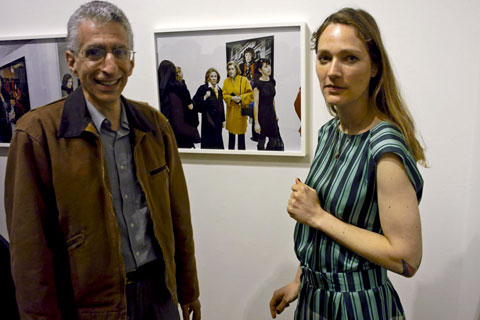
    John Bartelstone and Danielle van Ark
    © Brian Rose

    Went to the opening of Dutch Seen: New York Rediscovered at the Museum of the City of New York. Large, lavish show funded by the Dutch government and others. Panel discussion moderated by Kathy Ryan of the New York Times Magazine. Hundreds piled in for the reception afterward. The discussion was not particularly edifying, though Misha de Ridder’s explanation of how he found the locations for his photographs was interesting–maps and historical references to early Dutch settlement. Hendrik Kerstens could only manage to say that his work was about Paula, his daughter, which is superficially true, but not true in any larger sense. I’ll write something about the exhibition once I’ve had a chance to go back for a longer look.

    I ran into John Bartelstone, and Danielle van Ark, who is one of the photographers in the show. John is coming out with a book of his photographs of the Brooklyn Navy Yard, the former shipyard, now an incubator of all kinds of businesses and creative ventures. I photographed them in front of one of Danielle’s photos of gallery openings. Seemed appropriate.

    And a couple of images snapped on the way to the museum, which is located on the edge of Harlem on Fifth Avenue:


    Lexington Avenue and 104th Street


    East 104th Street