Category: Photographers/Photography

  • New York/Kahn Bath House

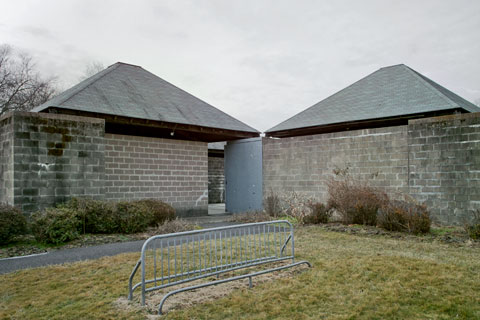
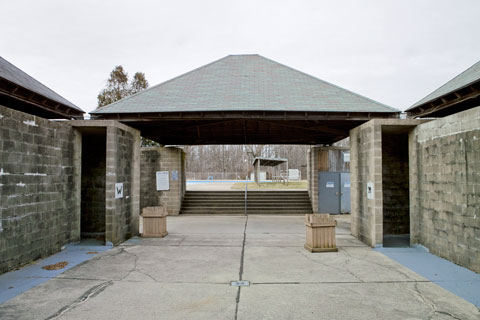
    Trenton Bath House — © Brian Rose

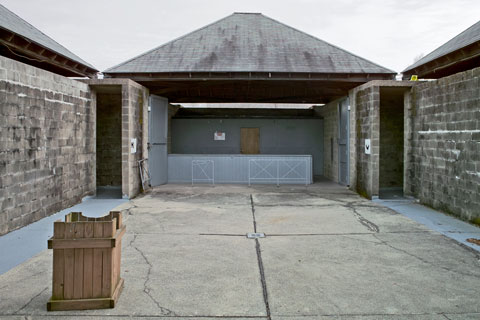
    Trenton Bath House — © Brian Rose

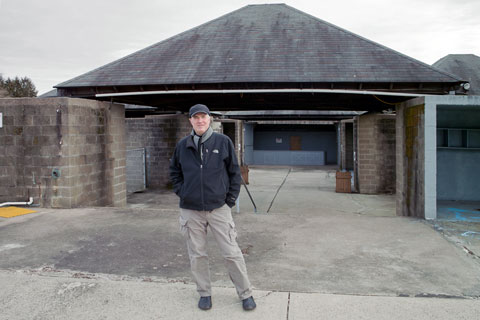
    Limited demolition and construction has already begun on the Louis Kahn bath house, so I will not be doing “before” pictures with the 4×5 camera. Disappointed that there wasn’t the money to get me down there in time, but I have been working on the photographs I did with my Sigma DP1, and feel that I have a reasonably good record of the building as it stood at the end of its first life, so to speak.

    Trenton Bath House — © Brian Rose

    I wrote about this earlier–about approaching the building as a modern day ruin–the result of a continuous process of use, neglect, and decay that will be irrevocably disrupted. This is restoration that absolutely needs to be done, however, and I am looking forward to seeing the building once it has been returned to its original state. It will be properly dignified as architectural icon while still serving in its prosaic role as changing rooms for a swimming pool.

    Brian Rose at the Trenton Bath House — photo by Michael Mills

    We are still talking about doing a book on the Bath House–its history, significance, how it was saved, and the process of restoring it. I will photograph the finished project with the full treatment–probably 4×5 film. But in the meantime, I have put a number of my photographs of the Bath House here on my website.

  • New York/Prada

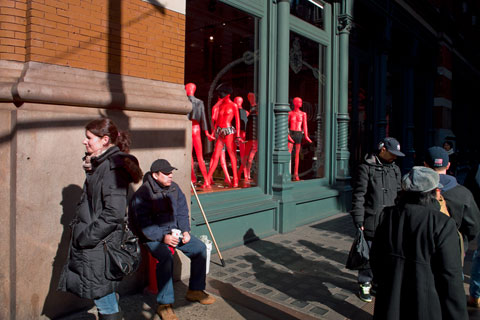
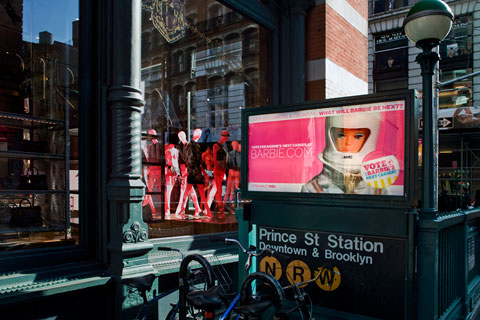
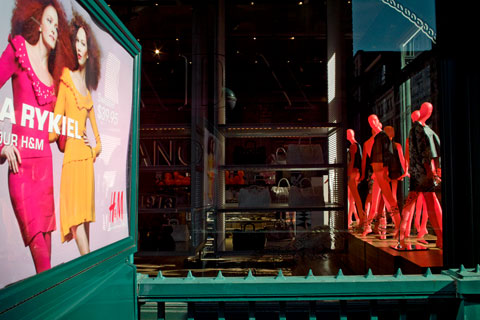
    Broadway and Prince Street — © Brian Rose

    Prada parade.

  • New York/West Village

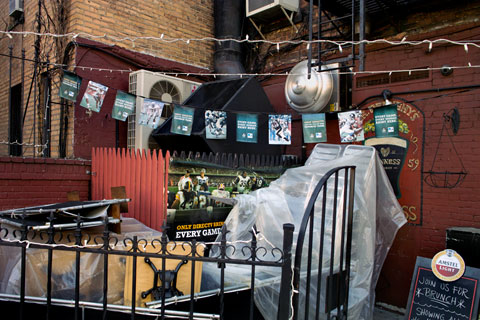
    7th Avenue — © Brian Rose

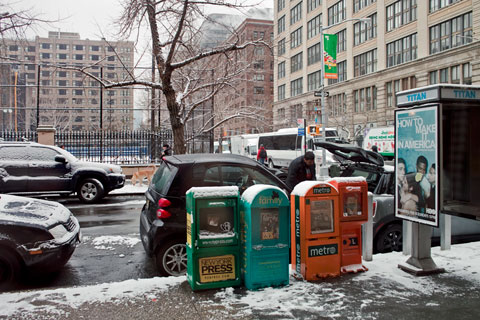
    Football season over. Winter slowly winding down despite recent snows.

  • New York/Vinegar Hill

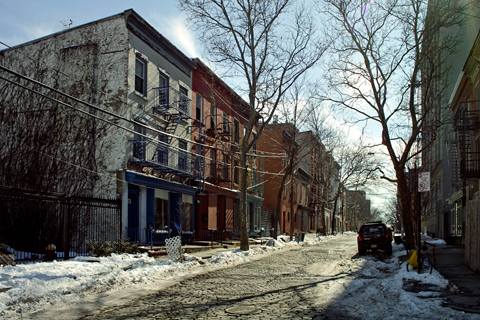
    Hudson Avenue and Water Street — © Brian Rose

    Vinegar Hill is a small neighborhood in Brooklyn located between the Brooklyn Navy Yard and Dumbo. Go here for a map.

    We did a long walk on Monday from Williamsburg to Dumbo, over the Brooklyn Bridge, up Broadway, and then over the Williamsburg Bridge to make a full circle. About 10 miles.

  • New York/Nolita

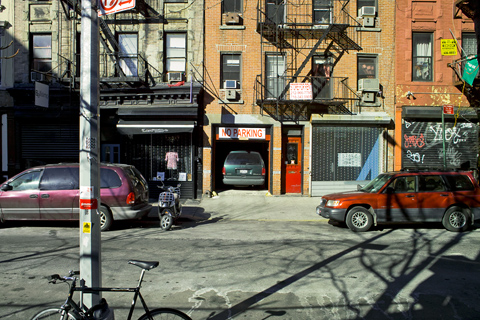
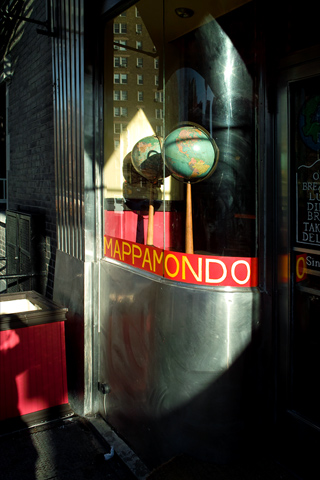
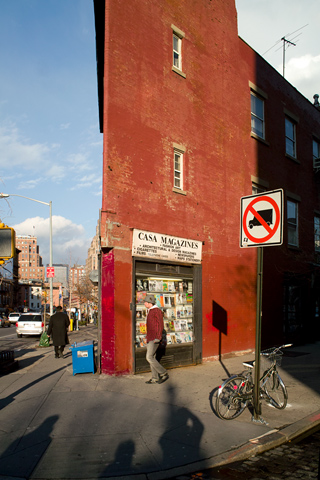
    Mott Street between Prince and Spring — © Brian Rose

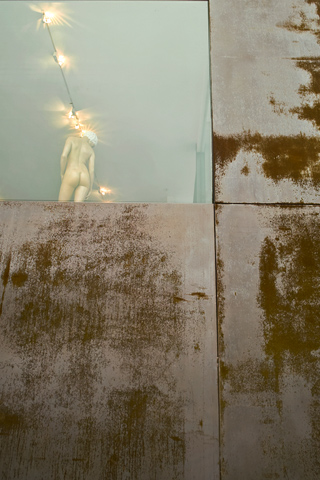
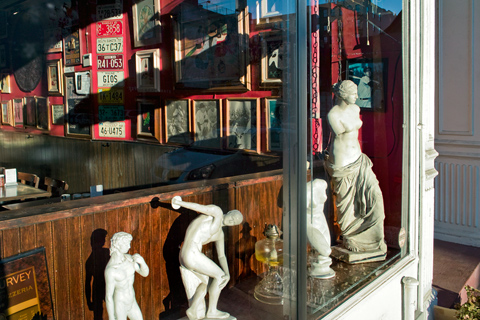
    Used to be part of Little Italy, now known as Nolita. Bah. Lots of small shops, designer clothes, as well as vestiges of its Italian roots. An intimate urban neighborhood, it’s just on the other side of the Bowery from my studio on Stanton Street. I was getting some coffee when I took this photograph through the store window.

  • New York/West Village

    Hudson Street — © Brian Rose

    Without comment.

  • New York/Olympics

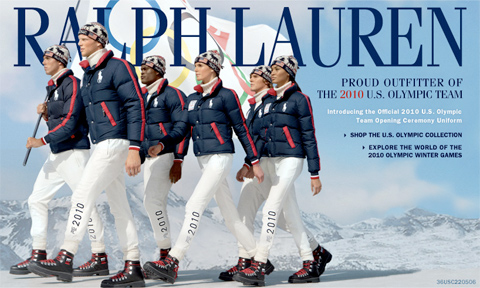
    Ralph Lauren ad from the New York Times website. Grubby commercialism. Ugly clothes. Creepy authoritarian vibe. 100% fail.

  • New York/Chelsea

    10th Avenue — © Brian Rose

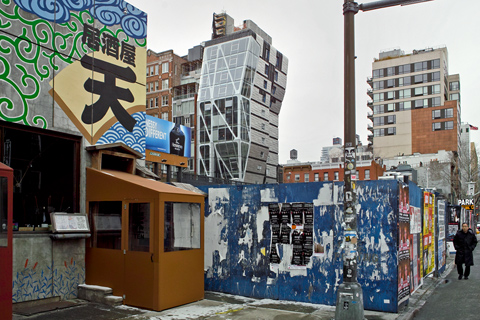
    First post using WordPress. It hasn’t gone as smoothly as I hoped. Can’t seem to  install into the same location as my Blogger site. So, I’m redirecting people here, and giving up on saving my Blogger permalinks. In any case, I’m happy with the new interface, both the look of the blog and the WordPress dashboard.

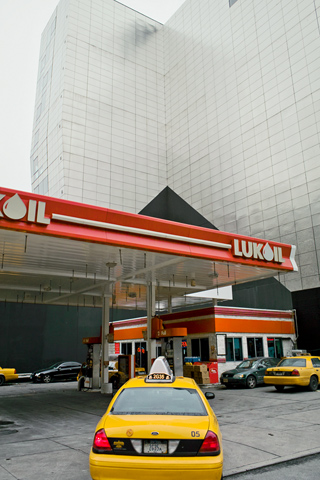
    10th Avenue in the teens and twenties is a hodgepodge of factory buildings, tenements, housing projects, and parking lots–even a seminary. To the west is the gallery district with contemporary housing sprouting here and there like mushrooms. In the photo above is a new condominium by Neil Denari cantilevered over the High Line. You can see some terrific computer renderings here.

    10th Avenue — © Brian Rose

    An old New York survivor barely hanging on.

    10th Avenue — © Brian Rose

    A new apartment building wrapping around a gas station.

  • New York/Good Bye to Blogger

    Blogger/Google is dropping its support for ftp blog publishing next month. For those of us wishing to keep our photographs and other files on our own server that means migrating to a new platform–WordPress.

    So, here goes nothing. Hopefully nothing.

    New URL: https://www.brianrose.com/blog

  • New York/Chelsea


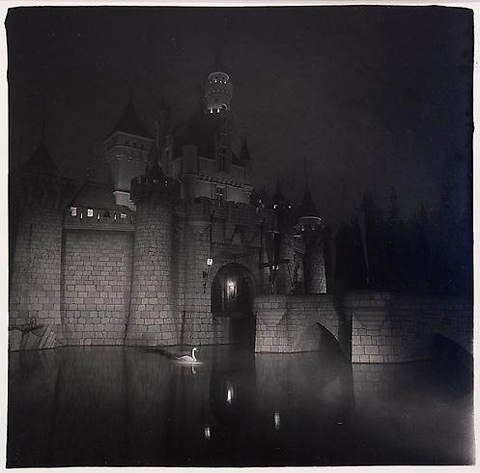
    Disneyland Castle 1962 by Diane Arbus

    In Chelsea before the big snowfall, I went to the Richard Misrach show (see post below), and across the street, to see new photographs by Williams Eggleston and older, unpeopled, photographs by Diane Arbus. This Arbus work, though less known, has much of the same foreboding, edgy quality as her portraits. In the adjacent gallery, Eggleston’s bright saturated prints seem almost blinding after the Arbus darkness.


    Photograph by William Eggleston — © Brian Rose

    The Eggleston images are the usual visual nonsequiturs–often fascinating, often forgettable–inspired randomness at its best. But what does one take away from all this sniffing around? Without the history, it’s hard to imagine this work getting a show. I’m not sure if that reflects poorly on Eggleston or on the current state of our visual acuity. Whatever the case, after looking at Eggleston pictures, I end up seeing Eggleston pictures everywhere I go.


    Photograph by William Eggleston — © Brian Rose


    W23rd Street — © Brian Rose

  • New York/Chelsea


    10th Avenue — © Brian Rose

    After a year and a half of exposure to this virulently toxic presence, the question on the table is: In our lifetime, has there ever been a worse human being in American politics than Sarah Palin? For all the morons and criminals and bigots we’ve been subjected to, has there been anyone else who has combined all of the fetid qualities — the proud ignorance, the sadistic viciousness, the shameless hypocrisy, the arrogant laziness, the congenital dishonesty, the unctuous sanctimony, the bilious resentment, and whichever others I’m forgetting for the moment — that this morals-free harridan so relentlessly displays? (Not to mention that atonal bray with which she communicates it all.)

    Paul Slansky

  • New York/Richard Misrach

    As a landscape photographer working in color with a view camera I have always had enormous respect for Richard Misrach. I own several of his books, and regard him as a pioneer in the field. After years of sticking to a reliable, if predictable, way of working, Misrach has recently experimented with different points of view–the beach series–and now, has begun exploring digital photography, both with camera and print.
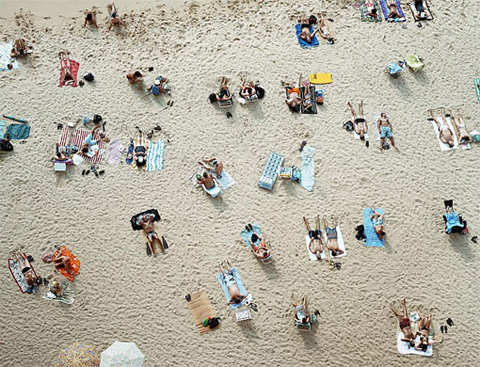

    Photograph by Richard Misrach — from On the Beach

    The current show at Pace Wildenstein presents a series of large scale photographs printed as negative images, that is, inverted in Photoshop. Going to the gallery I had trepidations about the work having seen a few small images on the Internet. My first reaction on seeing the actual prints, however, was that I found them seductively beautiful, especially at such a size. And I was not troubled by the trick of inverting the images.

    Since leaving the gallery, I’ve been having second thoughts, and I’ve gone back and forth on my opinion of the validity of the “the trick.” It’s not that this kind of thing is unheard of in the history of the medium. On the contrary, such experimentation has long been a part of the development of photography from Man Ray to recent color enhanced views of the surface of Mars.
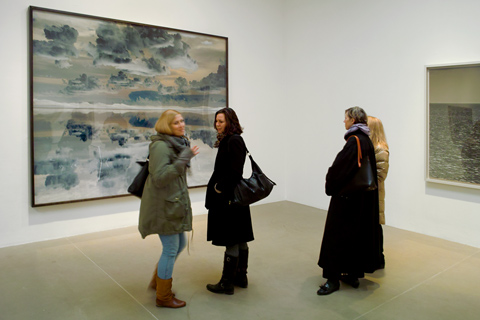

    Richard Misrach show at Pace Wildenstein — © Brian Rose
    Mouse over for effect, click through to larger image.

    Looking at my snapshots of the exhibit I began thinking that the prints were essentially inverted versions of typical Misrach scenes of the American west, no more, no less. The inversion gave them an otherworldly appearance, but really, they were less strange once the initial disorientation wore off.

    And then suddenly I thought, what if I flipped the images in Photoshop. What would they look like? First, I inverted whole snapshots, but then just the images within their frames. The startling result can be seen by mousing over the snapshots posted above and below.
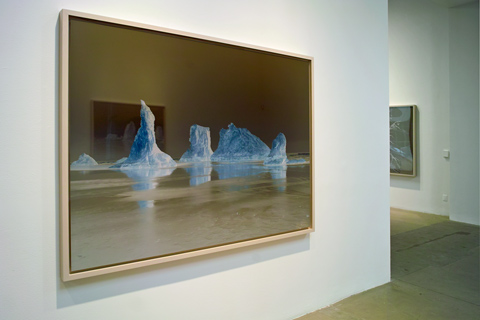
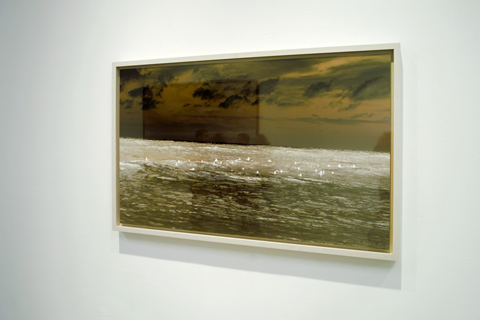
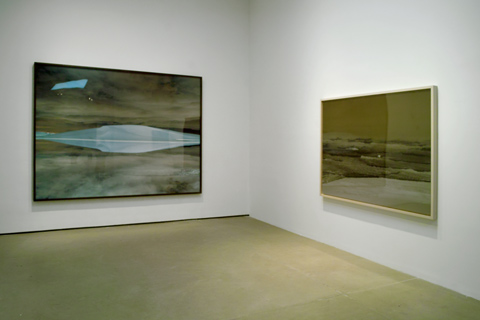
    Richard Misrach show at Pace Wildenstein — © Brian Rose
    Mouse over for effect, click through to larger image.

    I’ve decided, for the moment, that I prefer the more abstract images because they are less recognizable as landscapes, but I’m still wrestling with the whole thing. As gorgeous as the prints are, I’m more and more convinced that the negative effect is too much a Photoshop product, a passing infatuation with digital wizardry. Very simplistic wizardry at that. And I’m put off by the press release language: Misrach’s newest pictures – the majority of which are made entirely without film – mark a radical shift from his past work and herald a new era in photography’s history.

    Entirely without film. Wow.
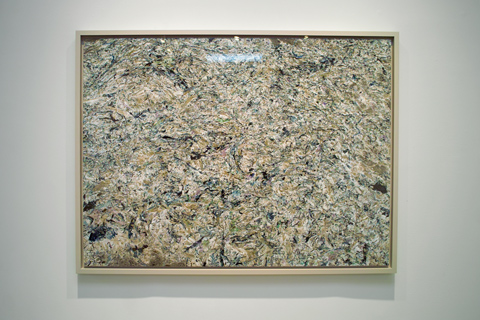

    Richard Misrach show at Pace Wildenstein — © Brian Rose
    Mouse over for effect, click through to larger image.

    I still really love the image of stars in motion, the first picture one sees entering the gallery. The sky is white and the streaking stars are black. And I like the “Pollock” evocation above, which is disorienting without being inverted. It’s positively a positive.
  • New York/Columbia University


    Knox Hall, Columbia University — © Brian Rose

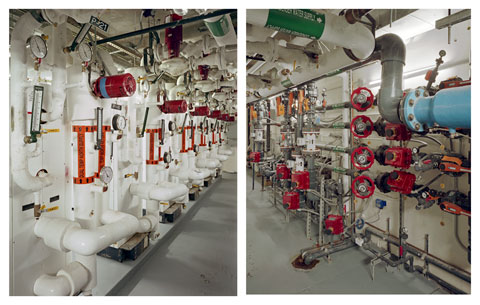
    Assignment work photographing Knox Hall at Columbia University for the architects. Aside from shooting the lobby, classrooms, and various offices, I photographed the geothermal well system in the basement. The four wells are 1,800 feet deep and the system heats and air conditions the building reducing energy consumption by 50 or 60%. Here is a somewhat technical explanation of how it all works.

  • New York/West Village


    Leroy Street — © Brian Rose

    Without comment.

  • New York/Brooklyn Heights


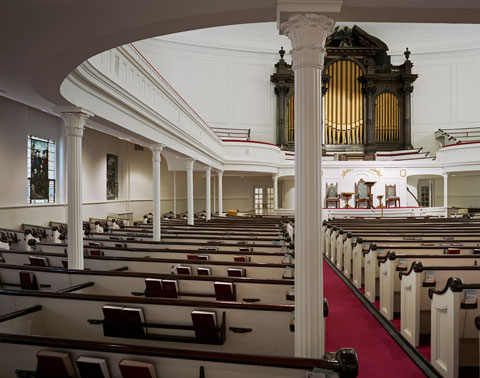
    Plymouth Church, Brooklyn Heights (4×5 film) — © Brian Rose

    On a recent assignment, I photographed Plymouth Church for the magazine America’s Civil War. This was the church where Henry Ward Beecher, the famous abolitionist preacher, delivered his sermons. Beecher’s sister was Harriet Beecher Stowe, the author of Uncle Tom’s Cabin, the best selling anti-slavery novel. Abraham Lincoln sat in one of the pews at right listening to Beecher the day before his Cooper Union speech, which helped propel him to the White House.

    Neither let us be slandered from our duty by false accusations against us, nor frightened from it by menaces of destruction to the Government nor of dungeons to ourselves. Let us have faith that right makes might, and in that faith, let us, to the end, dare to do our duty as we understand it.


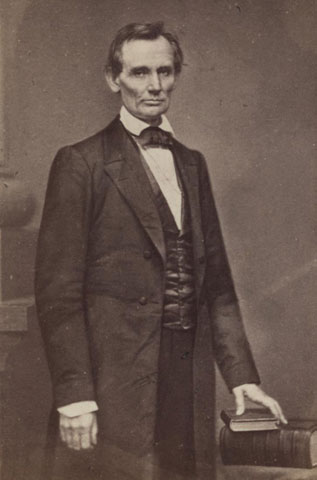
    Abraham Lincoln by Matthew Brady

    Lincoln was originally supposed to give his speech at Plymouth Church, but as I was told by the church historian, Brooklyn was deemed too difficult to get to for the invited dignitaries. The Brooklyn Bridge was not constructed until 1883. So, the location was changed to Cooper Union in Manhattan. On his way to Cooper, Lincoln stopped in Matthew Brady’s studio at Bleecker and Broadway and had his portrait taken. Brady later documented the Civil War, and his photographs remain some of the most powerful depictions of war ever made.

  • New York/West Village


    Hudson Street — © Brian Rose

    Without comment.

  • Berlin/Leninplatz


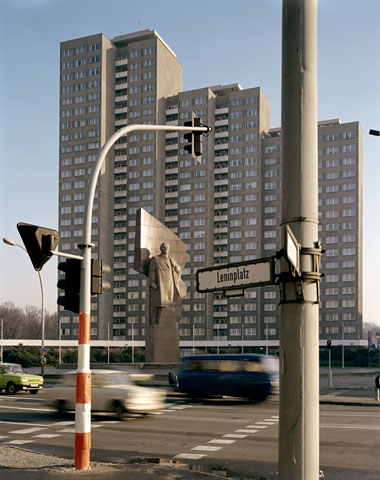
    Leninplatz, Berlin, 1990– © Brian Rose

    Spiegel Online International:

    In a sign of how time is healing Berlin’s wounds, the city plans to dig up the giant Lenin monument it famously buried in 1991 and place it in a new museum for disgraced statues. The works will span the communist and Nazi eras and date far back into Prussian times.

    Full article here.

    One of the things I’ve noticed in my recent trips to Berlin is a greater acknowledgment that visitors come to Berlin to see and feel history, however painful much of it may be. For years, Nazi sites were mostly unidentified, hidden. Then the Wall was hastily removed, communist monuments ripped down. Now, there is a greater openness along with regrets about what was lost. There are serious attempts to present and interpret history such as the Topography of Terror as well as kitschy Trabi rentals and fake G.I.s posing for pictures at Checkpoint Charlie. I still haven’t made up my mind about Peter Eisenman’s Holocaust Memorial, but it is irrevocably planted–a vast field of stones–in the heart of the German capitol.

  • New York/Houston Street


    Houston Street — © Brian Rose

    Winter light on Houston Street.