Category: Photographers/Photography

  • New York/Chelsea


    Chelsea rooftop and Empire State Building — © Brian Rose

    The picture above was taken while doing a walk-through of a building I will be shooting in the next couple of weeks. Having recently photographed several projects in California with green roofs–both low income and market rate–I was bit taken aback by the black rubberized roof on this building. The extreme heat from the surface immediately seeped through my FiveFingers shoes, which I wear most of the time, and I doubt I could have remained standing up there more than a few minutes. Not only does this increase the energy required to cool the building, it also adds to the heat island of the city, which has all kinds of negative impacts on the environment. I was told that the budget for this non-profit project was not sufficient for a more environmentally friendly solution.

    There is no excuse for this. I am not necessarily blaming the developer and architect who are struggling to deliver a product on a shoe string budget. It is clear that without government mandates, tax incentives, and if necessary, subsidies for non profits, we are going to continue in the wrong direction.

    Here’s a start.


    Chelsea water towers — © Brian Rose

    News report from here in the trenches:

    Good news. I will be teaching a class at the International Center of Photography this fall inspired by my book, Time and Space on the Lower East Side. The class will photograph various aspects of the neighborhood, and then put together a book using Blurb, the online printing/publishing service. I am excited about the opportunity–it has been a while since I last taught–and I hope this leads to other teaching assignments.

    Bad news. Princeton Architectural Press, which published my book The Lost Border, turned down Time and Space on the Lower East Side on the basis that it would have too limited an audience. I am not an expert in marketing, to say the least, but as someone with a nose to the ground, I know they are wrong about the audience. There has already been substantial interest in the book–I’ve sold at least 30 on my own–doing almost nothing. But aside from that, it seems that publishers–not just PAP–have forgotten the concept of taking compelling photography and selling it.

    Good new and bad news. When I did the Lower East Side project in 1980 with Ed Fausty, the Bowery served as the western boundary of the neighborhood. It had its own character, of course, infamous as the skid row of New York. But we didn’t focus on the Bowery much, perhaps because it seemed like a separate enclave at the time. Since recommencing the project I’ve done many photographs along the Bowery, enough that they almost constitute a separate series.

    With all the interest in the Bowery of late–museums and galleries, hotels and apartments, restaurants and boutiques–and the efforts to preserve some of the character of this previously maligned, but historic, place, I’ve decided to begin photographing the street in a more comprehensive way. The only problem at the moment is that there is no 4×5 negative film available. Fujifilm has stopped making the stuff, leaving Kodak the only supplier, and all the New York shops have it backordered. Uh oh.

    When the film comes in I’m going to have to buy as much as I can afford and refrigerate.

  • New York/Governors Island

    A few more photographs of the spectacular Mark di Suvero sculptures on Governors Island.


    Figolu, 2011 by Mark di Suvero — © Brian Rose


    Figolu, 2011 by Mark di Suvero — © Brian Rose


    She, 1978 by Mark di Suvero — © Brian Rose

    The only troubling thing about the installation on Governors Island was that  people were climbing on the sculptures–all the way to the top of the red Figolu–a scary sight. And kids were swinging on and hanging off  the very heavy wooden platform of She, a serious accident waiting to happen. I usually chafe at unnecessary restrictions on public behavior, but I am hoping that steps have been taken to avert potential disaster.

  • New York/Union Square


    Union Square station — © Brian Rose

    A moment on the L train platform.

  • New York/MoMA


    MoMA photography gallery — © Brian Rose

    I am happy to announce that one of my photographs is on exhibit at the Museum of Modern Art. The permanent collection galleries have recently been reinstalled including new acquisitions–like mine–and historic photographs. My print can be seen at right in the picture above. It is one of my recent Berlin images acquired by the museum last fall.


    William Christenberry photo above, Brian Rose below — © Brian Rose


    Kudzu Devouring Building, near Greensboro, Alabama, photography by William Christenberry


    Mauerstrasse, Berlin, 2006 (4×5 film) — © Brian Rose

    My photograph is paired with one by William Christenberry, one of the pioneers of color photography, who is known, particularly, for his images of vernacular architecture, signs, and the rural landscape. A few years ago Christenberry did a series of images of structures enveloped by kudzu, the non-native vine that has become ubiquitous in the south.

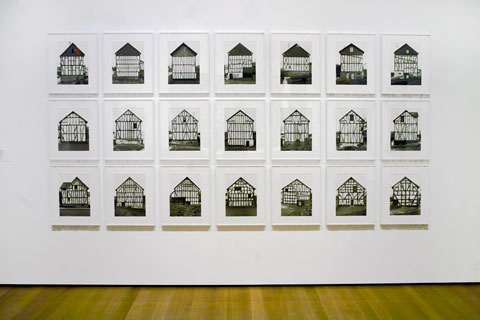
    There is an interesting symbiosis between the two images–a building being devoured by natural forces, and my multi-layered deconstruction of architecture in the heart of Berlin. The one concealing, the other revealing. It is also an honor to be shown with an artist of Christenberry’s stature, and in the same room with Tina Barney, Philip-Lorca diCorcia, Leandro Katz, Bernd and Hilla Becher, Jan Groover, and other noteworthy photographers.


    Framework Houses by Bernd and Hilla Becher — © Brian Rose

    I’ve written in the past that it sometimes seems that the Bechers are overexposed. You can’t go anywhere without seeing their images, often in large grids, like the Fachwerk facades above. But let’s face it, this is brilliant work, especially this grouping. Their approach transcends genres. It is rigorous and seemingly impersonal, but in the end, suffused with pathos for human endeavor.

  • New York/Governors Island


    Mark di Suvero on Governor’s Island — © Brian Rose

    Back in New York after five days in Virginia. My father is hanging on at 90 years old. I spent much of the past week visiting him in the hospital, and then as soon as I get back, my son Brendan ends up in the ER with a badly sprained ankle. Before that happened we went out to Governor’s Island in New York Harbor. The Mark di Suvero sculptures currently on display around the island are magnificent.

    I just received word today that one of my photographs is on display at the Museum of Modern Art. I’ll go tomorrow and take a look.

  • Williamsburg, Virginia


    Duke of Gloucester Street, Williamsburg, Virginia — © Brian Rose

    I am in Williamsburg, Virginia visiting my father who is in the hospital. He appears to be doing fine after surgery, but is still unsure where he is and what is going on.

    Last night I took a walk down the Duke of Gloucester Street, the original main street of the 18th century town. The light was beautiful.

  • New York/Williamsburg, Virginia


    Sarah Roosevelt Park — © Brian Rose

    I’m in Williamsburg, Virginia tending to my 89 year old father who is in the hospital. So, I may be mostly absent for a few days. The picture above was taken recently at a street fair on the Lower East Side.

  • New York/Greenwich Village


    7th Avenue and Greenwich Avenue — © Brian Rose


    7th Avenue and Greenwich Avenue — © Brian Rose

    Tiles for America, a 9/11 memorial.


  • New York/The Bowery


    The Bowery — © Brian Rose

    The rapture mobile parked in front of the Bowery Poetry Club.   I wonder what they thought they’d find on the Bowery.

    UPDATE: No rapture–back to work.


    The Bowery — © Brian Rose

  • New York/Roosevelt Island


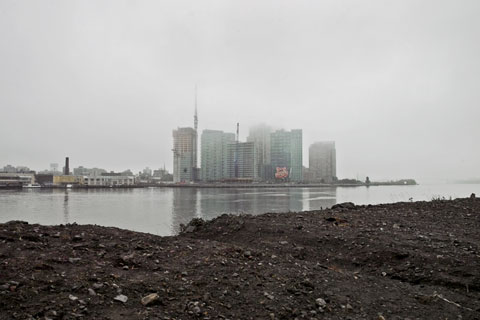
    Long Island City from Roosevelt Island — © Brian Rose

    On Sunday I took a tour of Four Freedoms Park, a memorial to Franklin Delano Roosevelt, currently under construction on Roosevelt Island. The island is located in the East River opposite Midtown and the Upper East Side. It is accessible by aerial tram and subway, and by a bridge from Queens. In the past, the island was primarily used for prisons and hospitals, a convenient location to keep separate from society certain people–notably the mentally ill, small pox patients, and victims of polio. In the 1970s a planned community of high rises was built for middle income residents, and more recently, market rate housing.

    It was damp, foggy morning, and I joined about 25 other Cooper Union alumni for the hour-long tour at the far southern end of the island. The memorial was originally designed by Louis Kahn in 1973, but it was not built because of the city’s fiscal problems. The project was resurrected a few years ago and is now going forward using the Kahn design. I snapped pictures of the construction site as well as views across the East River and historic structures on the island.


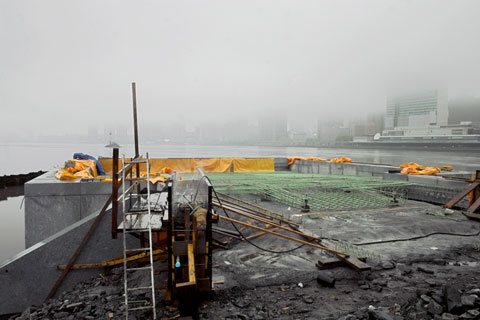
    FDR Four Freedoms Park under construction — © Brian Rose

    The memorial culminates in a granite enclosed “room” at the southern tip of Roosevelt Island opening onto a vista of the river and the adjacent United Nations complex in Manhattan–enveloped in fog above.

    The complete series of ten photographs can be seen here.

    The park website is here.

  • New York/The Bowery


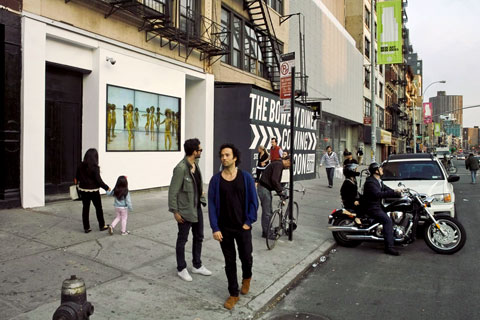
    The Bowery at Stanton Street — © Brian Rose

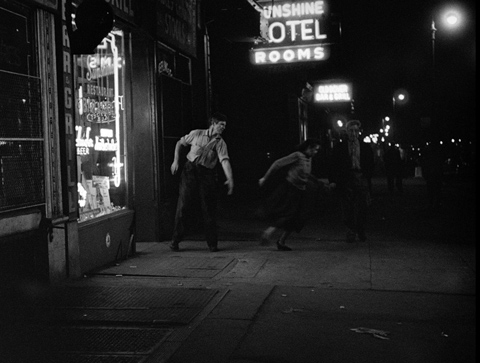
    Once again I found myself at the corner of Bowery and Stanton waiting for a taxi. I had a guitar slung over my shoulder and two bags, one full of groceries. I noticed that a group of people had gathered in front of the gallery video screen in the storefront of the old flophouse, the Sunshine Hotel. Gold painted figures dancing. During the day, the video screen is hard to see in the glare, but in the fading light of evening, it becomes relatively brighter. A last glint of sunlight touched the metallic skin of the New Museum just down the block.

    A couple of months ago I did a similar photograph standing in the same spot–also waiting for a taxi–and my first thought was that there was no reason to repeat myself. But no cabs were coming, and I continued to watch the scene unfold. I put my bags down on the pavement and fumbled for my pocket camera. I could not move more than a step or two in any direction because my stuff was lying in the street. But I began to consider a shot that included the motorcycle parked to the right. People stopped briefly to watch the video, then scattered this way and that. A man and woman in helmets arrived and mounted the motorcycle. A man veered toward me and the composition coalesced around him.


    From On the Bowery, a film by Lionel Rogosin

    I realized as I took the photograph that I was standing just a few feet to the right of the spot where Lionel Rogosin’s cameraman filmed the scene in On the Bowery where the drunken protagonist Ray Salyer slaps a woman and then stumbles up the stairs into the Sunshine Hotel, a Bowery survivor now surrounded by the most conspicuous of art consumption. On the Bowery is a remarkable film, half staged, half documentary, suggestive of much contemporary photography.

    I wrote about the film  here.


  • New York/Yankees


    Brendan at Yankee Stadium — © Brian Rose

    We’ve made it up to the stadium a couple of times this year. Brendan, my son, is a big Yankee fan. He’s been to five games all together, and has yet to lose.

  • New York/Ground Zero


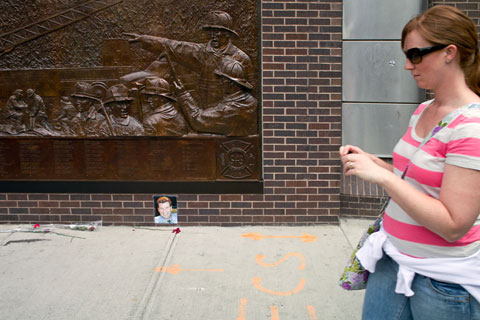
    Fireman’s Memorial, Greenwich Street — © Brian Rose

    The President was in New York last week in the wake of the killing of Osama bin Laden.  He lunched with firemen from a company that lost men on 9/11 and greeted families of others who died at ground zero.  I went downtown on Friday, a couple of days after Obama’s visit, to see how things were going. One World Trade Center appears now to be sixty or more stories high, and the above ground part of the 9/11 memorial and museum is being rushed to completion. Just a few months ago it was a steel skeleton–now it is mostly enclosed.  I made several photographs with the view camera in the area just south of Liberty Street near the Fireman’s Memorial. I also snapped a few shots with my digital camera.

    Tourists jammed the sidewalk near the Fireman’s Memorial, and possibly because of Obama’s recent visit, there were lots of flowers and pictures placed along the wall of the memorial. There were no such items the last few times I’d been there. A tour guide led a large group of out-of-towers by the memorial and I heard her refer to those “murdered” on 9/11. There was a thinly veiled anger conveyed by the use of the word murder. Yes, it’s true that those killed when the planes were crashed into the towers were, technically speaking, murdered in an act of violence. As are any victims of terrorism worldwide. And what about the innocent victims of unjustified wars? I’m not interested in a moral equivalency argument here. It’s clear enough what happened on 9/11. I just  think it is better to tone down the rhetoric.


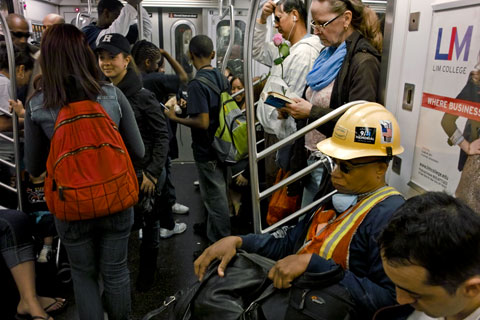
    On the 6 train in Lower Manhattan — © Brian Rose

    On the subway heading back uptown, I saw a construction worker from the World Trade Center site. His hardhat was decorated with stickers, one for the 9/11 memorial and an another with a flag and the Twin Towers.

  • New York/Nolita


    Elizabeth Street — © Brian Rose

    Lion-dog/dog-lion.

  • New York/Cairo, Illinois


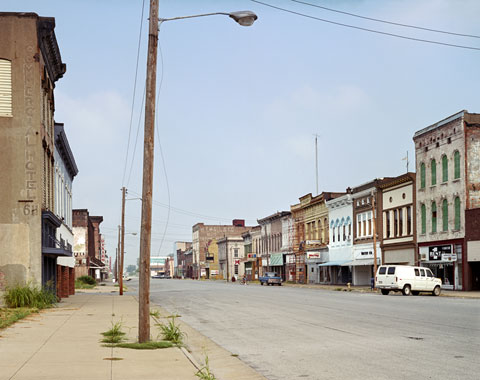
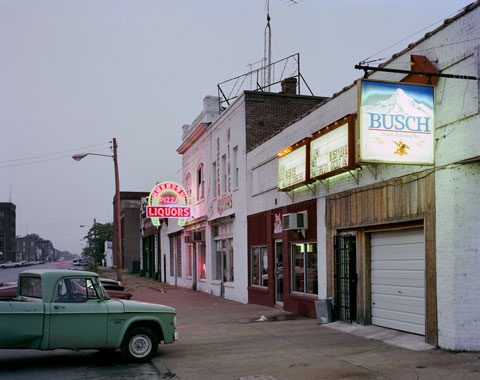
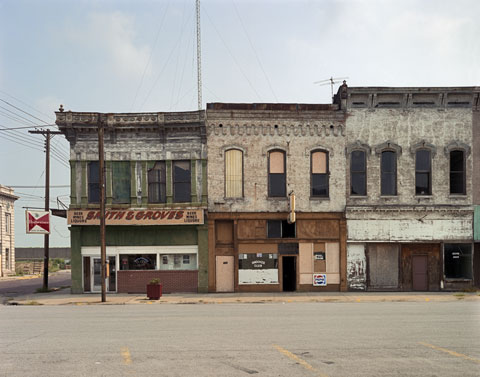
    Commercial Street, Cairo, Illinois, 1989 (4×5 film) — © Brian Rose

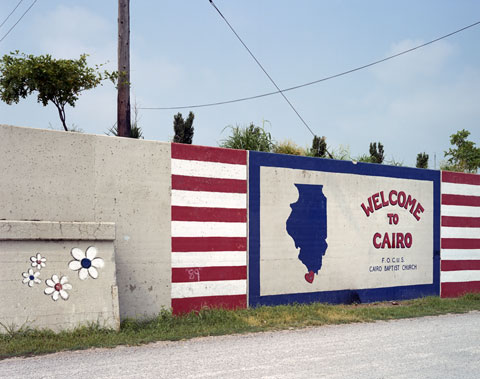
    With all the news about Osama bin Laden, less attention is being paid to an ongoing drama in the heartland of the U.S. The Mississippi and Ohio Rivers are running extremely high, threatening multiple locations, but especially the historic town of Cairo, Illinois. Cairo was once a bustling trading center at the confluence of the two rivers with its own custom house and 15,000 people. There were hotels, theaters, and fine mansions. As river transportation fell off, Cairo slipped into decline, which was exacerbated by racial segregation leading to riots in the ’60s, and wholesale white flight. Today, much of Cairo is a ghost town, its main street a ragged line of crumbling buildings interspersed with rubble strewn lots.

    In 1989 I traveled with my view camera along the Ohio River from Pittsburgh to Cairo–another of my unfinished projects–due to lack of money. After two or three weeks of shooting, driving southwest along the river, I finally made it to Cairo having no idea what to expect. It was then, as now, a shocking tableau of abandonment.


    Commercial Street in 1989, Cairo, Illinois (4×5 film) — © Brian Rose

    Along with the abandonment there was a palpable whiff of danger in the air, a few pick-up trucks pulled up at bars, solitary individuals drifting about with no apparent destination. Despite the menacing atmosphere I managed to take a few photographs as the sun went down, and then returned in the morning. Things were much less scary in broad daylight, but equally devoid of activity. As I wandered about with my camera I was approached by a middle aged who turned out to be the head of the chamber of commerce. The fact that an out of town photographer was interested in the place was reason enough for him to invite me to lunch at a nearby diner. He wanted to bring Cairo back–a middle-aged white man in a largely black city–but his blue-suited boosterism, seemed out of time and out of step in this scene of desolation.

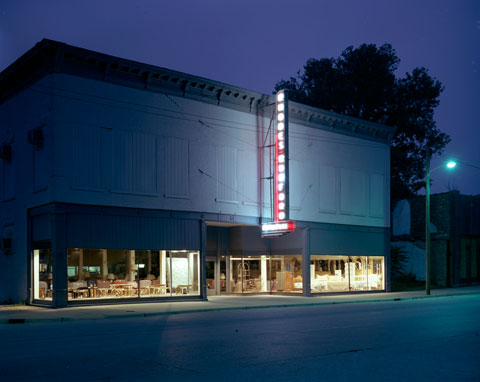
    That was in 1989–and almost nothing has changed in 22 years except that much of  Cairo’s extraordinary architecture has further decayed or has disappeared altogether. In the intervening years some of the historic mansions have been preserved as has the old custom house. But the downtown remains spectral, made all the more so by fancy brick paving stones and retro lampposts on parts of Commercial Street, a superficial attempt at revitalization.


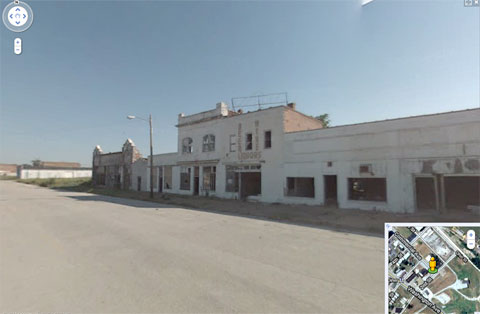
    Google Street View of the same stretch of storefronts as above.


    Commercial Street in 1989, Cairo, Illinois (4×5 film) — © Brian Rose


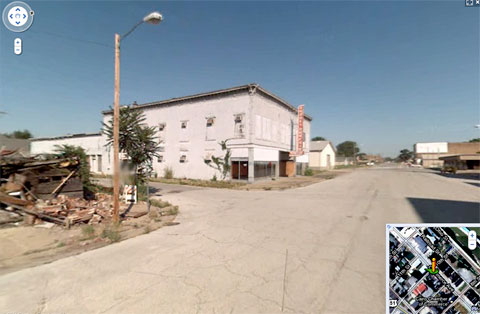
    Google Street View of the same building as above.


    Commercial Street in 1989, Cairo, Illinois (4×5 film) — © Brian Rose


    Ohio River levee in 1989, Cairo, Illinois (4×5 film) — © Brian Rose

    The reality is that Cairo is a doomed city, a wedge of river sediment between the Ohio and Mississippi walled in by levees. A desperate fight is underway to save the city as the river water threatens to top the flood walls and ground water pressure builds underneath. The city’s 3,000 residents have been evacuated. Yesterday, the Army Corps of Engineers blasted an opening in a levee to the south flooding miles of fertile farmland to relieve the pressure. As of this morning, the levee breech seemed to be working, the water subsiding, but Cairo remains vulnerable. It may survive this season’s flood, but how long can a sandy spit of land withstand the uncontrollable force of two mighty rivers?


    Cairo, Illinois in 1989 (4×5 film) — © Brian Rose

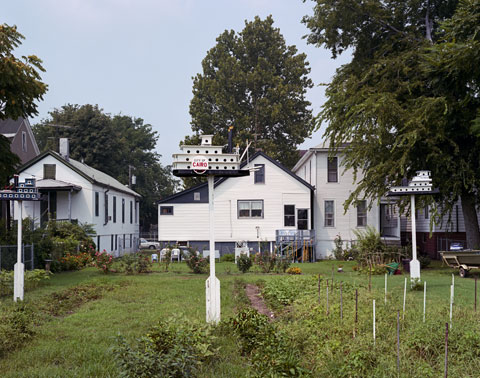
    Birdhouses in the form of barge tows, a thematic reminder of why Cairo exists where it is. But the river transit that once made this a thriving small metropolis faded like the car industry faded in Detroit, another symbol of American decline. Or if not decline, then abject neglect, a too easy eagerness to shift attention to the next boom town, to the next  swath of exurban frontier. Detroit may yet rise from the ashes, but Cairo sits betwixt and between, imprisoned by its history of racial strife and its impermanent geography.

    In Mark Twain’s Adventures of Huckleberry Finn, Huck and the runaway slave Jim float down the big river on the lookout for Cairo, where the clear Ohio water meets the muddy Mississippi. Cairo is Jim’s gateway to the Ohio River and freedom, but they missed their landmark in the fog and drifted on south into slave territory.

    There warn’t nothing to do now but to look out sharp for the town, and not pass it without seeing it. He said he’d be mighty sure to see it, because he’d be a free man the minute he seen it, but if he missed it he’d be in a slave country again and no more show for freedom. Every little while he jumps up and says:

    “Dah she is?”

    But it warn’t. It was Jack-o’-lanterns, or lightning bugs; so he set down again, and went to watching, same as before. Jim said it made him all over trembly and feverish to be so close to freedom.


  • New York/Osama bin Laden


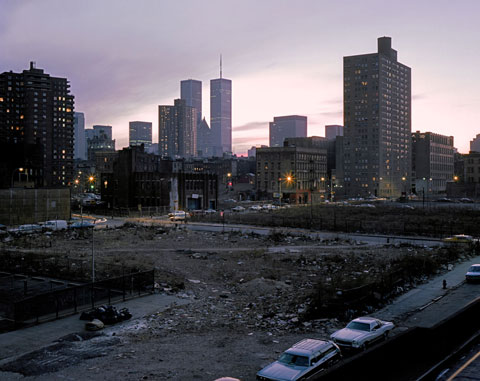
    Twin Towers, 1980 (4×5 film) — © Brian Rose/Ed Fausty

    Osama bin Laden killed in Pakistan. Nine years and seven months after 9/11.

    Although I share a degree of the elation demonstrated by the crowds that gathered near the White House and at Times Square last night, I’ve lived long enough to know that these moments are all too fleeting. I remember well when the Berlin Wall opened–I was there a few weeks afterwards to photograph its rapid destruction. And I remember the feeling that the world had changed forever, that freedom had won out over authoritarianism. That the long shadow of World War II had finally been lifted off of central Europe.

    Twelve years later, Osama bin Laden and his terrorist hit men flew airplanes into the World Trade Center  and another shadow descended. September 11th, and our reaction to it, led to an unjustified war in Iraq, torture, and the weakening of our economy–call it Bin Laden’s decade-long victory. Feel free to argue otherwise, but I do not think history will support it. Bin Laden’s death does not end that saga, but it offers, at least symbolically, the possibility that we can move forward again, after falling back.

    Undoubtedly, those who were directly touched by 9/11 will feel that justice has been served, though I doubt that closure is an appropriate word to describe their (our) ongoing loss. I think, especially, of my friend Jack Hardy, the songwriter, whose brother was killed in one of the towers. Jack died in March of cancer. Were he here today, I do not think he would find much solace in bin Laden’s demise.


    Twin Towers facade montage — © Brian Rose

    For me, it is a moment  of mixed emotions. I have spent a good deal of my life as a photographer focused, by design or by accident, on these two watershed events, the fall of the Berlin Wall and the destruction of the World Trade Center. They are two of the most important events of our time. I have books on these subjects, whole bodies of work. With today’s news I have this rare sense of being momentarily at the center of things, that my work connects to the flow of history. And yet, just as quickly, I feel history rushing forward and slipping from my grasp.

  • New York/Solar Panels


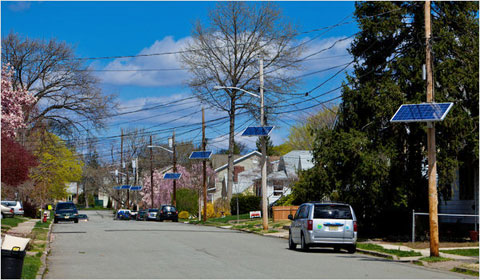
    Fair Lawn, New Jersey — Juan Arredondo for The New York Times

    I read with some amusement an article in the New York Times on New Jersey residents complaining about solar panels mounted on utility poles in their neighborhoods.

    “I hate them,” Mr. Olsen, 40, said of the row of panels attached to electrical poles across the street. “It’s just an eyesore.”

    Some residents consider the overhanging panels “ugly” and “hideous” and worry aloud about the effect on property values.

    Yes, looking at the photograph above there clearly is a problem. The street is cluttered with old wooden poles festooned with transformer boxes and draped with telephone and electrical wires. The solar panels merely add to the visual cacophony. This is how residential streets look all over the country–and I am sorry to say that most people have become blind to it. Moreover, in the current political and economic climate there is little hope that this design cancer will be addressed.

    Tassafaronga Village, Oakland, California (4×5 film) — © Brian Rose

    Recently, I photographed Tassafaronga Village in Oakland, California  for architect David Baker. It is comprised of low income and middle income housing. In the shot above I am looking over an undulating green roof toward townhouse apartments with solar panels mounted on stanchions and on the roofs. Utility lines are invisible–only the solar panels remain exposed. Imagine the street in New Jersey with a series of new appropriately designed poles mounted with solar panels. The panels would be plainly visible, of course, but the overall look greatly simplified. It could be done elegantly.

    Tassafaronga Village, Oakland, California (4×5 film) — © Brian Rose

    Here is another view of the project looking toward a larger apartment building containing community rooms and support offices. The previous view was shot from one of the narrow vertical windows on the second floor. Solar panels face south along the street.

    As a society we are neglecting the public commons. Our communities are visually polluted with all kinds ill-considered utility structures, cheaply built municipal buildings, and unregulated strip developments. Present day political discourse is all about what we can’t do rather than what we can do.

    New Jersey: require the utility companies to bury those lines.


  • New York/Lower East Side


    Houston Street — © Brian Rose

    Spring arrives in New York.