Category: Photographers/Photography

  • New York/WTC


    Broadway and Cedar Street — © Brian Rose

    I went downtown yesterday to add more photographs to my ongoing WTC series. I took the 4×5 view camera, which now requires carrying individual holders for the film instead of the pre-packaged paper envelopes that I used for about 15 years. Both Fujifilm and Kodak have dropped those from the lineup, now that digital is pre-eminent, and Fuji has stopped making 4×5 film across the board.

    I took the subway to Wall Street and walked a block or two up to Zuccotti Park, the primary location of Occupy Wall Street, the protest movement that has spawned similar actions in other cities across the country. I went with the intention of including the demonstration in some of my photographs, but not to attempt to document it per se. After all, the place is crawling with photojournalists and the media in general.  My approach, as usual, is more of a meta-documentation of events as they intersect with my main task, photographing around ground zero and the rising towers, particularly 1 WTC. More than once, other photographers looked at my equipment and referred to me as “a real photographer.”

    From across Broadway I could readily see the police presence on the periphery of Zuccotti Park–various barriers and cones directed traffic on the street–which continued to flow unimpeded. Every few moments a double decker red tour bus would pass by the park and tourists’ heads would swivel in the direction of the demonstration. I set up my camera on Broadway and did a photograph looking toward the park with a brilliantly red Mark DiSuvero sculpture towering over it. The new glass buildings in the background reflected sky and each other creating a confusing constructivist composition. Red construction hoists slid up and down 4 WTC as if intended to complement the color scheme.


    Trinity Place and Liberty Street — © Brian Rose

    I only did three or four photographs in and around the park, but I was there about two hours, setting up the camera, and then waiting for things to happen. I talked to a number of people, some active participants, some tourists, others just passing through, but curious to see what was going on. As expected there are plenty of “professional activists,” the people who come to any and every march or protest aimed at established power. So, the casual observer might assume that the crowd is dominated by Marxist anti-U.S. fringe groups.

    If this were actually the case, however, this demonstration would have been long over. It’s hard to get a handle on the composition of the crowd, but clearly, it is more diverse than usual for these kinds of things. At one point while I was there a contingent of union hard hats from the WTC construction site paraded through the park carrying an American flag. Another group of perhaps 20 marchers–young people, white and black–circled the park chanting “Stop, stop and frisk!” while almost the same number of NYPD blue shirts strolled along behind pied piper style. This was obviously an adjunct protest to the main Wall Street occupation demonstration. I talked briefly with a construction worker, a British tourist who was concerned about the economic future of Europe, and a person who had come specifically to see for himself what was going on. It’s the interest from outside the core group of demonstrators that seems to give  this rolling event momentum and importance.

    I set my camera in the northwest quadrant of the park facing Liberty and Trinity Place with demonstrators and the curious in the foreground, and the sky filled with glass skyscrapers in the background. It was particularly satisfying to put my tripod down right at this spot where I had been accosted by security guards a few years ago who informed me that Zucotti Park–while open to the public 24 hours a day– was, in fact, a private park, and tripods were not allowed. The park–really a paved public square–is the product of  one of these zoning deals New York City is so fond of. Developers get more height or floor area in exchange for creating a public amenity, often of dubious merit. In this case, the park is definitely a welcome amenity among the forest of skyscrapers of lower Manhattan, and the city sees it as a win-win, since they do not have to take care of it–Brookfield, the owner, maintains the space. So, we have a public square which must be open to everyone round the clock, in which tripods are not usually allowed, now occupied by 500 demonstrators and their NYPD chaperones. The irony of it all is delicious.


    Cedar Street — © Brian Rose

    Speaking of ironies. The crowd in Zuccotti Park is comprised largely of local New Yorkers, many of whom are undoubtedly Jewish as evidenced by a portable Sukkah to honor the current holiday set up among various other tents and tarps. The right wing talking point that Occupy Wall Street is anti-semitic is laughable. The reason they link a Wall Street protest to Jews is because they are under the mistaken notion that the nation’s banks are run by Jews, which is demonstrably untrue–Goldman Sachs not withstanding.


    Cedar Street — Brian Rose

    From Zucotti Park I walked a short distance down Cedar Street and came to Greenwich with its sweeping view of the construction of the WTC. Dozens of visitors were lined up to enter the 9/11 memorial–which requires obtaining a ticket. I had a long chat with a police officer, a young Asian cop assigned to the WTC who was interested in my project. I did a few photos here before finishing for the day. One World Trade Center is now at least 2/3 of the way up.

  • New York/Williamsburg


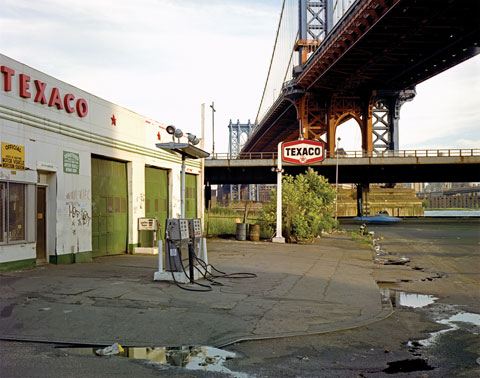
    Bedford Avenue, Williamsburg, Brooklyn — © Brian Rose

    If you’re building your own sukkah, here are the basic materials you will need:

    The Walls: The walls of a sukkah can be made of any material, provided that they are sturdy enough that they do not move in a normal wind. You can use wood or fiberglass panels, waterproof fabrics attached to a metal frame, etc. You can also use pre-existing walls (i.e, the exterior walls of your home, patio or garage) as one or more of the sukkah walls. An existing structure that is roofless or has a removable roof can also be made into a sukkah by covering it with proper sechach.

    The Roof Covering: The sukkah needs to be covered with sechach—raw, unfinished vegetable matter. Common sukkah roof-coverings are: bamboo poles, evergreen branches, reeds, corn stalks, narrow strips (1×1 or 1×2) of unfinished lumber, or special sechach mats.


  • New York/The Bowery


    The Bowery and Delancey Street — © Brian Rose (graffiti by Kenny Scharf)

    The process of making photographs varies with different photographers. There are some who work within conceptual frameworks that require a great deal of calculation ahead of time. Others, like me, tend to think in projects that take in long time lines, or that slowly, image by image, explore the relationship between self and the outside world. However, in any case, there is usually an element of discovery–a path found–a thread identified and then pulled–a momentary recognition of something essential. Often, these discoveries are fleeting, provisional, trivial. Not exactly mind bending paradigm shifting stuff.

    So, I pick up the paper this morning, as usual, and flip through the arts section, and land upon a review of a photography show–a rarity these days in the New York Times. It’s about the latest New Photography exhibit at MoMA. I was already aware of it mostly because I knew that Doug Rickard’s Google Streetview images are in the show. Rickard’s work is fascinating in that the images made are essentially available to all. He simply reframes the 360 degree  anonymous pans of the world glimpsed from Google’s ceaselessly cruising eye.


    New York City, photo by Doug Rickard (via Google Streetview)

    On the one hand, Rickard uses the images as social commentary, focusing primarily on the most neglected and down and out areas of the United States. There’s nothing new about photographing such areas. But on the other hand there is something different about seeing these places through a robotic lens–literally drive-by photography–seen voyeuristically as if through a roving security camera. Rickard has us gaze at the underbelly of society, at poor people, scary looking people, caught unaware by the camera, captured in the barrel distorted, light flared reality of Google–and we all become Big Brother in the process. Guiltily, I cannot stop looking at these disturbing images.

    This is work that deserves a good deal of critical thought, and even soul searching. But as I begin to read Ken Johnson’s review of New Photography 2011 I am slammed dead in my tracks by this:

    In the 1980s photography mutated into a monster that threatened to swallow fine art altogether. In the hands of artists like Cindy Sherman, Jeff Wall, Gregory Crewdson, Andreas Gursky and legions of copycats, photography parsed the day’s most urgent questions about representation, propaganda, truth and reality. But in the ensuing decades, the answers became increasingly routine, and today the beast that art photography was finds itself tired and toothless.

    If you are searching for signs of rejuvenation in “New Photography 2011,” an exhibition of six artists at the Museum of Modern Art, you will look in vain. 

    With that dispiriting introduction, Johnson then goes on to dutifully praise the work in the show including Doug Rickard’s “species of meta photography.” But why bother make the effort if none of the work offers signs of rejuvenation? Why saddle these photographers with this unfair and miserable burden? What a drag for Johnson to have to write this article. What a drag for us to have to read it. And now, excuse me while I resume my pointless search for relevance outside–or inside–I don’t know which–the tired and toothless art photography monster.


  • New York/Lower East Side


    Madison Street under the Manhattan Bridge — © Brian Rose

    A visually quiet moment in Chinatown–but the bridge above is never silent. Cars and trucks sound a constant din, and every few minutes a subway train clatters by, the squeal of steel wheels.


  • New York/Lower East Side


    Cherry Street — © Brian Rose

    Lost over Knickerbocker Village.


  • New York/Around Town


    10th Avenue and 30th Street — © Brian Rose


    Clarkson Street — © Brian Rose


    Williamsburg, Brooklyn — © Brian Rose

    Without comment.


  • New York/WTC


    WTC, East 4th Street — © Brian Rose


    Steve Jobs • 1955-2011


  • New York/The High Line


    Under the Standard Hotel on the High Line — © Brian Rose

    Today is the first day of my class at ICP, Photographing New York: The Lower East Side. We will look at work, mine and the students. And talk about the Lower East Side, and how to approach making photos of the neighborhood. Beyond the geographical, the question is, what is place? And how can you define and describe it?

    Please support Time and Space on the Lower East Side by clicking on the Kickstarter badge at right.


  • New York/Lower East Side


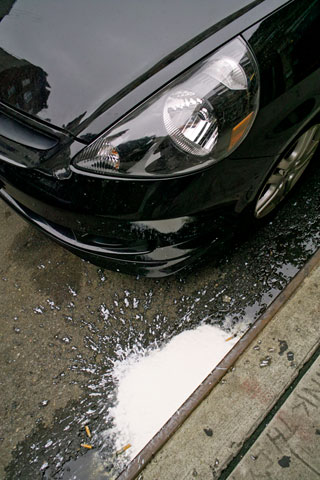
    East 4th Street — © Brian Rose

    White splash on 4th Street.

    Please support Time and Space on the Lower East Side by clicking on the Kickstarter badge at right.


  • New York/WTC


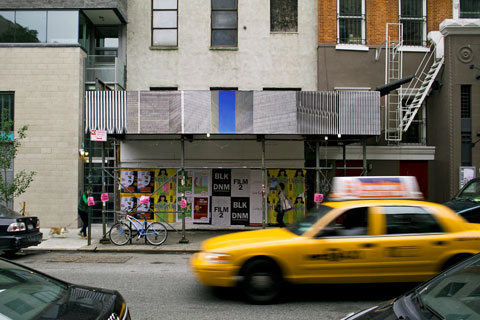
    East 4th Street — © Brian Rose

    My WTC mural during a street fair sponsored by FAB (Fourth Arts Block).


    Clarkson Street — © Brian Rose

    A commercial billboard commemoration of  the 10th anniversary of 9/11.


  • New York/Lower East Side

    Today I am taking the plunge and launching my kickstarter campaign to raise money for the publishing of Time and Space on the Lower East Side. Please watch the video and visit the project page on the kickstarter website.

    The campaign will last 45 days and I hope to raise at least $10,000. Donate whatever you can. But for $50 you can make real contribution by, in effect, pre-ordering a copy of the book.

    Time and Space is the culmination of a project that began in 1980 when I photographed the Lower East Side in collaboration with photographer Ed Fausty. We documented the neighborhood at its darkest but, perhaps, most creative time. While buildings crumbled and burned, musicians and artists worked to express the edgy quality of the place.

    In 2005 I returned to photographing the Lower East Side working alone this time. The result is a book spanning three decades of history, originally available through Blurb the online platform for creating photo books. I am working now with Golden Section Publishing, a new independent publisher headed by photographer Bill Diodato. With your help, the book will be completed this year and available in stores and online early in 2012.


  • New York/WTC

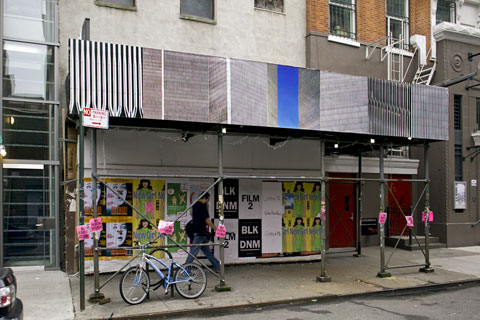
    The WTC montage is up and it looks pretty cool. Don’t miss the opening reception this Wednesday. There will be nine WTC images on exhibit in the cafe, which is directly across the street from the installation. Hopefully, the weather will allow for outdoor mingling.

    FAB cafe
    77 East 4th Street
    Wednesday, September  28
    7-9PM


    WTC, E4th Street between the Bowery and Second Avenue — © Brian Rose


    WTC, E4th Street between the Bowery and Second Avenue — © Brian Rose


  • New York/Stepping Up


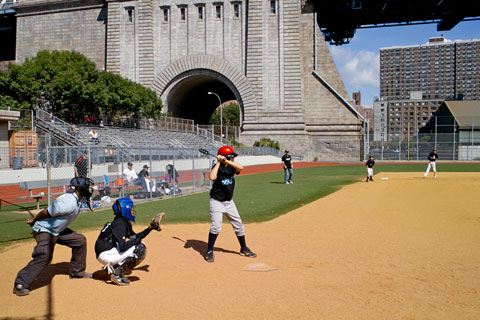
    Brendan, my son, at bat under the Manhattan Bridge on the Lower East Side
    © Brian Rose

    It’s time to step up to the plate and take charge. Several years have gone by since I introduced my book proposal, Time and Space on the Lower East Side. At this point it is clear that nothing is going to happen with this book unless I take the initiative. In recent months I have been talking with Bill Diodato, a photographer and book publisher. He has produced his own extraordinary book, Care of Ward 81 (slide video here), and is now taking on new projects as Golden Section Publishing. My book will be the first.

    We do not have a lot of money to work with, so I am hoping to raise a part of it via kickstarter, the internet fundraising platform–which, by the way, has its offices on the Lower East Side. I will be launching the campaign this weekend and it will run 45 days. My goal is $8,500, or more.


    Under the Manhattan Bridge, 1980 (4×5 film) – © Brian Rose/Ed Fausty

    Once the campaign is launched I will be sending out personal email requests for support, and I will provide a link here to my kickstarter project page. There will be many different levels of support available to fit all budgets.

    Time and Space on the Lower East Side is a portrait of one of America’s most important neighborhoods spanning three tumultuous decades. The project was initiated in the early days of color art photography, and includes view camera scenes of the Lower East Side in 1980, when the neighborhood was burning and crumbling, when artists and musicians celebrated the edgy, if not dangerous, nature of the place. I have since rephotographed the Lower East Side, post-911, a much gentrified, but still fascinating part of New York.

    It has never been easy getting photography books published. It took years for me to get the Lost Border published, which by the way, has sold over 2,500 copies. That may not sound like much, but it is in fact a very respectable showing for a serious fine art photo book. Not that it mattered when I sought a publisher for Time and Space.

    I have worked too hard and too long to be defeated by a publishing industry increasingly incapable of discerning important work and marketing it. With your support, I will get this book out, online and in stores, by the beginning of 2012.

  • New York/Icons


    Henry Street — © Brian Rose


    West 33rd Street — © Brian Rose

    Without comment

  • New York/Houston Street


    Houston and Lafayette Street — © Brian Rose

    Without comment.


  • New York/Mitch Epstein


    Berlin by Mitch Epstein

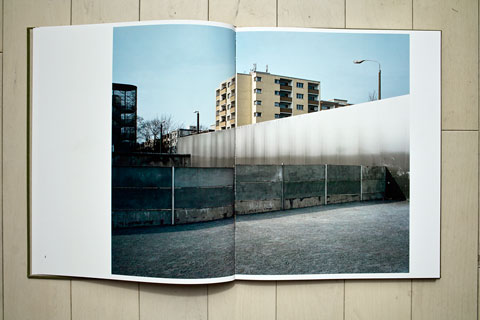
    I picked up Mitch Epstein’s Berlin recently. Published by Steidl, it is the product of a six month residency at the American Academy in Berlin. Epstein writes in the introduction about  his Jewish family’s refusal to visit Germany, and how he first went there  at the age of 49 to work with Steidl and to mount several exhibitions. Surprisingly, Germans had become some of his staunchest allies. He describes Berlin as ” more complicated and poignant” than any city he had known save Hanoi.


    Berlin Wall Memorial on Bernauerstrasse – © Mitch Epstein

    As you can imagine, given my decades long commitment to photographing Berlin and its Wall–the real concrete one that came down in 1989, and the ongoing Wall of the imagination and historical presence–I was interested in what Epstein would bring to the subject. I have never met Mitch, though we both went to Cooper Union in the 1970s–he a couple of years before me. And I have always had the highest regard for his work, especially his recent book American Power, an extraordinary journey across the United States focused on the use and abuse of energy.


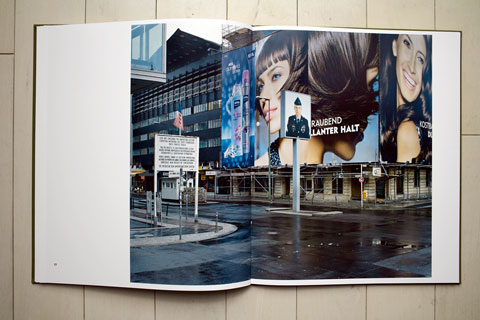
    Checkpoint Charlie – © Mitch Epstein

    I love Epstein’s photograph of Checkpoint Charlie, one of the most historically charged places in Berlin , the former Allied border crossing and scene of Cold War standoffs with the Soviets. It’s a perfect depiction of one of the the things I find fascinating about Berlin–deep and sobering history juxtaposed with crass commercialism and touristy kitsch. Berlin, the book, is a compilation of historical sites, many famous or infamous, others only known to those who have done the kind of research Epstein did.


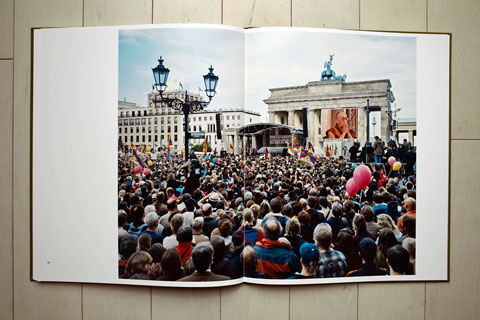
    The Dalai Lama at the Brandenburg Gate – © Mitch Epstein

    Only a few of the photographs show the urban vibrancy of Berlin, a missing element, perhaps, but it is absolutely true that one can find oneself utterly alone at times in this vast and dispersed metropolis. There are abundant open spaces–former industrial wastelands and abandoned railroad yards–and the grassy ribbons of land where the Wall  and death strip once ran. Berlin is still a semi-cultivated city, a wild tangle of layered past and present, resistant somehow to the homogenizing power of money, which has sanitized so many other cities, especially in western Germany.


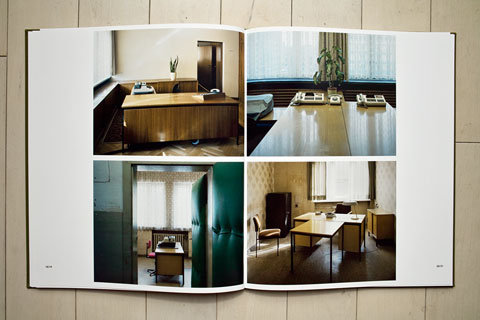
    Stasi offices and interrogation rooms – © Mitch Epstein

    As much as I like the photographs in Berlin, and I applaud its overall intent, I find this an oddly incomplete book–and not just because it offers only 37 images. The historical importance of each site photographed is clearly noted and visually explicated, but sometimes I sense that Epstein could not quite find a way to express the complex nature of the Berlin he alludes to in his introduction. Epstein does provide occasional glimpses of the new Berlin, a city in the midst of civic and cultural reinvention, however obliquely. But the limited  scope of the pictures gives the book the feel of an exhibition catalogue.


    Lichtenberg – © Mitch Epstein

    Epstein stumbled upon the scene above. There is no specific historic site here. But we are in the heart of the city in a large open plain with communist era housing blocks in the distance. Circus elephants caper about the field as if they have been transplanted from the African Savannah. Berlin, the city, is full of these moments of lyrical strangeness–I wish there was a little more of it in Berlin, the book.

    Nevertheless, there are few photographers of Mitch Epstein’s creative  intelligence and visual acuity, and those attributes are amply evident throughout Berlin.