Category: Photographers/Photography

  • New York/Black and White 1977


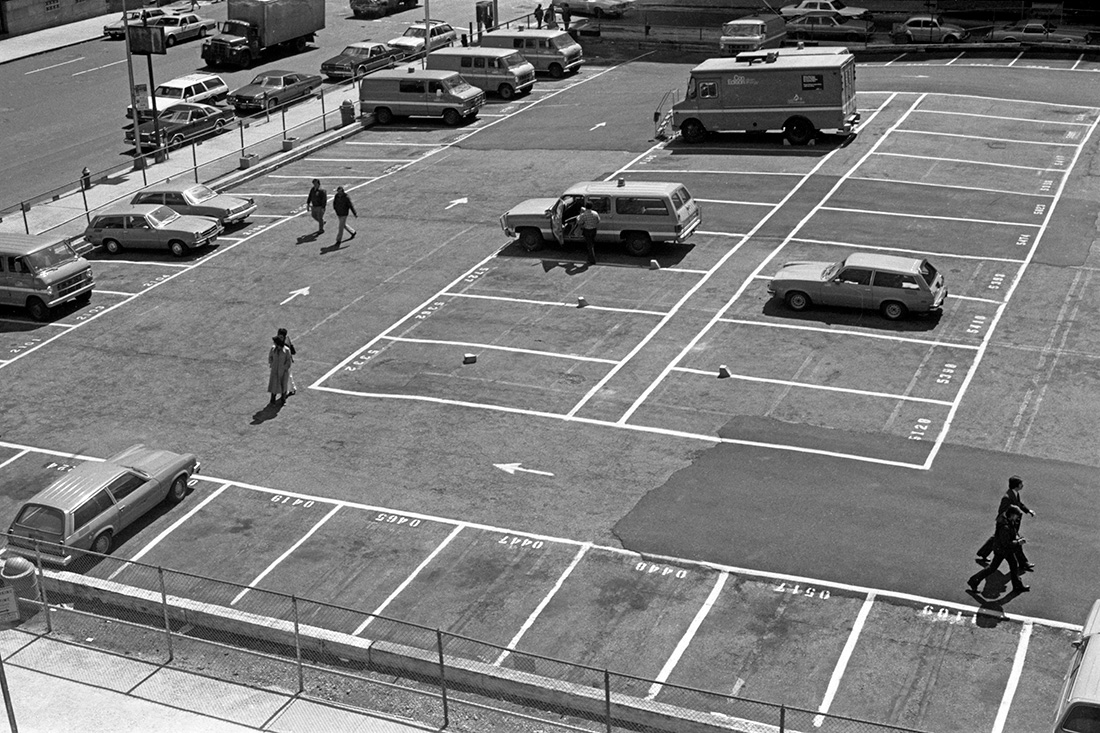
    New York, unknown location, 1977 — © Brian Rose

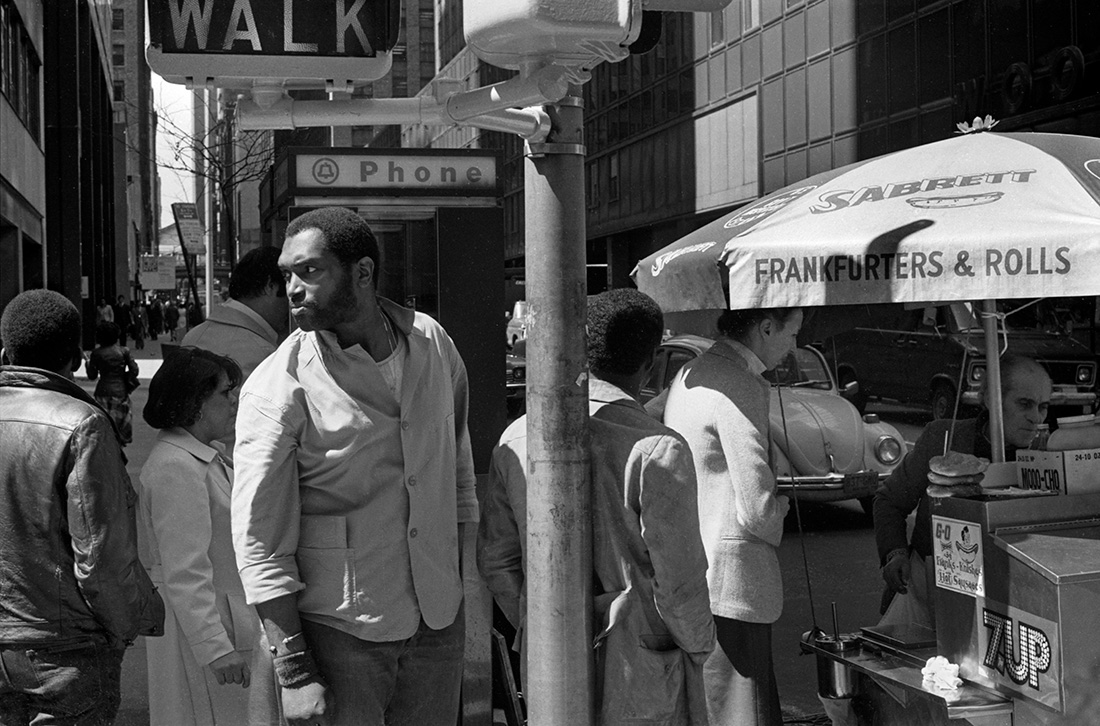
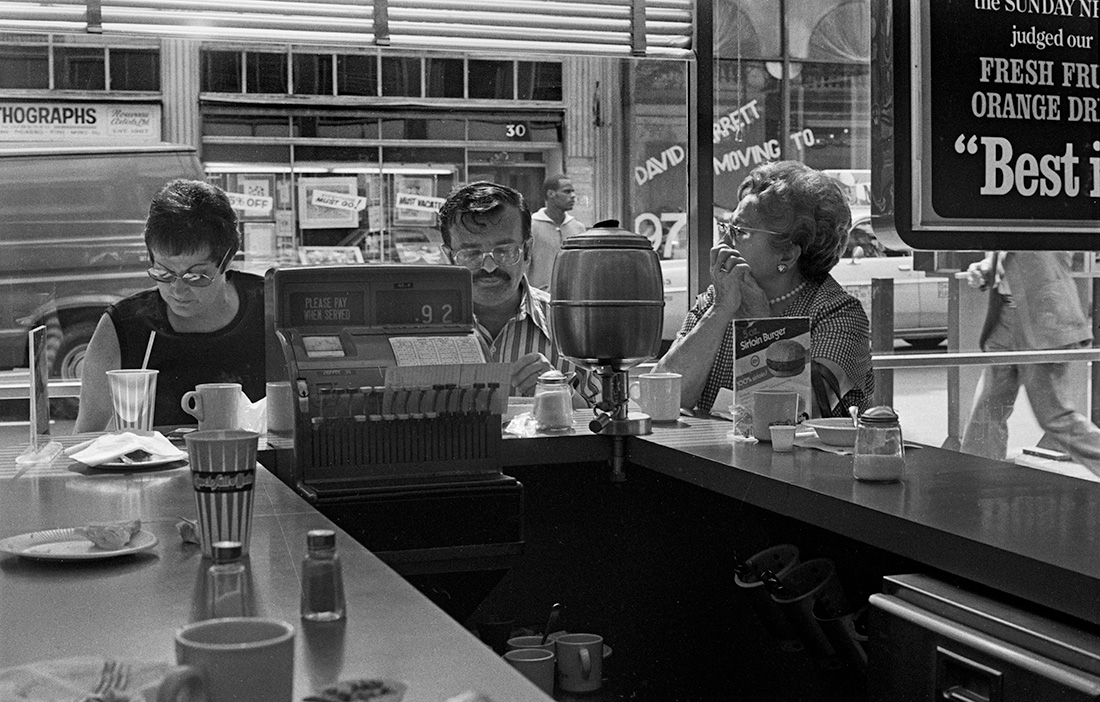
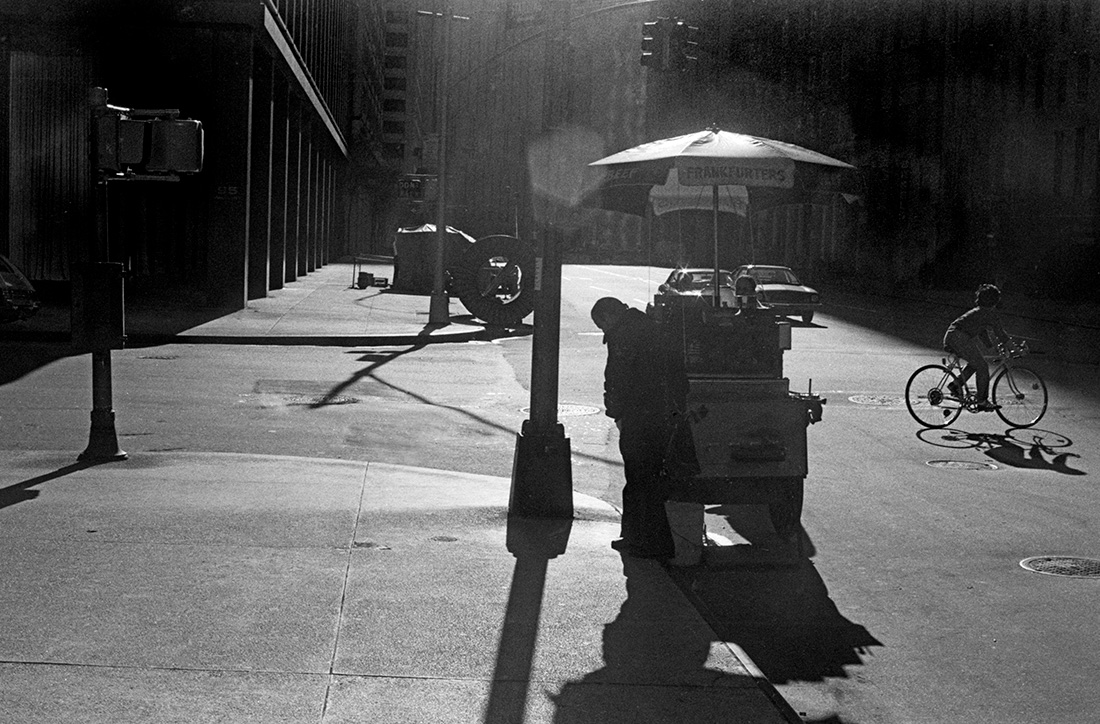
    Although my early black and whites are without question documents of time and place, I did not, as a student, consider myself a documentary photographer. There was never any question about the goal, which was to make photographs as art. Not some hybrid mixed media animal — though I did make a painting in school where I stuck a photograph onto the canvas — but photographs pure and simple — crystallized reality, but not reality at the same time. To me, there was power in that. I still think there is power in that.


    East 41st Street, 1977 — © Brian Rose

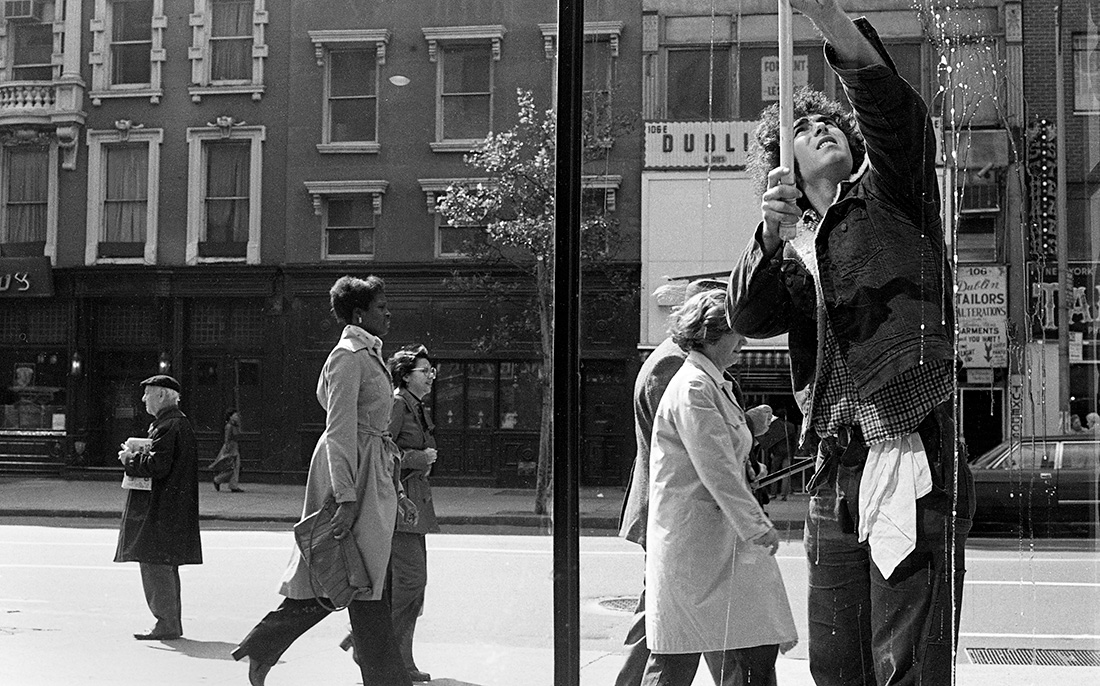
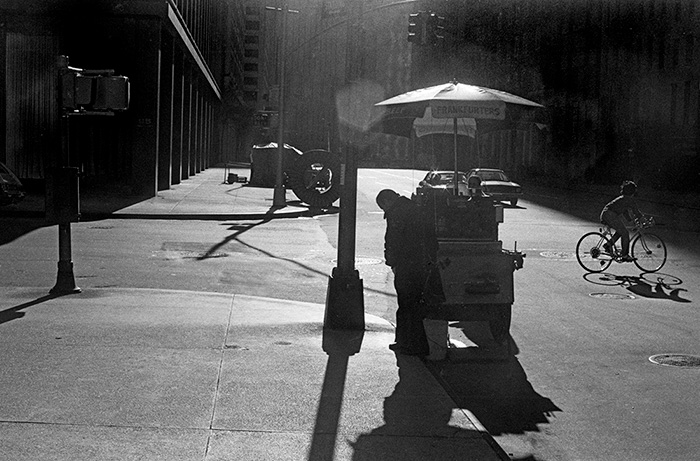
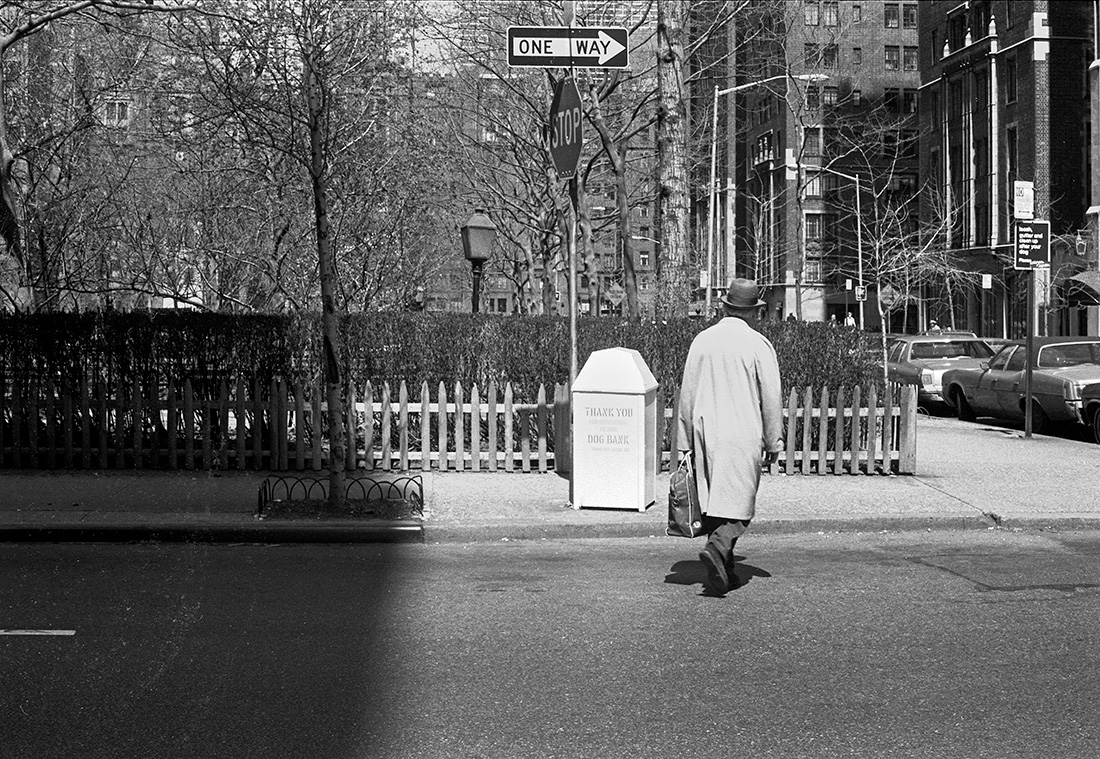
    One of the basic, and profound, truths of photography is that the moment preserved, is fleeting. It seems “decisive,” to quote Cartier Bresson, but it remains fugitive, unknowable, When I look at the man above crossing the street in the fedora (they were not so common even in 1977) I cannot know what he is thinking, or where her is going, or just came from. But he strides, nevertheless, through the frame as if there is meaning. It is an awkward meaning in a slightly awkward composition, but somehow compelling, cinematic. To me. Maybe not for you. I’m keeping this one in the mix for now.


    Tudor City Place, 1977 — © Brian Rose

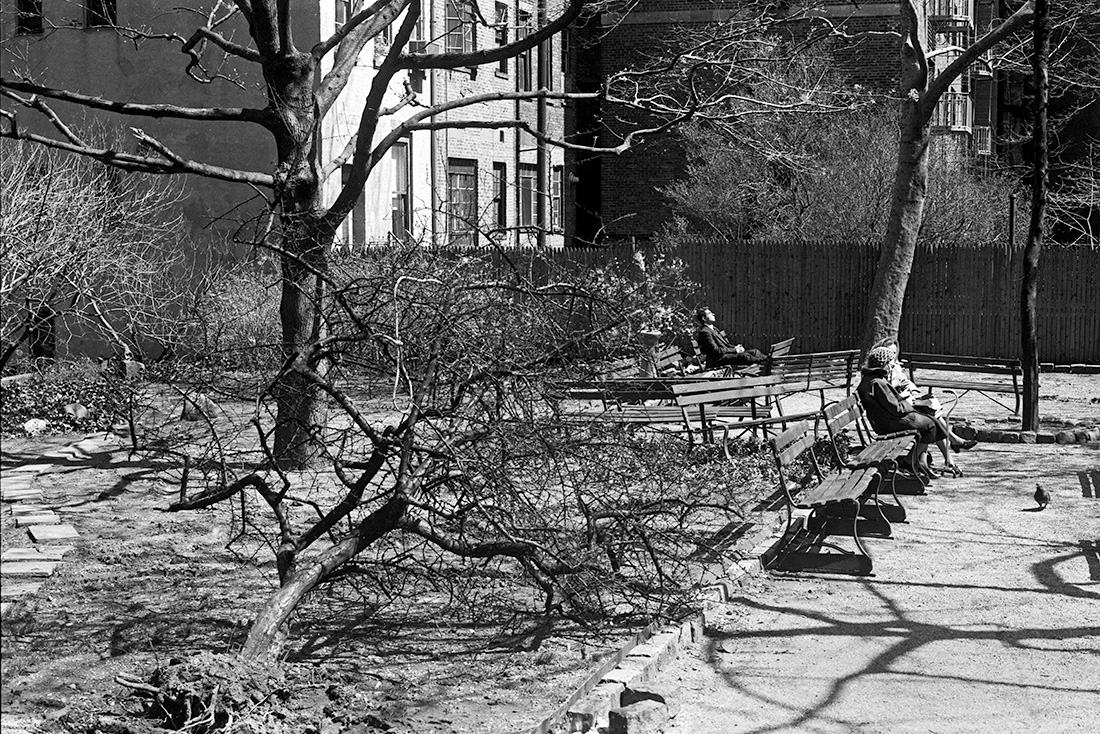
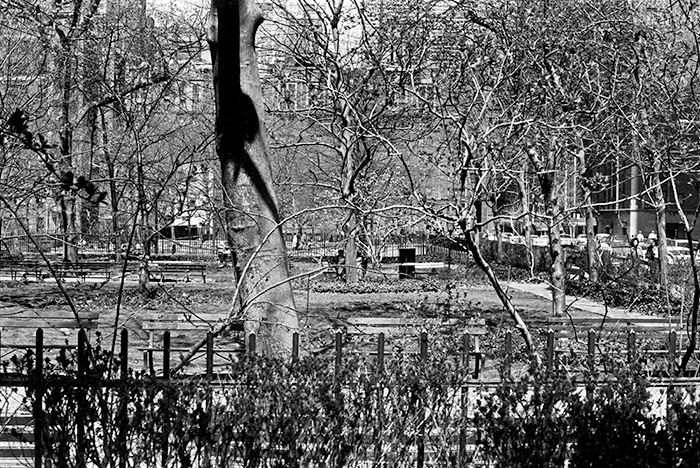
    New York was a mess in 1977, and you can see it in many of these pictures — in the scraggly vegetation in the parks, the trash on the streets and sidewalks, the frayed edges of the landscape. But the photograph above was not a critique on the condition of the city. I was aware, of course, that a small tree lay uprooted in the left foreground of my picture. It’s a notation, not central to the motive for the photograph. There are two verticals — the trees — and a tangle of limbs, benches, and shadows in between. There is a perfect sunlit square hovering left of center. Several people bask in the winter light, talking, dozing.


    East 41st Street, 1977 — © Brian Rose


    East 68th Street, 1977 — © Brian Rose


    Tudor City Place, 1977 — © Brian Rose

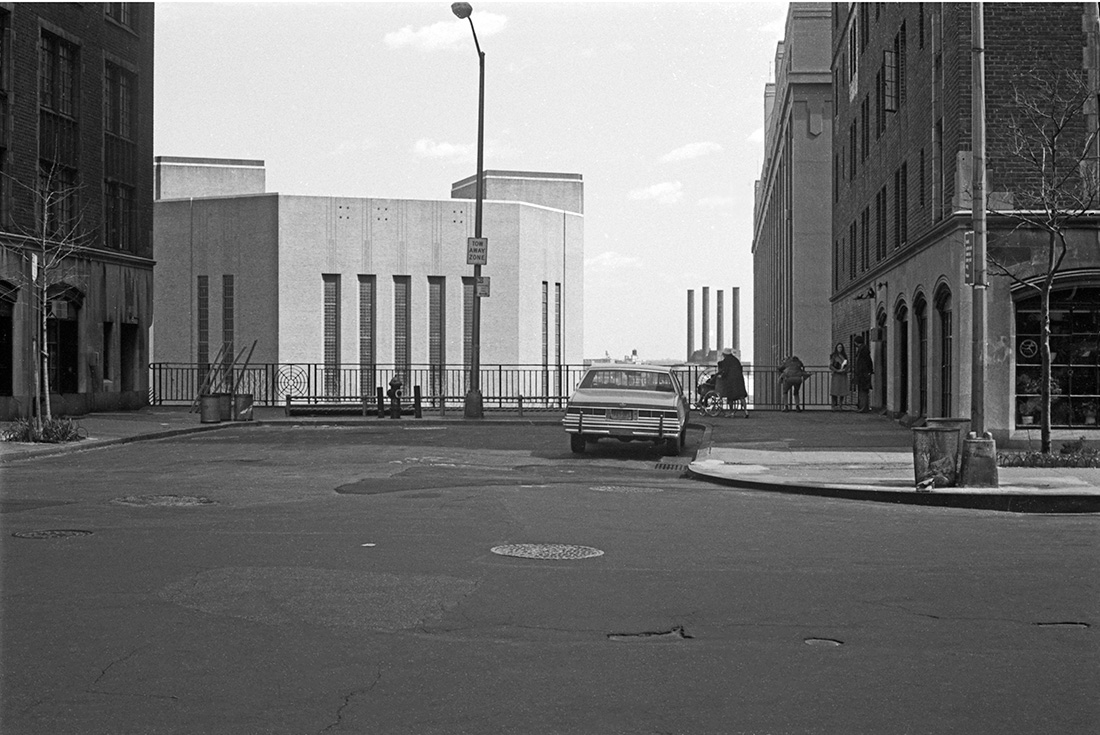
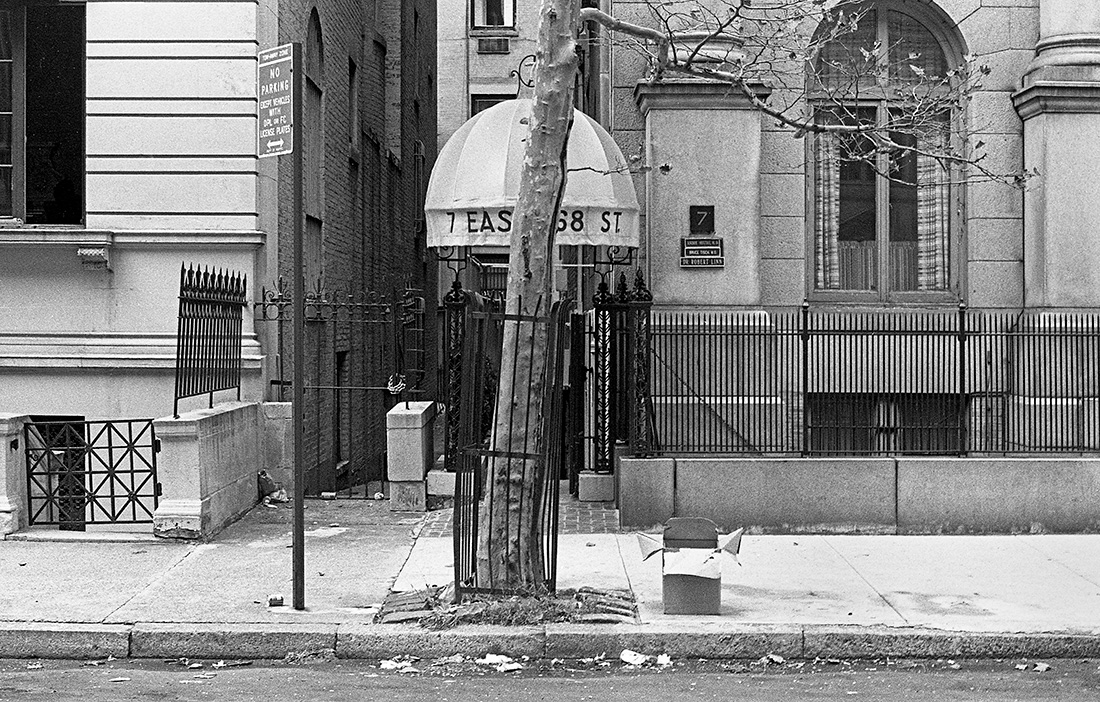
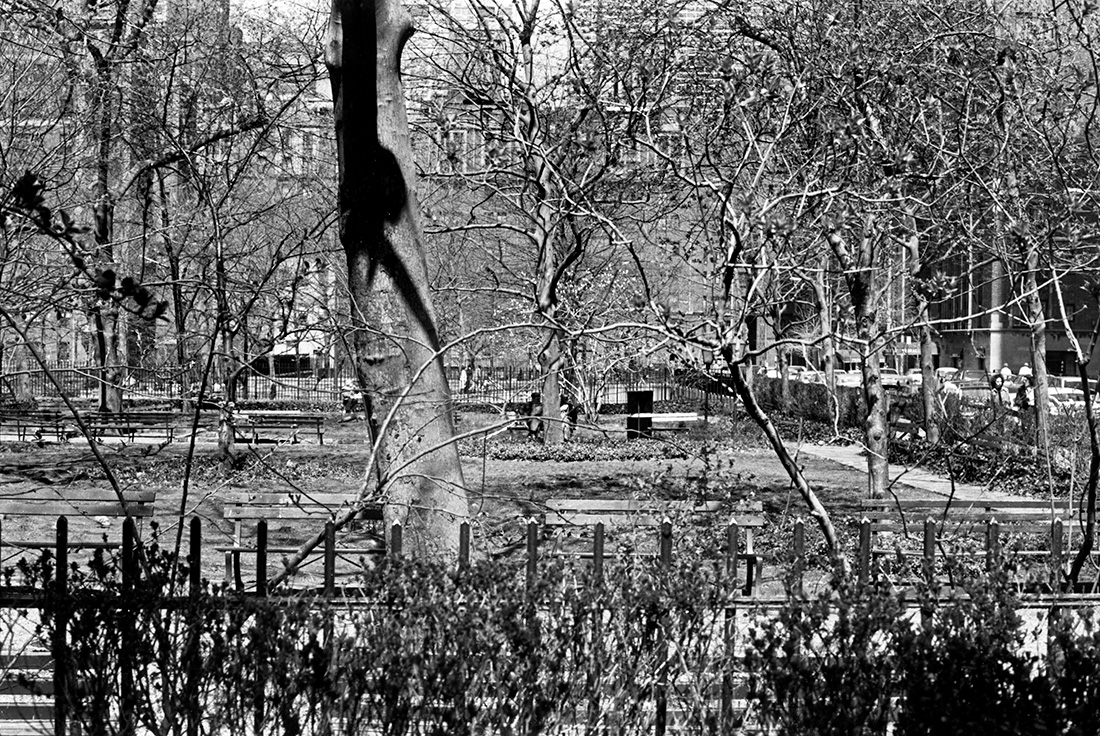
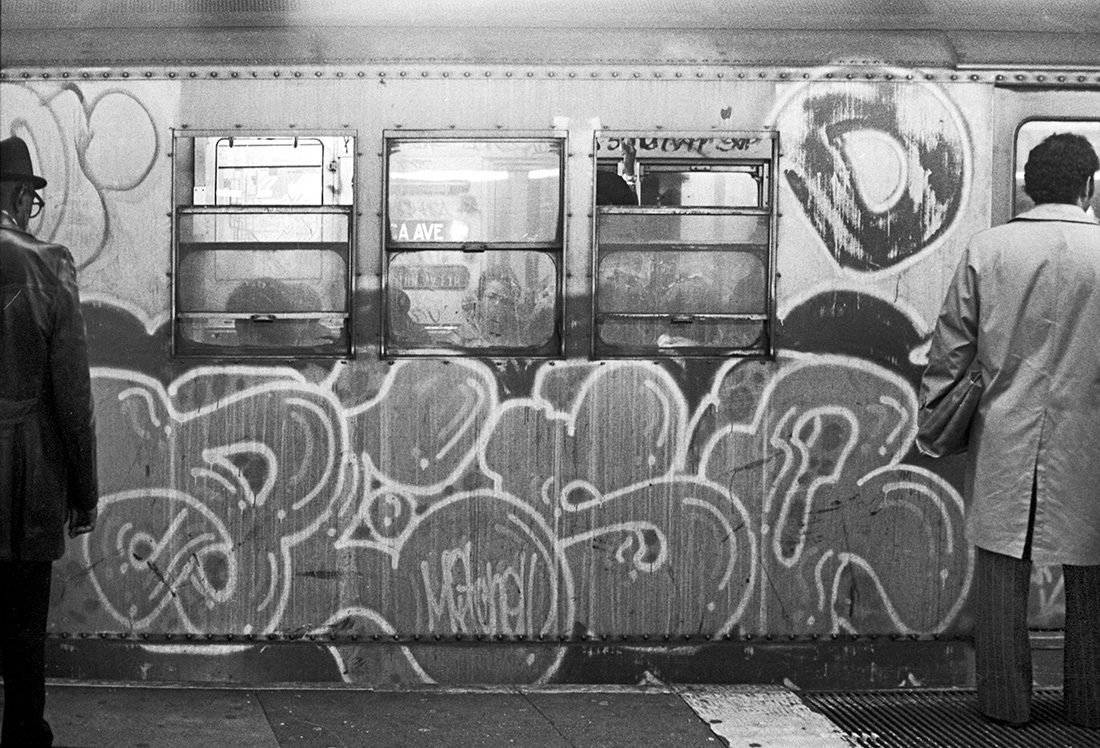
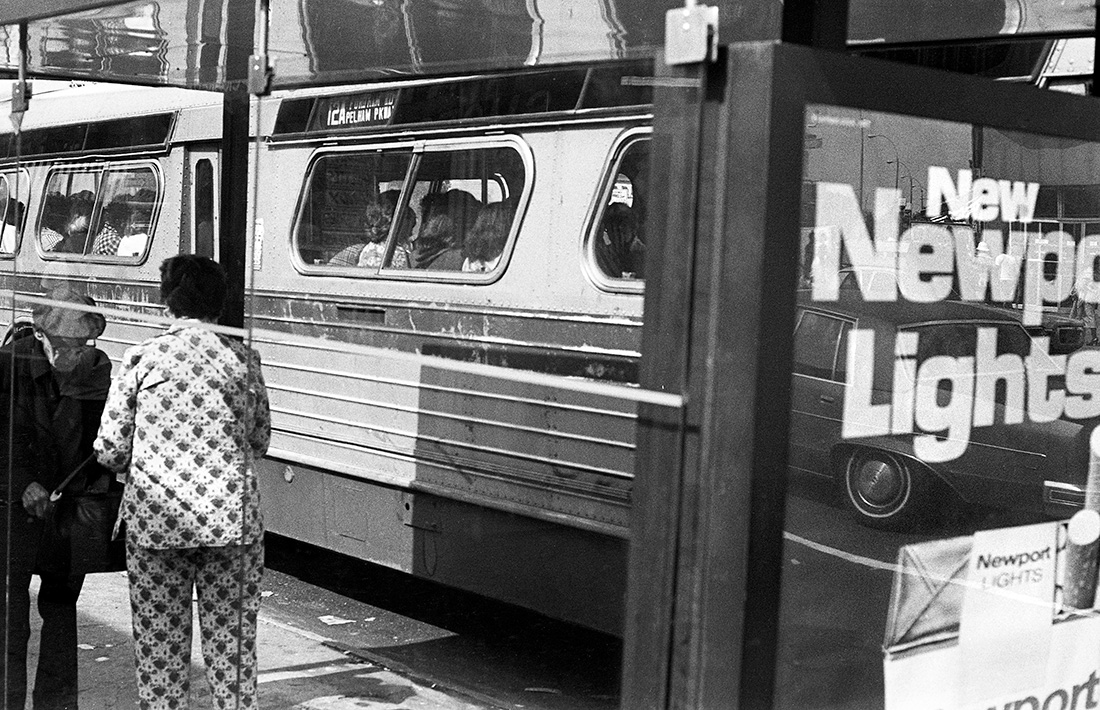
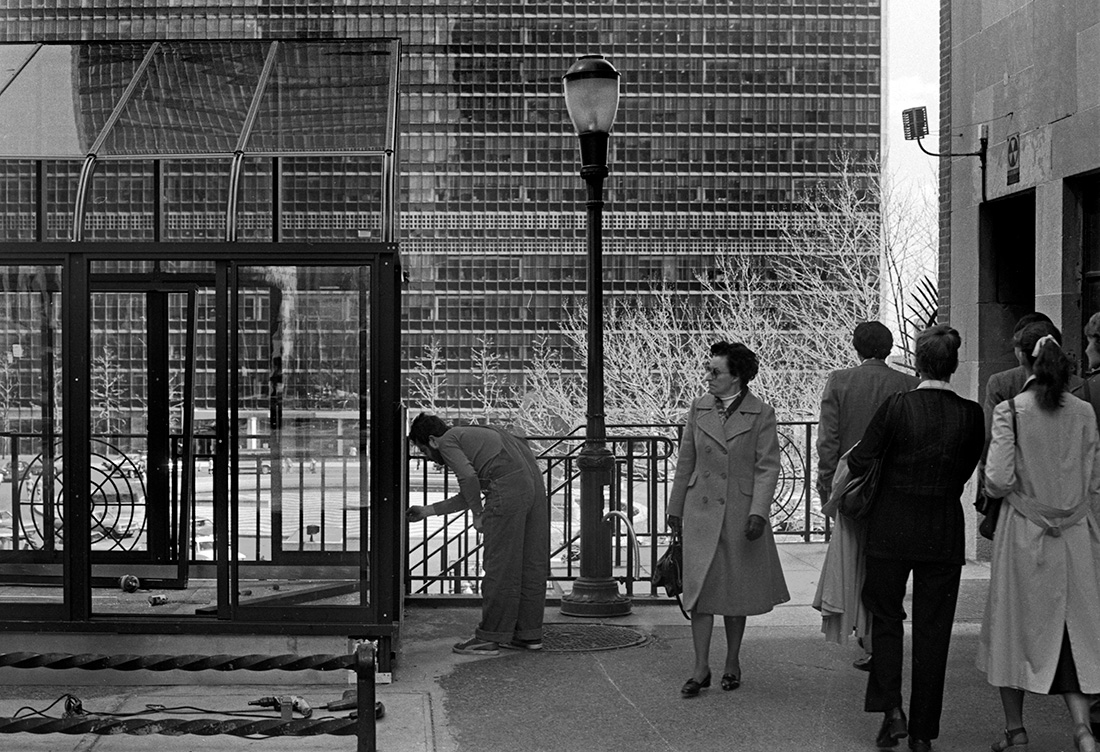
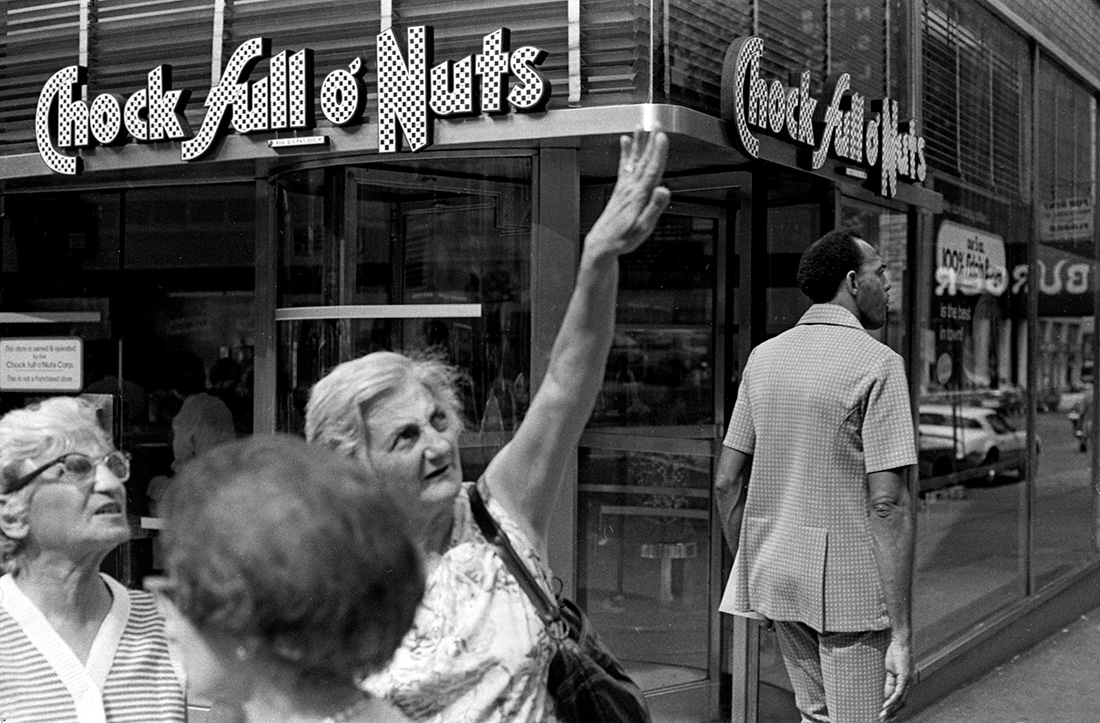
    I wanted the camera frame to take in everything evenly — non hierarchical. This was learned from Friedlander especially, and my teacher at Cooper, Meyerowitz. Composition was not just side to side, but front to back as well. Each shot was an experiment in seeing and describing the fabric of things not necessarily the things themselves.


    East 40th Street, 1977 — © Brian Rose

    I look at many of the pictures I made in 1977 and wonder what the hell I was thinking. Pointing the camera at what seems like nothing. Baffling to me now.

    But then — there’s the image above…


  • New York/Fordham Road 1977


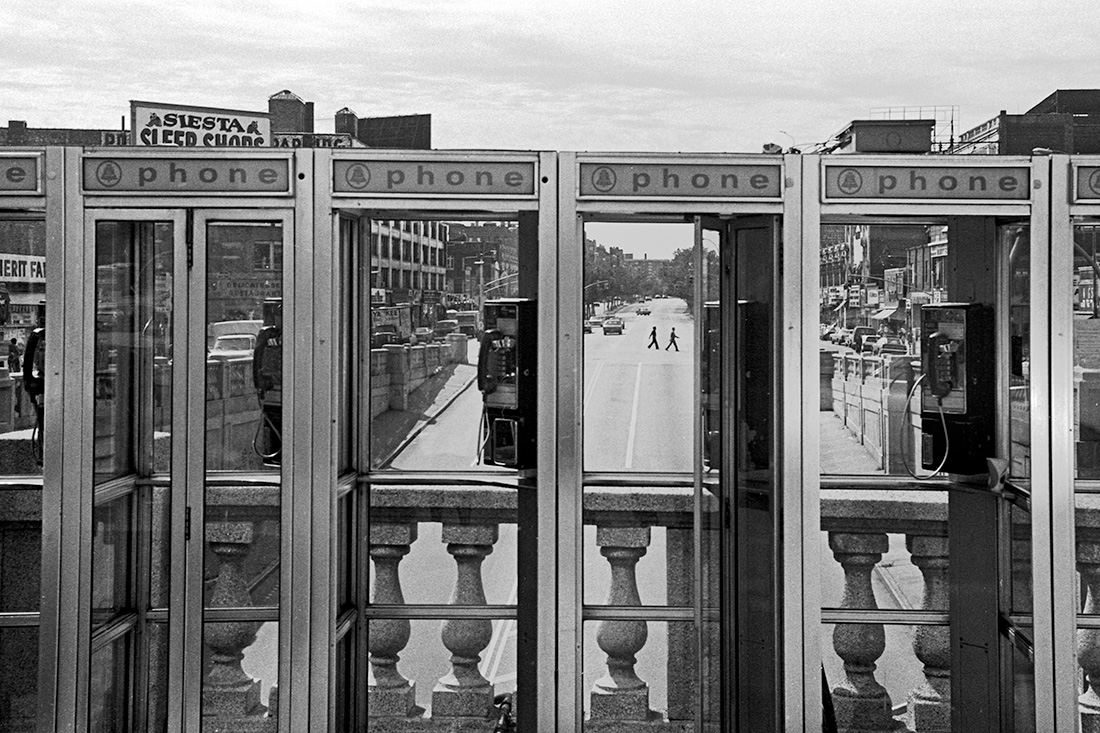
    Fordham Road and the Grand Concourse, The Bronx, 1977 — © Brian Rose

    As I was scanning my 35mm black and white negatives from 1977 I came across a series of images that I could not locate in the city, at least at first. I remember roaming the five boroughs with my camera, sometimes taking the subway to the end of the line, with no particular goal in mind other than satisfying my curiosity.

    Looking at the image above, I was not sure where it was — and I could not remember ever taking it. I knew it was not Manhattan because of the relatively low buildings and the fact that the street was passing underneath my position behind a balustrade and a row of telephone booths. That doesn’t happen often in Manhattan. But having spent a lot of time in the Bronx the past few years going to my son’s basketball and baseball games, I knew it had to somewhere along the Grand Concourse, the broad boulevard that runs through the center of the borough.


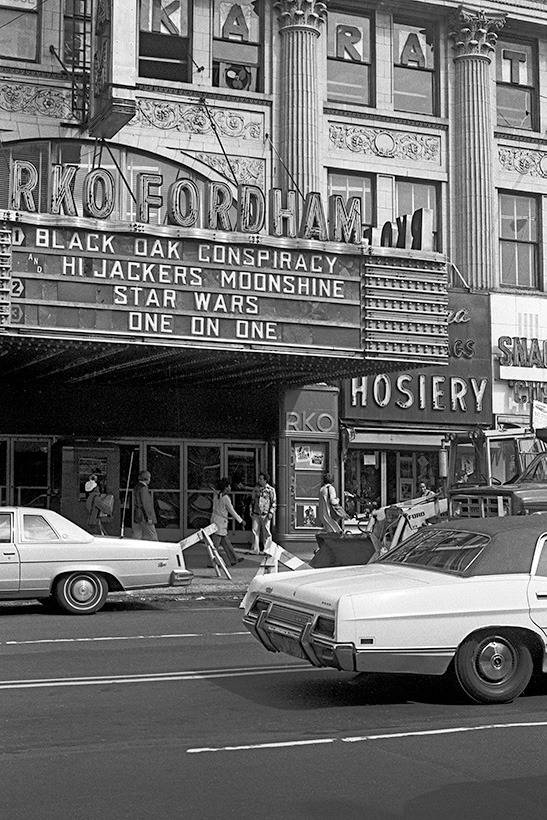
    Fordham Road, The Bronx, 1977 — © Brian Rose

    Bisecting the Concourse is Fordham Road, a busy shopping street that for a half mile or so defines the southern edge of the Fordham University campus. In 1977 it was a visually cacophonous place, and it still is today. The creeping blight, the fires and abandonment, of the South Bronx never made it up to Fordham Road though it threatened.

    The RKO Fordham Theatre was showing Star Wars, the cultural touchstone that premiered in 1977. The theater was demolished years ago and replaced by a nondescript retail building. And back then, there were still stores that specialized in “hosiery.”


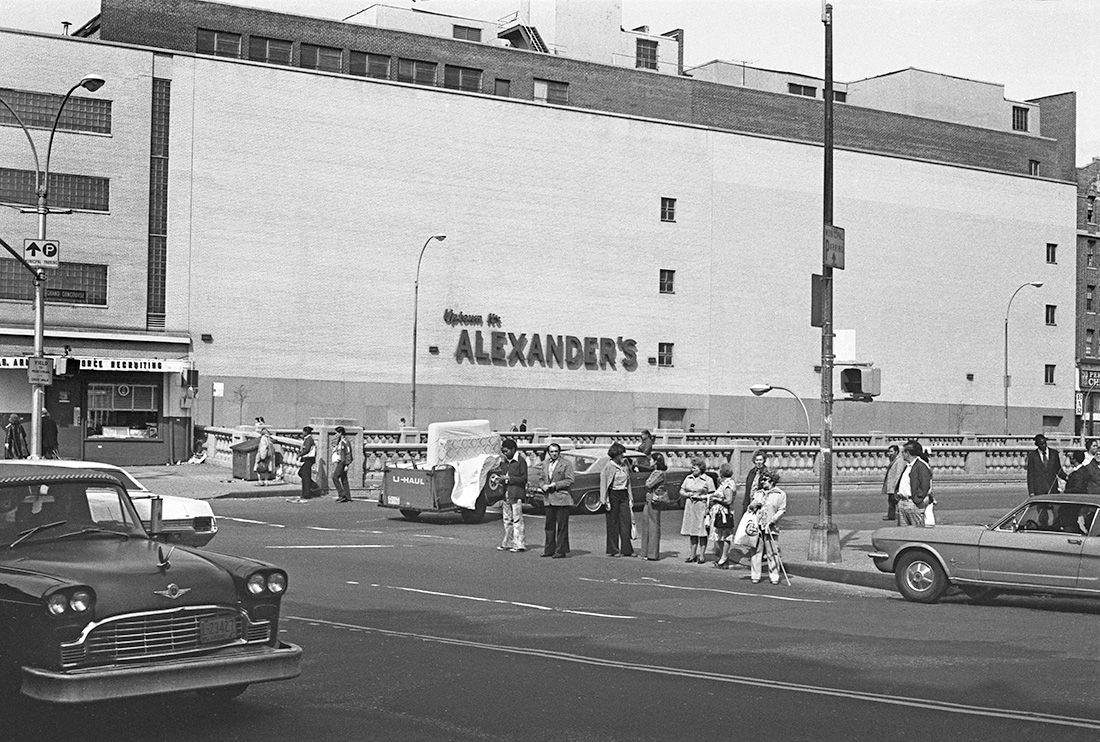
    Fordham Road and the Grand Concourse, The Bronx, 1977 — © Brian Rose

    Alexander’s was a big discount department store that dominated the corner of Fordham Road and the Grand Concourse. The building is still there, but divided up into smaller retail outlets. That’s a Checker Cab to the left and Ford Mustang to the right.


    Fordham Road, 1977 — © Brian Rose

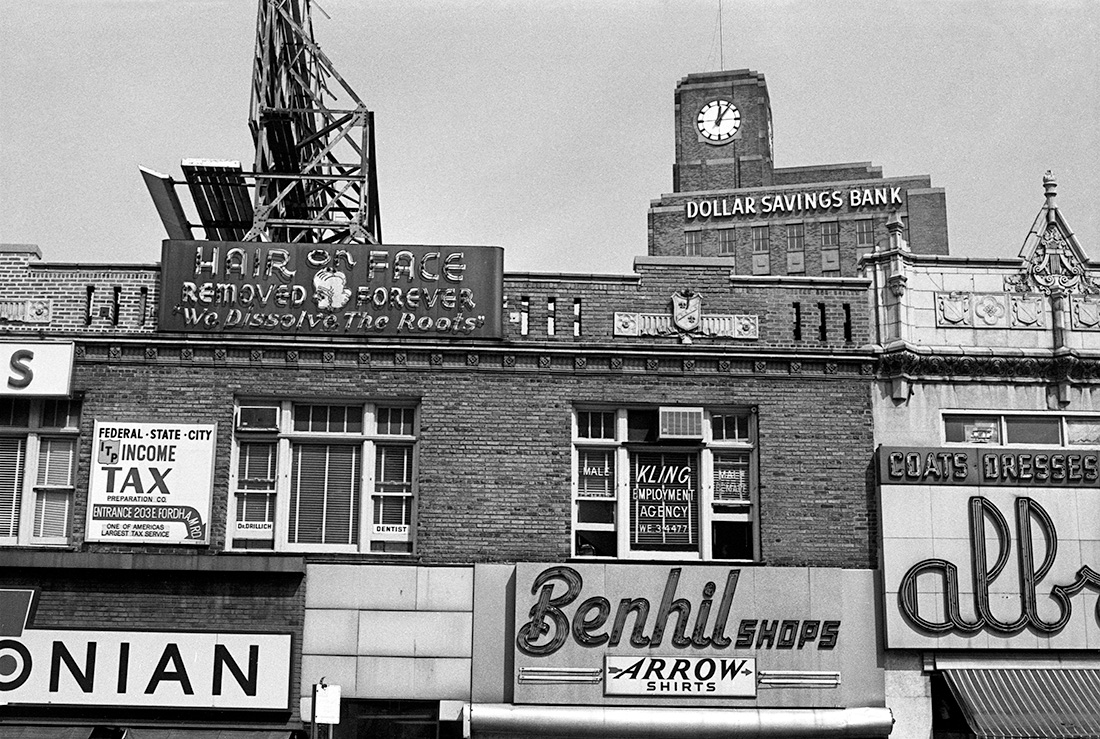
    Hair on Face Removed Forever. We Dissolve the Roots. These buildings are still there, but the Dollar Savings Bank is now an Apple Bank, and the parapet decorations to the right have either been stripped off or are obscured by new cladding.


    Fordham Road/Grand Concourse area, The Bronx, 1977 — © Brian Rose


    The Grand Concourse, The Bronx, 1977 — © Brian Rose

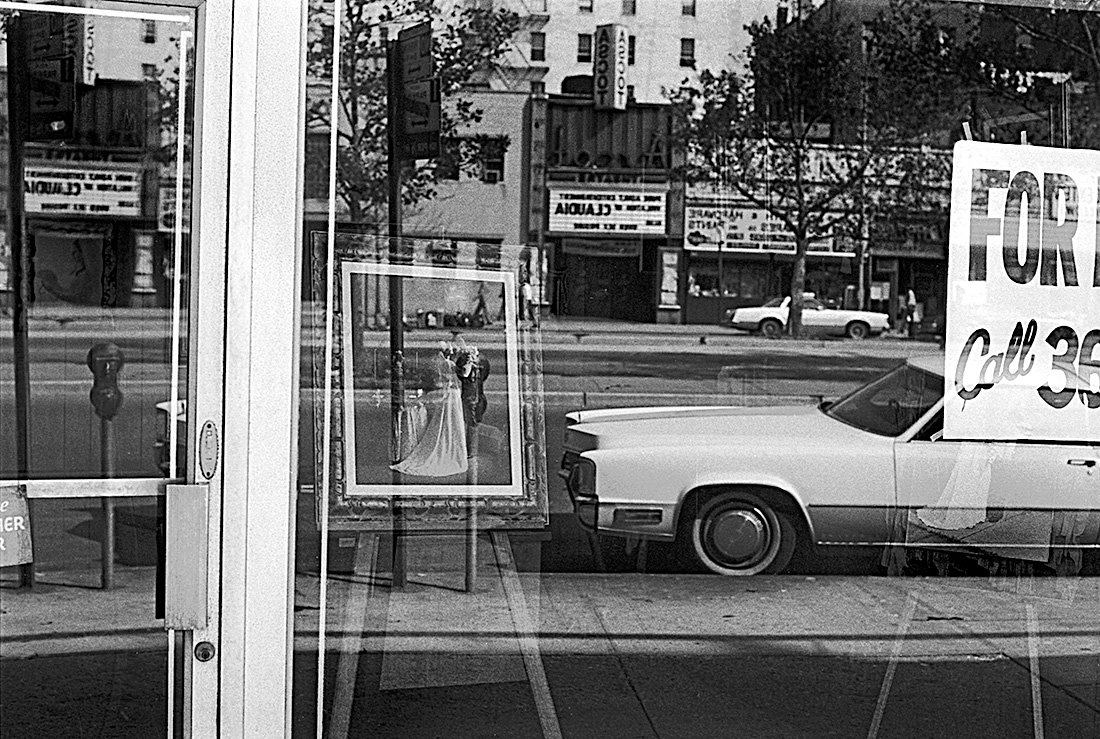
    I was able to locate this photograph by reversing it in Photoshop and identifying the Ascot Theater across the street. It was demolished in 2016.


    The Grand Concourse, The Bronx, 1977 — © Brian Rose

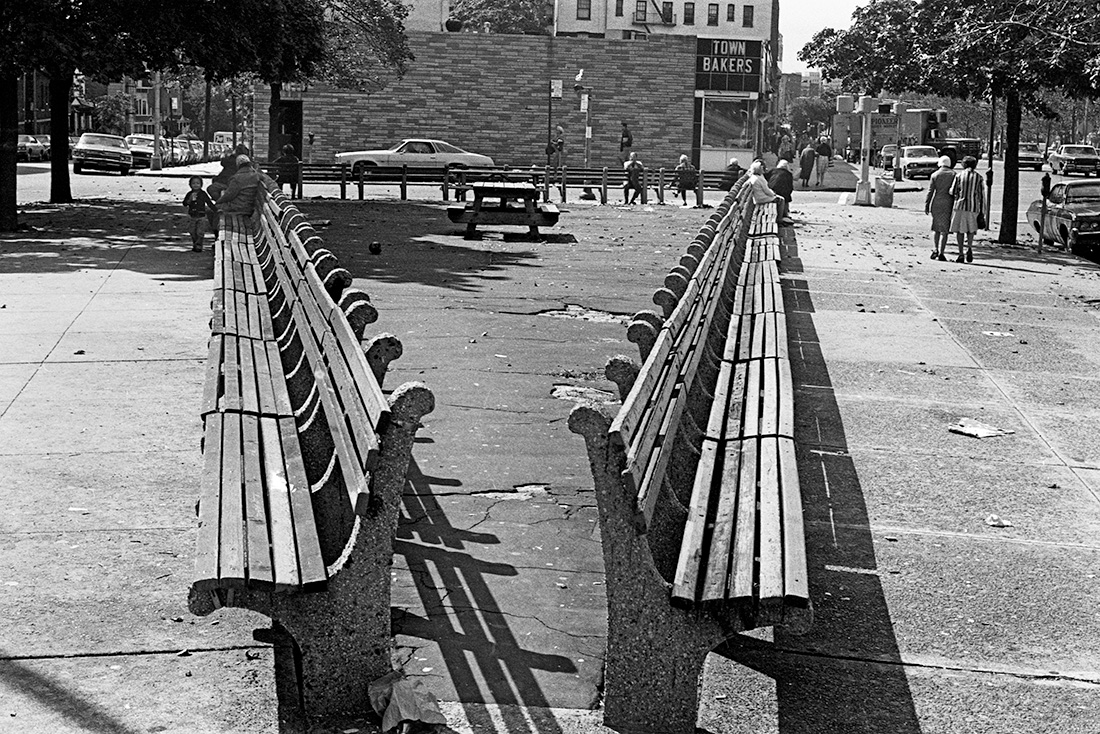
    This one was hard to find, but I eventually located a small triangular park on Google street view at 181 Street and the Grand Concourse. It’s still scruffy looking, but there are now a half dozen trees behind the benches.

  • New York/1977


    Madison Avenue and 41st Street, 1977 — © Brian Rose

    A story I’ve told many times — 40 years ago, today, i arrived in New York and found an apartment on East 4th Street between the Bowery and Second Avenue. At 9:34PM the lights went out, and I spent the night in Penn Station unable to get my train back down to Washington, D.C. where I  was living at the time. It was eerie in the station, but there were cops around, and I was unaware of the riots and fires raging elsewhere. A few days later I was back to this scarred and battered city with my stuff, mostly clothes, a guitar, and photography materials.

    I set up a darkroom in the bedroom of my tiny apartment, and that summer began roaming the street with a 35mm Nikkormat, mostly shooting Tri-X film.I didn’t print much of it, however, because I had already begun working in color, and I soon left black and white photography behind for good. This is the second installment of scans made from that work — most of it from 1977 and 1978. As I said in an earlier blog post, I do not remember taking any of these pictures. It’s like discovering an unknown self intently searching for a style, for a formal approach, for a subject, which to a great extent turned out to be New York City.


    Lexington Avenue Line, 1977 — © Brian Rose


    Unknown location, 1977 — ©˙Brian Rose


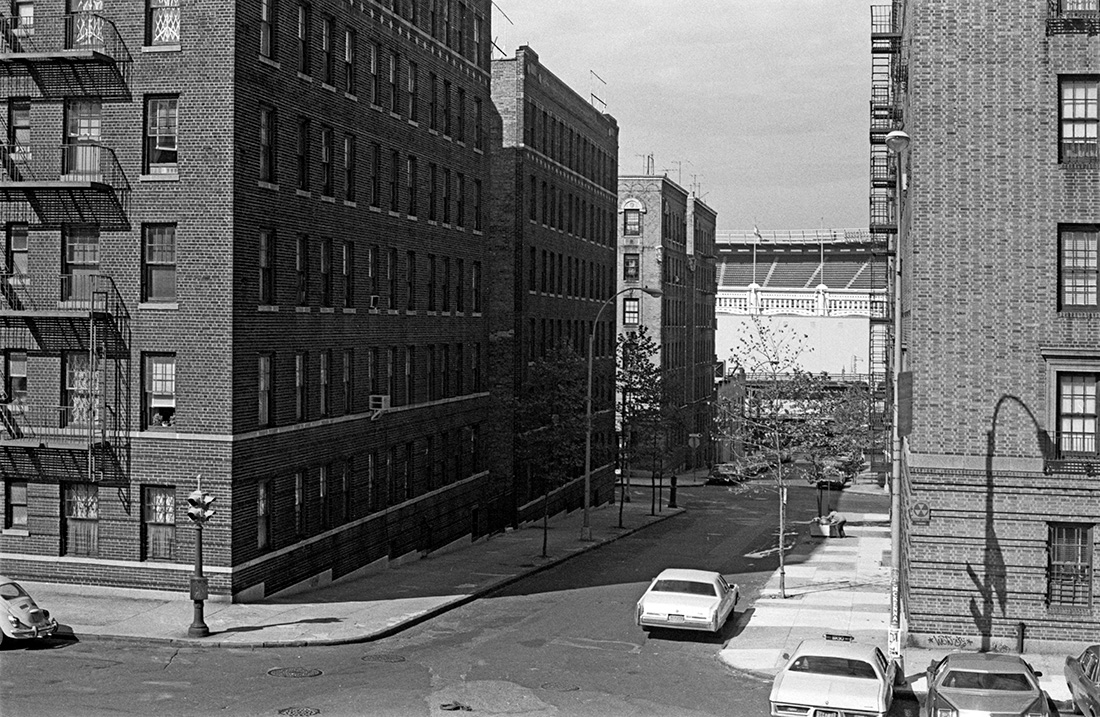
    East 43rd Street across from the United Nations, 1977 — © Brian Rose


    158th Street, The Bronx, Yankee Stadium, 1977 — © Brian Rose

    1977 — it was the summer of Son of Sam the serial killer, the Bronx was burning, and the Yankees won the World Series. It was my entree to a city that would become central to my life and career. In that first year or two I attended Cooper Union, wrote songs and hung out in clubs with my friends, met my musical comrades in arms, Jack Hardy and Suzanne Vega, and took a lot of photographs. In 1980 I teamed up with Ed Fausty to photograph the Lower East Side in color using a 4×5 view camera. It was an exciting time — though wistful nostalgia is tempered by the fact — which I have not forgotten — that it was also a difficult time, financially and emotionally.

    Stay tuned for more pictures.

  • New York/Long Beach


    L
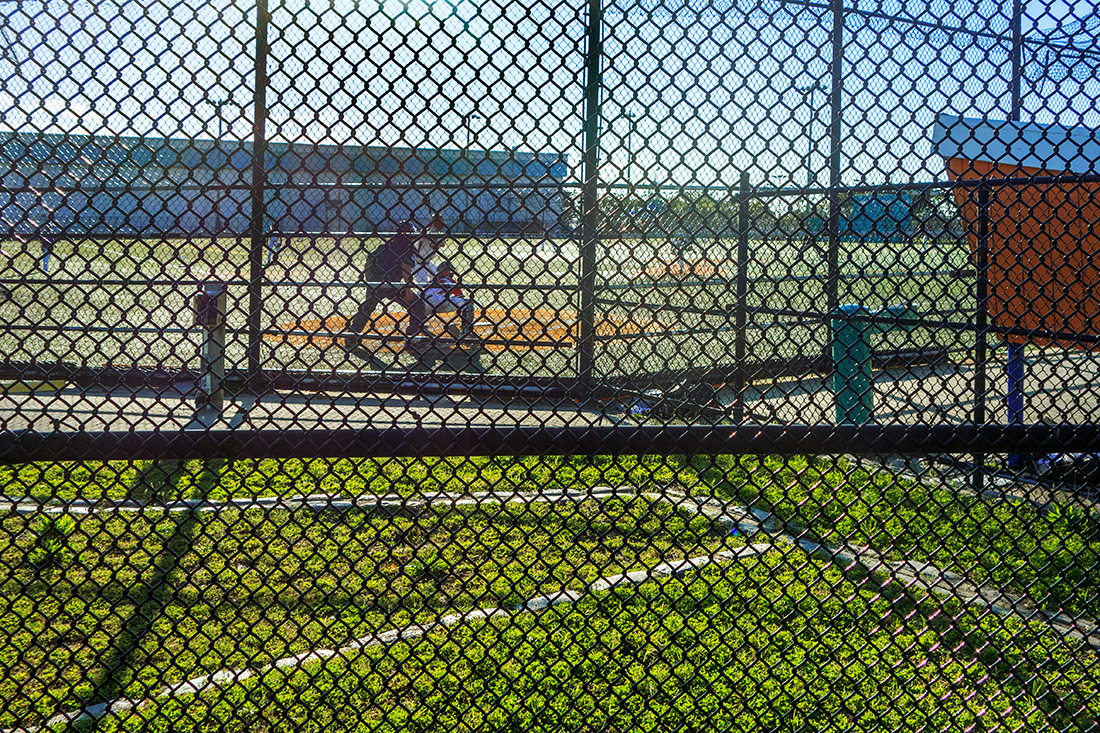
    ong Beach, New York — © Brian Rose

    Behind the backstop.

  • New York/Adrian Jovanovic


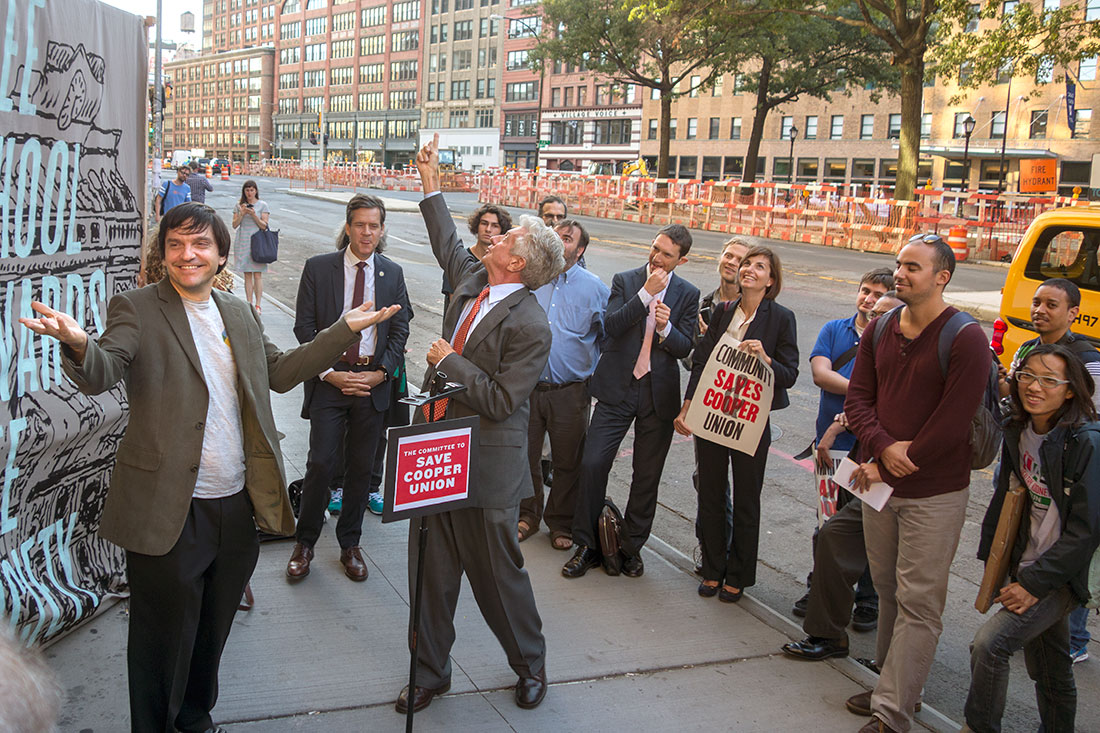
    Adrian Jovanovic and NYS Senator Brad Hoylman — © Brian Rose

    Adrian Jovanovic was a hero to me. He is, tragically, gone — and the Cooper community is reeling from the loss.

    From the Committee to Save Cooper Union’s statement:

    But it was Adrian’s creation of CSCU that channeled that broad community passion into a cogent legal argument and lawsuit that would succeed in validating the core intent of Cooper Union’s Trust, driving out managers and trustees who would not (or believed we should not) continue the fight for a free Cooper, and instituting critical board reforms and oversight. Without Adrian’s leadership, unstoppable optimism, and conviction, none of that would have been achieved.

    During the heat of the battle to save Cooper Union, I frequently posted on Facebook, despairing that important information was not getting out because of ongoing litigation, gag orders, and even self-censorship. Although we were all on the same side, there were disagreements, even rancor within the ranks.

    Several times, Adrian called me at night, patiently telling me what he could from his perspective on the inside as one of the petitioners in the lawsuit against the school. He was always optimistic, confident, and believed fervently that we would prevail. We did prevail — although the ultimate goal of returning to free remains elusive.

    The photograph above was made during one of the high points of the past few years — we had just returned from the courthouse downtown where the Cooper Union and CSCU lawyers informed the judge of their agreement to the consent decree brokered by State Attorney General Schneiderman. It was a shining moment of triumph, and an ecstatic Adrian led the brief victory ceremony in front of 41 Cooper Square.

    That unnamed building, and the onerous mortgage attached to it, has been a symbol of everything that went wrong with Cooper Union. Let’s do what my friend M’Liz Keefe suggests, and forever wipe it clean of the taint of bad history. Let’s make it the Adrian Burton Jovanovic Building.

  • New York/Cooper Square


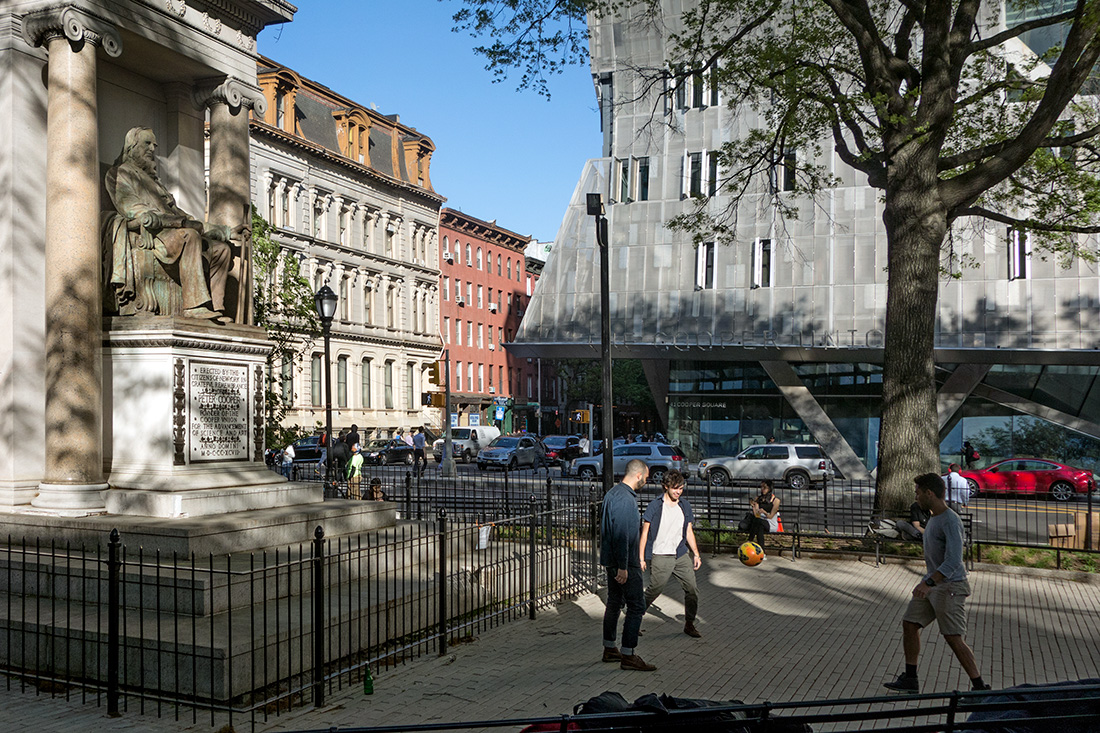
    Cooper Square — © Brian Rose

    Peter Cooper — keeping his eye on the ball.

  • New York/Atlantic City


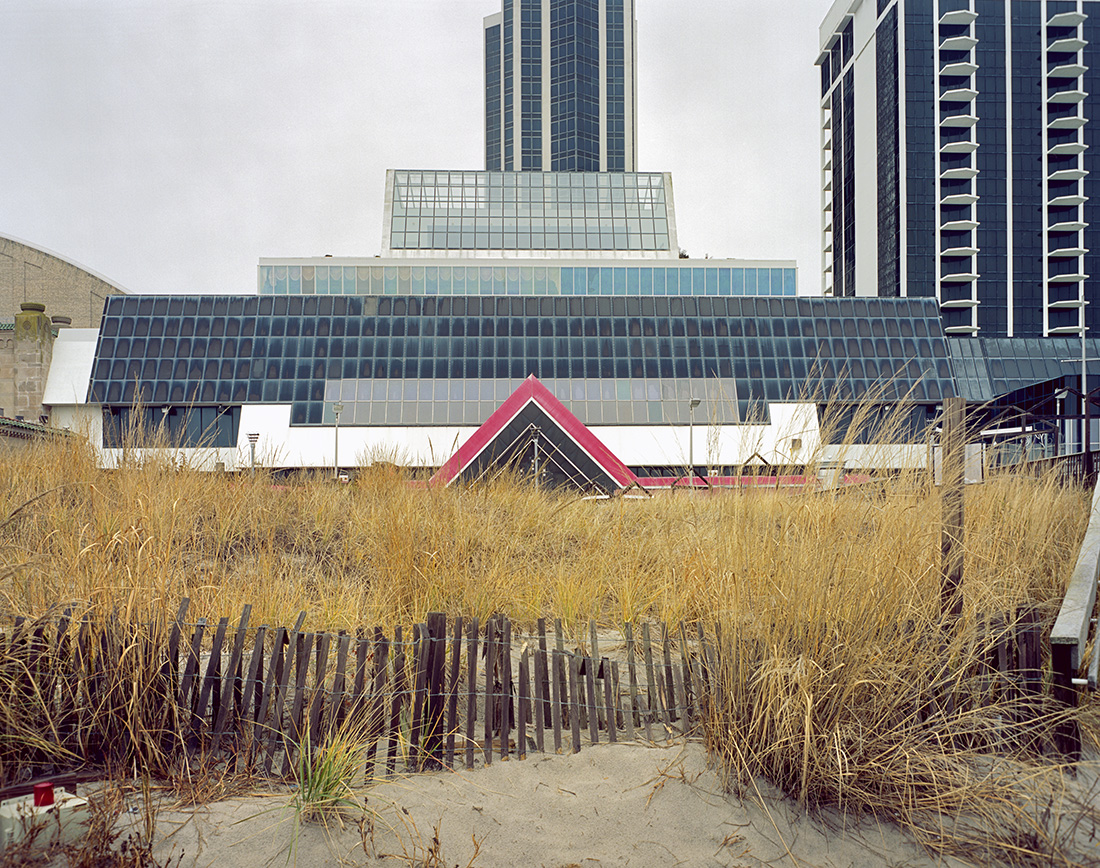
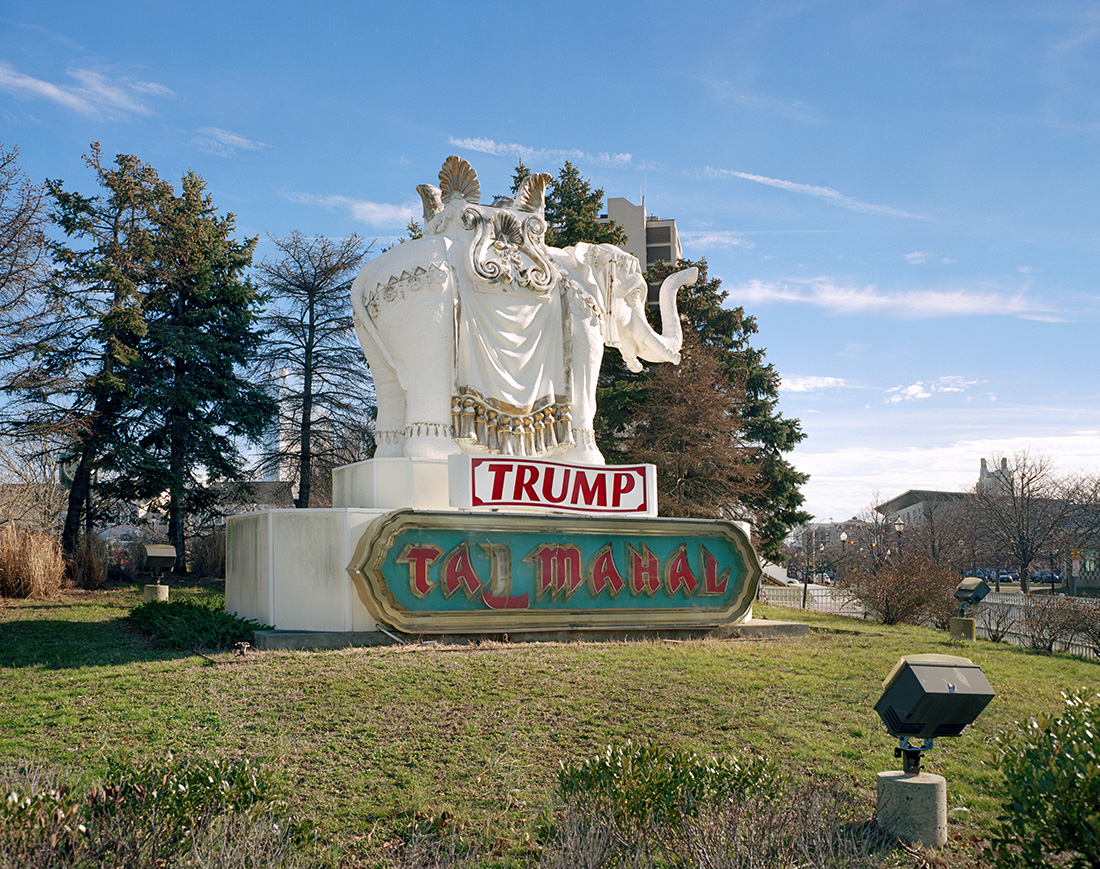
    Trump Plaza (4×5 film) — © Brian Rose

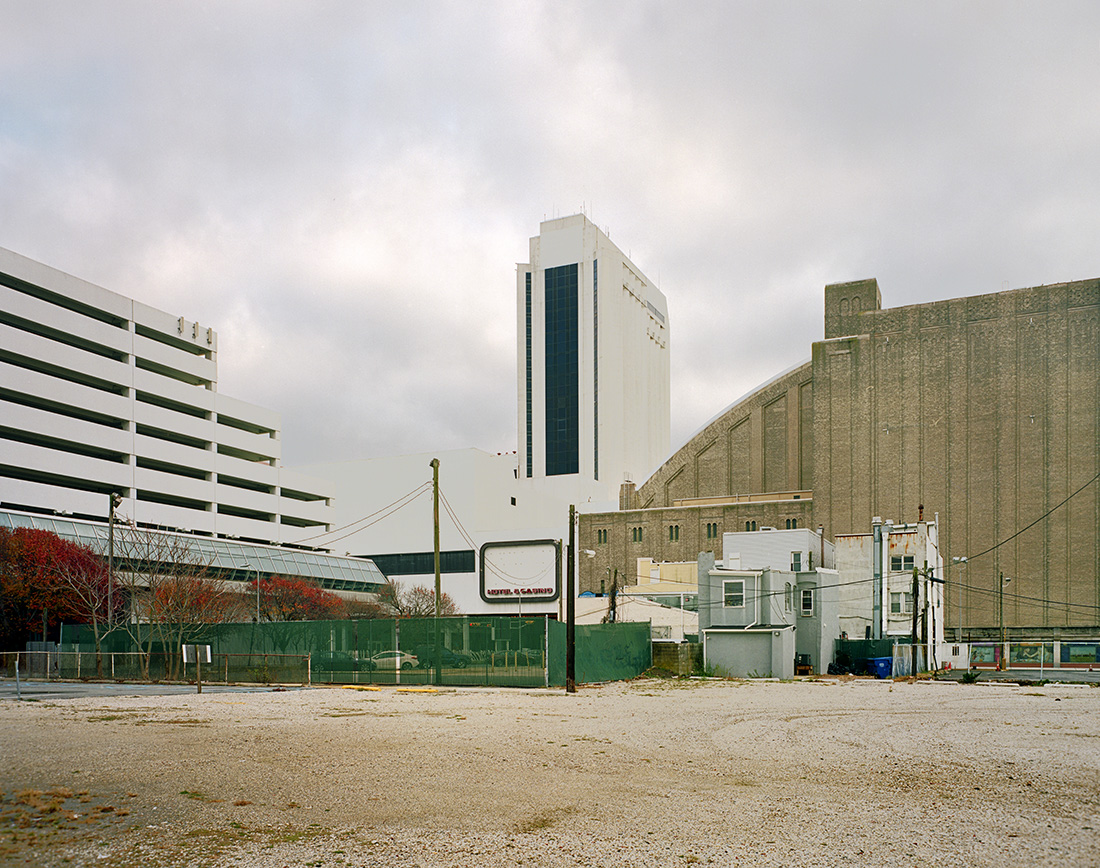
    Most of the pictures of Atlantic City and Trump’s abandoned casinos I’ve posted so far were made with a digital camera. But I am actually shooting 4×5 film with the digital camera primarily for backup and preview purposes. It’s hard to appreciate at 72 pixels per inch, but these are scanned at very high resolution and worked up meticulously in Photoshop. Trump’s buildings have never looked so good — in a manner of speaking.


    Trump Plaza (4×5 film) — © Brian Rose

    It is not merely the materialism of the 1980’s that Donald Trump embodies, it is the impatience, the insistence on having everything right now, all of it, the willingness to settle for appearance over substance. This is why it is hard not to sense, for all Mr. Trump has been identified with New York, that he is more at home in Atlantic City, where surface glitter is really all there is.

    — Paul Goldberger, New York Times

    My Atlantic City mini-website here.

  • New York/Black and White


    East 14th Street, 1977 — © Brian Rose

    Going through some boxes yesterday, I began looking at my early black and white negatives.

    During the 1970s I shot dozens of rolls of film, Kodak Trii-x and Plus-x, along with dozens of rolls of Kodachrome and Ektachrome color slide film. Most of the black and white has never been printed, or even contacted. I didn’t have the time, and I was moving quickly from one thing to the next.

    So, I scanned eight strips of black and white film — a small sample of negatives — and well, I’m kind of stunned. I literally can’t remember taking any of these pictures. It’s like discovering my alter-ego out on the street in New York, a young photographer fully engaged in making images, densely composed fragments of a now distant past.

    Unknown location in New York, 1977 — © Brian Rose


    Unknown location in New York, 1977 — © Brian Rose


    Unknown location in New York, 1977 — © Brian Rose

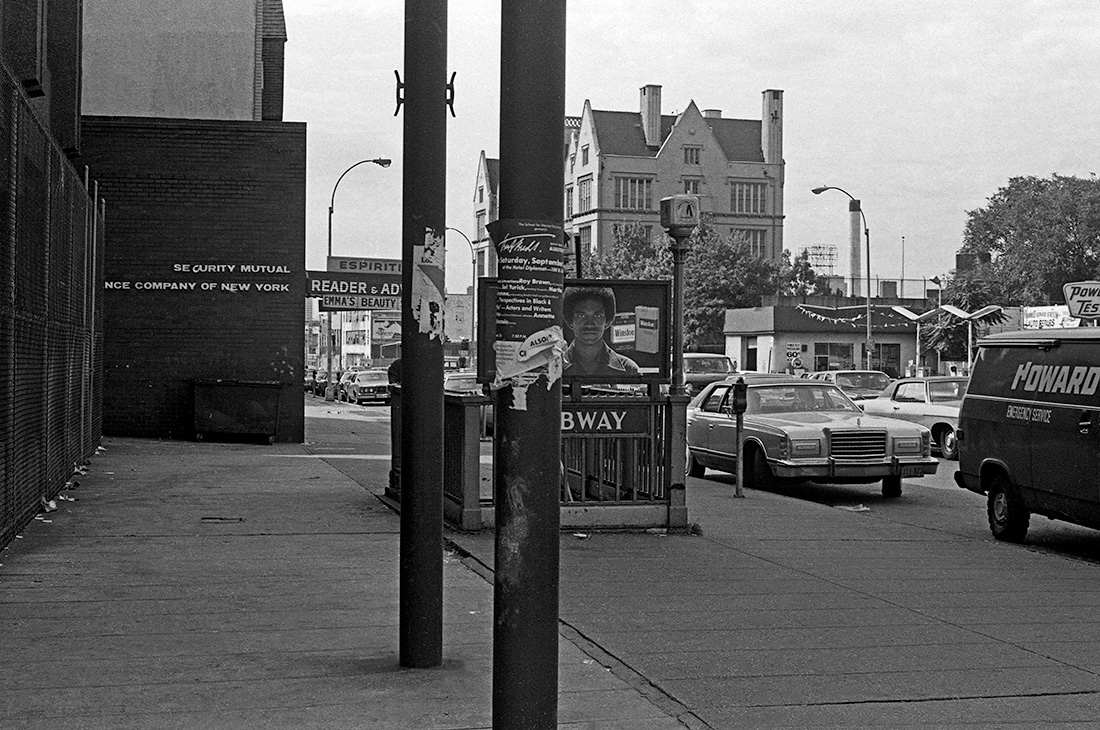
    A photograph of nothing and/or everything. A nondescript location in some far flung part of the city, a precise balance of interlocking elements welded together at the center of the image, a face staring out from a cigarette ad, two cobra style lampposts acting as quotation marks.


    Fifth Avenue and 53rd Street, 1977 — © Brian Rose

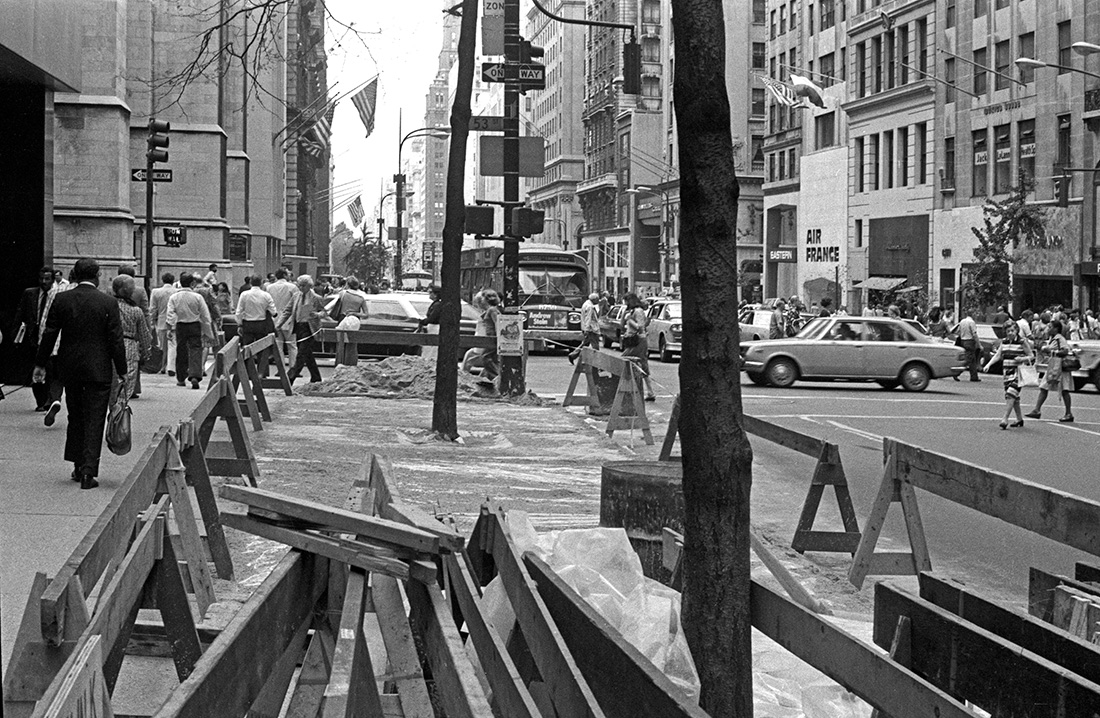
    Similar vertical elements dividing the frame, foreground and background brought together in an overall, highly activated composition. I remember now, the way I thought about things back then. I wasn’t interested in one area of focus, or one subject of interest. I wanted everything treated equally across the field of view.

    I’ll scan more images as time permits going forward.

  • New York/Around Town


    Williamsburg, Brooklyn — © Brian Rose

    After the storm.


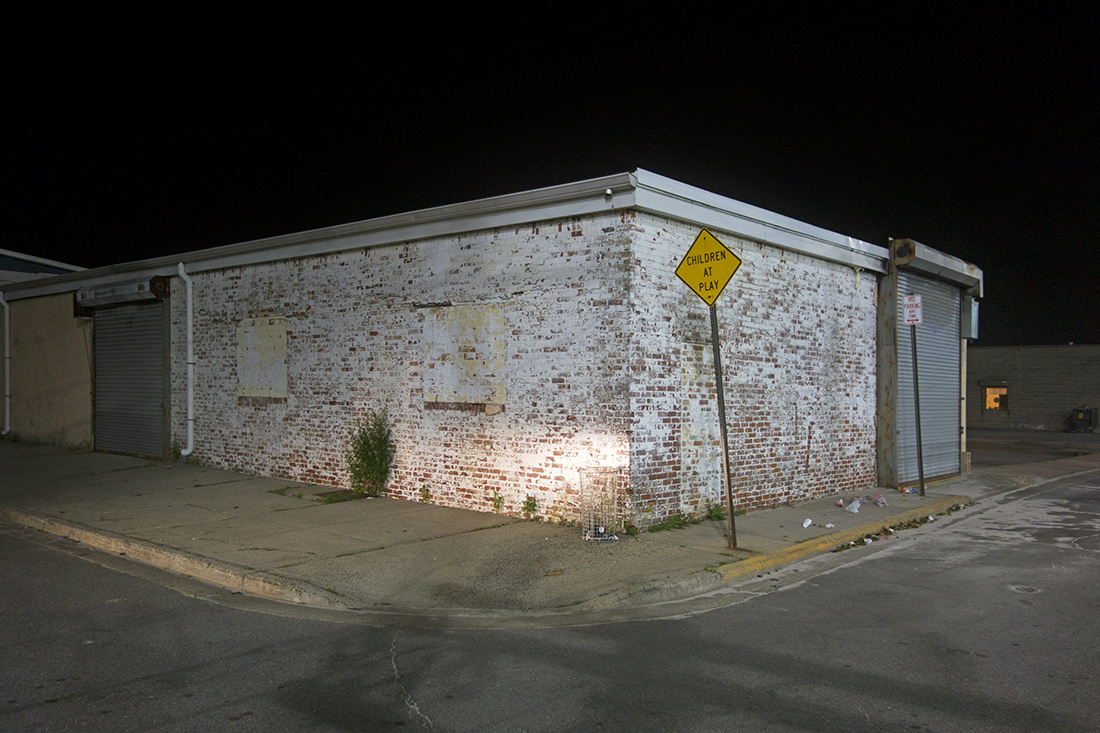
    Long Beach, New York — © Brian Rose

    Children at Play.


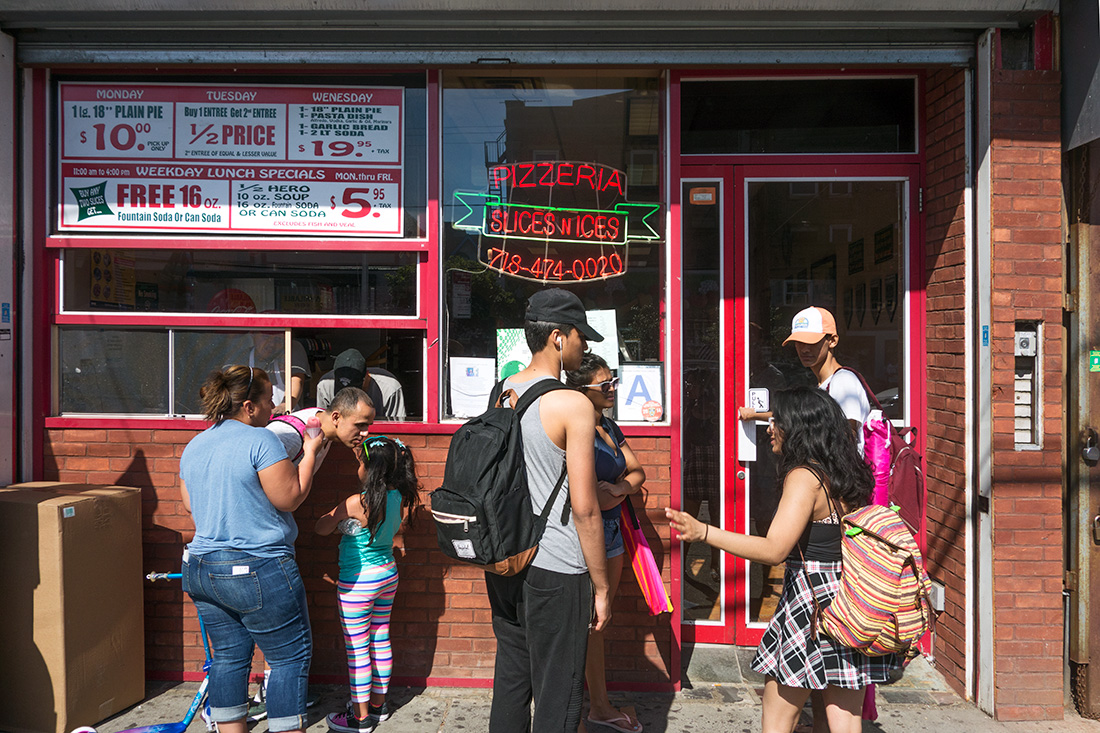
    Rockaway Beach, New York — © Brian Rose

    Slices ‘n’ Ices.


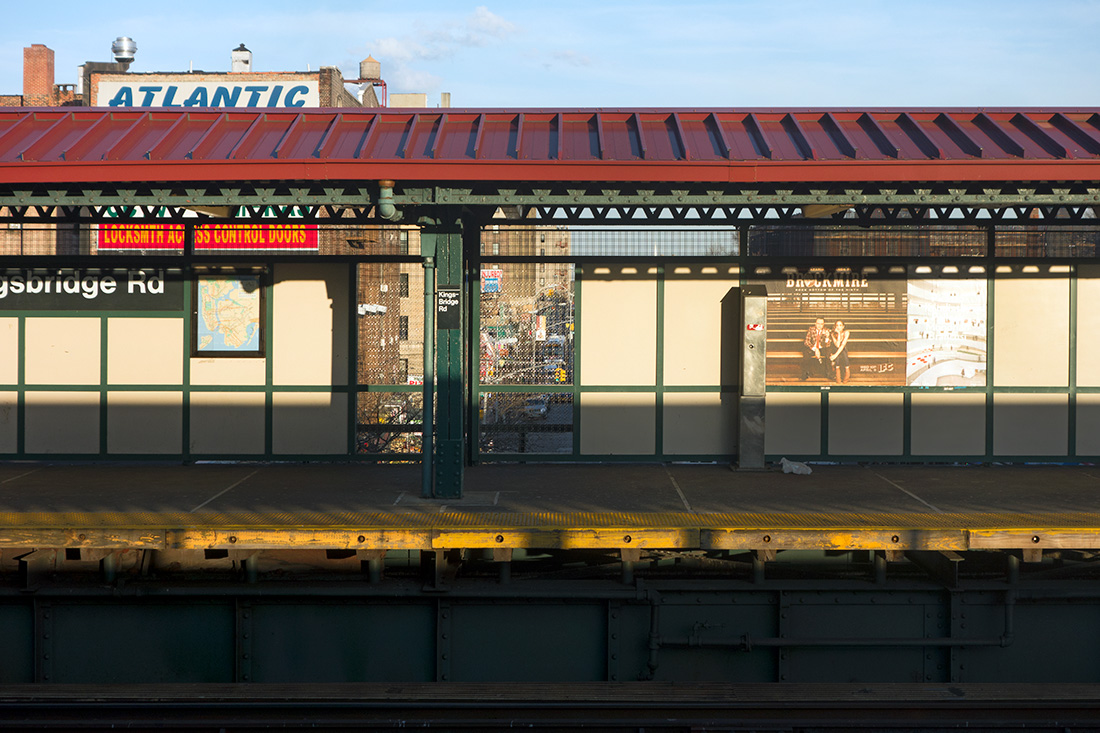
    Kingsbridge Road, The Bronx — © Brian Rose

    Elevated subway platform.

  • New York/Julius Caesar


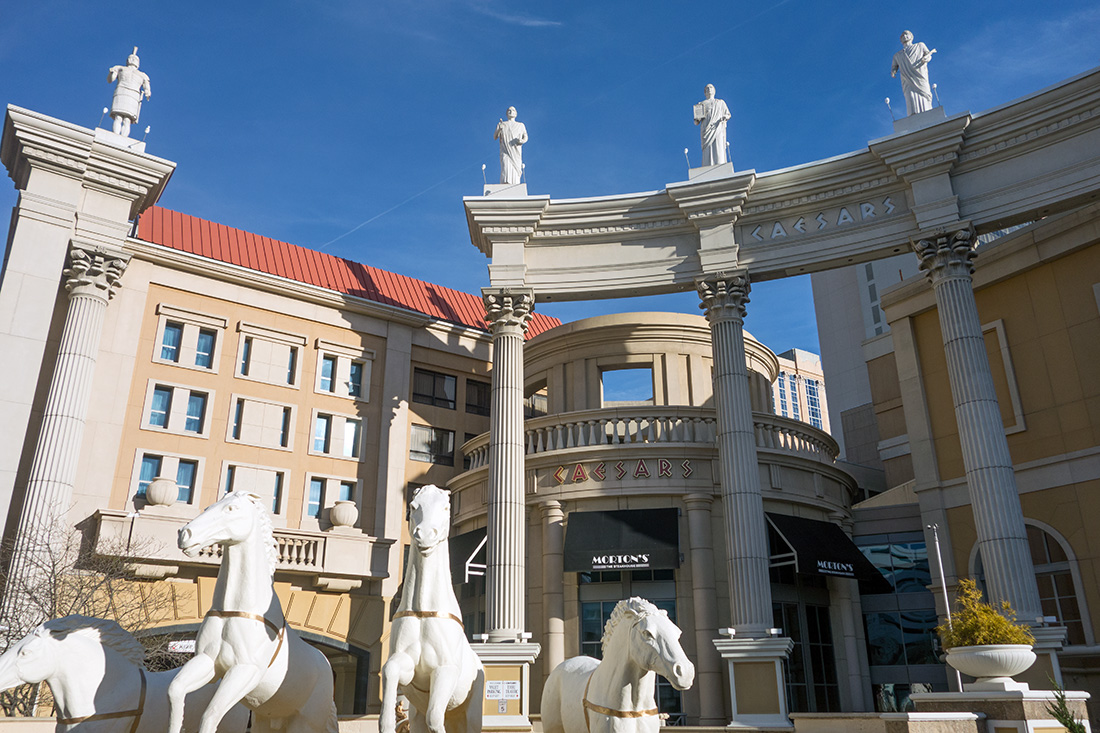
    Caesars Casino, Atlantic City — © Brian Rose

    In all the brouhaha about Public Theater’s production of Julius Caesar I’d like to point out that I made the connection to Shakespeare in a blog post on the day Trump’s inauguration. I used the quote below:

    Men at some time are masters of their fates.
    The fault, dear Brutus, is not in our stars,
    But in ourselves, that we are underlings.

    Cassius is trying to persuade Brutus to join the insurrection against Caesar, which in the case of the play leads to the assassination of the leader returning from war. In a literary sense it is about taking action as opposed to being a passive observer — that history is not determined by fate, but belongs to those who seize the moment.

    The assassination of Caesar, however, does not lead to the triumph of Cassius and Brutus, but to their own deaths and the ascendence of Mark Antony. The empire is preserved, but at great cost.

    As in all of Shakespeare’s tragedies, there are battles, literal and psychological, over honor and moral rectitude. Blood is inevitably spilled, and the heroes are often victims of their own flaws. Shakespeare’s plays are both highly dramatic entertainment and complex interrogations of human character.


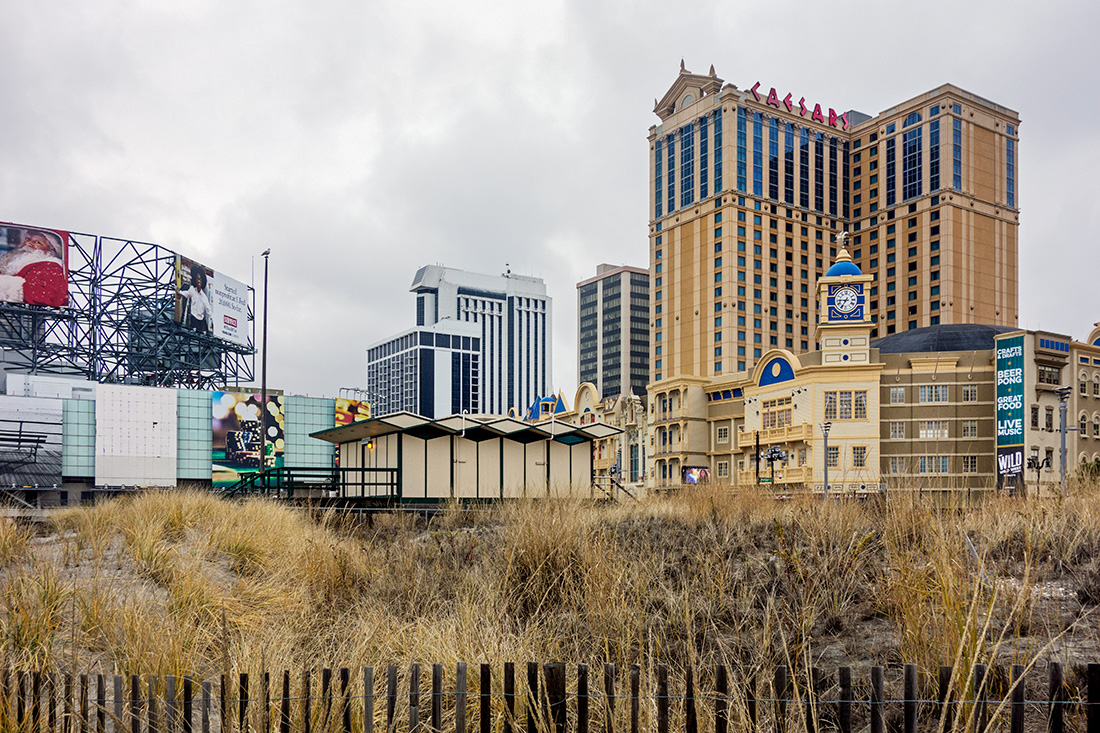
    Caesars Casino and the abandoned Trump Plaza in rear, Atlantic City — © Brian Rose

    I wasn’t able to see the Public’s interpretation of Julius Caesar in Central Park (closing tomorrow) with Caesar portrayed as Donald Trump. One assumes, based on the plot of the play, that the murder of “Trump” should be seen as a cautionary tale. Violence leads to more violence, and to tyranny. We are left understanding that change must come through our democratic institutions, and when necessary, in the streets — peacefully.

    That Trump supporters do not see this — or willfully refuse to see it — is, of course, to be expected.

  • New York/Rockaway Beach


    Beach 116th Street, Rockaway Beach — © Brian Rose

    Despite becoming a cool beach destination in recent years, Rockaway Beach still has its scruffy aspects. There are SROs, nursing homes, and low income projects. There was a time when the beach was a convenient place to dump things — and people. There are also blocks and blocks of neatly kept houses.


    Beach 116th Street, Rockaway Beach — © Brian Rose

    Chewing out a rhythm on my bubble gum
    The sun is out and I want some
    It’s not hard, not far to reach, we can hitch a ride to Rockaway Beach
    Up on the roof, out on the street
    Down in the playground, the hot concrete
    Bus ride is too slow, they blast out the disco on the radio

    Rock-rock, Rockaway Beach
    Rock-rock, Rockaway Beach
    Rock-rock, Rockaway Beach
    We can hitch a ride to Rockaway Beach

    — The Ramones


    Rockaway Beach boardwalk — © Brian Rose

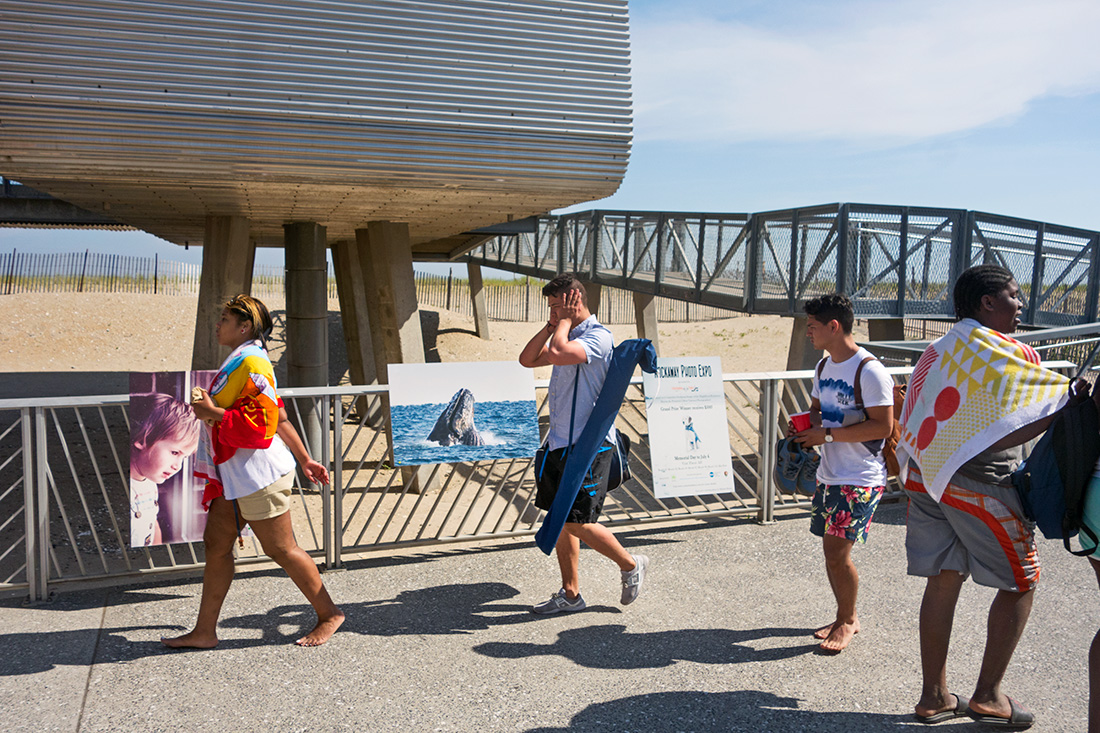
    Rockaway Beach was badly hit by Hurricane Sandy back in 2012 — hard to believe it was almost five years ago. The damage is still evident, though much has been rebuilt along the beach in the Rockaways. Elevated modular structures house a lifeguard station and restrooms. The wooden boardwalk has been replaced with a sturdier concrete surface that is less comfortable to walk on barefoot. We didn’t hitch a ride like the Ramones, but took the NYC Ferry back to Manhattan, which is a great ride, and only $2.75.

  • New York/Chain-link Baseball


    Long Beach, New York — © Brian Rose

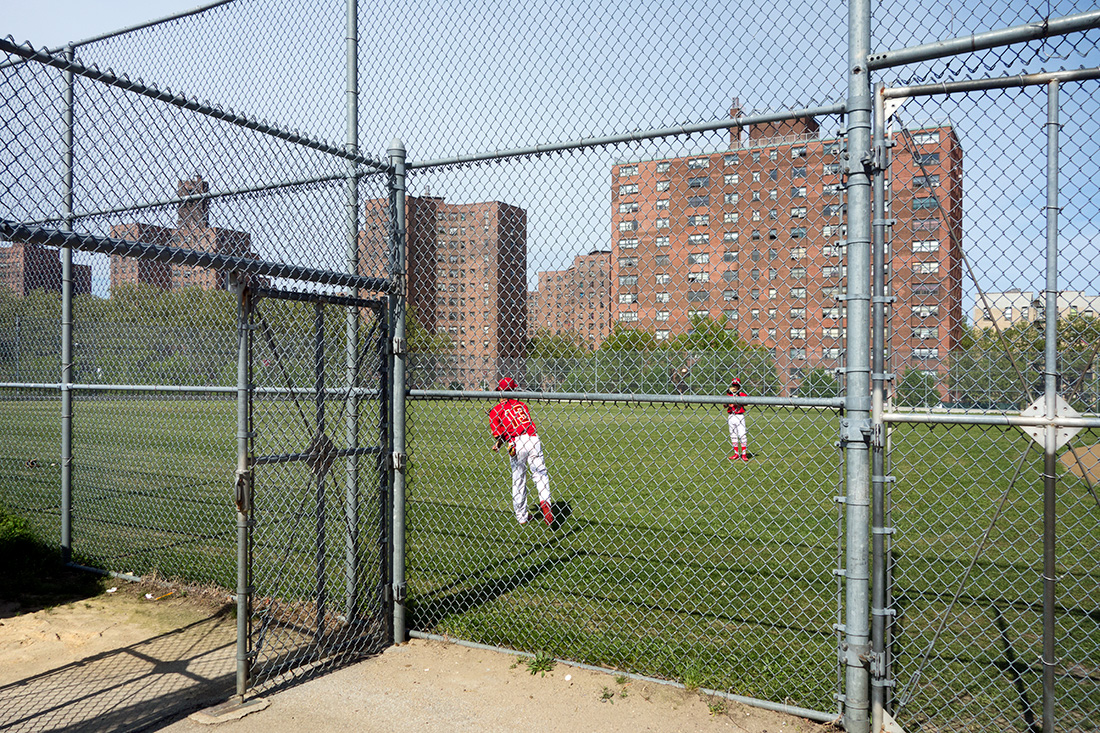
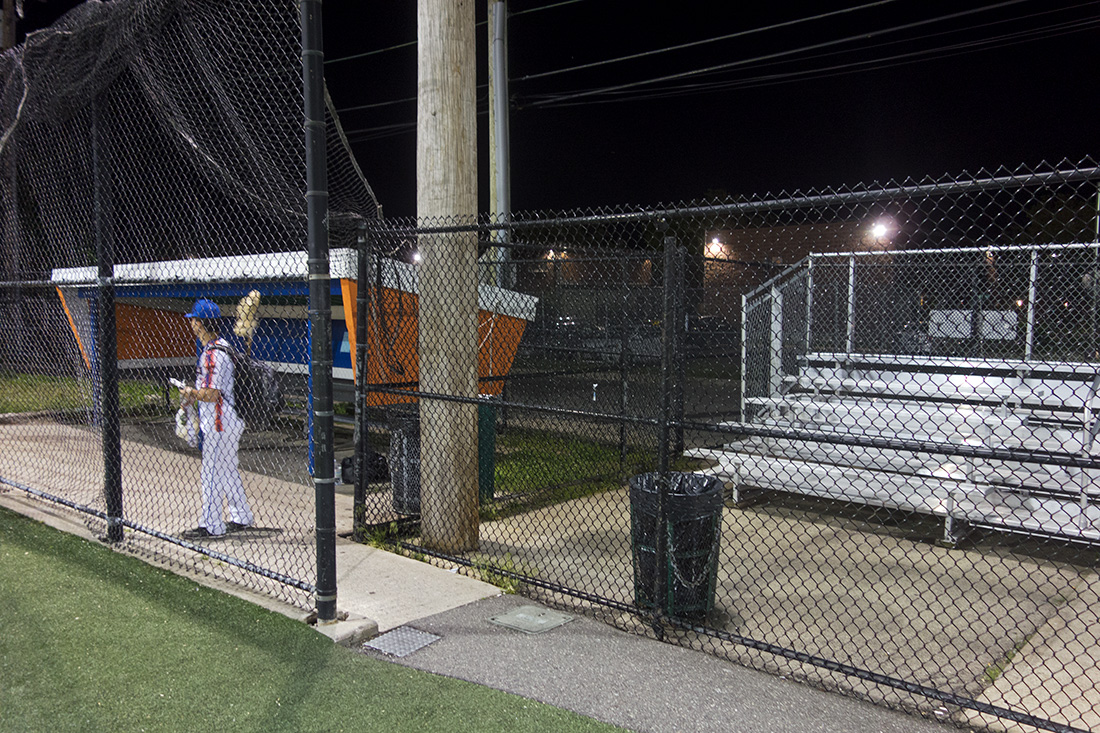
    Despite the it’s bucolic “field of dreams” image, baseball has urban roots. Before the development of suburbs after World War II, baseball was a city game played in vacant lots, and even in the street. The development of the suburbs changed the geographic and socio-economic basis of the game, and the rising popularity of football and basketball displaced the primacy of baseball as the great American pastime.

    But baseball is still played in the city on scruffy fields caged behind yards of chain-link fencing. My son, Brendan, is one of a relatively small number of New York City kids who made it all the way through Little League to college ball. I’ve journeyed to dozens of games in the Bronx and all over the five boroughs. These fields are not glamorous places — unlike nearby Yankee Stadium. They don’t engender much nostalgia, though I still feel somewhat attached to Pier 40 on the Hudson River in lower Manhattan, a disused passenger ship terminal converted into a recreational facility.


    Monroe High School, The Bronx, New York — © Brian Rose

    Baseball is played on fan-shaped fields, while New York is a city of rectilinear blocks. It’s not a natural fit. Nevertheless, baseball remains deeply associated with the city historically and in the present. In Greenwich Village Little Leaguers play on J.J. Walker field hemmed in by a high outfield fence to prevent well-struck balls from breaking windows across the street. And in the Bronx, housing projects overlook Monroe High School where many of the best Latino players in the city learn the game.

  • New York/Atlantic City


    Atlantic City — © Brian Rose (4×5 negative)

    President Trump has a magnetic personality and exudes positive energy, which is infectious to those around him. He has an unparalleled ability to communicate with people, whether he is speaking to a room of three or an arena of 30,000. He has built great relationships throughout his life and treats everyone with respect. He is brilliant with a great sense of humor . . . and an amazing ability to make people feel special and aspire to be more than even they thought possible.

    — Hope Hicks, White House spokeswoman

  • New York/Xanadu


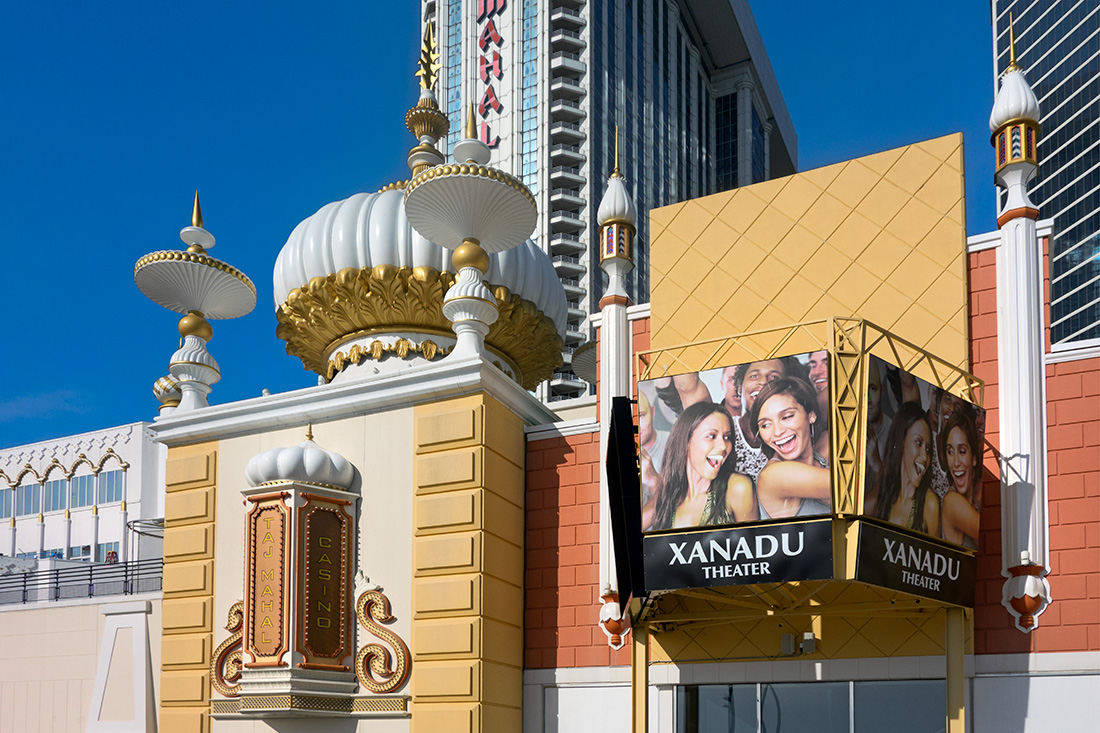
    Trump Taj Mahal, Atlantic City —  © Brian Rose (see more Atlantic City photos)

    In Xanadu did Kubla Khan
    A stately pleasure-dome decree:
    Where Alph, the sacred river, ran
    Through caverns measureless to man
    Down to a sunless sea.


    Donald Trump and King Salman of Saudi Arabia

    And all should cry, Beware! Beware!
    His flashing eyes, his floating hair!
    Weave a circle round him thrice,
    And close your eyes with holy dread
    For he on honey-dew hath fed,
    And drunk the milk of Paradise.

    (from Kubla Khan by Samuel Coleridge)

  • New York/Trilogy


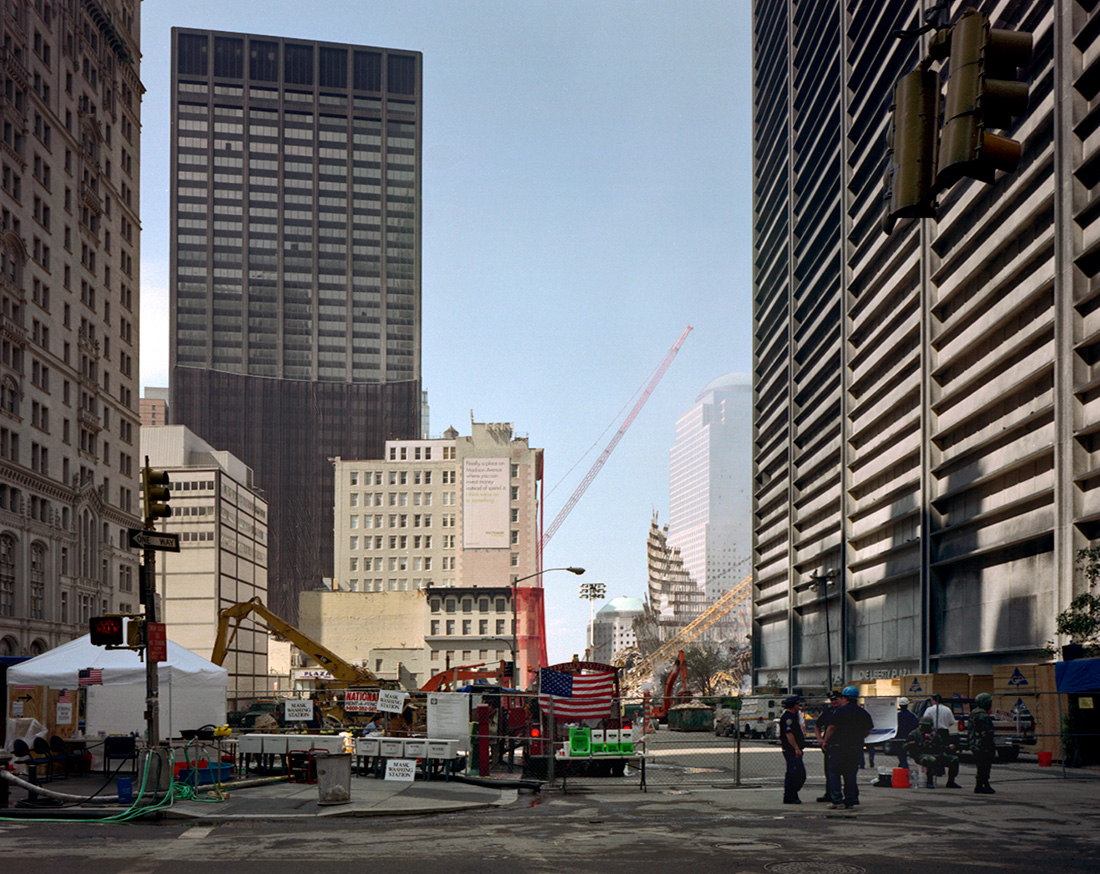
    Broadway, one week after 9/11 (4×5 film) — © Brian Rose

    The three books I have published in the past seven years comprise a New York trilogy — the city seen and explored over an extended period of time. Taken together they form a portrait of New York, especially lower Manhattan, during a period of extreme transformation. I hesitate to say “unprecedented” because change is integral to the nature of New York going all the way back to the first Dutch settlers.

    The story told in these books relates to past photographic projects even to the way in which Marville and Atget documented Paris during the remaking of the city under Haussmann. I was familiar with all of that history when I began photographing the Lower East Side in 1980. At the same time, I was influenced by contemporary strains of street, architectural, and landscape photography. Color was an exceptionally new thing when I started this work in the 1970s, Today, it is the default photographic medium. As I was exploring New York with my camera, I was also discovering color’s descriptive nature, and its capacity to reveal as well as obscure.

    These books also form a personal narrative, and I have kept my voice present throughout the text accompanying the photographs. I was 23 when the first images were made, and 62 when the most recent were done. At the center of this trilogy — though not seen directly — the World Trade Center was destroyed by terrorists on September 11, 2001. That wrenching event propelled the city forward, inexplicably, as a complex barely understood motive — and simultaneously, propelled the nation backward, convulsively, to the present moment of political crisis.

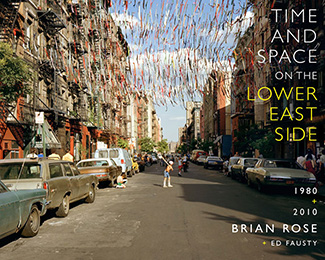
    Time and Space on the Lower East Side is a portrait of place, one of America’s most vibrant and historic neighborhoods seen over a span of 30 years.

    The trade edition of this book is, unfortunately, sold out, though used copies can be found on the internet.

    The limited edition is still available — signed books in a slipcover with an 8×10 inch print inside.

    Purchase the limited edition or browse images and reviews here.

    Metamorphosis. Meatpacking District 1985 + 2013 is before/after view showing rthe dramatic transformation of the former meat market of New York City. Rose spent several days in 1985 photographing the neighborhood with a 4×5 view camera. The negatives remained in a box unseen for over three decades. Rediscovered a few years ago, the images portray the streets and architecture of New York, stunningly empty, but vividly real.

    There are only 150 copies of this book still available.
    Purchase the trade or limited edition of the book here.

    WTC is a visual history of the Twin Towers and the rebuilding of the city after 9/11. It serves as both historical record and personal story going all the way back to 1977 when the Trade Center was only a few years old and Rose was a newcomer to the city.

    WTC pivots off of 9/11 with a series of images made directly after the destruction of the Towers, and moves forward to the ascendance of One World Trade Center on the skyline.

    Purchase the trade or limited edition of the book here.


  • New York/Times Square


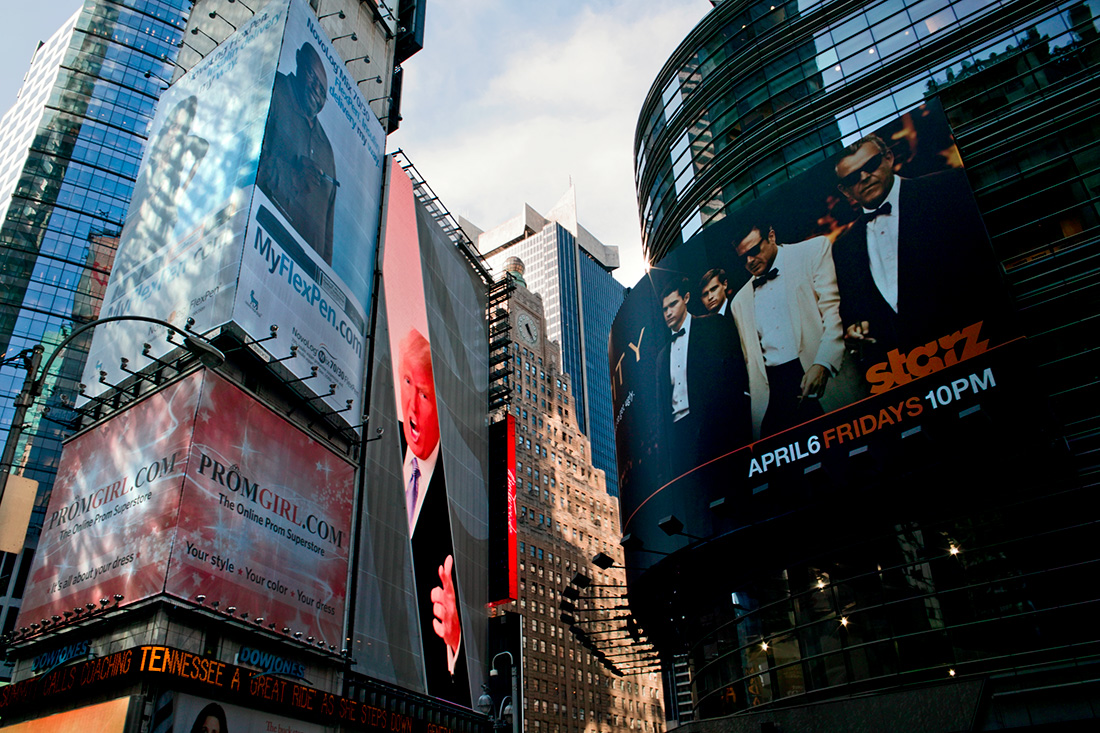
    Times Square — © Brian Rose

    From the heart of a great sanctuary city in the Northeast. An angry red face threatens.
    This photo was originally posted almost exactly five years ago — 04/22/12.

  • New York/Old Topographics


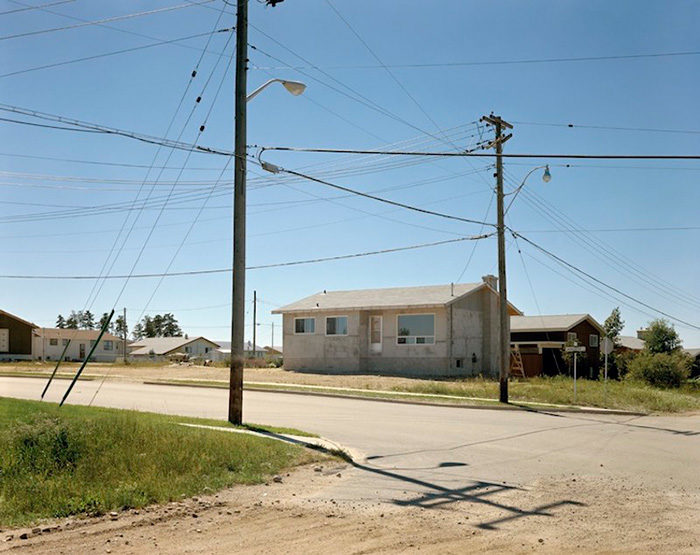
    Stephen Shore, Wilde Street and Colonization Avenue, Dryden, Ontario, August 15, 1974

    Forty-two years ago, an exhibition called New Topographics: Photographs of a Man-altered Landscape caused a stir in the photography world, and the controversy around it, surprisingly, has continued to ripple down through the decades. I was 21 in 1975 when William Jenkins mounted his now famous exhibition of landscape photography. I was in art school in Baltimore, and just beginning to shoot in color. No one at the Maryland Institute – teachers or students – was doing anything like what Jenkins highlighted in his exhibition, and certainly not color landscape photography.
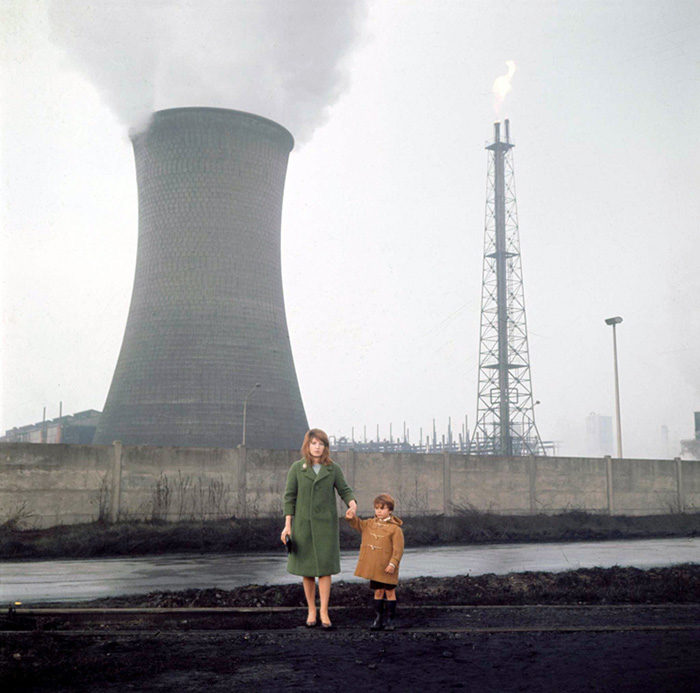

    Scene from Red Desert, Michelangelo Antonioni, 1965

    It took longer in those days for new ideas to percolate through the image making community, especially if you were not in New York City, or Rochester, the home of the George Eastman House where the exhibit took place. My strongest influences at that time were masters of the 35mm camera like Robert Frank and Lee Friedlander, but perhaps to a greater extent, I was fascinated by the color imagery of Michaelangelo Antonioni’s films from the 1960s and 70s, especially Red Desert and The Passenger. Consciously or unconsciously, I set out to bridge those worlds – socially aware street photography and the more studied color landscapes of Antonioni’s movies.
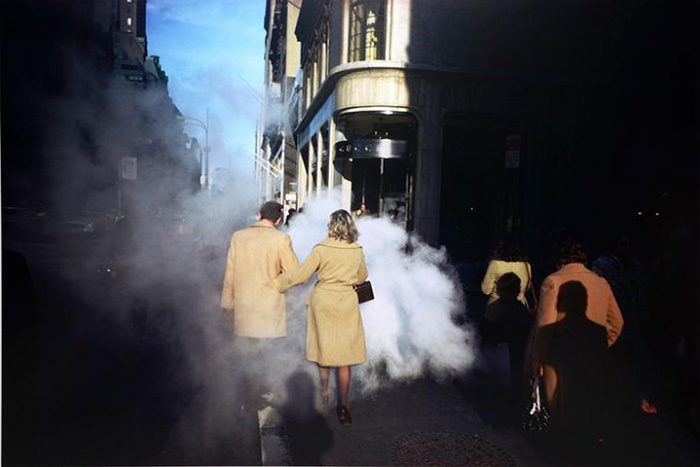

    Joel Meyerowitz, ‘Camel Coats, New York City’, 1975

    In 1975 I was basically following my instincts, not exactly in a vacuum, but at a remove from the groundbreaking shows that were coming out of the Museum of Modern Art under the leadership of the enormously important curator John Szarkowski. At some point, I came across several images by Stephen Shore, William Eggleston, and Joel Meyerowitz, pioneers of color photography. Seeing those pictures printed in a magazine, it was as if the future flashed before my eyes. I knew what I needed to do.

    By 1977 I was in New York where I studied with Meyerowitz at Cooper Union. It was the heyday of Light Gallery, which was one of the few galleries in the world dedicated to serious art photography. I remember seeing Frank Gohlke’s pictures of grain elevators at the Museum of Modern Art, and became familiar with Joe Deal and Robert Adams, particularly their images of the expanding suburbs of the American West. The way in which many of these photographers stayed back a bit, and allowed the detail afforded by the large format to do the work, appealed to me. When I photographed the Lower East Side in 1980 I turned to the 4×5 view camera as the best way to describe the neighborhood and its architecture.
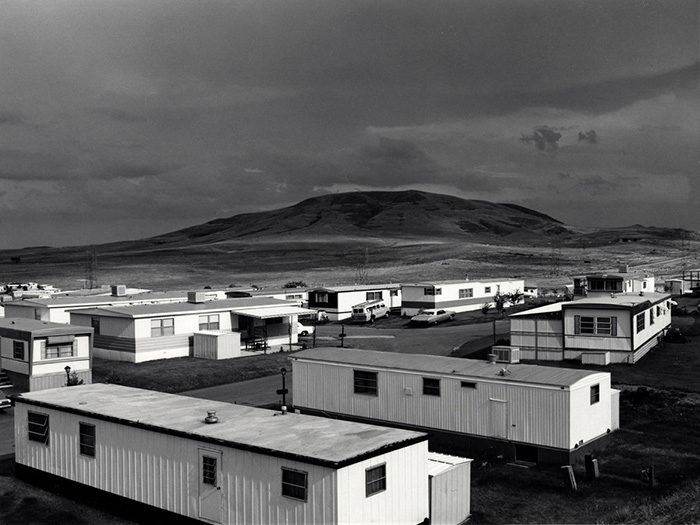

    Robert Adams, Mobile Homes, Jefferson County, Colorado, 1973

    I don’t remember when I became aware of the term New Topographics, but for me it was a curator’s thing – I was interested in individual photographers whose work I found compelling. To me, Robert Adams’ images possessed an almost spiritual power that transcended labels and art theory speak. At the same time, his pictures expressed  the uneasy symbiosis of our relationship with the natural world. That is true to some extent of all of the photographers that Jenkins grouped together in his show.

    That’s where Jenkins was most persuasive, I think, to point out that landscape photography had moved away from the romantic idealization of the world epitomized by Ansel Adams and Edward Weston. I’m afraid, however, that Jenkins unintentionally diminished the individuality of the photographers he chose for New Topographics. Placed in the same cubbyhole, the singular richness and complexity of their images was diluted by proximity, and this diverse group of photographers were seen to be part of some kind of group think. At the same time, many viewers were put off by the cool temperature of the images, the way in which visual content was diffused over the entire frame, rather than organized hierarchically.
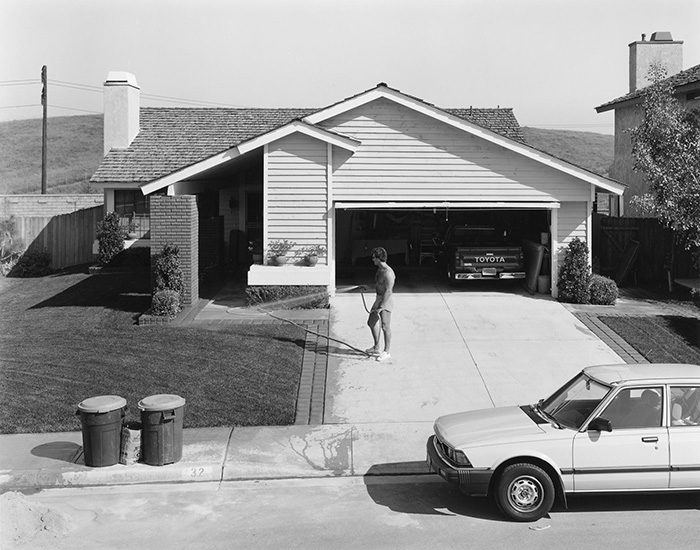

    Watering, Phillips Ranch, California, 1983

    Recently, in a Facebook group about contemporary landscape photography, a contributor suggested that too much of the work posted there looked derivative of New Topographics. I don’t actually know what that means. I suspect it refers to the wide angle, evenhanded, approach that many of Jenkins’ selected photographers employed. But that seems to me a narrow criterion for work by markedly different photographers. Are we talking about Lewis Baltz? Stephen Shore? Henry Wessel? New Topographics was a cuator’s thesis supported by the work of a number of talented photographers who eschewed conventional approaches to landscape. But it was never a movement, nor a particular style.
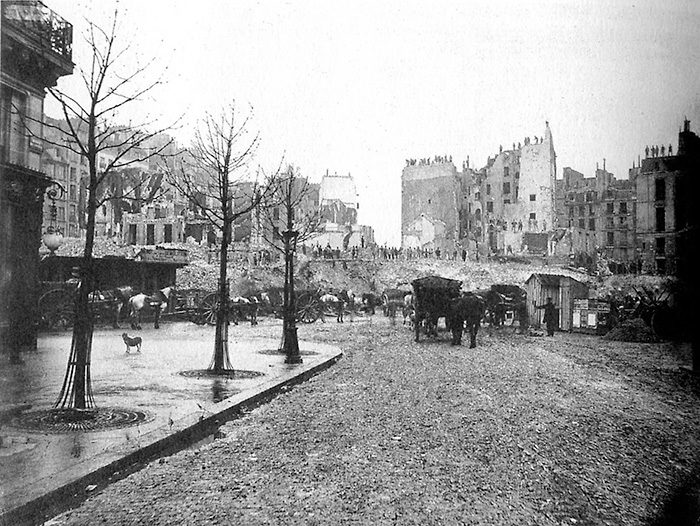

    Charles Marville, Demolition of Butte des Moulins for Avenue de l’opera, 1870

    The reality is that photographers have been documenting human presence on the landscape since the medium was invented. It could be argued that the photographs of Ansel Adams and others depicting a pristine picturesque world were the true aberrations, and that the New Topographics photographers were actually extending  — in various different ways — an unbroken line running through Marville, Atget, O’Sullivan, Evans, and others. The Düsseldorf School photographers who are often connected to New Topographics were undoubtedly influenced by this continuum inspired as well by German photographers like August Sander and Albert Renger-Patsch. Even the more conceptual work of Bernd and Hilla Becher echoes that history.


    Albert Renger-Patzsch, Winter landscape with colliery Pluto in Wanne-Eickel (1929)
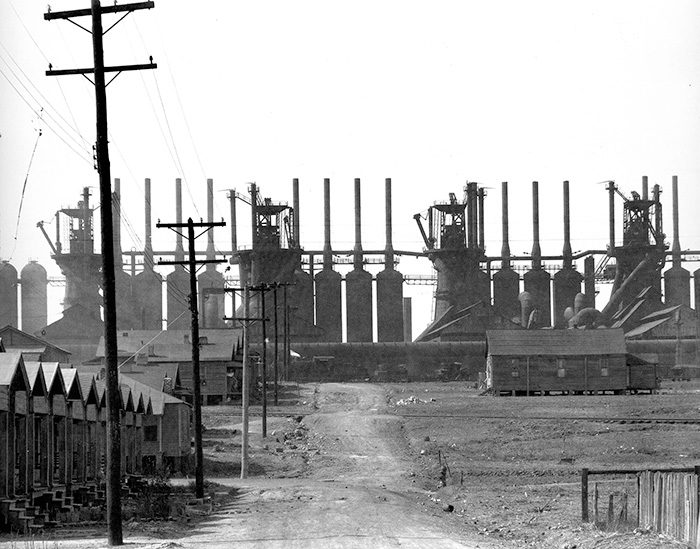
    Walker Evans, Birmingham Steel Mill and Workers’ Houses, 1936
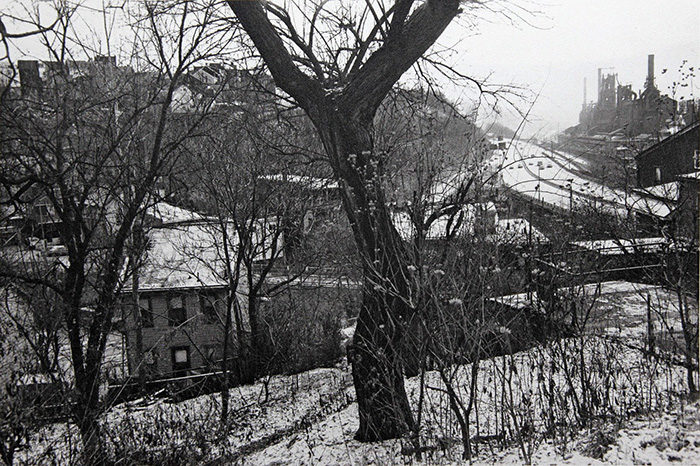

    Lee Friedlander, Pittsburgh, Pennsylvania, 1980

    As photographers we need not feel enslaved to curatorial constructs like New Topographics. What Williams Jenkins came up with was a timely recognition of the way in which photographers were becoming attentive to the accelerating encroachment of urban development in the late 20th century. That attention and the formal rigor of the images ran counter to the prevailing aesthetics of fine art photography, which had already been challenged by Winogrand, Frank, and other small camera practitioners. In my view, the whole uproar around New Topographics had less to do with an aesthetic or conceptual break than it had to do with a reconfiguration of the photography world including the growing importance of museums, curators, art schools, and galleries.
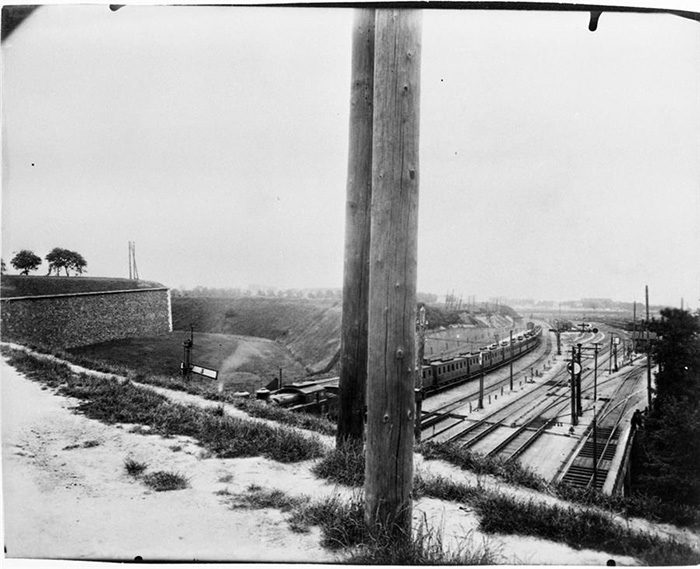

    Eugène Atget, Porte de Bercy, 1910

    Let’s not get distracted by all this. In my view, the critical observation of the landscape by photographers remains an important if not essential practice. With the explosion of new technologies, the increasingly inward gaze of virtual reality, and the lure of alternate notions of truth, the counter weight of objective observation keeps us attentive to the physical world we continue to inhabit with its ongoing environmental depredations, spasms of war and destruction – and beauty — wherever we may find it.
  • New York/WTC


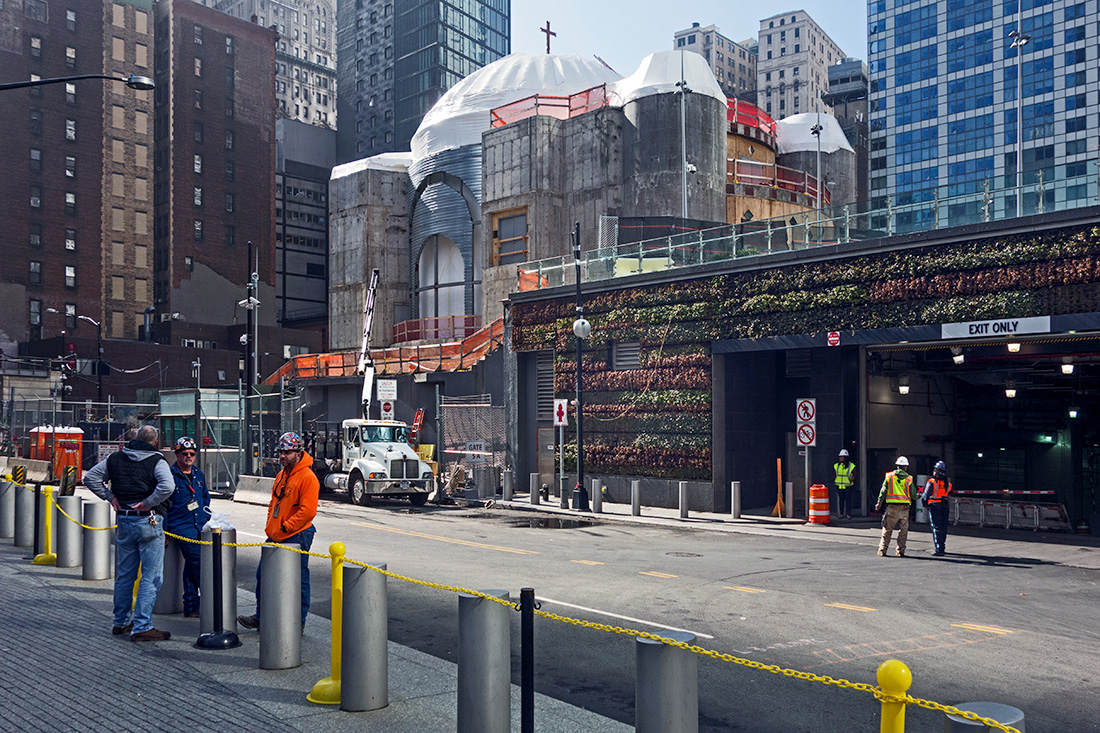
    St. Nicholas Church, under construction, WTC — © Brian Rose
    When the Twin Towers were destroyed on September 11, 2001, a small Greek Orthodox church, St. Nicholas, was obliterated by the falling debris. A replacement church designed by Santiago Calatrava is now under construction a short distance from the original structure. I snapped the picture above returning from an appointment at the 9/11 Museum offices. My book, WTC, will soon be available in the museum shop.

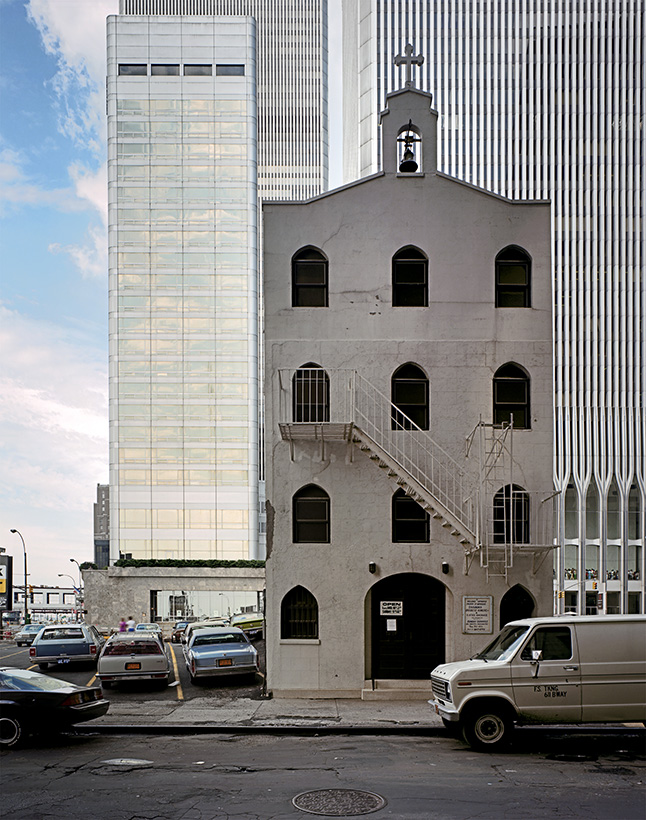
    St. Nicholas Church, 1981 (4×5 negative) — © Brian Rose/Edward Fausty

    The original church served a small congregation just south of the WTC on Cedar Street. The building, converted from earlier use as a tavern, stood alone on a parking lot. Photographers were fond of tilting up at the cross with the Twin Tower rising above. It was a perspective that Edward Fausty and I avoided when we made our picture back in 1981.