JOURNAL • BRIAN ROSE

New York/LES

by admin on 05/09/2007, no comments

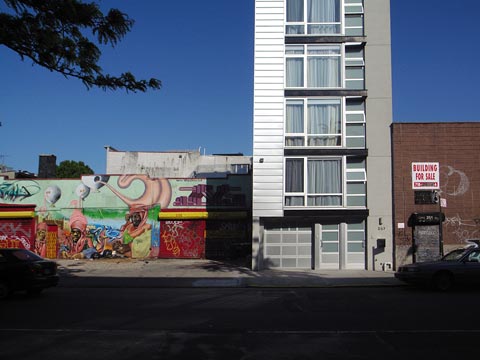
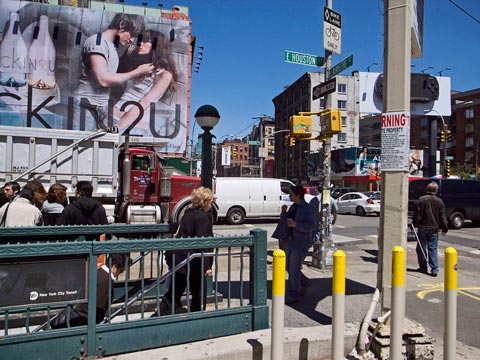
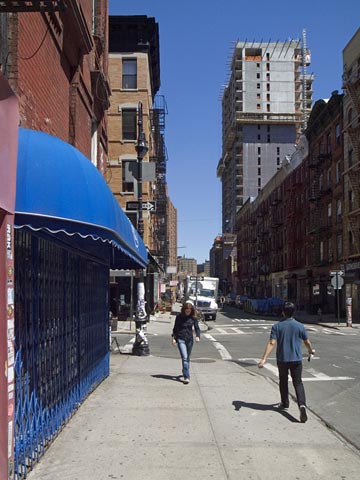
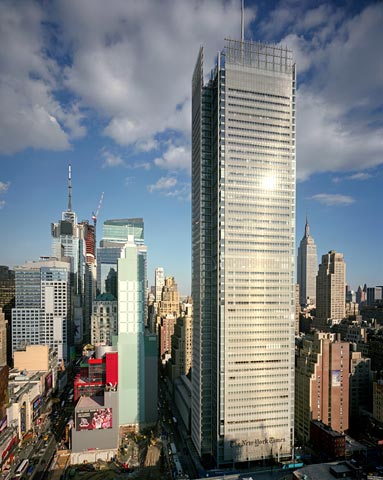
On the Lower East Side along Houston Street there are numerous buildings going up. One is a real monster, designed by the ubiquitous Costas Kondylis, towering above Katz’s Deli. This is your basic bland Manhattan high rise, the kind of building occupied by people you never meet, planted in a neighborhood where funky and chic collide.


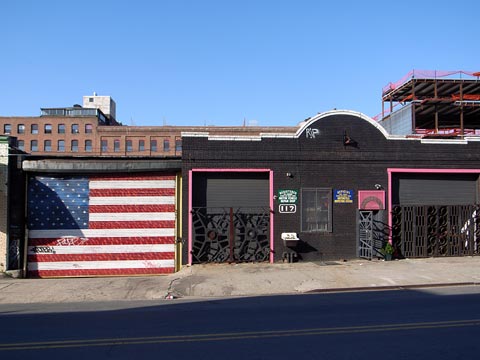
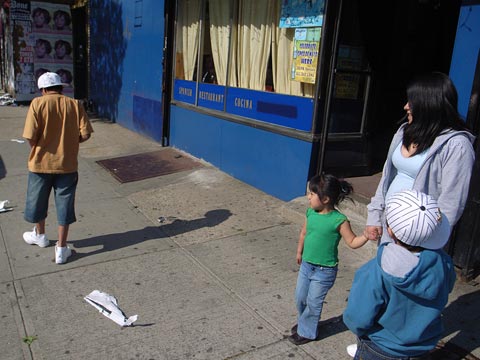
Essex Street near Houston Street


Norfolk and Stanton Streets

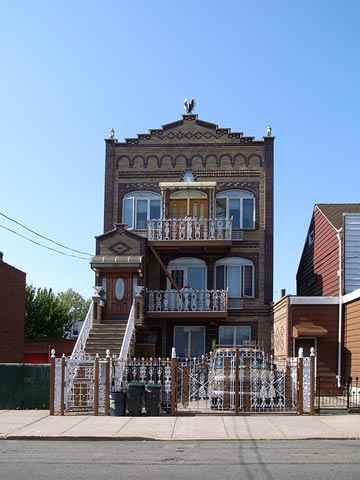
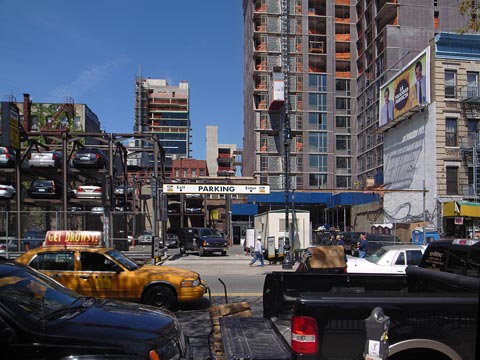
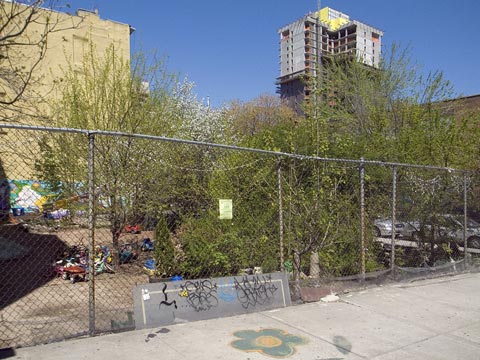
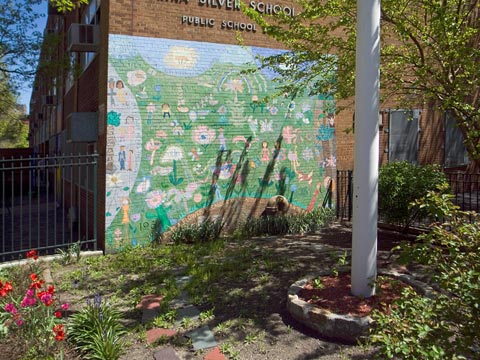
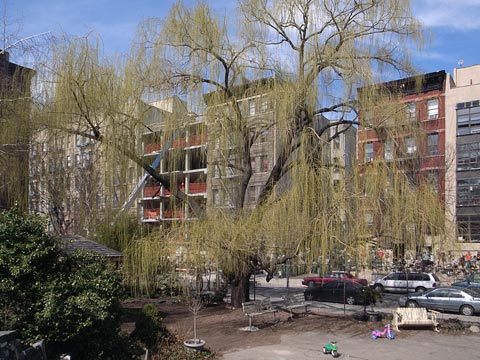
I circled the scene of the crime with my view camera looking for views that included, but did not necessarily focus on the building. I looked across Allen Street toward a multi-layered hodgepodge of tenements, stacked cars, and new construction. From there I headed for Norfolk Street past a school playground ending up at the corner of Stanton Street where a fenced in vacant lot serves as a children’s play area. In the distance, The Ludlow, as it is called, looms above the trees and a painted flower on the sidewalk.


Ludlow and Stanton Streets

New York/LES

by admin on 05/07/2007, no comments

New photographs of the Lower East Side. I continue to work on this never-ending project, still looking for a venue for showing this–I think–extraordinary encapsulation of New York history. It is important for any number of reasons, not the least of which is that the Lower East Side is America’s quintessential immigrant neighborhood, a portal through which millions of people can trace their ancestry and arrival in the United States. It is now undergoing fundamental change, reflecting the rapid transformation of the city since 9/11.

The Bowery at East 4th Street

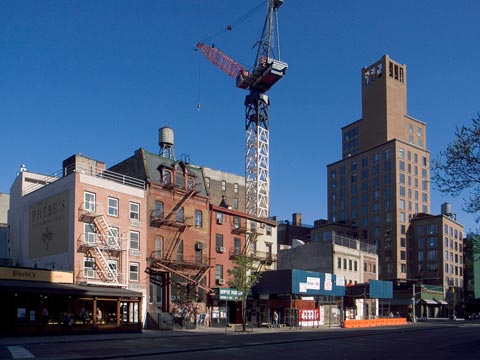
I did a few new pictures of the Bowery/Third Avenue north of Houston Street adjacent to the East Village. There are numerous buildings new or under construction along this stretch. At the Bowery and East 4th Street I did a wide shot of a group of low structures–some quite old–with the ultra chic Bowery Hotel towering above. A crane stands in a small vacant lot suggesting a very tall, thin, building to come.

Although there are some in the neighborhood who see the Bowery Hotel as out-of-scale–it replaces a grungy gas station that stood there for more than 25 years–it also replaces an earlier out-of-scale bank building. Across East 3rd is a Salvation Army shelter that once housed Jack Abbott, the writer of In the Belly of the Beast, a book about prison life championed by Norman Mailer. Here’s a bit from Wikipedia:

In 1965, aged twenty-one, Jack Abbott was serving a sentence for forgery in a Utah prison when he stabbed a fellow inmate to death. He was given a sentence of three to twenty years for this offense, and in 1971 his sentence was increased by a further nineteen years after he escaped and committed a bank robbery in Colorado. Behind bars he was troublesome and often refused to obey guards’ orders. He spent a great deal of time in solitary confinement.

In 1977 he read that author Norman Mailer was writing about convicted killer Gary Gilmore. Abbott wrote to Mailer and offered to write about his time behind bars and the conditions he was experiencing. Mailer agreed and helped to publish In the Belly of the Beast, a book on life in the prison system consisting of Abbott’s letters to Mailer.

Mailer supported Abbott’s attempts to gain parole. Susan Sarandon’s son, Jack Henry Robbins, is named after Abbott. Abbott was released on parole in June 1981. He went to New York City and was the toast of the literary scene for a short while.

On the morning of July 18 (1981), just six weeks after getting out of prison, Jack Abbott went to a small cafe called the Binibon in Manhattan. He clashed with 22-year-old Richard Adan, son-in-law of the restaurant’s owner, over Adan’s telling him the restroom was for staff only. The short-tempered Abbott stabbed Adan in the chest, killing him. The very next day, unaware of Abbott’s crime, the New York Times ran a positive review of In the Belly of the Beast.

I lived around the corner on East 4th Sreet at the time, and ate in Binibon the day of the murder. I was unaware that anything had happened. Nowadays one would expect to find the crime scene taped off, people milling about pointing and murmering, and, perhaps, the beginnings of an informal memorial of flowers. In those days, it was just another murder on the Lower East Side, though once the connection to Mailer was made, the story became national news.


Cooper Square with statue of Peter Cooper and site of new Cooper Union building

Further up the Bowery, where it turns into Third Avenue, there’s another giant hotel going up, and beyond that, Cooper Union has demolished the former Hewitt building on Cooper Square to make way for a glass academic building designed by Thom Mayne of Morphosis. I made a photograph across the square with Peter Cooper in his columned memorial obliged to look on the homeless men who still occupy this bit of the shiny, new, Bowery. For me, it’s another little piece of personal history gone. I remember meeting Anamarie Michnevich, a fellow Cooper student, in the cafeteria of the Hewitt building. We remained friends, and years later she helped me with my Lost Border project and book. And ironically, in the row of townhouses to the left, is the office of my publisher, Princeton Architectural Press.
New York/Bond Street

by admin on 05/05/2007, no comments


Bond Street

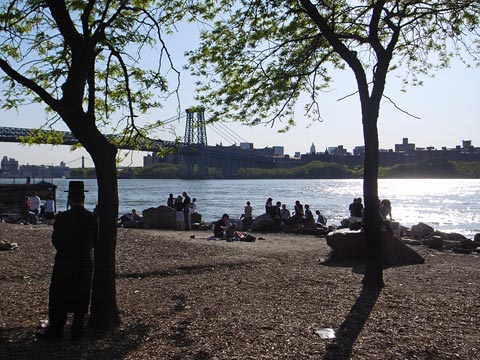
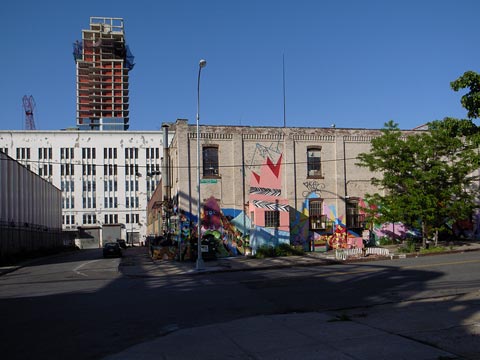
In my comings and goings to and from my apartment/office on the east side, I often walk through Noho, the relatively small area of loft buildings hemmed in by the East Village, Greenwich Village, and Little Italy (Nolita). For years, the neighborhood was dotted with small, odd, seemingly temporary structures, auto shops, gas stations, diners, etc. And lots of parking lots. Some of this lack of cohesion can be explained by the building of the IRT subway way back in the early 1900s when Lafayette Street was ripped through the neighborhood to allow for the cut and cover construction of the tunnel. The demolition left narrow bits of property on each side of the street, which ended up being used, or barely used, for an entire century by the above hodgepodge of structures.

There’s lots more history and information to be had here.

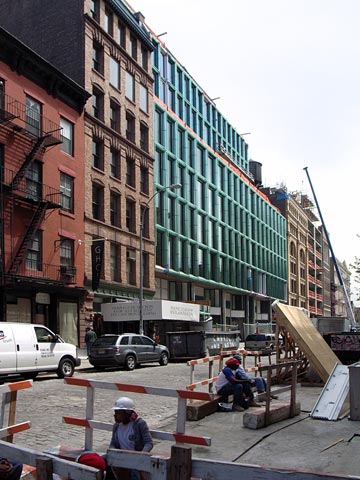
In any case, the parking lots and slender strips of property are being developed in the current boomtown climate of New York. The most interesting arechitecturally is Bond Street between Lafayette and the Bowery. Several infill apartments buildings are going up simultaneously, the most notable of which is 40 Bond. Ian Schrager, the Studio 54 entrepreneur ( and tax evader) turned to real esate development after a stint in prison. His residential developments are boutique buildings with an emphasis on design and chic life style. 40 Bond is notable for being the first building designed by the Swiss architects Herzog & de Meuron, who are known for the Tate Modern in London and the de Young Museum in San Francisco.

40 Bond’s facade features molded green glass framing around the large windows, and along the street–yet to be assembled–will be a grafitti inspired frieze of cast aluminum. Whatever one thinks of the sleek Schrader packaging of the project, the building embodies the new emphasis on architecture (in the service of real estate) in New York. The other notable aspect of the project is the level of craftsmanship evident, and the richness of materials–in this case the glass framing–something fatally missing in much contemporary architecture.

New York/Ground Zero/Potsdamer Platz

by admin on 04/24/2007, no comments


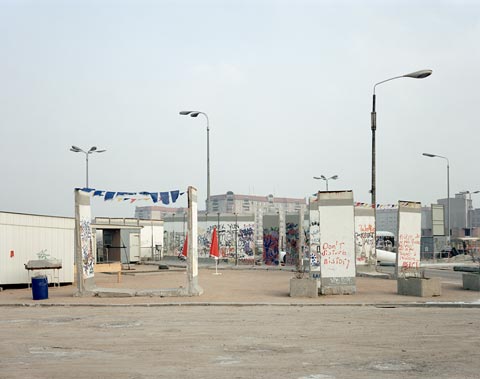
InfoBox and Berlin Wall, 1996 (4×5 film)

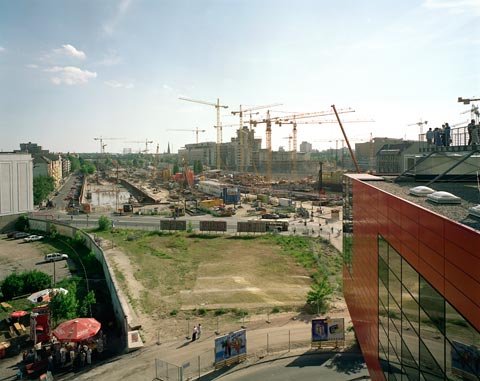
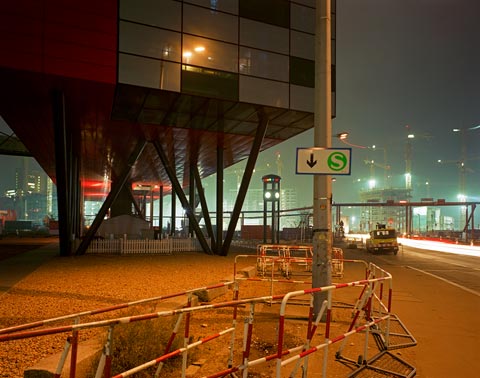
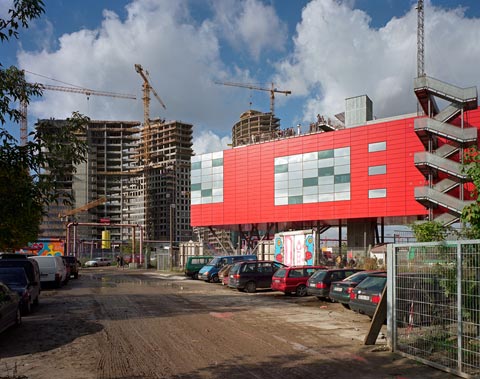
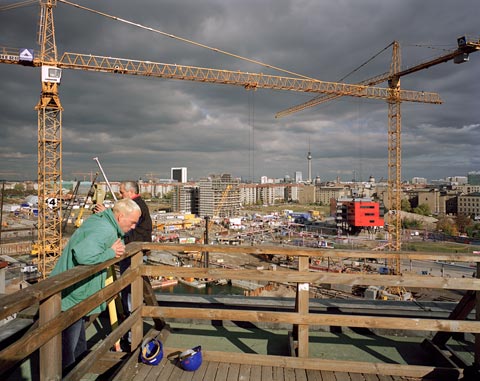
In the previous post I compared Potsdamer Platz in Berlin and ground zero (WTC) in New York. Both are historically sensitive places in which rebuilding symbolizes attempts at reclaiming loss. Both entail large commercial development, and both include memorials, either at the heart of the effort as in New York, or nearby as in Berlin. In Berlin the millions of tourists who came to view the vast rebuilding site were welcomed at the InfoBox, a temporary structure housing models, renderings and multimedia presentations, and on the roof, a deck for surveying the new architecture rising on the skyline.

InfoBox and Potsdamer Platz, 1996 (4×5 film)

The InfoBox was designed by Schneider + Schumacher, an architecture firm based in Frankfurt. From their website:

The commission for the InfoBox was the outcome of an invited competition in 1994. The aim was to design a building which would reflect the worldwide interest in the building activities on Potsdamer Platz in the recently re-united Berlin.

The box was concise and easily identified, hovering on stilts above the surrounding chaos, at the time the largest construction site in Europe. It was a simple yet powerful gesture.

In October 1995 the InfoBox opened and in very short time attracted a large audience, welcoming its four millionth visitor in February 1998. In january 2001 this temporary building was disassembled according to plan.

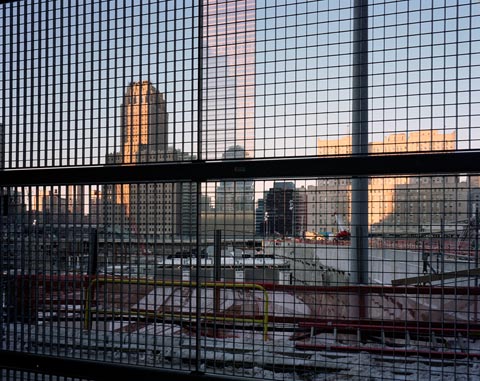
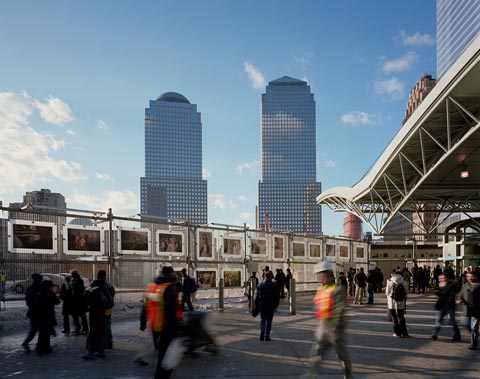
There is no comparable facility in the works for the World Trade Center site. Tourists wander aimlessly trying to grasp the scope of what was and what is to come. There is a small museum, nicely designed, but inadequate to the task. There are photos bolted up high on the metal grating around the Path station–though those are now coming down to make way for the relocation of the station. At the present, most visitors are interested in views into the bathtub, the pit formed by the foundation walls left after the site was cleared of debris that contained the remains of those who died there. There are a few places that afford views: an area under the sidewalk shelter in front of the Deutsche Bank building, which is now being torn down. The pedestrian bridges spanning West Street–very awkward places to stand. The glass wall at the back of the Winter Garden in the World Financial Center–good for an overall vista, but not high enough or close enough to see into the bathtub. That’s basically it.


Steel fence in front of Deutche Bank building, (4×5 film)

Ground zero is in great need of an InfoBox of its own, a structure built well above street level with an outdoor viewing promenade. It should contain the models and multimedia now available only on the various websites relating to the WTC. Even on the Internet there is no single clearing house of reliable information. The Port Authority has a website. Larry Silverstein, the developer, has one, and the Lower Manhattan Development Company (LMDC) has two including an informational site called LowerManhattan.info. There are others.

Under the InfoBox, 1999 (4×5 film)


InfoBox, 1999, (4×5 film)

This lack of focus and scatter-shot approach to disseminating information is, of course, evidence of the chaos created by competing agendas, financial interests, and governmental agencies plagueing the whole project. But despite all of that, it would seem possible for the city, state, Port Authority, and Larry Silverstein, to come together to create an Infobox-like center on the site. There is more than enough space for such an elevated temporary structure. Even as the 9/11 memorial takes shape, it will be years before the spiral of buildings that loosely follow the original Libeskind plan will be completed. During that construction period, millions of tourists from around the world need to be accomodated. Ultimately, an information center/observation deck would do more than that. It would help demonstrate that the city is looking to the future with confidence in the wake of the attacks on 9/11.
New York/Ground Zero/Potsdamer Platz

by admin on 04/16/2007, no comments


Wall fragments at Potsdamer Platz, 1990 (4×5 film)

As I wrote in an earlier post, ground zero (the World Trade Center site) reminds me of Potsdamer Platz in Berlin during the great wave of construction that occurred in the 1990s after the fall of the Berlin Wall. Although the circumstances leading to the two rebuilding efforts are obviously different, both were and are of intense interest to the public.

The reclamation of Potsdamer Platz was not just about the unification of Germany. It represented a new beginning reaching back to the zero hour (Stunde Null) at the end of World War II with its landscape of destruction. This no man’s land at the center of the city lay in limbo through the Cold War years, bisected by the Wall, and symbolized the unreconciled issues concerning the destiny of Germany and Europe, the Holocaust, and the role of Berlin as the historical metropolis at the crossroads of east and west.

The destruction of the World Trade Center and the death of nearly 3,000, while uniquely horrific, pales in comparison to the losses of World War II. Nevertheless, it created a trauma in human and political terms that cannot be underestimated for New York and the rest of the world.


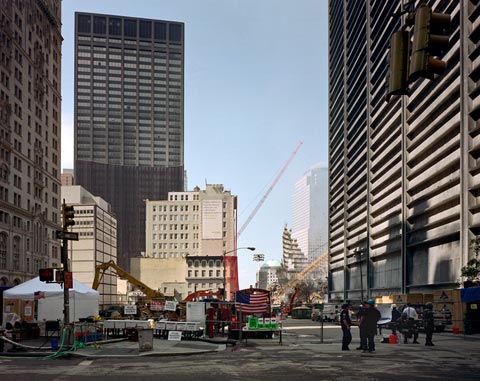
Ground zero seen from Broadway two weeks after the attack, 2001 (4×5 film)

In both Berlin and New York, the erasure of important symbols led to an immediate desire to rebuild. I won’t debate here the merits of the impulse to reclaim the image of the Twin Towers, or the wish of some to treat all of the WTC site as hallowed, therefore untouchable, ground. But there can be little doubt, that the public favored some combination of memorialization and the restoration of a heroic icon on the city’s skyline. With great fanfare a plan was selected, and despite all the compromises–some crippling–construction is now taking place. In fact, WTC 7 has aleady been rebuilt, an elegant glass tower, hovering over a vast chaotic tableau of yet unrealized plans.

In Berlin millions came to witness the rebuilding of Potsdamer Platz, and participate in the debate surrounding the plans of the architects who became household names in Germany and abroad. Many of the architects who were active at that time in Berlin–Libeskind, Piano, Rogers, Foster, Calatrava–are now similarly employed in New York affirming a post-9/11 recognition of the role of architecture in civic life.


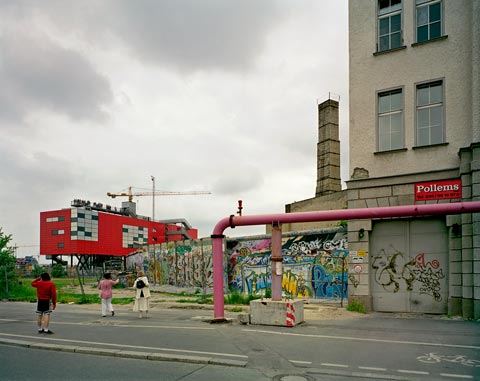
Potsdamer Platz construction with red InfoBox, 1996 (4×5 film)

The public’s passion for the rebuilding of Potsdamer Platz was properly understood in Berlin, and a temporary structure was erected in the midst of the site housing the models, drawings, and videos. The InfoBox, as it was called, also featured an elevated deck for surveying the surrounding urban forest of construction cranes. The InfoBox became the destination for the droves of tourists who otherwise would have wandered aimlessly about the site looking for views while trying to make sense of what was going on.


Ground zero visitors and commuters, 2007 (4×5 film)

This, alas, is the present situation at ground zero in New York.

To be continued…

New York/South Street

by admin on 04/12/2007, no comments


South Street, Fulton Fish Market, mid-1980s (4×5 transparency)

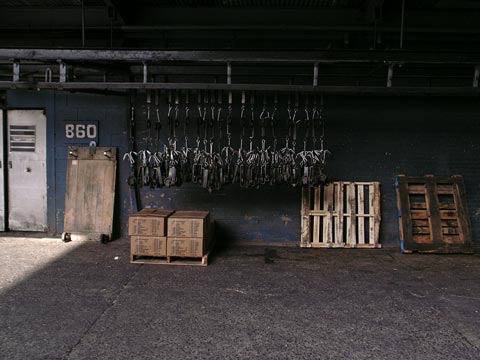
Going through my archive the other day, I came across this image of the former Fulton Fish Market on South Street in Lower Manhattan. The market was moved for a variety of reasons, the most important of which, was the requirement that it be in a refrigerated, sanitary, environment. South Street failed in that regard. Neither did it offer easy access for the trucks that long ago supplanted fishing boats as the main conveyance for bringing in fresh fish. The new market is at Hunt’s Point in the Bronx.

Things change–and are changing–rapidly in the city for better or for worse. The Fulton Fish Market was a vestige of an earlier Manhattan where related businesses congregated together. A few posts down I wrote about the transformation of the Meatpacking District. One by one, these marketplaces are disappearing. The garment district with its racks of clothing on the sidewalk is a shadow of its former self. The flower district is threatened. The restaurant supply row along the Bowery near my office is probably on its last legs. Orchard Street, once a lively bazaar with goods spilling onto the street on Sundays, is now mostly quiescent.

I haven’t anything particularly profound to say about all this. As a photographer of the city I note the passing of things and move on to the next wave of activity. But certainly, some of this progress comes at our loss.

New York/MoMA and Brendan

by admin on 04/06/2007, no comments


Brendan at the Museum of Modern Art

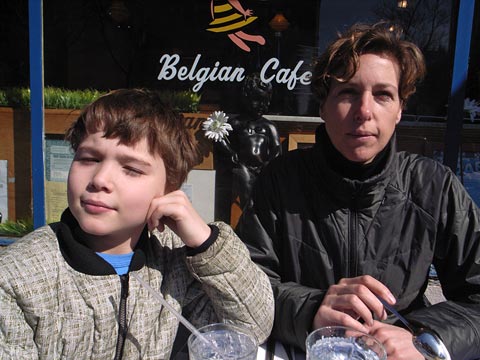
Went to MoMA yesterday with inlaws from Holland. Brendan, son, announced as we entered the museum that he didn’t like art, and then proceeded to go from painting to painting talking up a storm about the colors, lines, images, commenting about one Paul Klee that it appeared that the artist painted layers of color and then scratched into paint revealing underlying colors. He then stood in front of a Jackson Pollock drip painting and compared it to a Roadrunner cartoon in which the Roadrunner zipped above and the Coyote ran below criss-crossing each other repeatedly. He liked Broadway Boogie Woogie by Mondrian, and particularly appreciated the many Picassos on view in the galleries. Also, he liked the Helen Levitt street images in the photography gallery.

At 8, I hadn’t even visited a musuem.

New York/LES

by admin on 04/04/2007, no comments


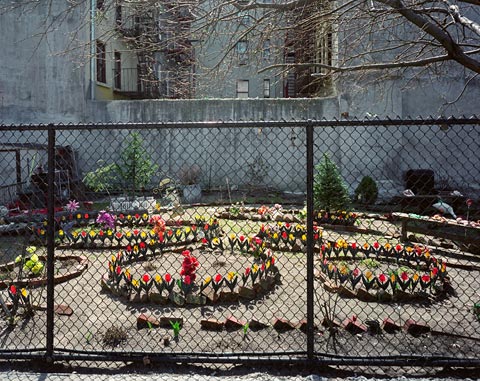
East 13th Street and Avenue B (4×5 film)

Spring is slowly arriving in New York. But on the Lower East Side spring blooms all year, at least at the community garden at East 13th and Avenue B.

New York/IAC Building

by admin on 03/31/2007, no comments


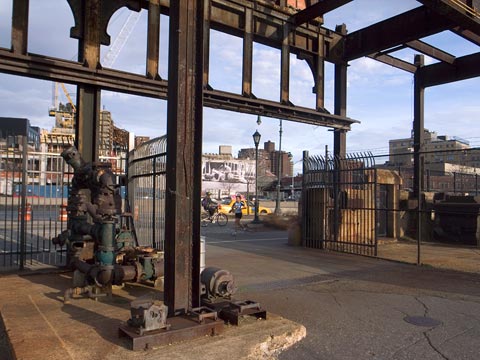
West Street opposite the meatpacking district

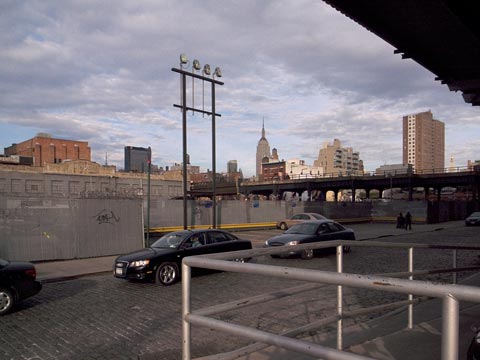
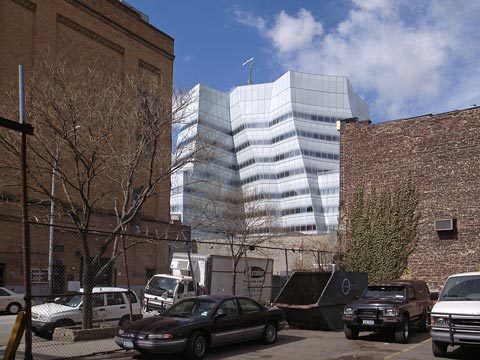
Yesterday, I walked again with my view camera up to Chelsea to photograph the IAC building, the first Frank Gehry building completed in New York. It’s fun for me to do this kind of thing when there’s no client breathing down my neck, and I can take things as they come. A few days ago I approached the building from the east, which one glimpses between existing brick warehouses and old factory buildings.


The High Line

The High Line cuts through the city along 10th Avenue, and its transformation into an elevated promenade is already well underway. This strip is rapidly turning into the most stylish area of Manhattan with art galleries and cutting edge architecture. At the moment, there is a certain happy tension between the gritty desolation of vacant lots and the encroaching chic and sleek.


IAC building


IAC building

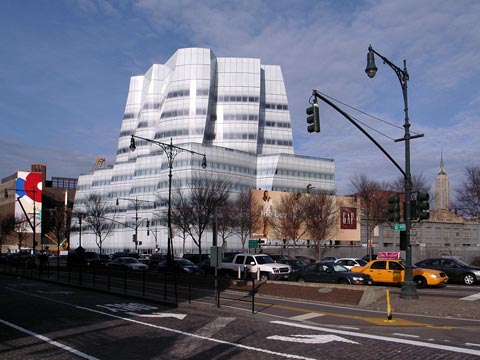
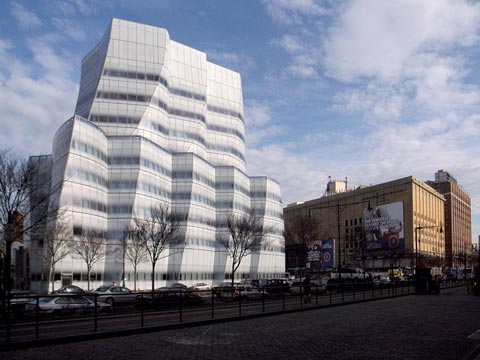
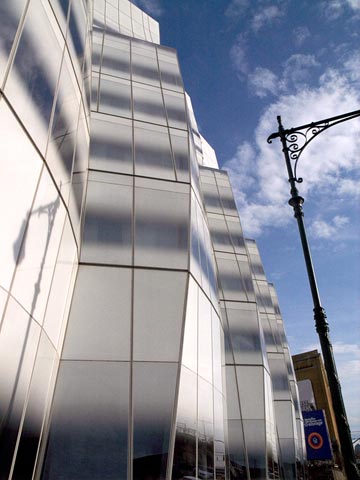
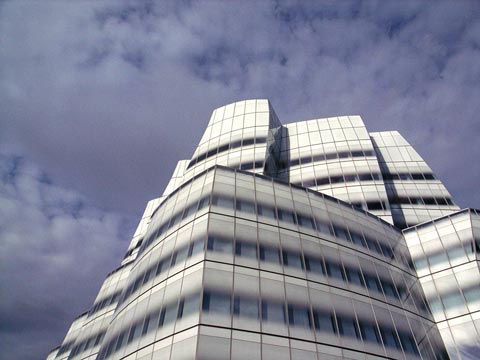
This time I approached the IAC building along West Street where it faces the Hudson River and the vast Chelsea Piers sports complex. As I’ve noted before, the building has the appearance of ship in full sail, its folds and pleats suggesting a southward heading. I’m not usually enthusiastic about such literal references in architecture, but I think in this case, the representational imagery is sufficiently abstracted formally.


IAC building

The snow-white fritted glass has been disparaged by some as better befitting a suburban office park, but I find the crystalline folds and fragments of the curtain wall quite beautiful. That said, this is not one of Gehry’s most ground-breaking efforts. It is, however, an elegant, urbane, building that dares to sashay in a town more prone to marching, at least architecturally speaking.


IAC building

New York/Chelsea/LES

by admin on 03/29/2007, no comments


The High Line under construction

I walked up to Chelsea by way of the Meatpacking District (Gansevoort Market), the formerly gritty meat market inhabited by bloody-aproned butchers and meat cutters as well as transvestite prostitutes. The area is now the epicenter of New York cool. The beautiful people wobble about on the cobblestones, and edge their way around the slabs of meat still hanging from hooks in front of the handful of remaining meat businesses. Like the Fulton Fish Market, New York is rapidly losing another piece of raw open air commerce. And like Soho, the area is destined to lose its buzz,though it’s hard to imagine where else the buzz can go in Manhattan.


One of the remaining meat businesses in the Gansevoort Market

For the time being, the Gansevoort Market and the Chelsea art district possess the kind of urban contrasts that I love to photograph. The High Line–the derelict elevated rail line–is under construction at the south end, and various buildings are going up around and literally over it with one structure straddling the viaduct. Of great interest is the almost finished IAC building designed by Frank Gehry. It’s Gehry’s first New York project, though there are numerous now in the pipeline.


IAC building in rear


IAC building

I’m fond of the building, not exactly in a critical sense, but in the way this white glass apparition emerges from its neighborhood of mostly brick warehouses. Since it will undoubtedly be photographed by other accomplished architectural photographers, I’ve decided to look at the building in a more contextual way, not worrying so much about definitive signature views. I also know that as the neighborhood changes, and more projects fill the large gaps that surround the IAC building, the building will no longer float so aloofly above the fray. Like many fine buildings in New York, it will be come part of the furniture. I spent several morning hours working the east side of the building poking around parking lots and openings between buildings. My intention is to return for afternoon views later this week.


Avenue C and East 10th Street

In the afternoon I took the L train over to the East Side and picked up again on photographing the Lower East Side. I walked across East 13th Street down Avenue C and over to Avenue B at Tompkins Square Park. I did several street views, and then spent almost an hour in the Campos Community Garden at East 9th and Avenue C. The trees were just beginning to show a hint of green. The morning began with a dynamic mixture of sun and clouds, but by later in the afternoon, the sky cleared, and the temperature soared almost to 65 degrees.


Campos Community Garden

New York/Voices in Conflict

by admin on 03/27/2007, no comments

On Sunday I fetched the paper as usual, turned to the Metro section as usual, and was surprised to see a photograph of James Presson, the 16 year-old son of good friends of mine, along with two other students from Wilton High School who have created a play about Iraq told primarily through the voices and writings of soldiers and their families. The principal of the school, Timothy Canty, has blocked the production of the play, Voices in Conflict, because of the complaint of one parent, who believes the play is biased. I don’t know how the story was picked up by the Times, but given that Wilton is a well-heeled community with lots of movers and shakers in the New York area, it makes sense that something like this would filter out. The story was quickly picked up by several blogs, most notable Firedoglake, which recently dominated the coverage of the Scooter Libby perjury/obstruction of justice trial.

Jimmy, as you might well imagine, is an outstanding person, the kind of student that schools should be encouraging not quashing. He’s destined to do great things, despite weak-kneed people like Canty. I’ve been there myself–back in the early 70s–at the end of the Vietnam War when I ran for student council vice president of Walsingham Academy, a Catholic school in Williamsburg, Virginia. My views about things didn’t sit well with the principal, a nun who did not understand what was going on in the school, or the outside world for that matter, and felt threatened by outspoken students like me. Never mind the fact that I was a good student, and a starter on the basketball team. I had to be taught a lesson.

One morning the entire upper school was called into the auditorium for an unscheduled assembly. The principal and vice principal then proceeded to denounce my campaign literature as well as things I had written in the school newspaper without actually mentioning my name. This shocking vilification, which to this day wounds me deeply, went on for at least a half an hour before we were sent back to our homerooms to begin the school day. I went home that evening unable to explain or discuss things with my parents who were largely clueless about what went on at the school. However, one of my teachers, Mrs. Johnson, called and told them what at happened, and said that they should feel proud of me. Mrs. Johnson, as U.S. government and social studies teacher, instilled in me a profound respect for the principles embodied in the Declaration of Independence and the Bill of Rights, the very things that are endangered today by the criminal cabal that led us into Iraq.

It’s obvious that Jimmy Presson has lots of support, and it’s coming in from far and wide. But he still has to walk into a school where, as I understand it from him, enthusiasm is tepid. For example, the student body president said in a post on the Voices in Conflict website: In fact, there is a very large portion of the students who support the principal, since for the most part he has only helped us out with our endeavors in the past. I do not know if any of you are school administrators (I certainly am not), but you should probably respect the fact that you get a lot of critisism (sic) for your actions. If this had gone the other way, Mr. Canty probably would have been the target of the voiced opposition (the family with the son in iraq). When it comes down to it, I do not know if his call was the right one, but it was his call to make. Please don’t think that I as a president don’t care how my students feel, but I cannot simply go in favor of a militant minority as opposed to an apathetic majority.

Please support the minority.

NY Times article
(registration required/fee after two weeks)
Voices in Conflict website
Other media links listed there
Firedoglake blog discussion

New York/Walking the Beat

by admin on 03/20/2007, no comments


Times Square (4×5 film), late ’90s

I’ve been reading Adam Gopnik’s most recent collection of essays, some previously published in the New Yorker, Through the Children’s Gate. After returning from two years in Paris, he rediscovers New York, especially as seen through his children’s eyes. In one essay he finds himself on school safety patrol and in the process sees the block he’s assigned to in a totally different way–a much slowed down more richly detailed place.

It’s an experience I’m familiar with moving randomly down the street with my view camera sometimes taking several hours just going a handful of blocks. One becomes aware of a countless small things that are invisible when flowing with the crowd in the street or whizzing by in a taxi or bus. As Gopnik writes: “Density reveals itself as a particular pattern of parts: this odd little auction house, and this garage entrance beside it, and the two rival rental-car offices anchored by the garage, and the tailors down the stairs into this basement, and the Chinese restaurant that no one ever seems to enter or order from two doors away.”

In the slowed down world seen by few–the cop on the beat, the mailman, the photographer–the city seems suspended, still, the rushing pace of everything else blurs by and one becomes aware of a face, a figure, a buzzing neon light, the denizens of the block, the intimate moments held within the great rushing of sight and sound. Something, it would seem, is about to happen, a latent meaning suggests itself, then vanishes.


Chop Suey, Edward Hopper, 1929

Gopnik:
“On one street, a thousand small efforts at making a living, none seeming obviously to thrive; all, in fact, to a single policeman’s passing eye, as empty and soulful as a Hopper afternoon interior, and yet it works. Somehow it thrives. (What Hooper was showing, it occurred to me, was not the desolation but the energy of American life: This is what capitalist city looks like most of the time, half asleep and waiting.)”

It’s always a question, what is it I am up to out there with my camera? When I was a student shooting 35mm slides I alternately went with the flow of the street and fought against it until I tied myself in knots with the exercise. It was color on color, pattern on pattern, light and dark, gesture juxtaposed against gesture, people in motion, everything stretched to the limit across the frame of the camera. I look back and there’s an exhilaration in it all, but I can also see where I had to stop, regroup, and think about why. It was then that I began working with the view camera. I had to slow down.


Orchard Street (Fausty/Rose 4×5 film) 1980

Gopnik:
“That tone cops have–that steady wariness, even if you ask them for something simple and innocent, directions or advice–is the product of their experience. There really are sinister jigsaw-puzzle patterns out there, and you may be one of the pieces. This is why cops, so to speak, examine your edges even as they answer your entreaties.”

To me as a photographer it’s also about examining the edges, taking nothing at face value, recognizing the patterns, and walking the beat.

New York/The Lives of Others

by admin on 03/15/2007, no comments


The former Leninplatz in East Berlin, 1990 (4×5 film)

I saw The Lives of Others today sitting in a sparsely-filled midday showing at the Angelica on Houston Street. The movie, which recently won the best foreign language Oscar, is a deeply felt psychological thriller about life in the German Democratic Republic (DDR/East Germany) before the Wall came down. Much has been written about the film, the superb acting, the compact well-told story, and the clear laconic directing style of Florian Henckel von Donnersmarck. So, I will confine my remarks to visual elements.

The Lives of Others is first and foremost about the interplay of the characters, and the story, it seems to me, could as easily be adapted for the stage as for the screen. That is not to say that the setting, both the exterior views of Berlin, and the interior views of apartments, are unimportant or not well-photographed. But the streetscape is glimpsed–often effectively–rather than lingered on. Although much has changed in Berlin in the 17 years since the collapse of the communist regime, there are countless streets throughout the former East Berlin that still feel, at a glance anyway, frozen in time. There are scores of buildings still pock-marked from World War II shrapnel, and vast tracts of DDR era housing remain at the edges of the city. Finding appropriate locations for the film did not require much recreation.


Prenzlauerberg, East Berlin, 1987 (4×5 film)

In the film, the writer Georg Dreyman lives in a commodious Berlin apartment at the top of a turn of the century walk-up, much like others I’ve seen, in Prenzlauerberg. The Stasi agent Gerd Wiesler lives in a sterile high rise like the one shown above on Leninplatz. In one scene, Dreyman and a couple of dissident artists stroll through a Soviet war memorial in Pankow in order to converse out of earshot of the Stasi. I photographed a similar Soviet memorial in Treptow in 1990. The film shows nothing of the Wall’s quick demise, the rush of people through it on the night of 9 November 1989, but it’s easy to spot the grafitti-plastered buildings of post-Wall Berlin, and the odd mix of western and eastern cars that shared the streets for several years.


Soviet war memorial in Treptower Park, Berlin, 1990 (4×5 film)

I had one brush with the Stasi when photographing Berlin in the ’80s. My friend Anamarie Michnevich and I–both interested in early modernist architecture–were poking around East Berlin looking for a particular housing project. I was carrying my view camera. We were confused by the map we had–the housing didn’t seem to be there–and suddenly I realized that we were standing adjacent a large complex of camera studded buildings. Suddenly, a voice called out and uniformed guards started approaching. We quickly retreated down some nearby steps into the subway, a train pulled in, and we were whisked away. Later, I found out that we had unwittingly stumbled upon the notorious Normannenstrasse headquarters of the East German secret police, the Stasi.