Category: Photographers/Photography

  • Amsterdam/New York


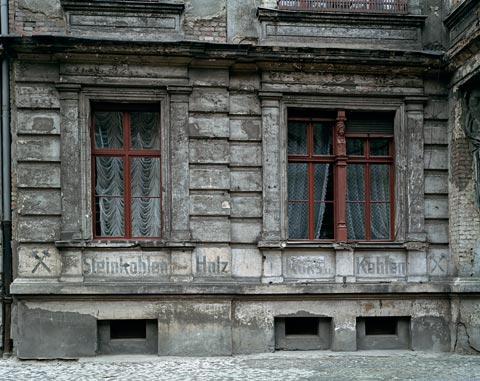
    Sidewalk shed, the New Museum, under construction on the Bowery

    Flew to New York on the weekend with my family. Plan to do more Lower East Side photos as well as begin printing the Amsterdam, Berlin, New York portfolio series that I’ve been working on. The Berlin images will include one or two of the new pictures that I posted earlier. Scroll down to see those images. Next week we’ll be in the Berkshires for some outdoor and cultural recreation.

  • Amsterdam/Berlin Scans


    River Spree, Dutch Embassy on right (4×5 film)

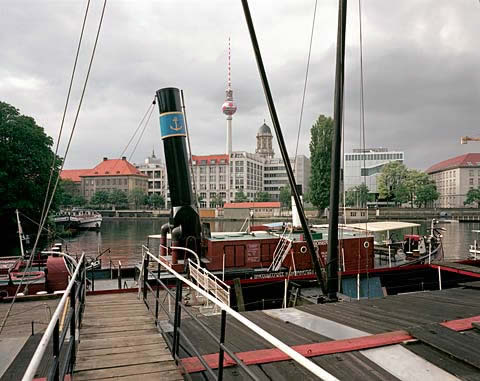
    A couple of final pictures of Berlin before I turn my attention back to New York. I was looking for the Dutch embassy, designed by Rem Koolhaas, which was completed in the last year. I came across this scene across the Spree from the building. The Fernsehturm (TV tower) was decorated as a soccer ball in the unmistakable magenta of Deutsche Telecom. Although I was focused, during my trip to Berlin, on certain key sites and areas–the Holocaust Memorial and Jewish Museum–I was also looking for more textural views through the seams of the landscape. The embassy is not prominent in the picture, but unlike most of the published architectural views, here one can see how it sits in the cityscape.

  • Amsterdam/Berlin Scans

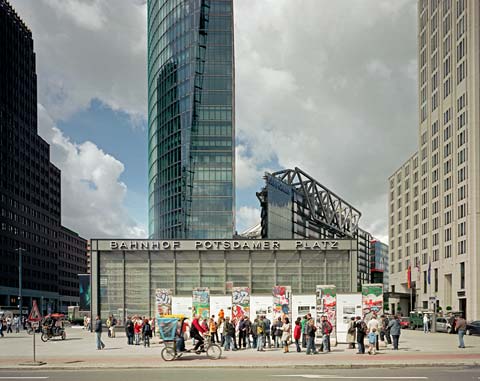
    I began my Berlin photographic odyssey in 1985 when the city was divided in two–the western part was surrounded by the Wall–and I’ve returned numerous times over the years. Like most visitors to Berlin I still look for remnants of the Wall and the DDR (East German) past. At Potsdamer Platz there is an exhibition comprised of grafittied slabs of the Wall with photos and text information on panels in between. The slabs follows the line of the border, which is marked by bricks set in the pavement. Behind is the Sony Center designed by architect Helmut Jahn.


    Wall exhibition at Potsdamer Platz (4×5 film)

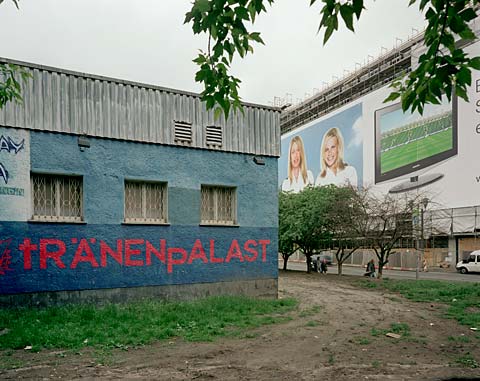
    Everything in Berlin, it seems, is a potential memorial. Overlooked by most tourists is a nondescript building adjacent to the Friedrichstrasse Bahnhof called the Traenenpalast (Palace of Tears). This was the border crossing for train passengers and subway riders. Western day visitors passed through here routinely after undergoing an extremely officious passport control. In my case, on at least a couple of occasions, it meant being ushered with my camera gear into a tiny room to be interrogated about my plans for the day. For East Germans it was the hall where friends and family from the West said their good byes before crossing back to the other side of the world. Hence the “palace of tears.” Today, it is a scruffy-looking performance venue and cultural center.


    Traenenpalast (4×5 film)

    Scroll down for more Berlin photos and observations.

  • Amsterdam/Berlin Scans

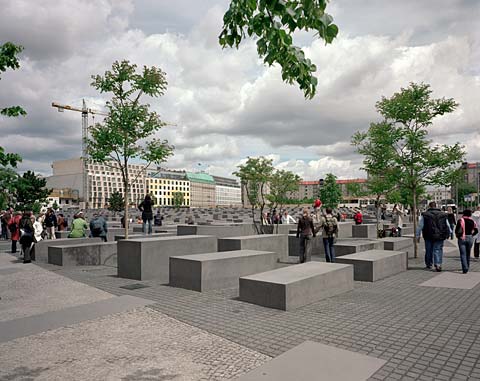
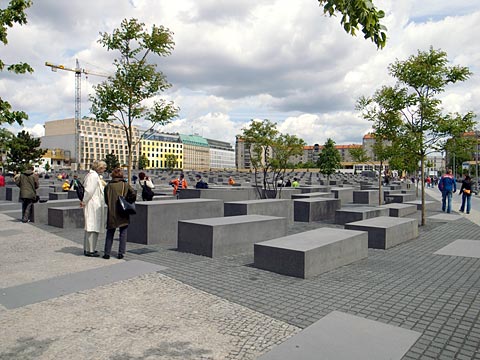
    Back to the Berlin scans. One of my goals while in Berlin was to get a good photograph of the Holocaust Memorial designed by Peter Eisenman. I spent several hours there–a somewhat blustery day with more cloud than sun. The obvious “photographer’s” view of the monument is to emphasize the abstraction of the black slabs. Telephoto lenses nicely compress the space and flatten it out, if you like that kind of thing. The picture I am most satisfied with is almost identical to the digital camera image I posted earlier.

    It’s a simple view from the southwest corner of the site. At first it seems to contain a ramdom sprinkling of objects and colors. But after looking at the image awhile I noticed a centrally located diamond shape formed by the lines of the pavement and the tree branches. Just off center a couple holds hands and directly in the middle a group of people behind some trees poses for a camera. The walls of buildings in the rear reinforce the spatial geometry of the picture. The sky vaguely mirrors the slabs of the memorial.


    Holocaust Memorial (4×5 film)

    The memorial is clearly popular, situated conveniently between the Brandenburg Gate and Potsdamer Platz. It is also located at the heart of what was once the Nazi government quarter, and in the cleared swath of the death strip of the Berlin Wall. The somberness of the dark slabs is lost on the children who run pell mell through the gridded maze. Tourists stand or sit on the slabs posing for snapshots, digital cameras held high at arms length.

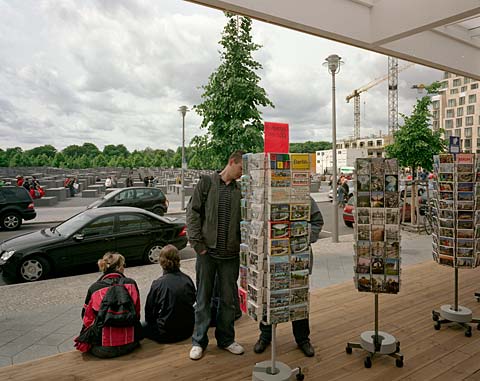
    Along the east side of the memorial a row of souvenir shops and fast food restaurants has recently been built. The stores sit on a raised wooden veranda with postcard racks and tables and chairs in front. Dunkin’ Donuts and the Monument to the Murdered Jews of Europe.


    Holocaust Memorial and postcard racks (4×5 film)

  • Amsterdam/July 4


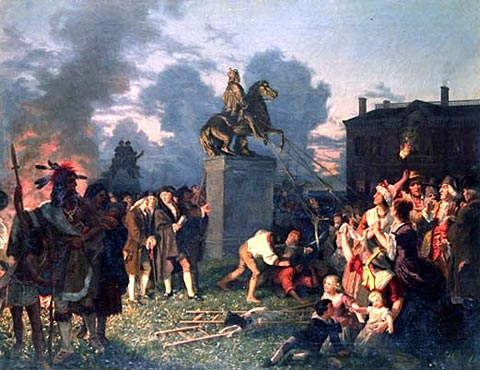
    Pulling down statue of King George III, New York City, July 9, 1776

    The following song is loosely based on the Declaration of Indpendence. Lines taken or adapted from the original text are highlighted. The recording was done straight to computer without any benefits of a recording studio. But the quality should be listenable to most ears. Please feel free to share the lyrics and sound file.

    declaration.mp3

    ***

    declaration

    in the course of human events
    these truths betray a liar

    red rockets glare our flag still there

    over baghdad nights afire

    the tyrant king usurps the throne
    lets slip the dogs of war

    terror thrown a useless bone
    to settle obsolete scores

    pull the statue down
    watch it tip fall and shatter

    break his phony crown

    and his cronies tumble after

    let facts be submitted to a candid world
    the chaos of shock and awe
    a long train of abuses

    he refuses his assent to laws

    a shadow state perpetual war
    mercenary corporations
    complete the works of death

    tyranny and desolation

    pull the statue down
    watch it tip fall and shatter
    break his phony crown
    and his cronies tumble after

    tramped on dragged through
    a prison of earthly delights
    strip searched and naked

    certain unalienable rights

    morning light frozen height
    the blinding gates of hell
    declare the causes which impel

    the day the towers fell

    pull the statue down
    watch it tip fall and shatter
    break his phony crown

    and his cronies tumble after

    throw the gauntlet down
    our lives our sacred honor

    © Brian Rose

  • Amsterdam/Ijmuiden


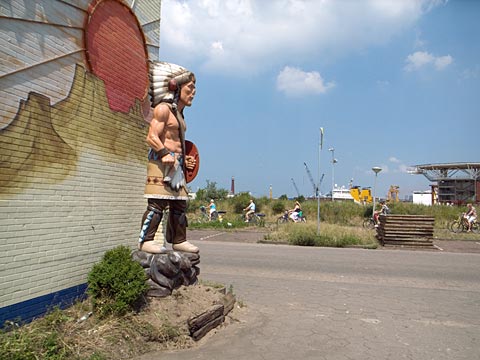
    Dutch Indian on the road to the beach at Ijmuiden

  • Amsterdam/Berlin Scans

    Since I’ve begun photographing the city in 1985, much of Berlin continues to lie exposed, whether ruined and abandoned, or under construction and in transition. I stepped into a hinterhof (rear courtyard) of a building between Mauerstrasse and Wilhelmstrasse in the heart of the old government quarter. A number of art galleries had taken over spaces hidden from view from the street, and a hodge podge of different structures, some old, some new, were revealed. I found it a particularly vivid example of the layering of the city.


    Courtyard between Mauerstrasse and Wilhelmstrasse (4×5 film)

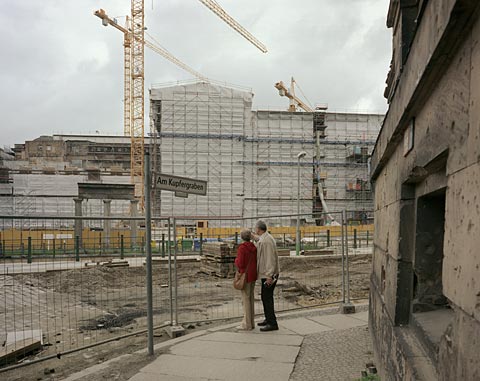
    When I first visited what was East Berlin in ’85 I was shocked by the condition of the buildings, most still showing the scars of World War II, and even the new ones already beginning to look shabby. There were a number of showcases, however, that had received some attention like the Pergamon Museum and Schinkel’s Schauspielhaus, the concert hall. The Neues Museum on the Museum Island, on the other hand, was a ruin. It is finally being renovated based on plans by David Chipperfield.

    From the architects’ website: The power of the ruin not least stems from this exposed brickwork shell, investing the building 150 years after it was first imagined, with the indelible presence of a picturesque classical ruin.

    Today the building is under construction, covered with scaffolding and towered over by cranes, that ubiquitous element of the Berlin skyline. A shrapnel pocked building was on the right, a piece of a classical collonade stood beyond wire fencing, and a tourist couple stopped to gaze.


    Neues Museum under reconstruction (4×5 film)

  • Amsterdam/Berlin Scans

    I have finally gotten my recent Berlin film developed and scanned. The pictures came out well, and there’s a lot to work with. Primarily, I am interested in two or three images to round out the portfolio I am working on: New York, Amsterdam, Berlin.


    The Jewish Museum, Berlin (4×5 film)

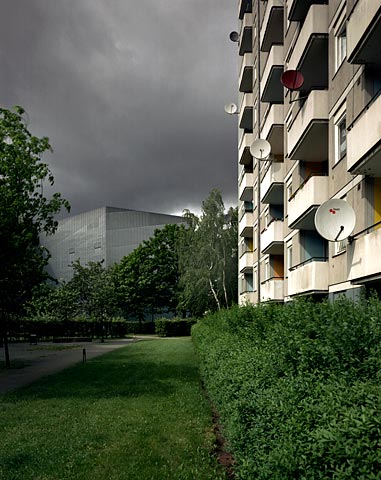
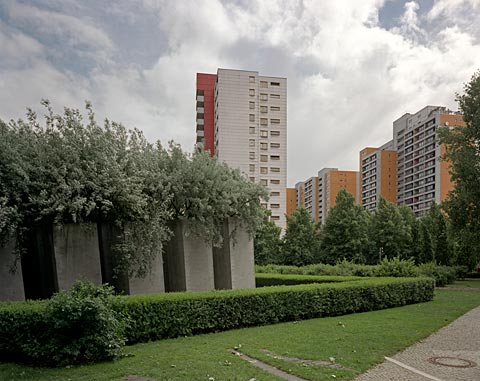
    One of the images has to be this one of the Jewish Museum. Having visited the museum before I had a sense of what I wanted to do, which was to show the relationship between the museum building and the adjacent low income housing projects. The area was virtually obliterated during World War II, and has been rebuilt in a hodge podge manner without any sense of coherence. Libeskind’s museum building, an abstracted Star of David, appears as a jagged thunderbolt in the midst of this landscape.

    From the ground it is difficult to visually connect the museum structure to the housing projects, but it’s possible to do so tangentially, showing a piece of the building or a recognizable element of the museum garden. As I wrote before, it is supremely ironic that the residents surrounding the Jewish Museum are largely Muslim immigrants, and evidence of that can be seen in the numerous satellite dishes afixed to the residential buildings.

    The day was extremely unsettled with squalls sweeping across the sky. When one particularly fierce looking storm moved in I dashed over to a postion I had scoped out earlier and took a series of pictures with the 4×5 camera.


    Jewish Museum garden and nearby housing projects (4×5 film)

    Later, I made a photograph looking south toward the apartment towers with the the Garden of Exile and Emigration (the concrete pillars with willows emerging from within) seen in the foreground. This, too, is a successful photograph, but has less drama and mystery. I like the relationship between the concrete structures of the garden and the tower blocks behind.

  • New York/Amsterdam


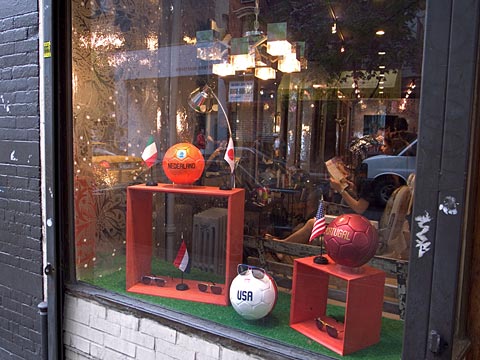
    Shop window, Prince Street, New York

  • Connecticut/New York


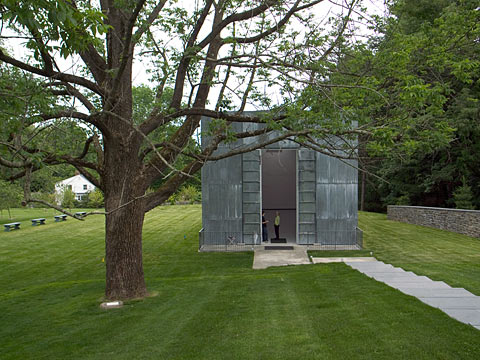
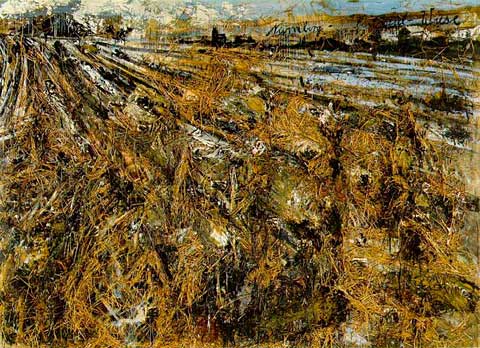
    Anselm Kiefer: Velimir Chlebnikov, The Aldrich Museum

    On Saturday, drove with friends Art and Eve to Ridgefield, Connecticut to see an exhibition by the German painter Anselm Kiefer who has created a huge multi-paneled piece inspired by the Russian poet Velimir Chlebnikov (1885-1922), one the founders of Russian futurism, the modernist art movement. To quote from the exhibit brochure: “He wrote poems and pamphlets that, through complex mathematical formulae, chart the ebb and flow of conflicts East and West, the creation of global communications systems, and the supposed existence of climactic naval battles every 317 years.”


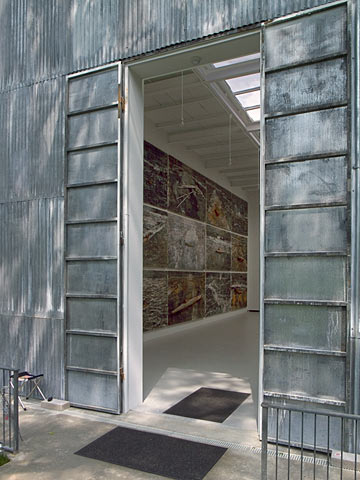
    A peek inside — photography not allowed

    The thirty canvases have lead boats and submarines wired to their surfaces along with various bits and pieces of cloth tape, straw, and dead sunflowers. Kiefer designed the shed-like building to house the paintings, and the whole thing was transported from Germany to the garden of the Alddrich. The piece is actually on loan from an anonymous owner and will only be viewable until October 1. Why anyone would acquire such a gargantuan–not to mention important–piece for their personal enjoyment is beyond me.


    Nuremberg, Anselm Kiefer, 1980

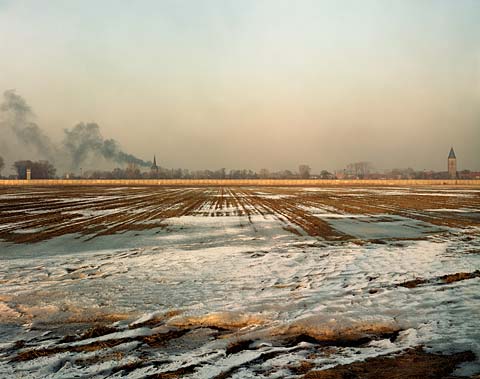
    Kiefer’s work has interested me for a long time. Back in the ’80s as I was beginning to photograph the Iron Curtain border, I saw Kiefer’s landscape oriented paintings at his gallery in New York. I then found these same haunted landscapes traveling across central Europe. I even wrote a song (mp3 file) based on the title of a series of Russian futurist drawings by Krutikov called Cities on the Aerial Paths of Communication, which was about the fall of the Soviet Union and the end of utopian idealism. I find myself attracted to the large themes that Kiefer grapples with so obsessively, though I pursue a less mythological approach.


    Oebisfelde, Germany — the Iron Curtain, 1987 (4×5 film)

    Grace Glueck of the New York Times writes of Kiefer: “he confronts the realization that civilization is still not a comfortable distance from chaos and may never be.”

  • New York/Connecticut

    Since I left Amsterdam I’ve been been dealing with necessary business stuff, and continuing to work on my portfolio. I picked up the film shot in Berlin, and will post some of the images in the coming days.

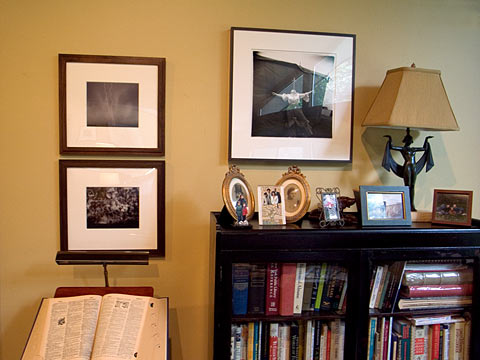
    On Friday I went up to Connecticut to visit friends Art Presson and Eve Kessler. I’ve know them both since the days when I worked at ICP (International Center of Photography) in the early ’80s. They have an outstanding collection of photography that I am pleased to be a part of. The prints hang all over their house in “salon style,” not always well-lit, but interesting for the unexpected juxtapositions of images. Most of the collection is comprised of black and white prints of modest size. Some of the images are well-known classics–like this one.


    Kessler/Presson collection with Albino Sword Swallower by Diane Arbus

  • Amsterdam/New York


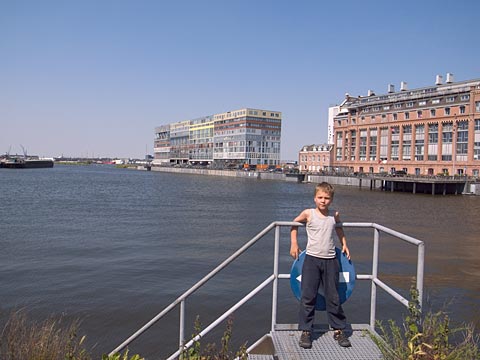
    Brendan, my son, in front of the Silodam, our apartment building in
    Amsterdam

    Back to New York with my film from Berlin and the scans I’ve been working on for the past several weeks. These I will be printing for my portfolio. Had a brief visit from my sister, Cathy Rose, who was on her way to a two-week literary workshop in St. Petersburg, Russia.

    In Amsterdam all eyes are on World Cup soccer–my Berlin pictures will, inescapably, include evidence of Germany’s hosting of the event. But I am happy to be heading back in the States in time to catch most of the NBA finals. I wonder if the Germans will be able to distract themselves from soccer long enough to see their countryman Dirk Nowitski lead the Dallas Mavericks to a possible title.

    On a darker note, the Times of London ran a story today about how the site of Hitler’s bunker adjacent to the Holocaust memorial and Potsdamer Platz has been identified for the first time with a sign in German and English. The reason given for its previous anonymity has always been the fear that it might become a right wing pilgrimage place. I have always felt that history must be acknowledged rather than covered up. Visitors to Berlin come looking for the past whether it be traces of the Wall or vestiges of the Nazi era. The city’s willingness to finally acknowledge the bunker’s location is further evidence of Germany’s confidence in itself as it moves into the future.

  • Berlin/Amsterdam


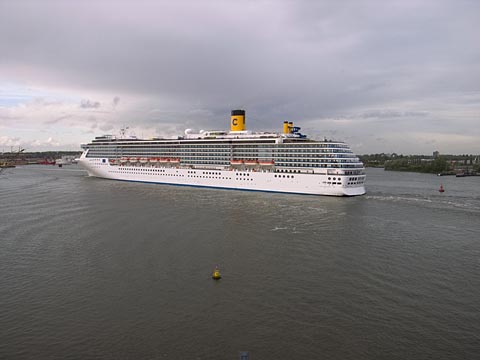
    Amsterdam, cruise ship on the way to the North Sea

    Flew back to Amsterdam. My thoughts now turn to the next trip to New York. Develop film from Berlin and scan last batch of Lower East Side pictures. Waiting patiently for architectural photography commissions to come through.

  • Berlin

    Day Four

    My last day shooting in Berlin, the weather was tumultuous with dark clouds sweeping across the sky, sudden showers and gusts of wind. It ‘s the kind of day that can drive you crazy trying to manage the view camera and keep your wits about you. But it can also lead to moments of visual drama. Fortunately, Anamarie, my friend from New York–living in Berlin for many years–came along for moral support and help with my equipment.

    We began, not by shooting, but by visiting several galleries on the Zimmerstrasse near Checkpoint Charlie, where the Wall used to run down the middle of the street. The building we went into was in East Berlin in those days. We stopped in Galerie Nordenhake and saw photographs by Esko Mannikko from Finland, someone I’d never heard of. The images were close-ups of horses and farm animals lit sharply with flash and printed in fairly contrasty saturated color. A number of the images focused on eyes, sometimes closed, sometimes open. At first glance I thought the images relied too much on the gimmick of tight cropping, but as I rounded the gallery I began to warm to them, and concluded that there was something deeply felt about the images. At the gallery desk I leafed through selections of the photographer’s other work, and found them equally compelling. Will watch for his work in the future.

    On the outside of the gallery building, words were printed on a blank wall, one of many such surfaces exposed by the bombing of World War II. The words, in German, were quotes from a homeless man talking about his life situation. The show continued inside where there were videos of various homeless men accompanied by similarly printed quotes. The work was well-done, but I’ve always been wary of this kind of aestheticizing by artists, however admirable the intention.
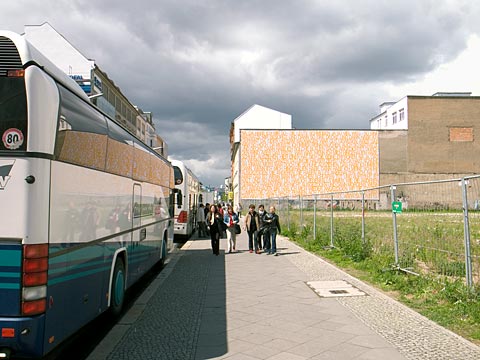

    Milovan Markovic – Homeless Berlin 2006, Zimmerstrasse
    near Checkpoint Charlie

    Most of the afternoon was spent photographing the Jewish Museum, the famous Daniel Libeskind building on Lindenstrasse. Up to this point I had never attempted to photograph the museum largely because it was not directly along the path of the Wall. But having finished the Lost Border book, I no longer felt constrained by previous limitations. The museum, of course, has been photographed by any number of serious architectural photographers and photo-journalists, so it was not my intention to add to that body of work.

    When I first visited the museum the present exhibition had not yet been installed. The empty interior spaces, employing allegory and geometric abstraction, presented Jewish history as a harrowing experience . As pure structure, the museum functioned to a great degree as a Holocaust memorial. The exhibition, however, is a historical overview of Jewish life in Germany and attempts to show the richness of Jewish culture, not just its tragic aspects. Unfortunately, for me, the exhibition is at odds with the architecture of the building, and neither comes off very well. Libeskind’s echoing emptiness is stuffed with bric-a-brac. And the exhibit itself would have been better off displayed in conventional rectangular rooms.

    But outside, the museum’s zig-zagging electricity remains as strong as ever, though its severity is somewhat softened by the lushness of the garden surrounding it, especially in late May. Most pictures of the museum don’t show the fact that it is located in a largely low income neighborhood of Kreuzberg. High rise towers with balconies festooned with satellite dishes indicate the presence of immigrants. The great irony of the Jewish Museum’s location is that it sits in the midst of a largely Muslim neighborhood.
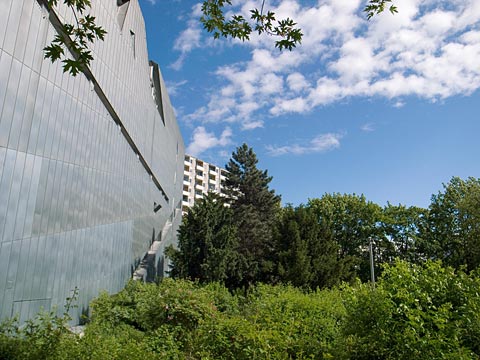

    Jewish Museum, Berlin with nearby low income apartment tower

    In the landscape surrounding the museum, the cuttout lines and slashes of the facade are delineated on the ground as well. Steel rails vector away from the building. Except for a fenced section in the rear that presumably needed to be protected, the landscape appears borderless, filtering out into the neighboring parkland.
    I did several photographs that attempt to show this integration of landscaping, though I doubt that any will be wholly successful. Other pictures I made illustrate the closeness of the adjacent housing projects. Go here for Google satellite view of the Jewish Museum.

    From there I headed back toward Checkpoint Charlie, taking pictures of interesting urban layering along the way. I did two pictures that include one of my favorite modern buildings in Berlin. The GSW building by Sauerbruch Hutton. At Checkpoint Charlie I had hoped to get a photograph of the crazy kitsch that now serves as historical monument to one of the most important and sensitive spots of the Cold War. The early ’60s checkpoint shed has been recreated complete with protective sandbags, and actors in American and Russian uniforms stamp tourists’ passports with phony East German day visas. But the street was in shadow, so I used my last sheet of film elsewhere. Go here for real checkpoint shed in 1987.
  • Berlin

    Day Three

    Once again I drove to Potsdamer Platz to begin the day. Not wanting to drive the car into Berlin Mitte where parking is difficult, I took the S-Bahn two stops to the Friedrichstrasse Bahnhof. Before 1989 this was the most common way to enter East Berlin as a visitor. The other, more famous crossing, was Checkpoint Charlie. Friedrichstrasse was also the way out of East Berlin, which was generally impossible for people living behind the Iron Curtain. Retirees, and others with some special dispensation made it across, however. The glass customs hall next to the station was the scene of emotional farewells as friends and relatives returned to the west, hence it’s nickname, Traenenpalast, or palace of tears. Today, the building is preserved in somewhat shabby condition as a historic site, and it is currently being used as a music venue. I took several photographs of the building and surrounding area.


    Traenenpalast (Palace of Tears)

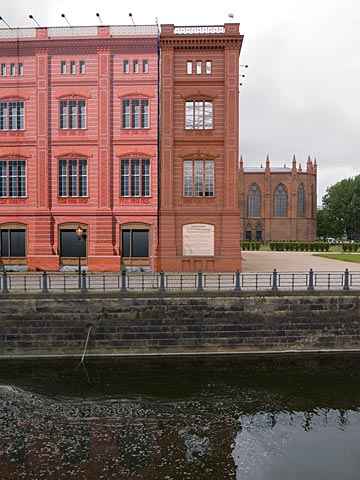
    From there I walked east below the elevated train viaduct stopping to make a photo or two, grabbing a currywurst at a makeshift beer garden across the street from the Pergamon Museum, and eventually reaching Unter den Linden in front of Schinkel’s Altes Museum, the Berliner Dom, and the partially demolished Palast der Republik across the street. I walked onto the Schlossplatz, the former site of the earlier Baroque palace, which was torn down after the war by the East Germans. The parade ground thus created was called Marx-Engels Platz and was primarily used as a parking lot for communist party functionaries. Across the Spree, Schinkel’s Bauakademie is being recronstructed–one corner of the building is complete–and the rest of the building’s volume is wrapped in a printed facsimile of the facade. I was quite taken by the trompe l’oeil effect. It was a cloudy day, but the false facade retained a permanently sunny aspect.


    Bauakademie, reconstruction based on design
    by Karl Friedrich Schinkel

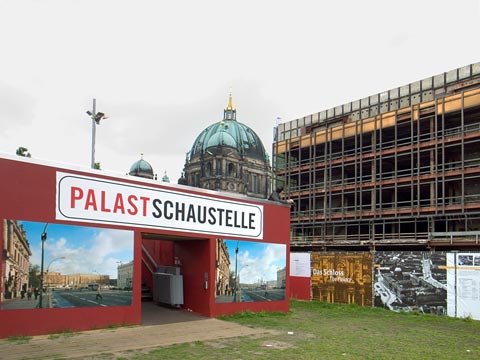
    Turning back to the Palast der Republik, I did two photographs showing the stripped frame of the building and an outdoor exhibition on the history of the site. Both the Prussian era Schloss and the Bauakademie survived the war–with damage–but could have been restored. The German Democratic Republic, short of money, and ideologically charged with cleansing the past, tore the historic structures down. Since the fall of communism, both buildings have been the subject of intense debates within the architectural community and among the public at large. The German parliament has voted to rebuild the pre-war Schloss, or at least some version of it.

    Go here for an earlier photograph of the Palast der Republik.


    Palast der Republik and exhibition, Berliner Dom

  • Berlin

    Day Two

    Began the day at the Potsdamer Platz Starbucks. That should give you an idea how much things have changed in Germany. Not to mention the fact that Potsdamer Platz was a desolate zone of abandonement with the Wall running through it until 1989. And then reconstruction only began in the mid-90s.

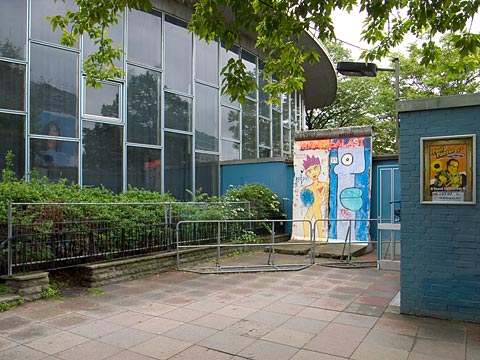
    The Platz was filled with soccer-related activities–the World Cup, hosted by Germany, is just a couple of weeks off–and on the horizon, the Fernsehturm’s ball-shaped top was decorated as a magenta and silver soccer ball. Magenta being the ever present color of sponsor Deutsche Telecom. I took a photograph of the Berlin Wall exhibit, comprised of wall segments and information panels, in front of one of the entrances to the Potsdamer Platz Bahnhof.


    Holocaust Memorial

    I then walked a short distance away to the Holocaust memorial, to be exact, the Monument to the Murdered Jews of Europe. I understand the reasons for the name, but the chilling specificity of it guarantees that it will never be used by most visitors. I’ve already had a heated conversation with someone who did not apprehend nor appreciate the fact that the memorial excluded the Gypsies, homosexuals, and other victims of the Nazis. Whatever the matter, the memorial has become an enormously “popular” tourist destination.

    I last photographed the site in 2004 when finishing up my book The Lost Border. At that time, it was mostly finished, but still fenced off. Visitors could climb viewing platforms for a better view. Now, the field of stone beckons one and all to wade in among the black slabs and descend into the disorienting grid. Children delight in the maze-like aspect of it, which is something architect Peter Eisenman anticipated. But he would likely not approve of the fast food outlets and souvenir shops that have been given residence along the eastern edge of the memorial.

    I stayed at the memorial for about three hours taking pictures. Several people came up to chat. One elderly woman from the Netherlands who remembered Kristallnacht and all that followed soon after. The sun was intermittent, which meant I had to wait for long periods of time for the light, but the skies were filled with swiftly moving clouds. I spoke with one student photographer from Germany, and told him that I was not really photographing the thing itself, but rather what contains the thing itself. By that I meant the landscape versus particular objects or events, as well as my philosophical approach to looking at the world.


    Berlin Wall Memorial, Marie-Elisabeth Lueders House,
    Reichstag in the background


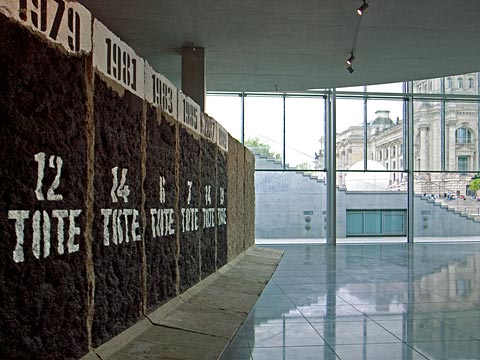
    After that I walked past the Brandenburg Gate and Reichstag taking a couple of pictures along the way. I was interested in the new Hauptbahnhof, which was about to open that weekend, but with cloudiness and light rain I moved on. I crossed the Spree river and entered a Berlin Wall memorial in one of the government buildings. A number of slabs of the Wall had been erected in a large space following the trace of the former borderline. The slabs were painted with the numbers of people killed trying to escape across the border each year beginning with 1961 when the Wall was erected. The presentation was credited to the building’s architect, but I knew that the idea was taken from an earlier unofficial memorial done outside by Ben Wargin. Here is the original installation.

  • Berlin

    Day One

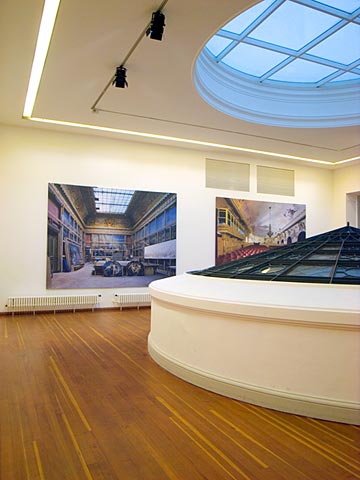
    I flew into Tegel airport, a hopelessly outmoded airport left over from the Cold War days, rented my car, and met up with my friend Anamarie at her house in Zehlendorf. It rained heavily all afternoon, so we went to the Martin-Gropius-Bau (museum) to see the Robert Polidori show. I have long admired Polidori’s architectural photography and have two of his books. There is a strong formal rigor to his compositions, which anchors the lush colors of old Havana or the acidy greens and purples of abandoned Chernobyl. This was the first time I’d seen his large prints–size being the rage these days–but appropriate, perhaps, for his work. The prints appeared to be conventional c-prints mounted on plexi or some other backing and then floated inside a frame. It is clear that the prints were made from digital scans, the tonal range often a bit unbelievable–shadows too open, highlights too closed, colors too saturated, separate surfaces too well delineated. Sometimes it gave his images a Vermeer-like photo-realism, which was enhanced in the Versailles pictures by the side light and glimpses of other rooms through doorways. But was this quality intentional? Would the prints have worked just as well with a lighter hand in Photoshop?


    Polidori at the Martin-Gropius-Bau, large digital prints

    The Martin-Gropius-Bau spaces were haphazardly lit, and I fought reflections constantly, but the older architecture of the galleries suited the images fine. I could have used fewer prints, however, and wish the exhibit had stayed exclusively with the Havana, Chernobyl, and Versailles images. Two extremely large images, digitally rendered more coarsely than the others, were completely unnecessary and should have been left out. I enjoyed the exhibit, despite the above complaints, but I prefer Polidori’s books and seeing his color spreads leap out of the black and white print of the New Yorker magazine.


  • Amsterdam/Berlin

    I’ve been working pretty much every day on the scans I did in New York a few weeks ago. There are about 45 images all together, 15 each from New York, Amsterdam, and Berlin. The plan is to print these at 20×24 inches for portfolio purposes with a few, perhaps, at 40×50 inches. I will be working with Ben Diep in New York at Color Space Imaging to make the prints.

    The Berlin series includes a few of the Lost Border pictures, but none from before 1989 when the Wall came down. A number of them were made in what was East Berlin and show vestiges of the former Communist regime. One picture was shot through the Iron fence in front of the Soviet embassy on Unter den Linden, a bust of Lenin staring outward. Another includes a large statue of Lenin standing on a traffic island in front of a large housing project. And I made several photographs of the Soviet war memorial in Treptow, a monumental assemblage of statues and stone sarcophagi with bas reliefs depicting the heroism of the Soviet Army. There are quotes by Stalin etched in stone, chilling to encounter in person. The memorial at Treptow still exists and is being actively maintained, but much of Communist East Germany has already disappeared. The Palast der Republik is presently being torn down (see pictures here on Flkr), and I have a photograph from the late ’90s that will be part of my Berlin series.


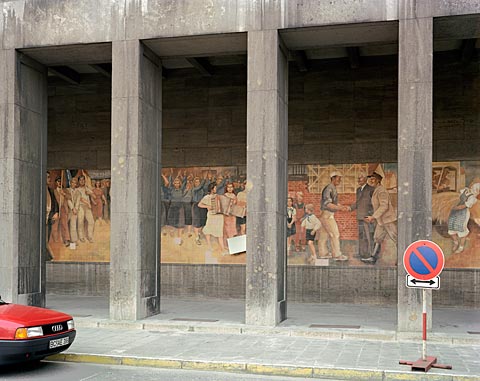
    Communist era mural (4×5 film)

    Another existing piece of pre-1989 history, a mural illustrating the supposed worker’s paradise of the German Democratic Republic, has been preserved in Berlin Mitte. My photograph was made shortly after the Wall came down. I also took some photographs of East Berlin before ’89, see below, but I found the experience unnerving, and felt that it was just a matter of time before I was detained by the East German authorities. So, I ended that mini-project after several days of work.


    East Berlin, 1987, before the Wall came down (4×5 film)

    Thursday I am flying to Berlin and plan to put in three or four days shooting. I no longer feel the need to stick to the former path of the Wall, though I will certainly retrace the line through the center of the city. I will see what’s left of the Palast of the Republik, and I am hoping to get a good photograph of the Holocaust memorial near Potsdamer Platz. I will also take a look at the new central train station recently completed near the Reichstag. Since I am traveling without a laptop, I won’t be able to post anything until after I return next week.