Category: Photographers/Photography

  • New York/Death of Photography


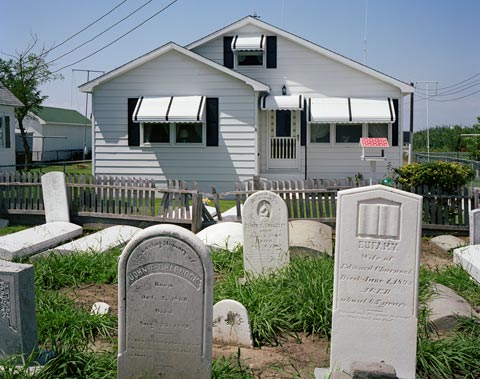
    Tangier Island, Chesapeake Bay, Virginia, 1984 (4×5 film)

    Is Photography Dead? Peter Plagens in a Newsweek article makes a mess of the recent explosion of photography in the museum/gallery scene and the concomitant use of Photoshop to create seamless fictional realities.

    Here’s the key paragraph from his article:

    Yet wandering the galleries of these two shows (the Met and National Gallery), you can’t help but wonder if the entire medium hasn’t fractured itself beyond all recognition. Sculpture did the same thing a while back, so that now “sculpture” can indicate a hole in the ground as readily as a bronze statue. Digitalization has made much of art photography’s vast variety possible. But it’s also a major reason that, 25 years after the technology exploded what photography could do and be, the medium seems to have lost its soul. Film photography’s artistic cachet was always that no matter how much darkroom fiddling someone added to a photograph, the picture was, at its core, a record of something real that occurred in front of the camera. A digital photograph, on the other hand, can be a Photoshop fairy tale, containing only a tiny trace of a small fragment of reality. By now, we’ve witnessed all the magical morphing and seen all the clever tricks that have turned so many photographers—formerly bearers of truth—into conjurers of fiction. It’s hard to say “gee whiz” anymore.

    First of all, there have always been photographers who used the medium to create alternate realities, or who sought to make photography more art-like by using different techniques, materials, or color palettes, and, of course, those who mixed media to create hybrid objects that were not easily classifiable. Indeed, it has long been understood that photography’s relationship with reality, while rooted in it, is tenuous. Even a photographer like Cartier-Bresson considered himself, ultimately, a surrealist despite being the epitome of a “straight photographer.” As the Richard Lacayo wrote in Time earlier this year:

    We connect Cartier-Bresson to photojournalism because he founded the news photo agency Magnum. But he was trained first as a painter. And when he started to take pictures in the early 1930s he wasn’t interested in gathering news. He was a newly hatched surrealist on the hunt for miracles, moments when the real world somehow gave you a fleeting glimpse of the uncanny.

    I recall the John Szarkowski curated show at the Modern in 1978 (just after I arrived in New York) called Mirrors and Windows, which posited two main paths in photography, the one seeing out into the world through a frame, the other reflecting the inner world of the photographer. This dialectic made for a contentious exhibition–which side of the great divide do you live on? Obviously, there was and is no clear divide between inside and outside, although there is no doubt that photographers and artist have different intentions with regard to depicting the inner and outer world. Those intentions are still at the heart of the matter, and the introduction of Photoshop has not changed things one bit.

    Robert Hughes, back then, wrote in Time about Mirrors and Windows:

    The most striking thing illustrated by the show is how far behind photography—meaning the photographs Szarkowski designates as “serious”—has left its old role as witness to public events. …Wars, elections, riots, disasters, communal ecstasies, the speeches of politicians and their deaths—all are eaten up by the omnivorous lens, as photography (through journalism) defines the terms of our fictitious intimacy with the world.

    So in 1978 Hughes talked about photography and the “fictitious intimacy” with the world, and now almost 30 years later Plagens refers to photographers as former bearers of truth turned into “conjurers of fiction.” Plagens goes on to suggest that the turning point in this move away from realism was the work of Cindy Sherman, specifically her movie stills series, which quoted a photographic genre expressive of verisimilitude as opposed to unmediated reality. As actual photographs, however, they are documents of a performance–her dressing up and posing in carefully chosen locales–and have nothing to do with a Photoshop created reality. While they were groundbreaking pictures conceptually, they were, otherwise, conventionally made.
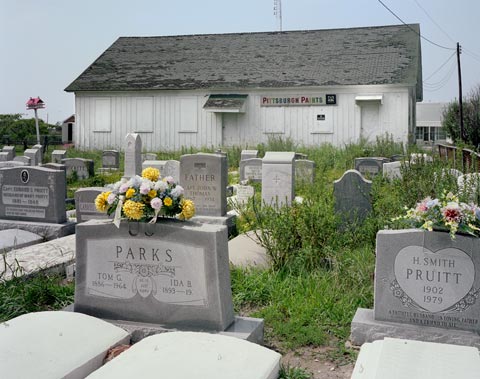

    Tangier Island, the Chesapeake Bay, Virginia, 1984 (4×5 film)

    For a while it appeared that postmodernism, which Cindy Sherman is linked with, declared every creative endeavor dead on arrival. How could one write a conventional story, make a painting, or compose music as authentic expressions of observation or self-reflection once we knew that such attempts were exercises in futility like trying to nail jello to a wall?

    Well, we stared down that abyss and moved on with a myriad of different strategies (fractured beyond all recognition) in spite of the eschatological pronouncements of the high priests of art criticism. I will have more to say about all this, perhaps, unless the now useless task of making photographs gets in the way. Stay tuned.
  • New York/Houston Street


    Houston Street

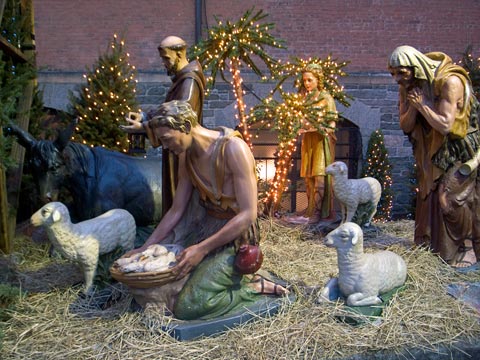
    Manger scene in Soho.

  • New York/New Museum


    The New Museum (4×5 film)

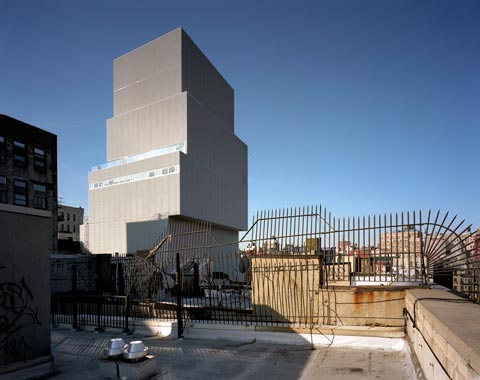
    Here is a wider view of my rooftop looking toward the New Museum made with the 4×5 camera. It was a crisp, but not uncomfortably cold morning. This is the back of the building, although, except for the transparent glass ground floor, there really isn’t a front or back to the tower. But since it only takes up a small lot on the Bowery, it will tend to be viewed primarily from the street.

    This is an oblique view that will work well in my Lower East Side series–a roofscape rather than a streetscape. Another icon of the rapidly changing neighborhood.

  • New York/Gorbachev


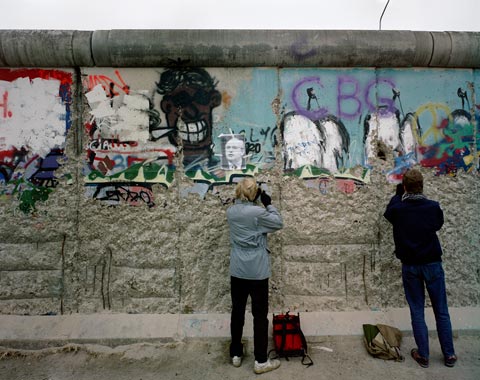
    The Berlin Wall (click for closer view)

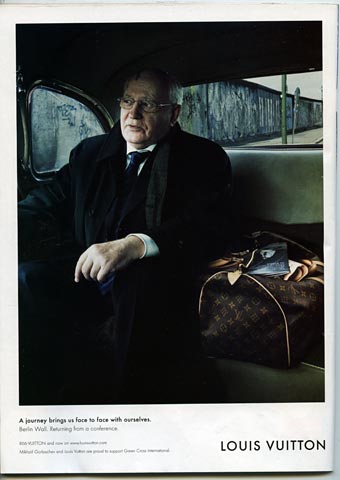
    Gorbachev and the Berlin Wall 1989.


    Photo by Annie Leibovitz

    Gorbachev and the Berlin Wall 2007.

  • New York/LES

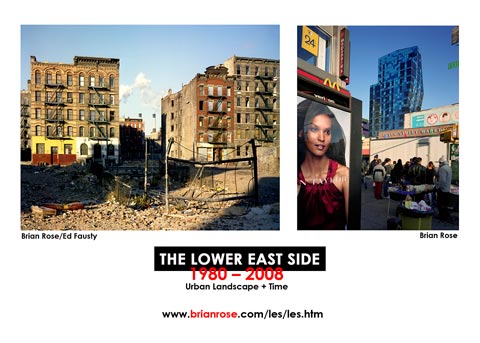
    Today I launched my newly redesigned Lower East Side web pages. I’m planning to send out, shortly, the card above. As I worked on the new LES pictures, I realized that I have a surprisingly complete set of images of the Bowery taken in the past five years. This last remaining strip of gritty reality in Lower Manhattan is poised for rapid gentrification, the recent opening of the New Museum a vivid marker of the change. So, I am also putting together a Bowery web page.

    Yesterday, I discovered that the popular blog MetaFilter featured my Lost Border website, and since then, I’ve gotten about 1,500 visits–it’s usually 50.

  • New York/Eldridge Street Synagogue


    Rivington Street

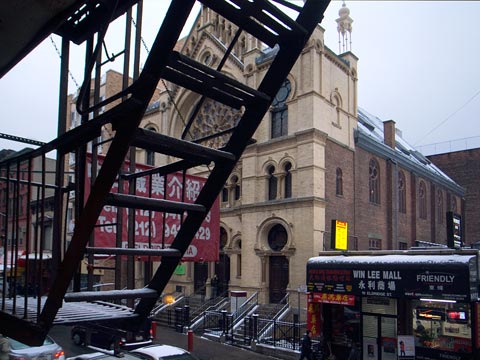
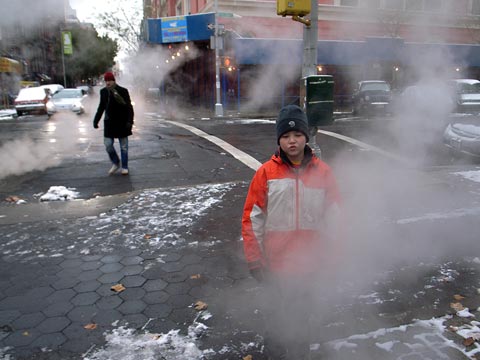
    It snowed on Sunday and for much of the day the city looked quite magical. Brendan, my son, and I walked across town and down the Lower East Side to visit the opening of the newly renovated Eldridge Street Synagogue, which as I understand it, will be called Museum at Eldridge Street. The restoration looked beautiful, a good sized crowd was on hand, and a klezmer band played jauntily in the main sanctuary.


    Eldridge Street

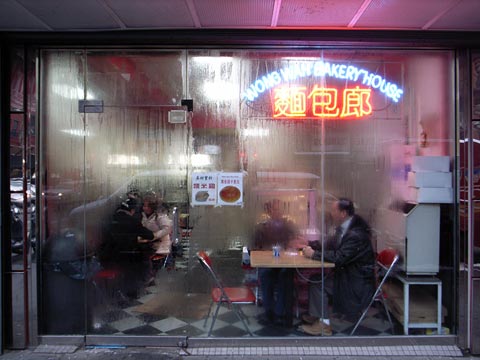
    The synagogue is located at the southern end of Eldridge Street near the Manhattan Bridge, an area that is now the heart of Chinatown. The incongruity of the old world Moorish themed building surrounded by Chinese businesses is striking. But this is the kind of jarring cultural collision that makes the Lower East Side and New York in general so fascinating.


    Eldridge Street


    Canal Street


    Canal Street


    Brendan on Forsythe Street

  • New York/New Museum


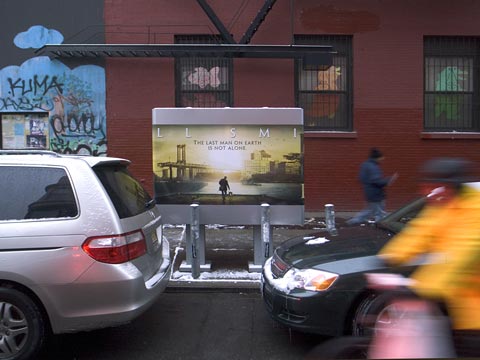
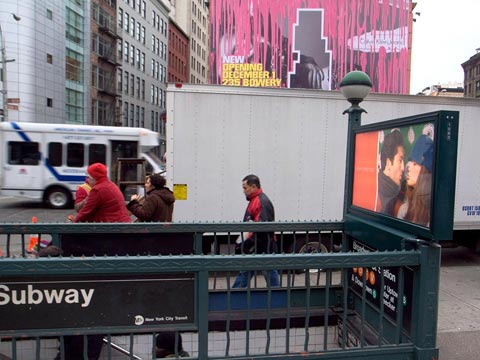
    Calvin Klein ad morphs into New Museum ad on Houston Street

    Well, I won’t be going to the New Museum today as planned because they have already given out all the tickets to the 30 hour free admission marathon. The ultimate brilliance of the New Museum may be their ability to harness the full corporate/media juggernaut that runs this town. Will “new” art be mostly about the art establishment creating a new brand? Will the New Museum serve primarily to give museum imprimatur to artists already ensconced in the commercial galleries? For those of us toiling in the shadow of the museum–literally in my case–the museum may represent a shining, but unattainable Oz.


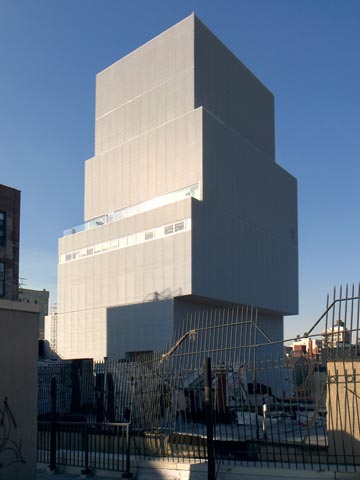
    The New Museum from my rooftop

    Yesterday morning I climbed out my window and up the fire escape to photograph the New Museum from the roof. It is perhaps the best way to view the building, its off kilter boxes emerging amid the confusion of the elevator sheds, skylights, and water towers that define the rooftop landscape of lower Manhattan.

    The New Museum building, designed by Kazuyo Sejima and Ryue Nishizawa of the firm Sanaa, is, on the one hand, a pristine object standing aloof from the still very gritty Bowery. But viewed close up, the metal scrim, which glistens in the sun from a distance, is rather more utilitarian. As I wrote a while back in an earlier post, it has a provisional off-the-shelf feel unlike the richer materiality usually associated with museums. It is, after all, a institution dedicated to the here and now as opposed to the preservation of the past.


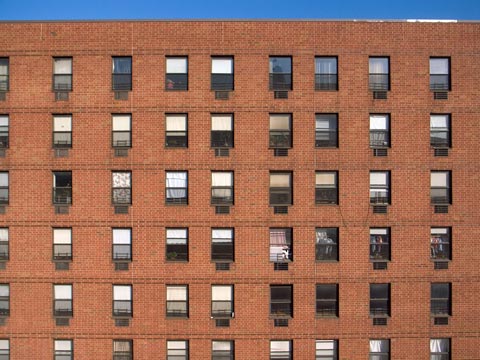
    Thelma Burdick apartments

    I took a number of pictures with the view camera, a few not including the New Museum. Running the whole block of Stanton between the Bowery and Chrystie is a low income housing project built during the ’80s composed of an endless monotony of brick and windows. This, too, is part of the neighborhood in which the New Museum now calls home.

  • New York/Hampton Roads

    I traveled with my family to Virginia for the Thanksgiving holiday to visit with my parents–separately–as has been necessary since their divorce a long time ago. Extended sit downs with one parent or the other are to be avoided since they usually, unfortunately, turn painful. My mother reminisces about my growing up, remembering things as a parallel universe that barely jibes with my own recollections. My father, who is elderly but not senile, cannot or chooses not to remember anything at all.


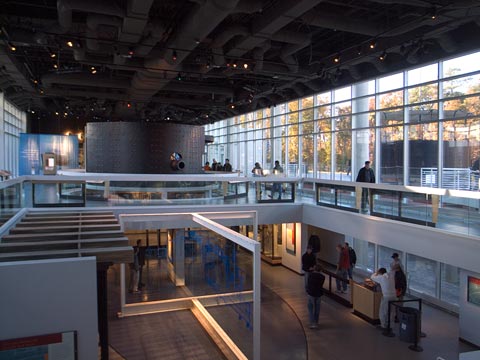
    The Monitor Center, The Mariner’s Museum, Newport News, Virginia

    So, excursions out into the real world are necessary, especially since we are traveling with a nine year old who is not content to sit around the living room.
    This time we drove down the peninsula (between the James and York rivers) to the Mariner’s Museum in Newport News. I’d only been there once as a child and knew that much had changed in the last few years, most notably the building of the Monitor Center, a new wing of the museum to house the recently recovered turret of the ironclad Civil War ship the Monitor.

    The Monitor Center is actually a vast addition to the original museum, perhaps doubling its size, and it tells the story of the famous battle between the Monitor and the Merrimac (dubbed the Virginia by the Confederates). The center includes interior and exterior mock-ups of both ships as well as the actual rotating gun turret of the original ship salvaged from beneath the sea off the Outer Banks of North Carolina.


    Monitor memorial, Greenpoint, Brooklyn

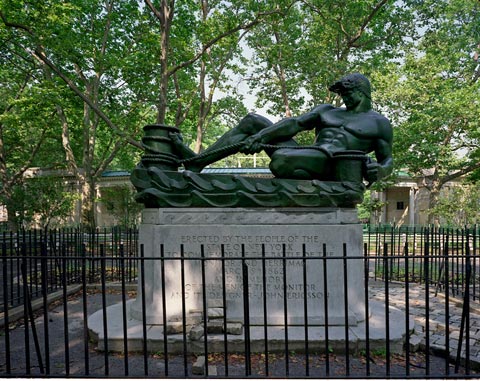
    Earlier this summer I photographed the Monitor memorial in McGolrick Park in Greenpoint as part of a documentation of Civil War monuments in Brooklyn. Standing before the memorial for the first time I wondered why this rather odd statue was placed here. On it were the words:

    ERECTED BY THE PEOPLE OF THE
    STATE OF NEW YORK

    TO COMMEMORATE THE BATTLE OF THE
    MONTOR AND MERRIMAC
    MARCH 9TH 1862

    AND IN MEMORY OF THE MEN OF THE MONITOR

    AND ITS DESIGNER JOHN ERICSSON

    Later, I found out that Ericsson, a Swede who had come to New York via a successful engineering career in London, was the designer of the Monitor and supervised its construction and launching into the East River from a shipyard in Greenpoint. None of this information is provided by the inscription beneath the statue of a stylized heroic figure pulling on a diminutive ship’s hawser. The nude figure carries no reference to a period of time, and the tiny ship bears no resemblance to the Monitor. And McGolrick Park, while in Greenpoint, is not particularly close the place where the Monitor was assembled and launched.

    So it goes with a majority of memorials that inhabit, often invisibly, the streets and parks we pass through daily. The event, person, or locale depicted has, with the passing of time, become disconnected from our own era. These, often, lavish tours de force of sculpture serve more as urban furniture than as carriers of memory or history.


    The Monitor’s turret

    In Hampton Roads, in the heart of Navy country, the battle between the Monitor and Merrimac is central to the region’s symbology and meaning. The Monitor’s turret lies in repose beneath a watery solution (eventually to be exhibited dry) like Lenin embalmed in his tomb in Red Square. The accompanying exhibition is exhaustive in detail, almost fetishistic in its focus on this one story and object.

    In New York, however, where the Monitor was built, there are two monuments offering cryptic references to the ship and the battle. One is the strange sculpture in Greenpoint, the other is a statue of Ericsson in Battery Park in Manhattan, which I have undoubtedly walked by, but have so recollection of ever seeing.

  • New York/LES


    Delancey Street (4×5 film)

    Another Lower East Side photograph. Garishly photogenic Delancey Street between Suffolk and Clinton. This one is the 4×5 version seen in an earlier post.

  • New York/LES


    Clinton Street

    It’s four in the morning, the end of December
    I’m writing you now just to see if you’re better
    New York is cold, but I like where I’m living
    There’s music on Clinton Street all through the evening.

    Leonard Cohen (Famous Blue Raincoat)


    Houston Street

    a man lay dead on Houston street
    he’d been dead for many days
    and they all walked by with nervous feet
    as though he was just drunk or dazed

    after all there was nothing they could do
    like donate time or money
    but I’m going on back to Houston
    where they don’t talk so funny

    Jack Hardy (Houston Street)

  • New York/The Bowery


    The Bowery and Houston Street

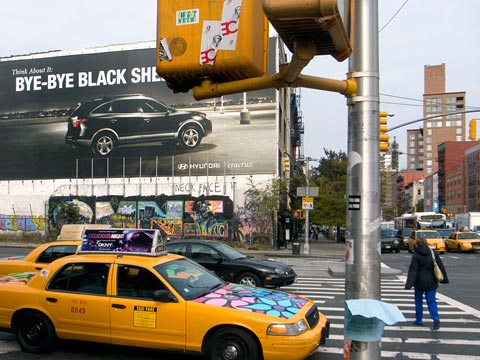
    There will be a short period of history in which many of the cabs in New York were seen stickered with flowers. It’s an art project involving children from schools and community groups who colored the decals. Here’s the official website if you’re curious.

    Previously, such momentary cultural expressions might get photographed, but the specific circumstances of the thing would be lost along the way. In today’s flourishing blogosphere, flowered taxis will not go undocumented.

  • New York/Bleecker Street


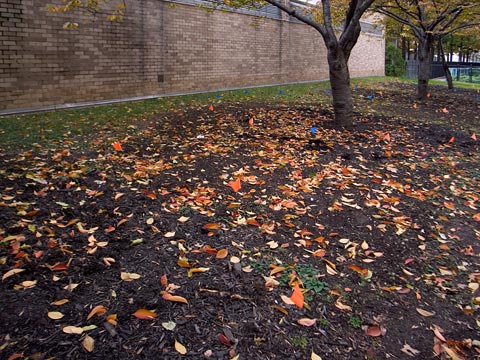
    Leaves and flags on Bleecker Street

    Without comment.

  • New York/First Color Photo


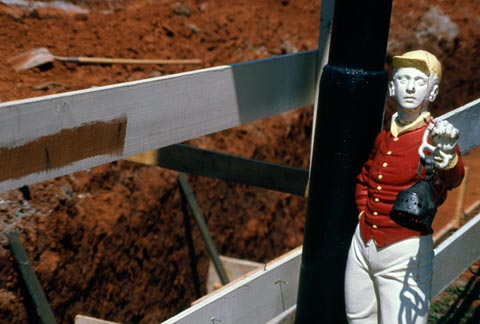
    Richmond, Virginia, early ’70s

    I got my first camera when I was a teenager, a Nikkormat 35mm with a 50mm lens. I had bought it with my savings and hid it away for a year because my parents were not enthusiastic about my “hobby.” I surreptitiously shot black and white film for a while and had some small glossies made. I was pretty good right off the bat. At some point I ran a roll of Kodachrome through the camera.

    The photo above was from that roll. I was, perhaps, 16 or 17 years old. I remember that it was taken in Richmond, Virgina, which is an hour away from Williamsburg where I grew up. It’s a fully realized image. I knew somehow what I was doing, maybe a mixture of luck and intuition. The photograph doesn’t mean anything necessarily, though such lantern jockeys were common in those days, especially in black face, and I may have been thinking about the social significance of such things.

    What I see is a vigorous composition of lines and colors incorporating a vernacular street object, an eyeless blank gaze, the raw earth of a construction site, a shovel slightly out of scale in the rear. For a number of years afterwards, I tried to make black and white pictures do what this color slide does. I did all right, of course, but I don’t think any of my photographs were as good as this early one. It was only in 1976 when I began shooting color in a systematic way that I found–or re-found–my way.

  • New York/Glass Houses


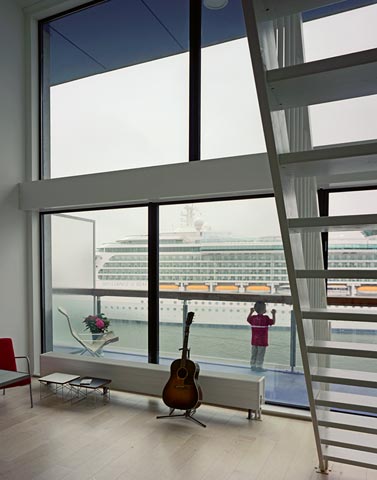
    Silodam apartment, Amsterdam
    designed by MVRDV architects

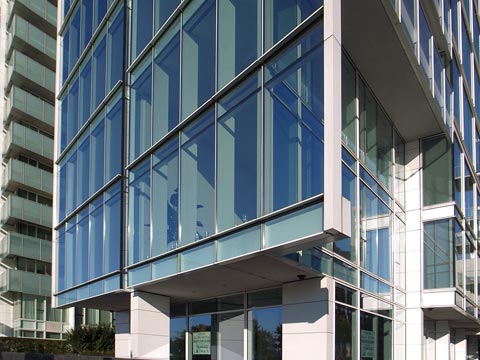
    When the glass Richard Meier towers on the Hudson in the West Village appeared a few years ago, they were heralded as a new phenomenon. At least in New York. Having lived much of the last 15 years in Europe–the last few behind double height windows overlooking Amsterdam–I was surprised to see the furor these new buildings elicited. I knew that New York (and the US in general) had slept through the 90s, architecturally speaking, but now in the 00s, things were changing. So, what was the fuss all about?


    Richard Meier in the West Village

    Last Sunday in the NY Times, the issue was further inflated, if not examined, in an article by Penelope Green:

    In New York City, where the streetscape is being systematically remade by glassy towers like the W, which have been spreading like kudzu in the seven years since the first two terrarium-like Richard Meier buildings went up on the West Side Highway, the lives of the inhabitants are increasingly on exhibit, like the performance art wherein the artists “live” in a gallery for 24 hours and you get to watch them napping or brushing their teeth.

    It’s not always a pretty picture.

    She goes on to reference Curbed, the snarky real estate blog (that I’m addicted to), Hitchcock’s Rear Window, and Sherry Turkle, a psycholgist at M.I.T., who proclaims life in a goldfish bowl “a turning point in form.”

    I think there are a number of social trends at work here, and pulling them apart tends to trivialize the matter as Curbed does cheerfully, and Turkle does more ominously:

    These buildings, she suggested, tell a story of anxiety, not exhibitionism.


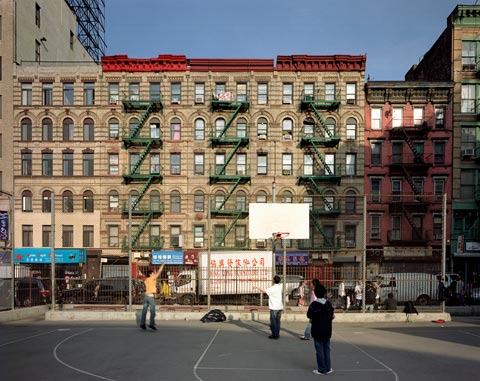
    Eldridge Street, Lower East Side tenements

    In my view, New York has historically been a city with a clear distinction between public and private spheres. The street was, and is, the grand theater of urban life. People here have always lived in small quarters, sometimes inhumanely crowded together as on the old Lower East Side. The street was the space where people interacted, shopped, and communicated, while the skyline provided the dramatic backdrop. The street grid functioned as an ordering structure for all the energy, commercial and creative, flowing in the city, and the continuous street wall guarded the mini domestic castles of apartment life.


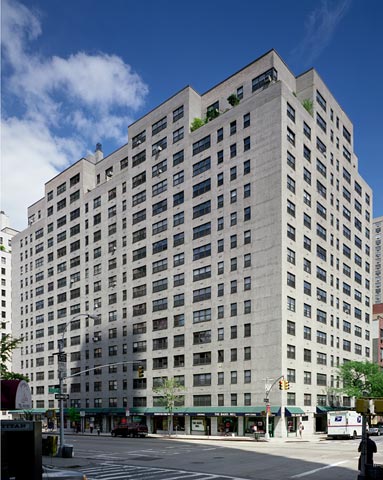
    Punch card conformity on the Upper East Side

    Modernism called for transparency in architecture, and in New York, that aesthetic conflicted with the notion of protected private space. Corporations embraced the glass curtain wall for economic reasons and efficiency. But there was little to see behind those walls besides endless cubicles and generic corner offices. Ironically, the World Trade Center with its barred pinstripe fenestration demonstrated profoundly its structural weakness. Few developers, however, were willing to risk disturbing the status quo when it came to residential buildings.

    After 9/11 something happened in this city that has only been tangentially addressed. Certain fundamentals changed in the way things work, for better or worse. Despite the horror of the event, the city reasserted itself and began moving forward. Crime, already down, continued to plummet. Population increased. People started having families in the city, a dramatic turnaround after decades of flight to the suburbs. And for many, the silly post modern buildings of the 80s and 90s suddenly looked out of date and irrelevant.


    Hell’s Kitchen tenements with 90s post modernism

    There are those who bemoan the changes that have occurred. Some believe that the city has lost its soul from Disneyfied Times Square to the formerly dark neighborhoods of lower Manhattan. People reminisce endlessly about the ferment of art and music back in the late ’70s when there were cheap apartments, empty streets, and danger lurking. In many ways they are right–more economically marginal activities have decamped to other parts of the city–but it does little good to pine for the past when there is a present being defined by new generations with different priorities and a different internal map of the city.

    I have come to believe that in recent years there has been a noticeable shift in the relationship between public and private space in the city. September 11th stripped bare the illusion of security symbolized by the walls, honey-combed rooms, and claustrophobic elevators of our homes. Inside those walls we are all online now, as is pointed out in the Times article, and the definition of community has been redefined. It takes place in real places and virtual ones interchangeably. And as has always been the case, money is the engine of this most commercial of cities. Since 9/11 money has sloshed through the streets of this town like water sweeping away and through all our old haunts.

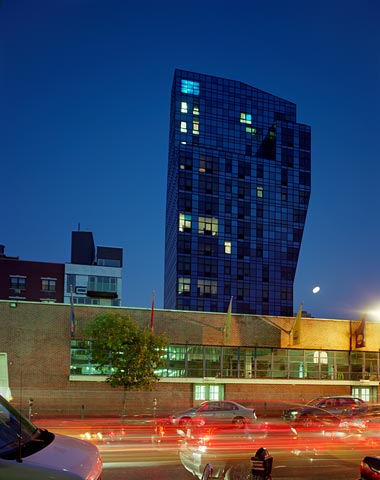
    Blue Condo, conspicuous consumption on the Lower East Side
    Bernard Tschumi, architect

    The new New York is not about hunkering down behind walls. Modernism’s (now ancient) promise of light, air, and transparency is upon us, finally. We all live in glass houses, at least in the virtual world, so we might as well live in them in the real as well. For some it represents a kind of exhibitionism–we have nothing to hide–and there is no shortage of voyeurs with telescopes and cell phone cameras at ready, not to mention the hydra-headed apparatus of homeland security. But for others it is a breath of fresh air–and light–in a place called home.

  • New York/Midtown


    Midtown, somewhere in the 50s

    Without comment.

  • New York/West Village


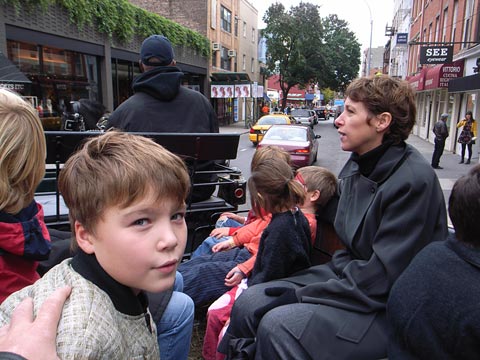
    Brendan and Renée taking a hayride

    Saturday was Fall Festival at Brendan’s school–a seasonal fund raising event coming right after Halloween, which is an all day extravaganza at school followed by trick or treating and the Village Halloween parade. It’s fun, but all a bit over the top for me.

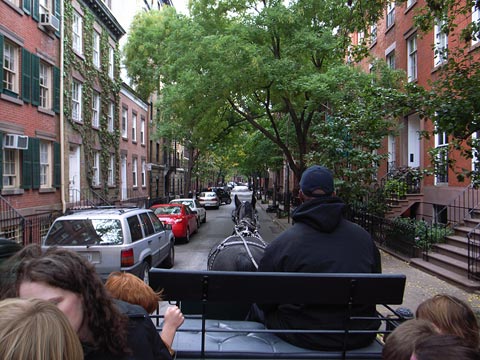
    As part of the festival, we took a hayride through the streets of the West Village. If you squint a bit, and pretend the cars aren’t there, it could be 150 years ago.


    Barrow Street

    Meanwhile back in Washington:

    WASHINGTON (CNN) — The Department of Homeland Security will investigate a Halloween costume party hosted by a top immigration official and attended by a man dressed in a striped prison outfit, dreadlocks and darkened skin make-up, a costume some say is offensive, the department’s secretary said. Julie Myers, head of Immigration and Customs Enforcement and host of the fundraising party, was on a three-judge panel that originally praised the prisoner costume for “originality.”

  • New York/LES

    Take what may be called “the” typical tenement house district, the triangle or rather trapezium, bounded by Fourteenth Street, the Bowery and the East River. This district comprises the even numbered Assembly Districts from the Fourth to the Sixteenth, inclusive, and the population of it is just short of half a million, 480,626. It is thus in itself the second city in the State of New York.

    It is perhaps the most crowded district in the world. Part of it certainly carry congestion to the utmost limits. The normal habitation is the “double decker” tenement, four families to the floor, five floors high, often six, sometimes, by dint of a high stoop and a basement for shops, seven. And this population in a large measure and particularly in hot weather lives on the sidewalks. There are squares where it is hard to make one’s way, for the absolute pressure of the crowds of sitters and standers.

    -New York Times, July 21, 1901

    On Friday I did a three hour Lower East Side walk. Moving slowly, I covered a relatively small area, but took about a dozen photos with the view camera. The first spot I got to was of a vacant lot I photographed in 1980 with a mural of a baseball game on an adjacent wall. The painting had faded, but was still visible. A few days ago I noticed that the wall was in the process of being torn down. When I arrived yesterday, it was mostly gone, and a fence obscured the view, though I did a shot of it anyway.

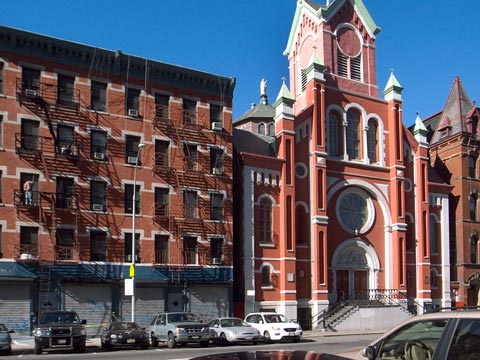
    Around the corner on Pitt Street, I photographed a large Catholic church and tenements next door. It was a crisp fall day, and the light was beautiful. I moved on down Pitt Street toward the Williamsburg Bridge and did a couple more photographs on the same side of the street.


    Our Lady of Sorrows church, Pitt Street

    The church, Our Lady of Sorrows, was apparently once called St. Aloysius and had a largely German congregation according to the 1901 New York Times column quoted above:

    There is a remarkable church, remarkable for the spaciousness and gorgeousness of its interior in such a region, St. Aloysius in Pitt Street, attached to the Capuchin monastery at Pitt and Stanton. How many readers of this paper know that there is such an institution in New York as a monastery of barefooted Capuchin friars?

    This church holds its services in German, and it is a curious testimony to the changing conditions of its neighborhood that the authorities report that its congregation has sadly fallen off of late years by reason of the migration of its parishioners.


    Attorney Street

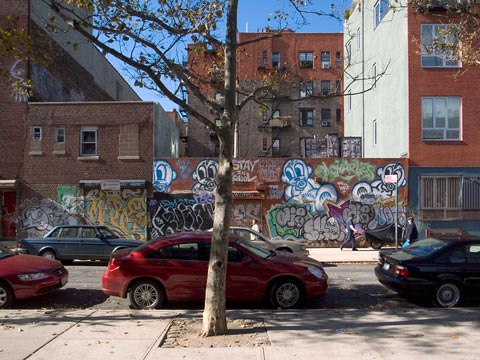
    I turned the corner at Delancey Street and walked west, turning again into Attorney Street. I mad two photographs in the street including one with a graffitied wall by Andre Charles with his street logo “Brandon,” a baby with a pacifier in its mouth. Charles’ stuff is pretty good, and on his website he writes:

    But through out the year’s I was painting walls, doing night clubs, running with the lady’s, which is all part of being a famous urban super star artist from the hood. I really didn’t understand what I was really doing or what was going on around me. All I know is when I look at T.V., pictures in art books of other artist. I wanted to be famous just like them. So I went out to do what I’ve seen as a young entrepreneur black boy from the SOUTH BRONX running after my dreams.

    He goes on to thank God for his gift, which, despite the modesty/bravado is significant. All the graffiti writers, including Charles, ramble on about Keith Haring, who I remember seeing at work in the subway, and Basquiat, the painter who spun out of control and died of a drug overdose in his studio, a block from where I lived at the time. A Basquiat website states:

    Basquiat.com is a tribute to Jean-Michel Basquiat (1960-1988), an artist who came to personify the art scene of the 80s, with its merging of youth culture, money, hype, excess, and self-destruction.

    Okay. I guess that sums up the 80s. Some of us missed out on the money, hype, excess and self-destruction, but at least we’re still here making art.


    Delancey Street

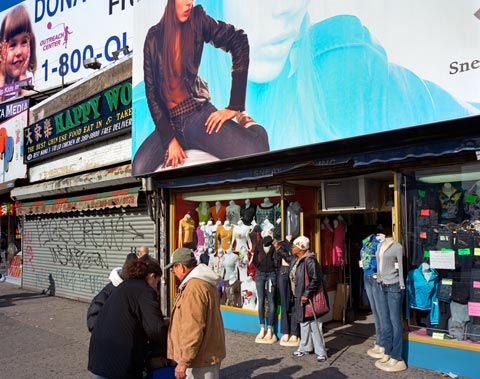
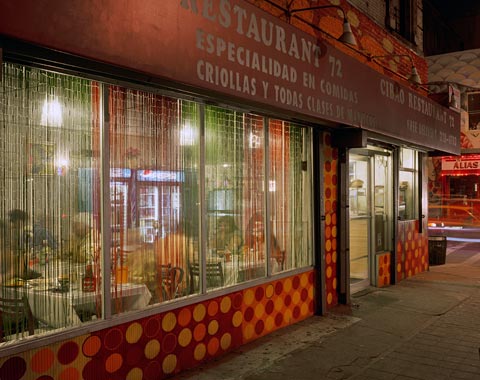
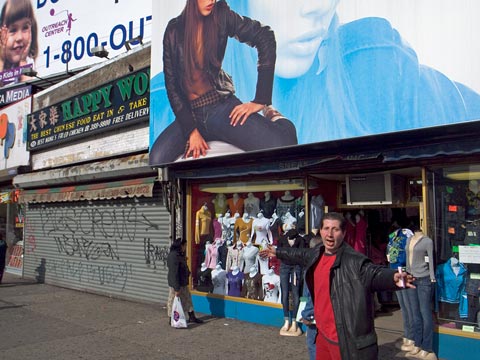
    Back out on Delancey Street I did a photograph of the window of a fast food restaurant, and then planted my tripod in front of a row of shops that I’ve photographed before. Delancey is a ragged concourse of discount shops that cater to the Latino population of the neighborhood and beyond. It’s long been a shopping destination. Million dollar apartments are now sprinkled in among the discounts and cheap chains, a dissonance nearly impossible to express in photographs except by means of crude juxtaposition, which I try to avoid.

    As I began doing a series of pictures of the storefront of a clothing shop with a wonderful array of signage above, the owner/manager came out and we chatted about the changes in the neighborhood. He’d been around since the early 70s. He told me that the shuttered shop to the left and several others in the row are coming down to make way for another condo project. We agreed, however, that, whatever happens, there will always be people who need discount. As I fiddled with the view camera a crazy/drugged man veered in front of me. So, I snapped.

  • New York/Halloween


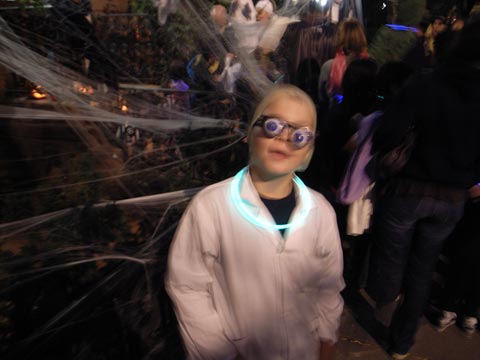
    Mad Scientist on West 22nd Street.

    Brendan joined the throngs of kids and parents to trick or treat in Chelsea. We tried catching a glimpse of the big Halloween parade, but couldn’t get near it. Watched a bit of it on TV at home.