Category: Photographers/Photography

  • New York/Joel Sternfeld


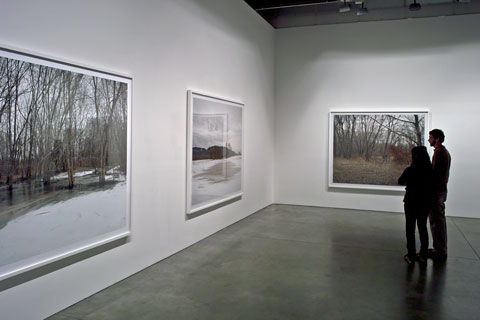
    Joel Sternfeld exhibition at Luhring Augustine, New York (digital)
    © Brian Rose

    A month ago I took in Joel Sternfeld’s exhibit at Luhring Augustine in Chelsea. The work shown—the Oxbow Archive—is a series of pictures of a square mile of farm, field, and woodland, along the Connecticut River, made over a year’s time, ordered by date.
    The full set of 77 photographs is available in a book of the same name.
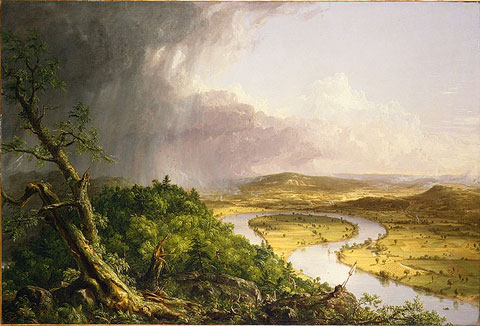

    View from Mount Holyoke, Northampton, Massachusetts,
    after a Thunderstorm—The Oxbow, 1836, Thomas Cole,
    The Metropolitan Museum of Art

    The landscape depicted in Sternfeld’s series was famously painted by Thomas Cole in 1836 in all the idealized grandeur of the Hudson River School. Sternfeld, rather than mount the nearby heights like Cole, stays close to the muddy ground.
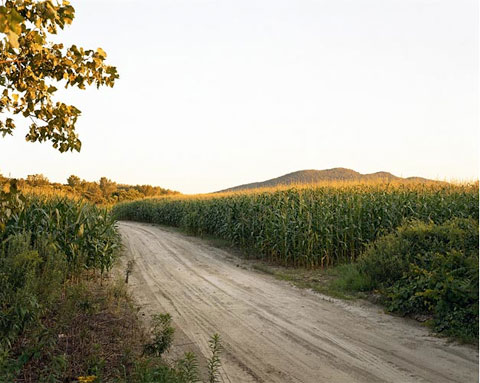

    August_19_2006 • Joel Sternfeld • The Oxbow Archive

    It is a landscape held, for the moment, in a cautious equilibrium. Tractors leave their imprints in the soft soil among the swaying cornfields. Weeds and puddles of water luxuriate beneath changing skies, as often dull and clouded as sunny and radiant. The fields alternate between cultivated and fallow.

    As in Sternfeld’s earlier pictures of the High Line in New York City, the persistence of nature springs forth everywhere despite the taming influence of the plow and other man made incursions. The smallest gestures of tangled growth are carefully described by the view camera—even celebrated. Visual events are carefully, but gently, noted in passing: a flock of sleeping geese in a field, a curled up raccoon (dead or alive?), an abandoned campfire, a toppled tree, clumps of withered cornstalks in a field.

    There is no text in the book, though there is a gallery press release that emphasizes the political and social critique offered by Sternfeld’s work, especially in relation to his earlier visual essays on American utopian communities and global warming. These new images fit within the continuity of Sternfeld’s work going back to the more acerbic and ironic pictures of American Prospects. But there is something about these images that resonates on a different level–something personal or spiritual–expressing the culmination (at this stage) of a long career of looking and thinking deeply about the world we live in.


    Mohonk Mountain House • New Paltz, New York (digital)
    © Brian Rose

    Recently, I traveled with my family up the Hudson River to the Mohonk Mountain House with its fairy tale hotel nestled in the mountains near New Paltz. And I thought about Sternfeld’s photographs as I hiked around and climbed Sky Top for the views of the surrounding countryside. The resort dates back to the 19th century and its siting in the landscape arrayed with rustic pavilions and rocky pathways embodies the romantic concept of nature expressed by Thomas Cole and his compatriots. Some of the same ideas can be found in Olmsted and Vaux’s great urban parks and private gardens. Nature majestic, yet tamed by man–if not by actually constructing upon the land, then by framing it, aestheticizing it.
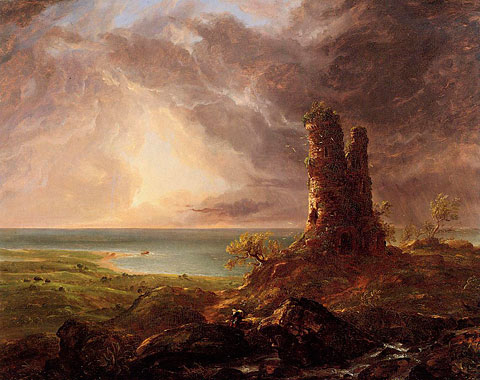

    Romantic Landscape with Ruined Tower, Thomas Cole, 1832-36
    Albany Institute of History and Art
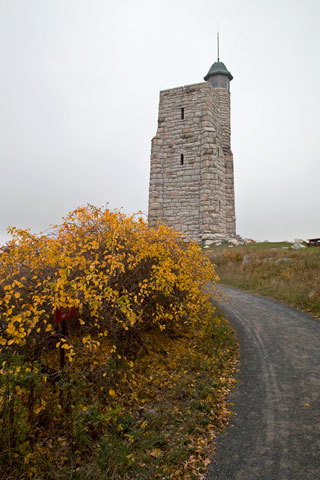

    Smiley Memorial Tower, Mohonk Mountain House (digital)
    © Brian Rose

    Rustic tower on the promontory of Sky Top overlooking the surrounding Hudson River valley and Shawangunk Mountains.
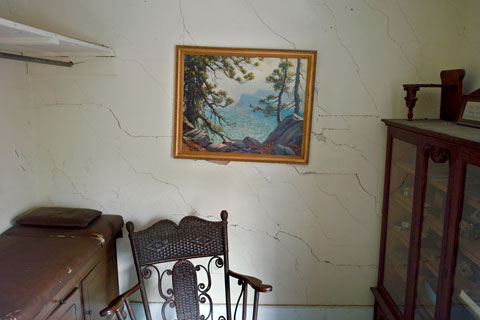

    The Barn Museum at the Mohonk Mountain House (digital)
    © Brian Rose

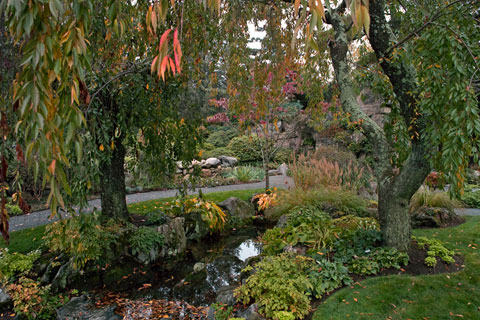
    Mountains framed by rocks and trees. Nature sublime, but ordered.
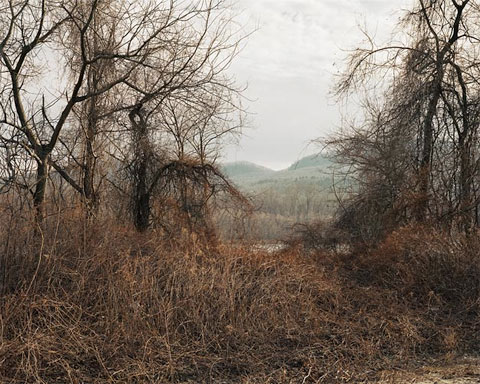

    November 29, 2006
    • Joel Sternfeld • The Oxbow Archive

    For many years photographers embraced the notion of framing the landscape for heroic or picturesque affect. But it has been a long time since serious photographers have taken that approach. Sternfeld doesn’t bring a wholly new way of seeing to the task of photographing the Oxbow. He builds his visual case methodically, image by image, day by day, season by season. He treads the same ground over and over, follows the same paths repeatedly, revisits familiar fields, ponds, glades, the same briar patches. Systematic becomes meditative and vice versa. What emerges eventually is a comprehensive experience of time and space.
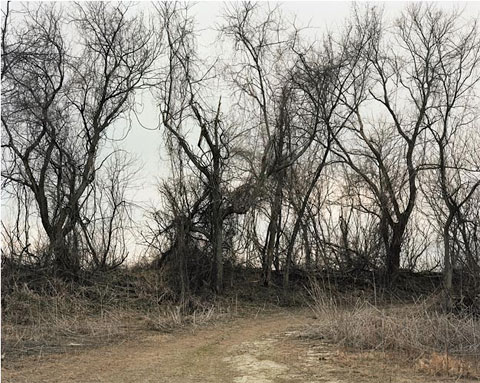

    March 13, 2006 • Joel Sternfeld • The Oxbow Archive

    When I first looked at Sternfeld’s Oxbow images, their stillness seemed absolute. But out of that silence I began to hear sounds off camera–the crunch of the photographers boots on crusted snow, the snap and crack of twigs and branches, the sibilance of wind through leaves. And then, the growl of a distant tractor, the drone of an approaching plane, the white noise of nearby Interstate 91. I began to sense the encroaching proximity of civilization in these unpeopled images.

    When I greeted Joel Sternfeld at the exhibit opening back in September I told him that these were, perhaps, his most beautiful photographs. His response was that he felt that he was born to do this work. Whatever the presumed message of this project, environmental or political, I see the Oxbow Archive, ultimately, as a search for an ineffable nexus–a muddy path leading into an unknowable and uncertain future.
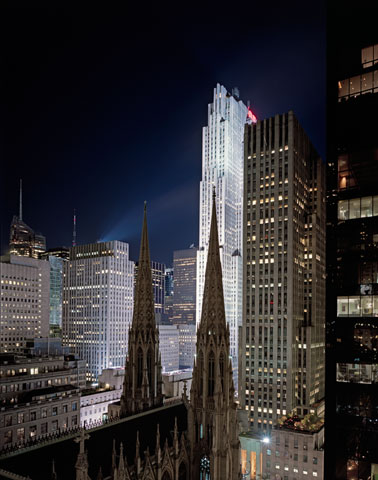
  • New York/Rockefeller Center


    Rockefeller Center and St. Patrick’s Cathedral (4×5 film)
    © Brian Rose

    The architectural photography I do tends often to be corporate interiors, very often in Midtown Manhattan. Most of the time I shoot after hours when the office workers have gone home. If possible I get a couple of shots just before sundown, when the light turns blue, and the inside and outside are relatively balanced. But after that, the windows go black and reflect the brightly lit florescent interior. The city outside almost disappears.

    Recently, I was shooting in a 1960s wedding cake building at 51st and Madison, so called because of the multiple setbacks required at that time by zoning regulations. There were doors from some of the offices leading out to a narrow terrace formed by the stepping of the facade. From the terrace I saw a stunning view of Rockefeller Center seen across the spires of St. Patrick’s Cathedral. Near the end of the shoot–1am or so–I took my view camera out on the terrace and did the image above. Two minute exposure, little wind.

  • New York/Union Square Park


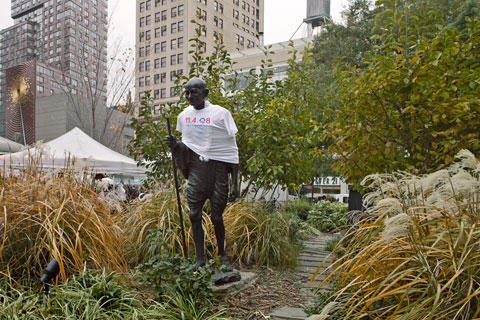
    Gandhi, Union Square Park (digital)

    Without comment.

  • New York/Halloween


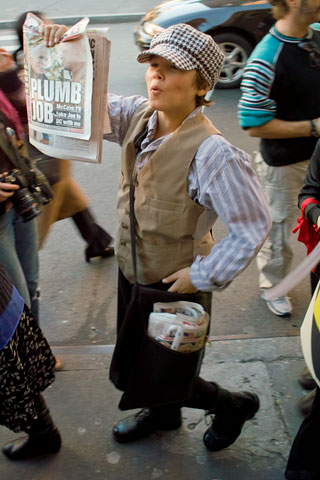
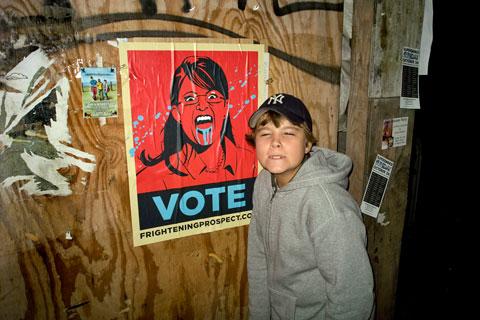
    Brendan, my son, in the PS 3 Halloween parade. (digital)
    © Brian Rose

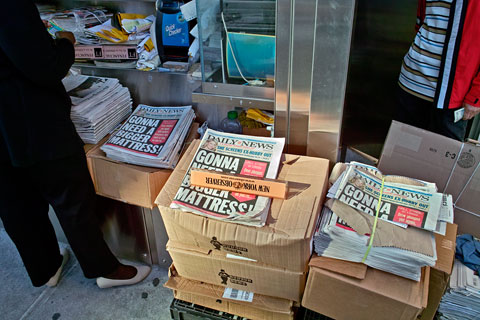
    Extra! Extra! Read all about it! Joe the Plumber goes to Washington!

  • New York/New Paltz


    In the Barn Museum at the Mohonk Mountain House (digital)
    © Brian Rose

    Without comment.

  • New York/Kykuit


    Kykuit, the Rockefeller estate in Sleepy Hollow, New York (digital)
    © Brian Rose

    Without comment.

  • New York/Koudelka


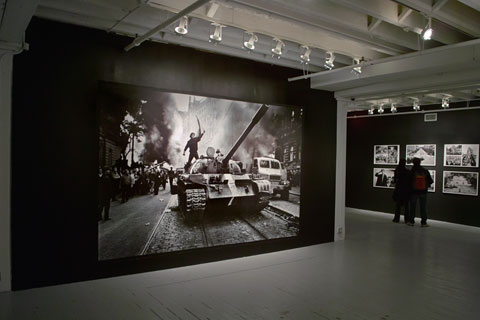
    Invasion 68 Prague, Photographs by Josef Koudelka at Aperture Gallery (digital)
    © Brian Rose

    A few posts back I wrote about 1968 and Paul Fusco’s photographs of the Robert Kennedy funeral train. Currently, at Aperture Gallery in Chelsea, is another exhibition dealing with 1968–Josef Koudelka’s photographs of the Soviet invasion of Czechoslovakia, which brought to a brutal end what is known as Prague Spring, a fleeting period of blossoming freedom behind the Iron Curtain.

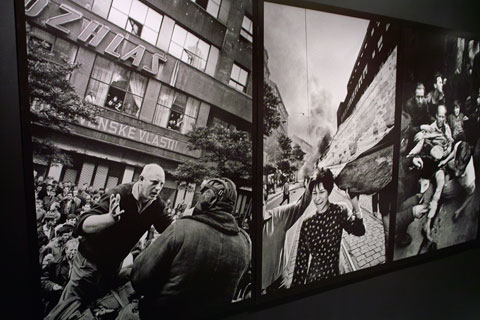
    The exhibition features a series of images made by Koudelka over the course of one week when Soviet tanks entered the Prague and were confronted by (mostly) young protesters in the street. Koudelka was just starting out as a photographer, and these pictures represent a spontaneous response to unfolding events–events that he was a part of–even as he remained unflinchingly faithful to the narrative of what was happening all around him. As a result his images do not exhibit the stylized framing that one sometimes associates with the genre. There is a fluidity to them. Although certain compositions achieve dramatic effect, more often they are part of a flow of images, almost filmic in nature. And they remind me, a little, of the direct cinema of the ’60s when documentary filmmakers participated in events as silent witnesses.


    Koudelka at Aperture Gallery (digital)
    © Brian Rose

    Although the photographs show the bravery of the Czech people standing up to tanks and machine guns, heroism ultimately gives way to the futility of flesh and blood against the mechanized armor of the invaders. Koudelka’a images of swirling crowds pause here and there to capture the faces of Czech citizens and young foreign soldiers. Eventually, peaceful confrontation devolves into violence–fire and smoke rise from the streets. And the Czechs were defeated.

    As much as one wants to celebrate the emergent skill of Koudelka, the bitter and gritty beauty of his photographs, the ultimate lesson of these images is that freedom is fragile and can be swiftly obliterated. It would be 21 years before a new Velvet Revolution emerged on the streets of Prague.

    The Aperture exhibition is comprised of new inkjet prints, made from high resolution scans, which have a richness and texture different from silver prints and allow for large blow ups. Although I appreciate the qualities of vintage prints, I generally approve of these kind of reprintings, which often enhance and reveal detail and subtlety inherent in the images. Things can go wrong, of course, but in the right hands, the results can be stunning. They are here.

  • New York/Williamsburg


    Brendan, my son, on Bedford Avenue (digital)

    I’m back from a week upstate, and will resume lengthier posts shortly.

    Update: Jenny did the poster.

  • New York/New Paltz


    Mohonk Mountain House (digital)

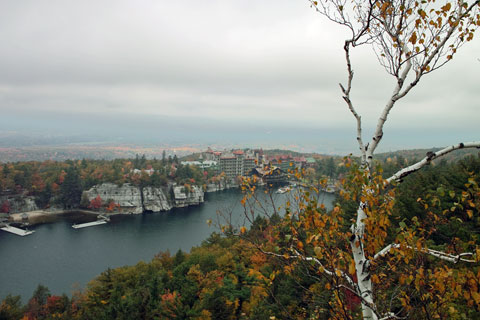
    A few days away from the city, we are at the Mohonk Mountain House near New Paltz, New York, up the Hudson River. This is the classic view of the historic lake and hotel, a Catskill retreat that dates back more than a hundred years.

    It was cool and foggy this morning, but has brightened up considerably. Fall colors are vivid.

  • New York/Astor Place


    Astor Place (digital)
    © Brian Rose

    Without comment.

  • New York/RFK


    Paul Fusco, RFK funeral train, 1968

    I was 14 years old in 1968, undoubtedly the most tumultuous year since World War II–at least in the western world. Although I was too young to be seriously engaged in what was going on, I was acutely aware of the epic events occurring–Vietnam, civil rights, the assassinations of Martin Luther King, Jr. and Robert F. Kennedy, and the violent end to Prague Spring in Czechoslovakia.

    Two exhibits I visited recently in New York touch on events of 1968: Paul Fusco at Danziger Projects (show closed October 4) and Josef Koudelka at Aperture. Fusco photographed Robert Kennedy’s viewers of the funeral train as it made its way from New York to Washington, D.C.

    I remember well watching the railroad cortege on television as it passed the thousands of people who lined the tracks. I also have a distinct memory of a brief bit of video shown once, in which a train coming from the opposite direction mowed down a number of people standing on the tracks adjacent to the funeral train.


    Paul Fusco, RFK funeral train, 1968

    When I first saw the Fusco pictures, I was immediately swept back to the sorrow and apprehension of that time, to the fear and uncertainty that I have never been able to shake, a fear that rises to the surface today as a black man carrying the hope embodied in the Kennedy brothers nears the presidency, as earthshaking economic events rumble around us.

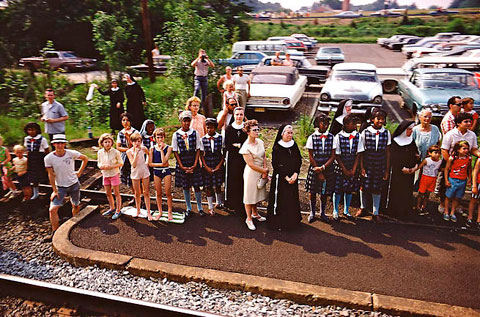
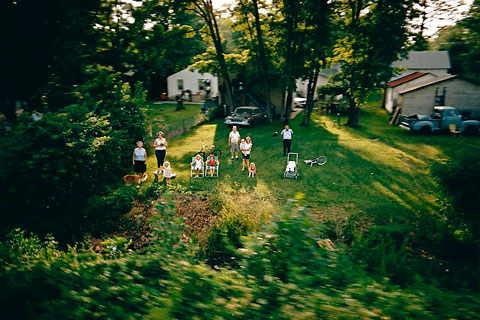
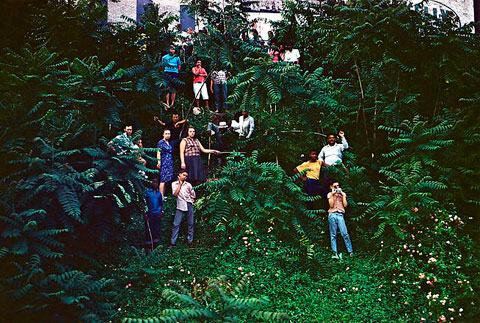
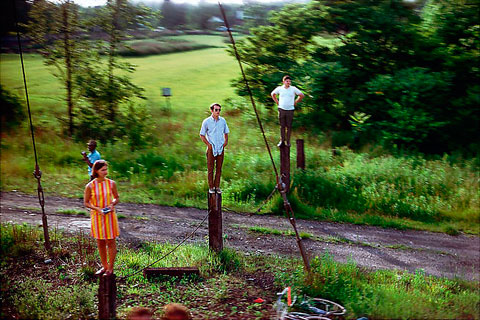
    Fusco’s photographs were very simply made. On assignment from Look magazine, he rode the funeral train and did what he could from a fixed vantage point. He aimed his camera at the crowds and small knots of people standing at relaxed attention, some waving, some saluting, troubled, saddened faces, staring, transfixed, as the rail coaches slid by.


    Paul Fusco, RFK funeral train, 1968

    Fusco made his photos on 35mm Kodachrome, a vibrant slide film that stands up well over time unlike early color negative film, which tends to shift color and fade. As a result, these images from 40 years ago seem fresh and immediate, which makes them emotionally all the more jarring. The people depicted came “as-they-were” in a colorful array of flowered prints and decidedly unfunereal stripes and plaids. It was June and people came in shorts, bathing suits, sandals and bare feet. And although it was 1968, one sees scant evidence of the psychedelic trappings that so dominate our collective memory of the era.

    The train passed through rural areas, small cities like Trenton, and big ones like Philadelphia and Baltimore where the faces are mostly black, people standing in scruffy backyards and vacant areas along the tracks. Some of these neighborhoods were in the midst of violent upheaval as racial frustrations boiled over after the murder of Martin Luther King. Fusco’s pictures, while freezing the momentary unity of grief, also reveal the racially segregated nature of a society coming apart at the seams.


    Paul Fusco, RFK funeral train, 1968

    Because the train remained in motion, most of Fusco’s photographs were necessarily made on the fly. They are fleeting glimpses, poignant, abbreviated moments of individual solitude among crowds. Fusco focused on the motionless people, rotating his head and camera slightly to stay fixed on his subjects, as the train moved horizontally. The blurring of the surrounding landscape further isolates the figures and creates a model-like hyper-reality, akin to recent narrow focus imagery created in Photoshop.

    The images have a posed quality as well, due to the fact that people had staked out viewing positions, sometimes awkwardly balancing on steep embankments or even standing on elevated objects. As the train went by they looked intently at the coaches and often their eyes met the gaze of the photographer. In Fusco’s photographs this relationship creates a strange and compelling phenomenon–they seem to look at us as we look at them. Do we recognize ourselves?

    ***

    Paul Fusco’s photographs have been collected in a handsome book, RFK, published by Aperture. It tries to be both a tribute to Bobby Kennedy and an art photo book, which I think is a little forced. The book starts with pictures not taken from the train of the memorial service held in St. Patrick’s Cathedral and ends with the funeral in Washington. I would be happier without these bookends.


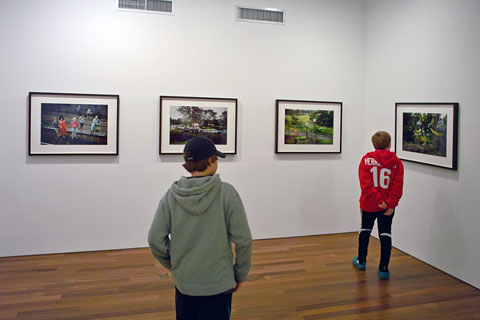
    Paul Fusco at Danziger Projects • Brendan, my son, at left (digital)

    The images as printed in the book, however, are nicer than the gallery prints, which are somewhat harsh and over saturated. The slightly more muted tones in the book seem more natural to me. Kodachrome is a punchy color material, but I don’t think prints have to mimic the straight slide film.

    Next, a look at the Koudelka exhibit.

  • New York/14th Street


    East 14th Street

    Without comment.

    I’ve been busy lately, but have several posts coming up. Saturday I visited three exhibits in Chelsea: Joel Sternfeld, Josef Koudelka, and Paul Fusco. The latter two deal with tragic and tumultuous events in 1968. Sternfeld’s work is new and majestic. I’ll write soon about all of these.

  • New York/Bowery


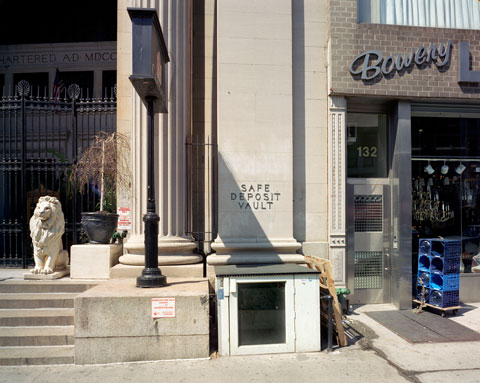
    The Bowery (digital)© Brian Rose

    Walked through the Lower East Side and up the Bowery with Rodger Kingston, photographer and Walker Evans scholar. Took the snap above.

    If you haven’t seen it, be sure to read Suzanne Vega’s blog post on the New York Times website about the origins and subsequent history of her song Tom’s Diner. I figure in the story.

  • New York/Bowery


    The Bowery • 2008 (4×5 film)
    ©Brian Rose

    Without comment.

  • New York/London


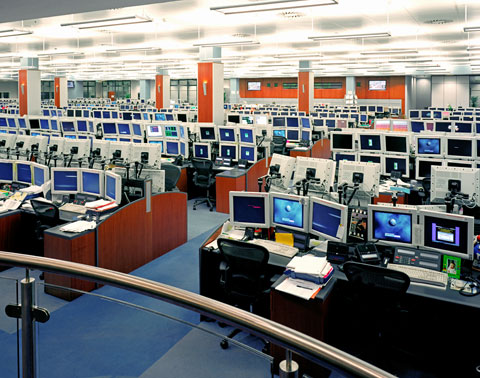
    Morgan Stanley • London trading floor (4×5 film)
    © Brian Rose

    Goldman Sachs and Morgan Stanley, the last big independent investment banks on Wall Street, will transform themselves into bank holding companies subject to far greater regulation, the Federal Reserve said Sunday night, a move that fundamentally reshapes an era of high finance that defined the modern Gilded Age.

    The New York Times

  • New York/Lower Manhattan


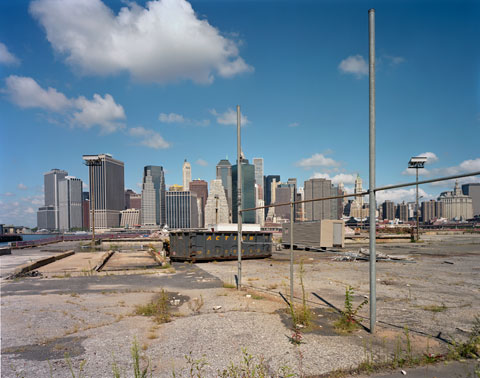
    Lower Manhattan (4×5 film)
    © Brian Rose

    Without comment.

  • New York/Wall Street


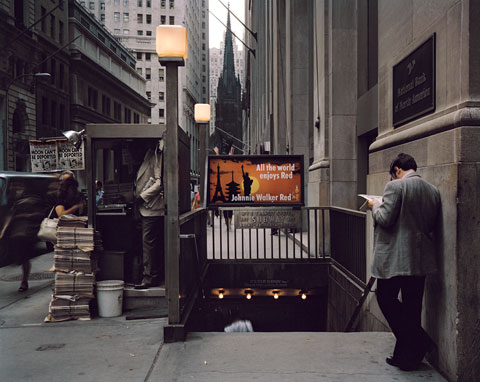
    Wall Street • 1981 (4×5 film)
    © Brian Rose

    Without comment.

  • New York/Seven Years


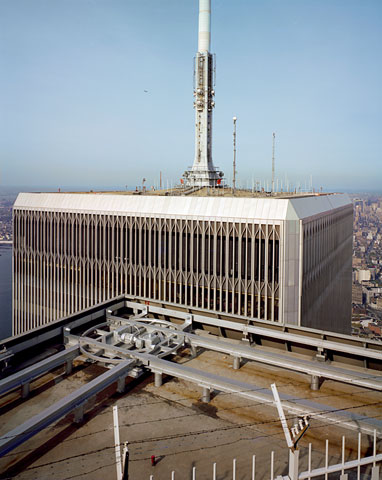
    The World Trade Center • 1982 (4×5 film)
    © Brian Rose

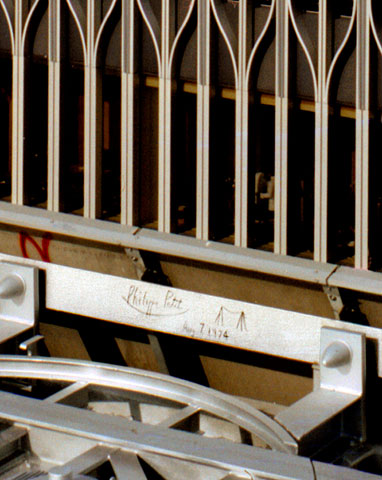
    In 1974 when the WTC was just being completed, Philippe Petit, a French street performer strung a cable between the Twin Towers and proceeded to tightrope walk back and forth 6 or 8 times. Thousands watched in amazement from below. Eventually he surrendered to the waiting arms of the police. In the end, public sentiment ruled in his favor, and charges were dropped in exchange for a performance by Petit for children in Central Park. His breathtaking walk between the Twin Towers has become part of the folklore of New York, made all the more poignant by the horror of 9/11–seven years ago.


    The World Trade Center • Phillipe Petit’s signature (4×5 film)
    © Brian Rose

    In the early ’80s I did a series of photographs of Lower Manhattan, funded by the National Endowment for the Arts, back when there was still NEA support for individual artists. Shortly after the destruction of the Trade Center, I sifted through my archive for photographs that included the WTC. They can be seen here. On of the pictures I came across was taken from the observation deck on Tower 2. I did a high resolution scan of the 4×5 negative and discovered something unseen in normal prints of the image, Philippe Petit’s scratched signature and tightrope icon.