Category: Photographers/Photography

  • New York/Swastika


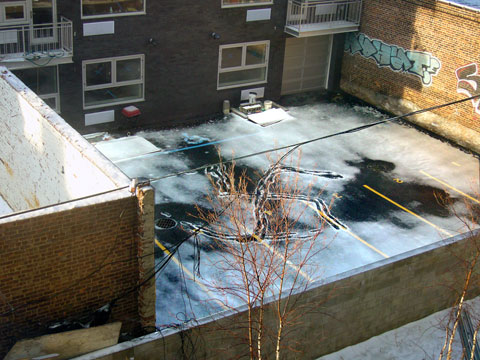
    Williamsburg, Brooklyn, behind a building on Metropolitan Avenue (digital) © Brian Rose

    We live in ugly times. I woke up this morning and looked out our window in Williamsburg, Brooklyn. A swastika had been drawn in the parking lot behind a newly completed, but unoccupied, apartment building. I know that this building, and the construction site next door, are owned by Hasidic Jews, who have a large presence in the neighborhood, especially on the south side of the Williamsburg Bridge.

    The parking lot is locked, but easily accessible through the sloppily maintained construction fencing next door. But someone would have to know where they were going. The swastika was crudely drawn, but unmistakable.

    Given the current situation in the Middle East, there is tension in the air–there were protesters at Union Square yesterday. But whatever one’s opinion concerning Israel and the Palestinians, such expressions of hate and/or ignorance are an affront to us all.

  • New York/Guggenheim


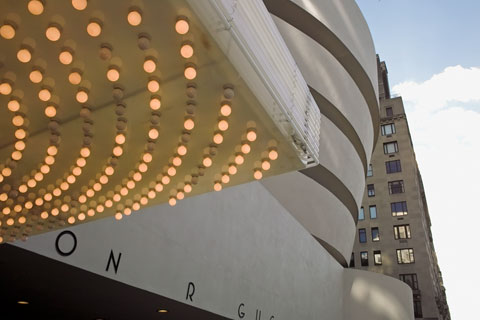
    The Guggenheim Museum, Marquee by Philippe Parreno
    © Brian Rose

    I went to the Guggenheim and Whitney museums to see a couple of photo exhibits–Catharine Opie and Williams Eggleston. The Opie work was relatively unknown to me, and I wanted to see what or why she was given a large retrospective at the Guggenheim. Her career was launched by gender identity work, portraits of lesbians and transgender individuals, and self-portraits. This stuff seems dated to me at this point, which means I think it’s work with a limited shelf life, now expired. The poses are wooden, the references to old master painting pretentious. But I give Opie credit for giving visibility to people who are at the margins of mainstream society.


    Opie exhibit at the Guggenheim

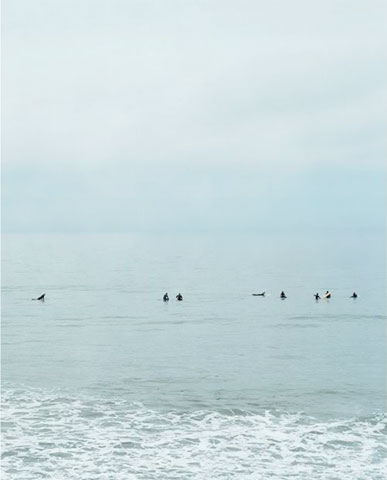
    I liked the ice houses and surfers waiting for waves in one of the galleries–not so much the individual images, but the way they were lined up to form multi-panel panoramas. There’s a lot of textual mumbo jumbo accompanying these beautiful pieces, however, and they would be better off without it.

    Around the time that this series was completed she summarized her artistic project: “I concentrate on disturbing the devices that society imposes on variant communities to keep them ‘ghettoized’ by class, race, sexuality, and gender. It’s important that my work be seductive as a visual language, as I want to keep the viewer engaged. This allows for multiple readings which challenge viewers to consider both people and space in their various complexities.”

    What I like about the two series is the way in which the panoramas are comprised of individual images made at different times. The line of surfers never exisited in real time as seen across the panels, and there is a progression from fogginess on one side to clearer images on the other. Only a few surfers are shown riding the waves–most paddle about waiting for a wave.

    The freeway flyovers and empty city street photographs do not connect with me. They suggest meaning that I do not think is sustained in the images.

    We’ve somehow lost sight of what America was originally. Think about the power of Ellis Island, the melting pot, and how all that is disappearing in favor of white-bred America. . . . America’s not about multiculturalism anymore. And that’s what I mean, that cities still hold this utopian notion of what America once was.” To help bring home this sense of loss, starting with St. Louis, she once again portrayed her chosen cities bereft of their populations.

    I don’t agree with the statement about white-bred America. We just elected a black president, and we are gradually becoming less white, less homogeneous.


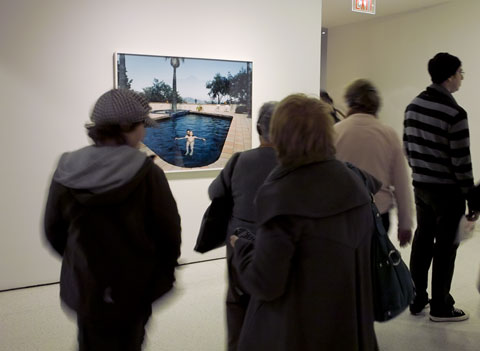
    Opie exhibit at the Guggenheim, (digital) © Brian Rose

    The domestic series–large scale images of lesbians in family/home situations–is not as compelling as the intention implied. There’s supposed to be a tension between the ordinariness of the activities in the pictures and the extra-ordinariness of the couples and families depicted. OK, I get it. I do like the image of the pregnant woman floating in a pool–heaviness and weightlessness. But too much of Opie’s work is about telling rather than allowing the viewer to discover.

    There’s a ton of laudatory opinion about Opie on the Internet, much of it from the star making machinery of the art world. Feel free to Google.

    On to William Eggleston at the Whitney.

  • New York/Williamsburg


    Bedford Avenue and N 7th Street, Williamsburg, Brooklyn (digital)
    © Brian Rose

    Cold and clear.

  • New York/Guggenheim Museum


    The Guggenheim Museum (digital) © Brian Rose

    Went to see the disjointed mid-career retrospective of Catherine Opie at the Guggenheim. More on that later. Can’t help but say it, but the building upstages everything in it.

  • New York/New Year’s Eve


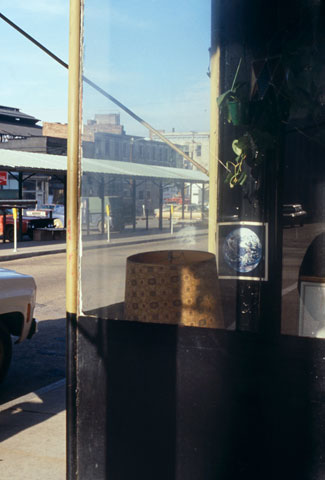
    Richmond, Virginia, 1977 (35mm) © Brian Rose

    It’s the end of 2008, and the calamitous Bush reign comes down to its final days. The economy–capitalism itself–lies broken, while almost 150,000 American soldiers remain in Iraq. I look to 2009 with trepidation, but with measured hope, that all is not lost, as a new president comes to Washington.

    The photograph above was taken in downtown Richmond, Virginia, when I first began shooting color. I was struck by a photo of the earth, made a few years earlier on one of the moon missions, taped to the wall in a dusty window of a café. It was one of the first images of the earth seen as a ball floating in the darkness of space. That image changed the way we saw ourselves forever.

  • New York/Holiday Interlude


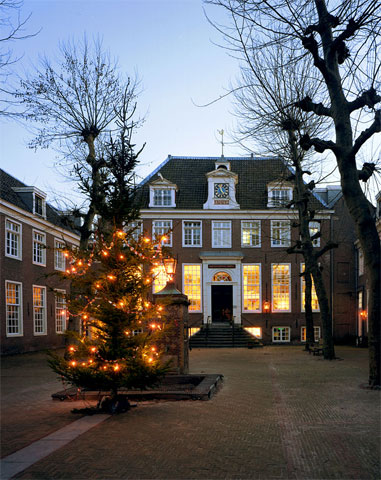
    Amsterdam, 2000 (digital) © Brian Rose

    A holiday interlude.

    Picture taken in the courtyard when we lived in the Jordaan, a neighborhood in central Amsterdam.

  • New York/South Bronx


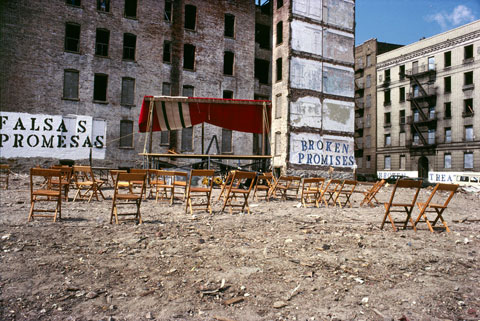
    The South Bronx, 1980, 35mm slide, © Brian Rose

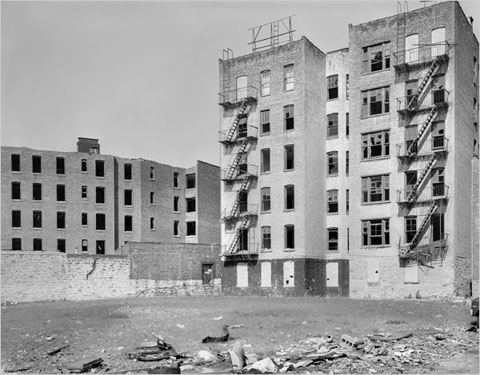
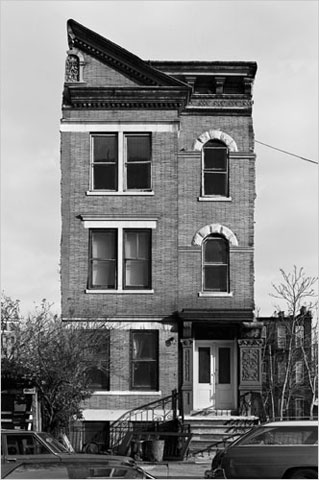
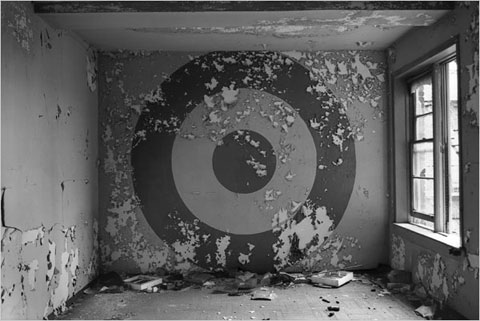
    I’ve been up to the Bronx a number of times in the past year shooting some new buildings for an architecture client. For anyone old enough to remember the devastation of the 1980s, the rebuilding that has taken place in the South Bronx in recent years is amazing, and heartwarming. While doing my Lower East Side project in 1980, which also dealt with urban desolation, I made my way up to the South Bronx a few times. The image above, scanned from a 35mm Kodachrome, is from one of those trips.


    The South Bronx, Ray Mortenson

    There is currently a show at the Museum of the City of New York that provides a vivid look back at the Bronx of that time–Broken Glass, photographs by Ray Mortenson. Mortenson photographed the abandoned buildings of the area with a dogged comprehensiveness. His work, evoking Bernd and Hilla Becher’s building typologies, is suspended somewhere between documentary and art. But unlike the Bechers who approached their subjects with absolute consistency, even to the point of shooting only on cloudy days, Mortenson’s photographs are less rigorously composed, done with a smaller camera, and are the result of more haphazard wanderings through the streets and cadaverous tenements of the Bronx.


    The South Bronx, Ray Mortenson

    It’s hard to tell from the pictures themselves what Mortenson’s motivation was exactly besides a wide-eyed astonishment gazing on such a desolate landscape of failure and ruin. They offer no explanation, no political engagement, no connection to the fragments of community that remained in the Bronx through the worst years. But that detachment makes them stronger historical documents–evidence rather than commentary.


    The South Bronx, Ray Mortenson

    That said, however, I can see Mortenson schlepping day after day through the streets with his camera, tip toeing gingerly through the rubble not knowing who or what lurks around the corner or in the next darkened room. That personal sense of mission, of passion–or whatever it was–comes through in these otherwise cooly realized images of destruction.

    More images from Broken Glass.

  • New York/Film


    Washington, D.C., 1977, 35mm slide
    © Brian Rose

    The other day I went to Fotocare on 22nd Street to buy some 4×5 film–Readyload Portra VC 160 to be exact. These are pre-loaded packs that do not require individual holders, a pricey convenience, but a great saving in weight, bulk, and time. Although I had just bought some a few weeks earlier, I was informed by the staff person that Kodak had discontinued the film. Boom. Apparently, Kodak had announced this a while ago, but I was unaware of it.

    So, my only option, other than carrying 20 film holders on shoots, was to revert back to Fujifilm color negative film, which was still available in Quickload format. My guess is that it came down to something trivial having to do with the company Kodak employed to package the film into the paper Readyload sleeves. It’s the same film, after all, as the individual sheet film.

    It has been a rough ride staying with film as the industry massively shifts away from analog materials. For the moment, Fuji seems committed to picking up the pieces as Kodak abandons us. And their 4×5 instant film is the only way to go now that Polaroid is out of the film business.

    I remember years ago talking to a Kodak executive on the phone imploring him to drop the the two sheet Readyload film packs they were making as so unwieldy and inconvenient that every photographer I knew had jumped ship to Fuji. He defended the company’s position. But within a year they joined Fuji with one sheet packs.


    Washington D.C., 1977, 35mm slide
    © Brian Rose

    Kodak has lurched from one corporate/marketing decision to another seemingly without a long range plan–akin to other giant American corporations now feeding at the public trough. Almost no photo equipment of any quality is made by American companies, which has been the case for a long time.

    Kodak’s fickleness with regard to legacy film products could be forgiven if they were taking the lead in the digital business. But they offer nothing for the professional. So, when Kodak discontinues a critical film product we are basically kicked out for good. You go either to Fuji for film, or if you go straight digital, to Canon or Nikon.

    Good bye USA. Hello Japan.

  • New York/Early Color


    Wilmington, Delaware, 1978, 35mm slide
    © Brian Rose

    Continuing going through my slides from 1975 to 1980. I was looking at a lot of painting as well as photography during those years, and I was thinking about how far you could reduce down an image and have it still be about real things and real space.


    Interstate 95, North Carolina, 1978, 35mm slide
    © Brian Rose

    As flat as the image above is, I would never have taken this picture without including a sliver of deep space–the sky ad pickup truck on the right. Both of these photographs were made on the road, traveling south. As reductive as they are, I was keenly aware of what they were photographs of–the chalk scrawls of children playing in a Wilmington, Delaware parking lot, and a soda machine set against a gas station wall along Interstate 95 in North Carolina.

  • New York/Early Color


    Richmond, Virginia, circa 1975, 35mm Ektachrome

    I’ve been looking back at my early color images made mostly on 35mm slide film. Although I was vaguely aware of work being done by Eggleston and a few others, I was pretty much making things up as I went along.

    This picture was made in Richmond, Virginia in the older part of downtown–Main Street near the train station most likely. I was particularly interested in compositional density in those days.

  • New York/Inspiring Space

    This blog has been a little quiet lately, but I’ve been busy with a few photo shoots, reorganizing my studio, and meeting with people about the Lower East Side project. It’s too early to say anything specific, but there is reason to be hopeful that there will be a major exhibition of the LES pictures in the foreseeable future


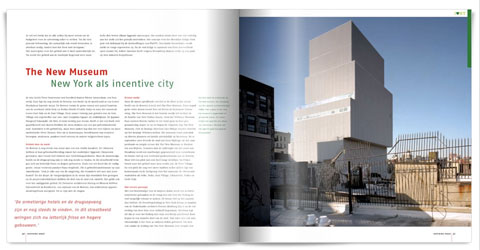
    The New Museum in Inspiring Space

    One of the people I met with recently is Ethan Swann of the New Museum, which is located around the corner from my apartment/studio. Ethan is heading up an initiative of the museum called the Bowery Artists Tribute, which is an educational and community outreach program having to do with the rich cultural heritage of the Bowery and surrounding neighborhood. There is a website with a map and bios of many of the artists, past and present, who have lived or worked in the area.


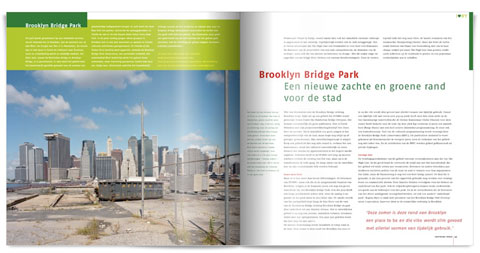
    Pages from Inspiring Space

    A few weeks ago I attended a panel discussion at the museum, sponsored by the Bowery Artists Tribute, featuring several artists talking about how they ended up on the Bowery, and how the surroundings may have influenced their work. Ethan has a great job, part of which consists of patiently listening to people like me rambling on about life and art on the Bowery. And I think it is admirable of the museum to open itself up to the local community.


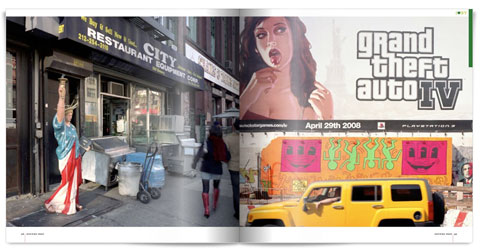
    Bowery images, Inspiring Space

    Back in the summer I made photographs for a Dutch publication called Inspiring Space, which is basically a promotional vehicle for a large real estate firm in the Netherlands. I worked with a journalist and put together a series of pictures about new park, cultural, and environmental projects currently underway in New York. The magazine can be read online–although the article is in Dutch–and 10 of my photographs are presented. Part of the article discusses the New Museum as a catalyst for change on the Bowery, and two of my Bowery/Houston Street photos are included.

  • New York/Rodger Kingston


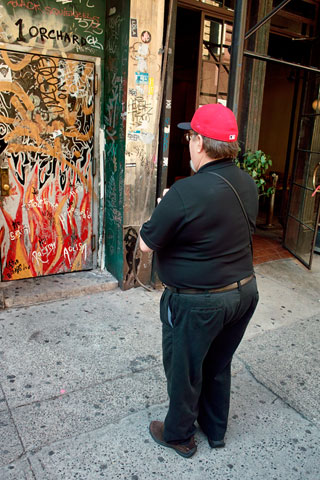
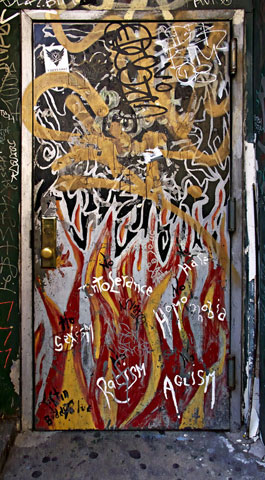
    Rodger Kingston nails a door (digital)

    A while back, when the weather was still warm, I was paid a visit by Rodger Kingston down from the Boston area. Rodger and I met online–somehow that doesn’t sound right–and have been corresponding regularly.

    We spent a few hours walking around the Lower East Side, and Rodger snapped away using his wide format Lumix camera. It’s territory I’ve covered extensively using a 4×5 view camera, and it’s interesting to see how differently another photographer looks at the same subject.

    Rodger often goes at things very frontally using the extended frame of his camera to its fullest. I caught Rodger in the act above firing away at a flaming doorway. He was kind enough to send me the result below.


    Flaming door by Rodger Kingston

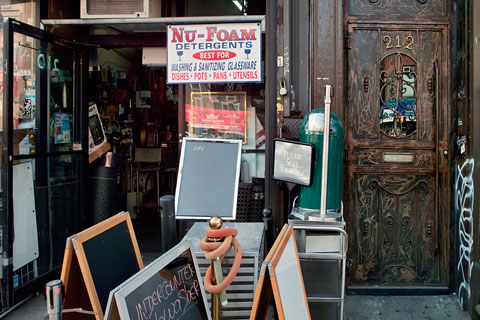
    I didn’t take as many pictures during our walk as Rodger, but I felt I compelled every now and then to follow his lead. One result below.


    Bowery restaurant supply with door
    © Brian Rose

    Be sure to visit Rodger Kingston’s SmugMug site to see more of his photographs including others shot during our walk together. Don’t miss his New American Photographs and recent photos made in Bethlehem, Pennsylvania in the footsteps of Walker Evans.

  • New York/Mumbai


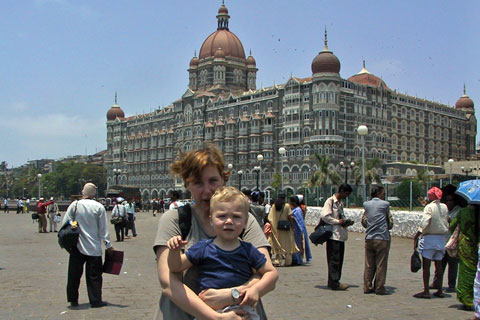
    Brendan and Renée at the Taj Hotel in Mumbai, May 13, 2001 (© Brian Rose)


    Taj Hotel, November 28, 2008 (David Guttenfelder/AP)

    Without comment.

  • New York/The Bronx


    The Bronx

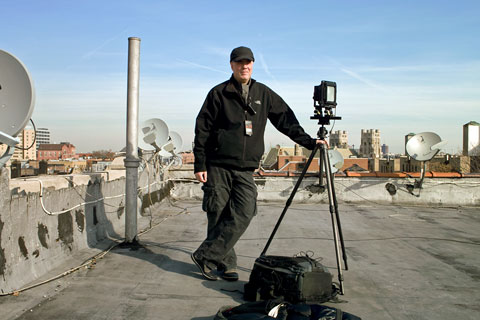
    Shooting this morning on a rooftop in the Bronx. Photo by my assistant Chris Gallagher.

  • New York/Yankee Stadium


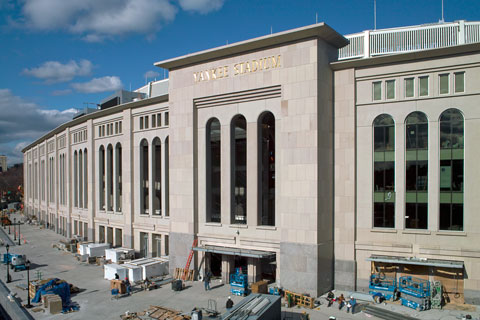
    Yankee Stadium under construction (digital)
    © Brian Rose

    Went up to the Bronx to scout a building for an upcoming photo shoot. The 4 train goes up by Yankee Stadium, and I got out and did a couple of snapshots of the nearly completed new stadium. The old edifice still stands across the street, but it will soon be dis-Mantled and de-Ruthed.


    Yankee Stadium under construction (digital)
    © Brian Rose

    I’m not sure about retaining the neoclassical facade of the original stadium, though I don’t think a techie steel and glass approach would make sense here in the Bronx. What I do like is that the stadium will, like the old one, remain a building on the street hugging the elevated subway. Not a stadium machine, like so many others. Glimpses of the field will still be possible from the windows of the passing trains, and a replica of the famous frieze will wrap around the upper deck. My understanding is that it is essentially a modern stadium inserted into the envelope of a more traditional exterior.


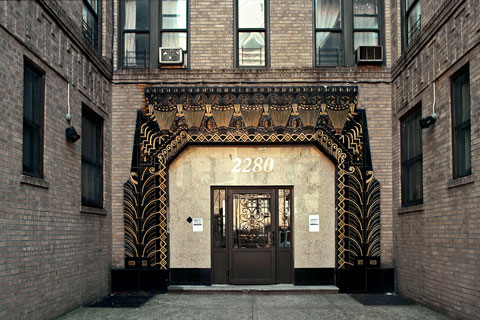
    Bronx apartment building entrance. (digital)
    © Brian Rose

    The new stadium, designed by HOK Sport echoes the design of the original ballpark, but it has a more monumental feel, cleaner, but with deeper cut arches. Although it doesn’t reflect Art Deco, the dominant Bronx style, it does remind me of other monumental buildings of that era, like 30th Street station in Philadelphia, which manages to incorporate both classicism and deco design. My guess is that it will wear well here on 161st Street. Fans will gather on the plaza as before, and the nearby bars and souvenir shops will flourish as always. And the ghosts of Mantle and Ruth will hover a while in confusion, but eventually decide that new stadium is nicer, and has better restrooms, among other amenities.

  • New York/Astor Place


    Astor Place (digital)
    © Brian Rose

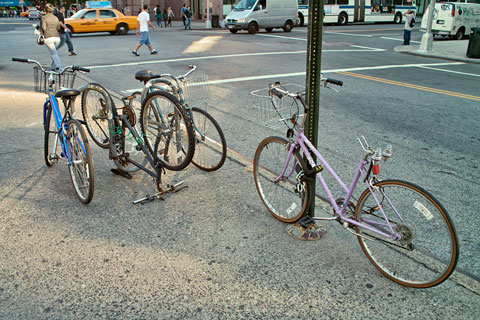
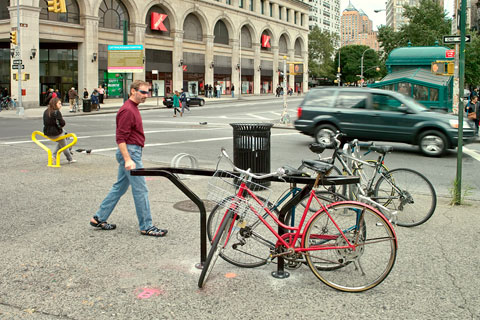
    The photograph above shows how bikes tend to be parked in New York. Usually, the only option is a signpost or light pole. Every now and then, one finds the repeating U shape rack as seen to the left. Not always with three bikes, one of them upside down.

    Having lived in Amsterdam for 12 years–while traveling back and forth to New York–and married to a Dutch urban planner, I feel I can comment with some level of authority on the issue of bike racks. The Netherlands, as is well known, is among the most bicycle-oriented places in the world, but even there, they continue to struggle with the problem of parking and storing thousands and thousands of bikes on the city streets.

    The Dutch attach their bikes to anything sturdy including light poles, signposts, bridge railings, fences, you name it. Bike racks, too. A quick image search on bike racks in Amsterdam produces dozens of different designs, mostly incredibly complicated and impractical. Despite the apparent riot of different designs, the official bike rack for central Amsterdam is a simple bent piece of metal shaped like a staple. There are no photographs of them on the Internet, presumably because they are so uninteresting. Unobtrusive is a virtue in my opinion.

    Astor Place (digital)
    © Brian Rose

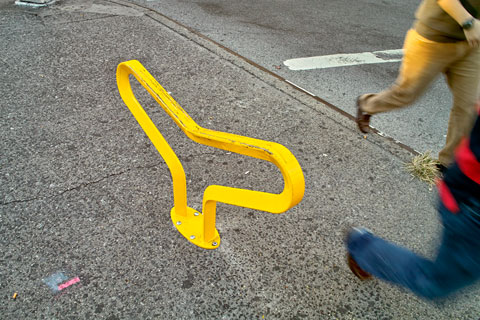
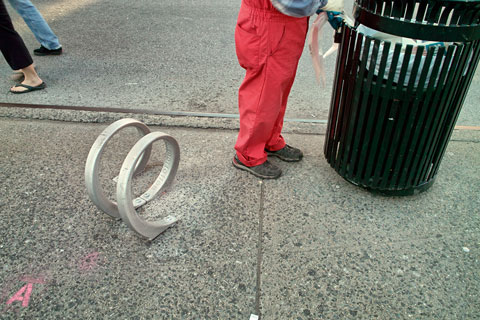
    The Bloomberg administration has actively promoted bicycle use in New York City, creating bike lanes, and in some cases, segregated bike paths along major avenues. The city has just completed a design competition for what will become the standard bike rack used throughout the five boroughs. Prototypes of the 10 finalists were mounted on the traffic island in Astor Place–the one with Alamo, the famous black cube sculpture by Tony Rosenthal.

    Astor Place (digital)
    © Brian Rose

    Good for sitting on.

    Astor Place (digital)
    © Brian Rose

    Good for tripping over.
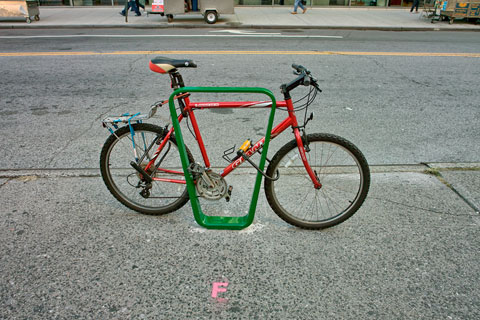

    Astor Place (digital)
    © Brian Rose

    Not bad.
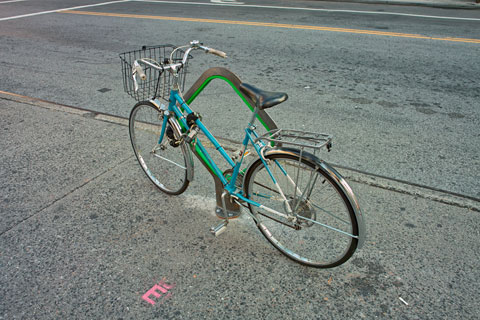

    Astor Place (digital)
    © Brian Rose

    Looks good with this bike.


    Astor Place (digital)
    © Brian Rose

    Almost.
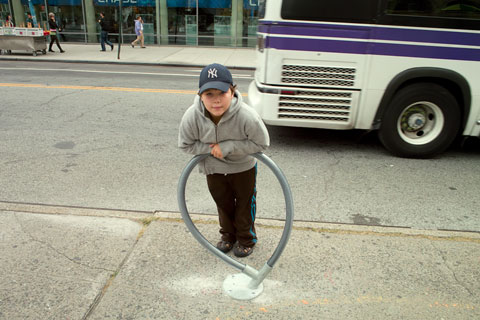

    Astor Place (digital)
    © Brian Rose

    Brendan, my son, leaning on the wittiest of the bunch, modeled after a steel cable bicycle lock.
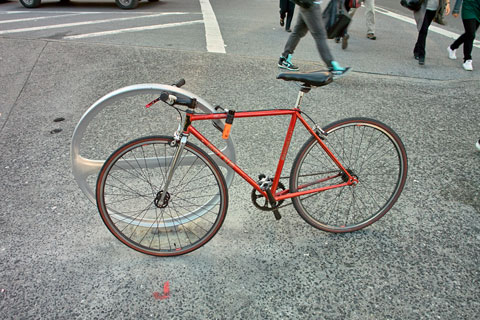

    Astor Place (digital)
    © Brian Rose

    The winning design, “Hoop,” by Ian Mahaffy and Maarten De Greeve, based in Copenhagen. It’s one of the simplest of the designs, can be used singly or in groups, parrallel to the curb when the sidewalk is narrow, and perpendicular when there is more space. Those commenting to the article on the New York Times website are all concerned about how it can be securely attached to the pavement. I think the round shape gives people the impression that it just grazes the surface of the sidewalk. But imagine a steel post beneath the wheel at the point where it touches the ground. It should be at least as sturdy as the traffic signposts already used by most cyclists.

    It’s elegant, flexible, iconic. I like it.
  • New York/Astoria


    Astoria, Queens (digital)
    © Brian Rose

    Without comment.

  • New York/Second Avenue


    Second Avenue (digital)
    © Brian Rose

    Without comment.