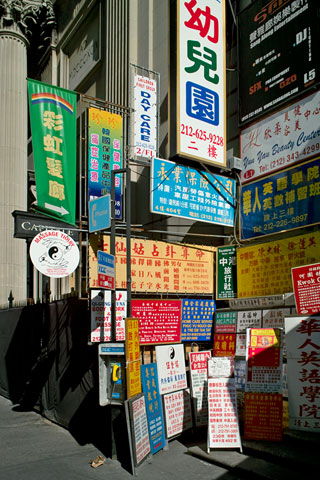
Bowery and Grand Street
The neo-classical columns of the former Bowery Savings Bank festooned with Chinese signs.
Bowery and Grand Street
The neo-classical columns of the former Bowery Savings Bank festooned with Chinese signs.
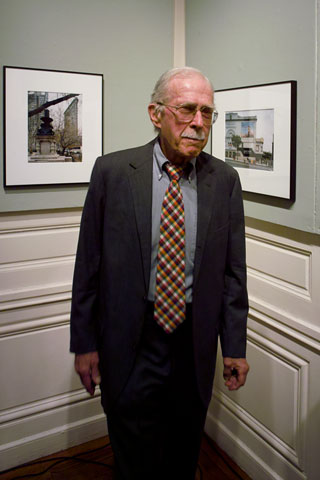
Cervin Robinson
Went to Cervin Robinson’s opening at the Urban Center Gallery in Midtown. Cervin, who lives on Broadway, has photographed Manhattan’s singular, slightly meandering avenue for many years. Thirty photographs are on display–black and white images and more recent color–all made with a view camera.
I will write more about the exhibit once I’ve had a chance to revisit and spend some time with the pictures.
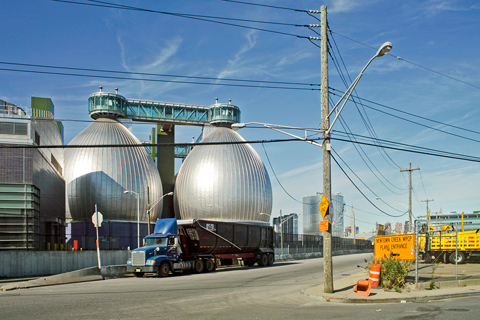
The Bowery
Without comment.
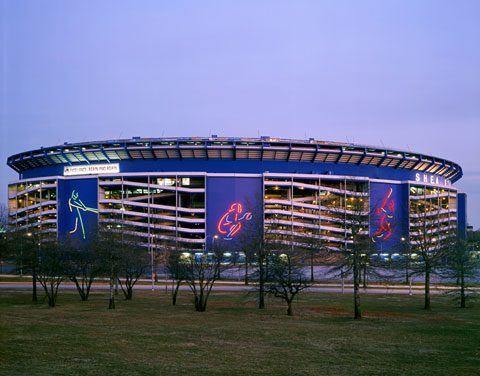
Shea Stadium — © Brian Rose
Opening day is not far off for New York’s two teams each with new stadiums. Both promise to be more pleasant places to watch baseball, even if some historical patina is lost forever. Yankee Stadium as I wrote before “will, like the old one, remain a building on the street hugging the elevated subway. Not a stadium machine, like so many others. Glimpses of the field will still be possible from the windows of the passing trains, and a replica of the famous frieze will wrap around the upper deck.”
Both stadiums follow the fashion of retro ballparks inspired by Camden Yards in Baltimore, and replicated in various forms numerous times since. Yankee Stadium echoes itself–or rather its original self–before renovation. It relates to the neighborhood around it, and will, I think wear well in the Bronx.
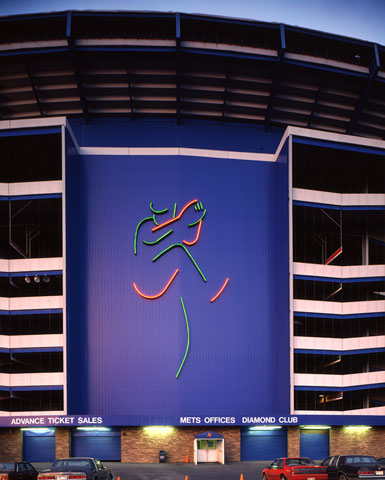
Shea Stadium — © Brian Rose
The Mets new stadium in Queens, named CitiField after the barely breathing mega bank relates to the distant memory of Ebbet’s Field, which of course was in Brooklyn, not Queens. It replaces a mostly unloved stadium that had little charm or comfort. It was, however, a very streamlined structure reflecting its time period compared with the new/old rather fussy architecture of Citifield.
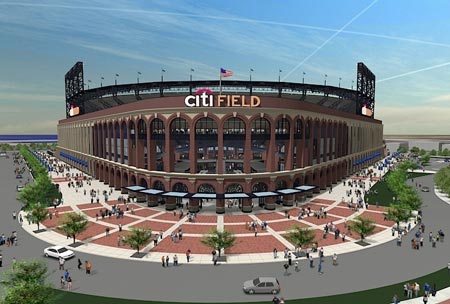
CitiField rendering, Queens

Ebbet’s Field, Brooklyn
Ebbet’s Field stood in the midst of a tightly knit urban neighborhood while the new reincarnation of it stands in the same vacant parking lot that Shea Stadium used to occupy. Wrong history, wrong location. The real history here is the still vivid memory of two world fairs with their visions of modernity and utopian urbanism. Imagine a stadium design that played to those memories rather than a neighborhood in Flatbush, Brooklyn.
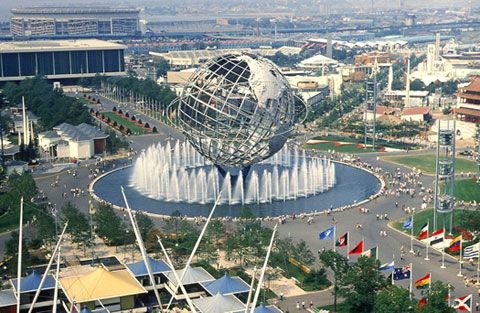
1964 World’s Fair with Shea Stadium at rear
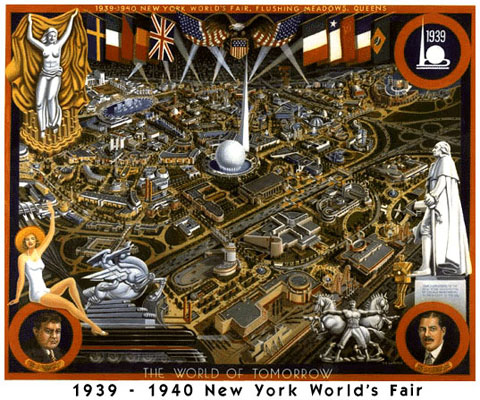
Alas, the new ballpark evokes only fictitious history, though it will undoubtedly be a nice place to see a game. But it’s another lost opportunity for architecture in New York City.
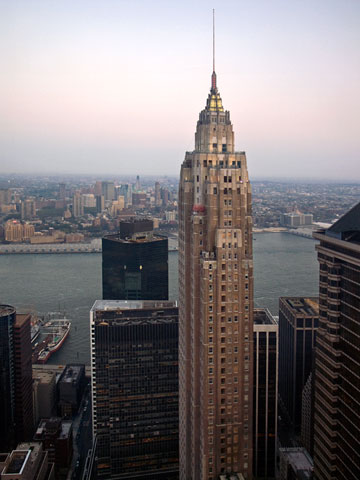
AIG headquarters in lower Manhattan
The New York Times:
The company paid the bonuses, including more than $1 million each to 73 people, to almost all of the employees in the financial products unit responsible for creating the exotic derivatives that caused A.I.G.’s near collapse and started the government rescue to avoid a global financial crisis.
The AIG building, originally, known as 70 Pine Street or the Cities Service Building, is one of the great Deco period skyscrapers, and still one of the tallest in the city.
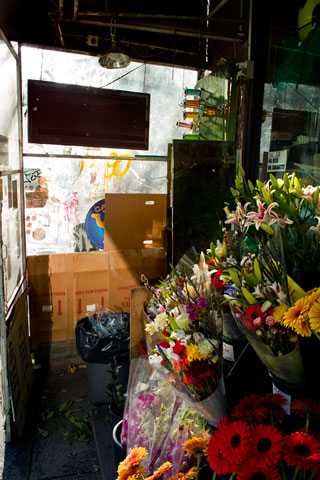
Prince Street — © Brian Rose
Where I buy the newspaper most mornings, a ritual that has not been replaced by the Internet. For me, at least, not yet. I fear, however, that the traditional paper’s days are numbered.
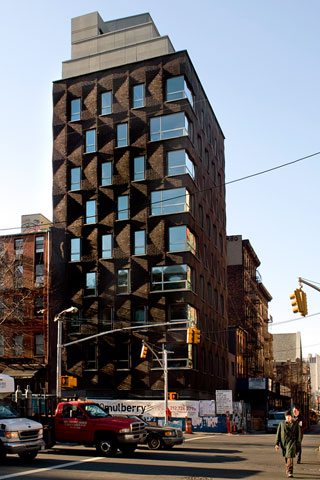
Houston and Mulberry Street — © Brian Rose
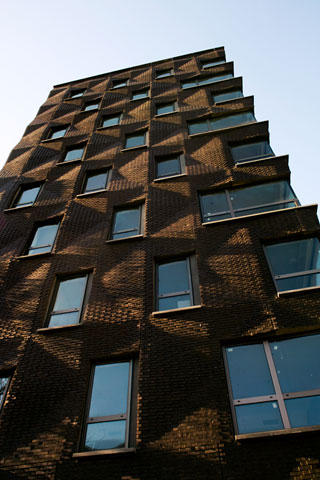
Most mornings I walk across town from my son’s school in the West Village to my office apartment just off the Bowery. I’ve been watching the construction of the apartment building above for quite some time. It’s almost finished, another new building entering the market at this particularly uncertain time. The architects are SHoP, one of the most innovative New York firms.
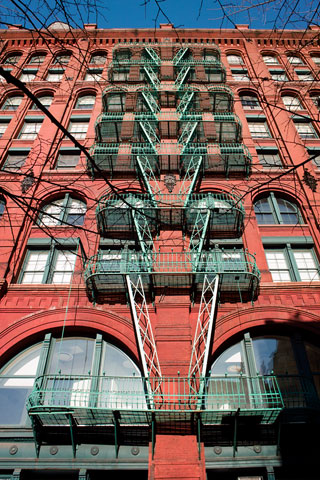
The Puck Building, Mulberry Street facade — © Brian Rose
Houston and Mulberry Street — © Brian Rose
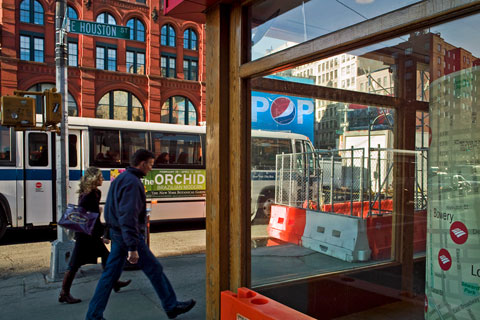
It’s right across the street from the richly detailed brick of the Puck Building with its gold statue of Puck, “that shrewd and knavish sprite” from Shakespeare. My understanding is that the prefabricated brick panels used by SHoP were used to meet contextual zoning requirements. Brick vs. brick. Anyone who has walked along Houston Street in the immediate area knows–the Puck Building’s glory not withstanding–that anything goes here.
Houston and Mulberry Street — © Brian Rose
Houston and Lafayette Street — © Brian Rose
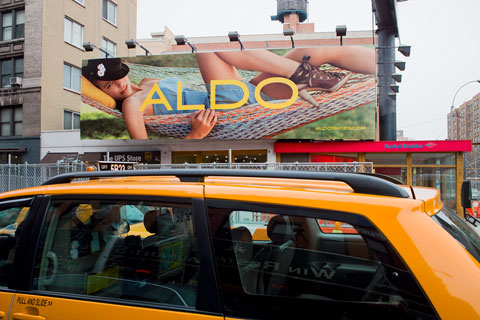
Despite the undulating facade, SHoP’s building feels somewhat reserved in this cacophonous context. But a bit of dignity, with a sly wink, might be the best policy with Puck himself looking on from across the street.
Lower Sixth Avenue, 1978, (35mm slide) © Brian Rose
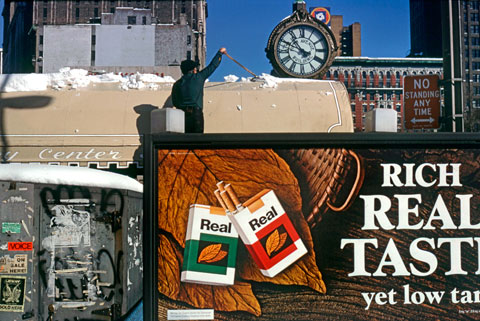
Fifth Avenue and 23rd Street, 1978, (35mm slide) © Brian Rose
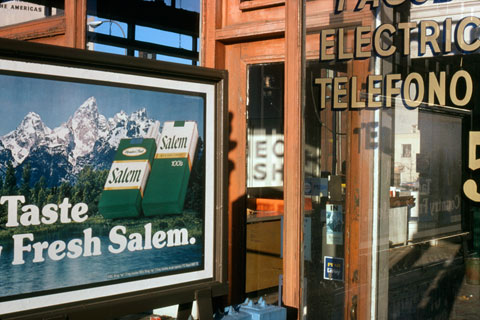
Cigarette ads were ubiquitous in those days.
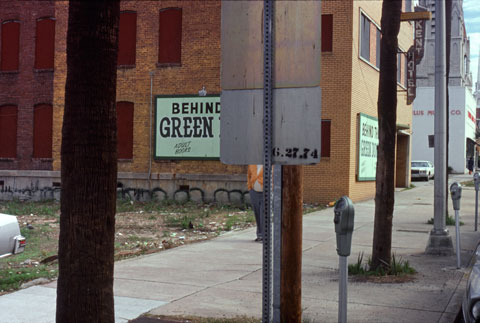
Jacksonville, Florida, 1978, © Brian Rose (35mm slide)
Another of the many slides I shot in the late ’70s.The back of the sign at center is dated 6.27.74, but that was a few years earlier.
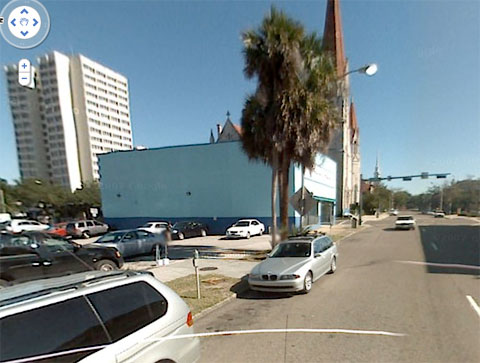
I looked on Google Maps and found the location on E. Duval between N. Main and N. Ocean Streets. The Kent Hotel and adult shop is gone, replaced by a parking lot. The boxy building further up the street is still there, as is the church.
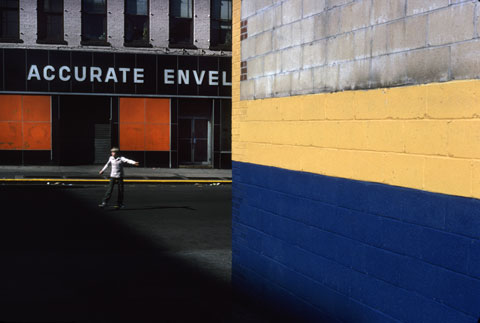
Lafayette Street (possibly), 1978, (35mm film) © Brian Rose
Taken when I was a student prowling around the city with a 35mm camera. I think this was on Lafayette Street in Noho or further down near Chinatown–not exactly sure.
I recall lining up the shot on the blue and yellow wall with orange panels to the left. A shadow cutting cutting across forming its own shape. All of a sudden a boy on a skateboard came shooting down the street.
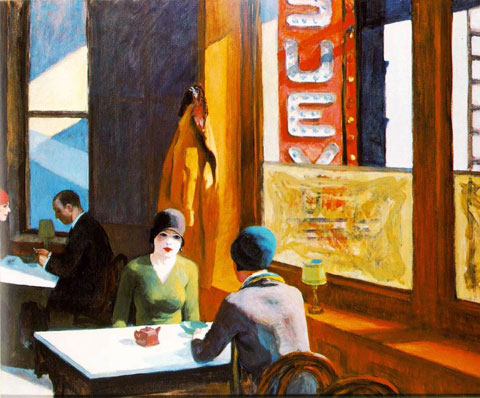
Edward Hopper, Chop Suey, 1929
Hopperesque. It’s a term that’s been thrown around for years to refer to art or literature that evokes the singular environments of Edward Hopper’s paintings. It’s a cliché–not necessarily used disparagingly–in fact, it’s most frequently used as praise. But as a cliché it isn’t the most helpful or insightful way of describing someone’s work. Maybe it’s a starting point to go deeper into things, which is fine, but by itself, it’s limiting.
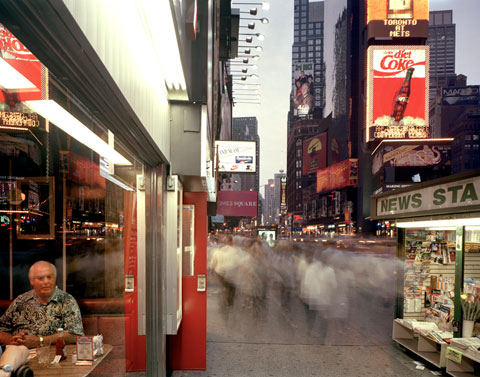
Times Square, around 1990 — © Brian Rose (4×5 film)
In the Sunday New York Times, Jori Finkel writes about a show at the Fraenkel Gallery in San Francisco that explores the relationship between Hopper and 20th century photography. It features seven paintings and a larger number of photographs made, primarily, by photographers represented by the gallery. Insert red flag here. Is this a serious show meant to challenge us to think about Hopper and photography, or is it a vehicle to promote the work of some of the most well-known photographers in the world? I haven’t seen the exhibit, nor do I know Jeffrey Fraenkel the gallery owner, so I don’t want to be overly judgmental. And I understand that it is the business of galleries to sell photographs. Still… Is this a show that justifies a large chunk of print in the paper of record?
Hopper’s work while often referred to as depicting loneliness and alienation, especially in an urban setting, is also widely appreciated as a painter of the American landscape. Not the heroic landscapes of the 19th century painters enthralled with nature and manifest destiny, but the more prosaic ones found on winding country roads or city street corners. He was modern in that sense. He painted common places and fleeting moments in the play of light both natural and artificial. He did it with a lush palette of fat paint, but the canvasses themselves were of modest size, simple compositions, unadorned, plain and direct. His often solitary figures were caught unaware, so it seems, and we look on almost voyeuristically. We apprehend the sliver of a story, a frame of implied narrative, and sense the inner life of characters, though we can’t know exactly what occupies their thoughts.
It’s easy to see the relevance to photography. But my feeling is that the obvious kinship between Hopper and, say, Evans or Shore is, perhaps, superficial. I know from my own experience as a photographer, and one who has spent an enormous amount of time in galleries and museums, that many types of art–from representational to abstract to conceptual–have had an influence on how I see the world and how I make pictures. I suspect it must be true for most other photographers.
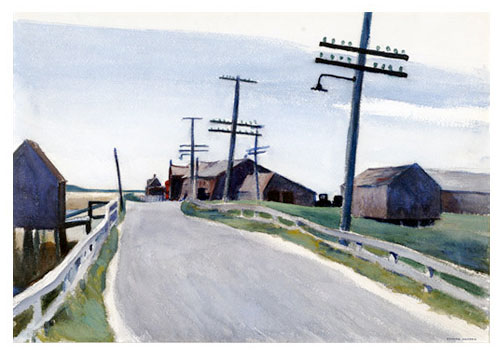
Edward Hopper, Wellfleet Road 1931
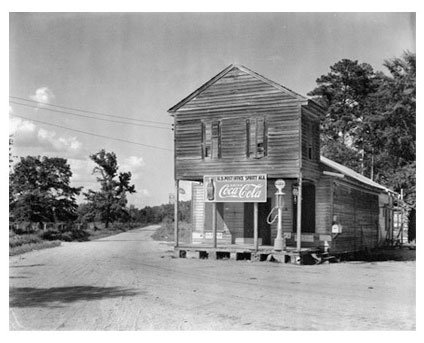
Walker Evans, Post Office, Sprott, Alabama, 1936
From the Times article:
“Hopper is huge,” Mr. Fraenkel said. “I think he’s had a pervasive impact on the way we see the world, so pervasive as to be almost invisible. Jackson Pollock is one of our greatest artists, but we don’t see Pollocks everywhere we look.”
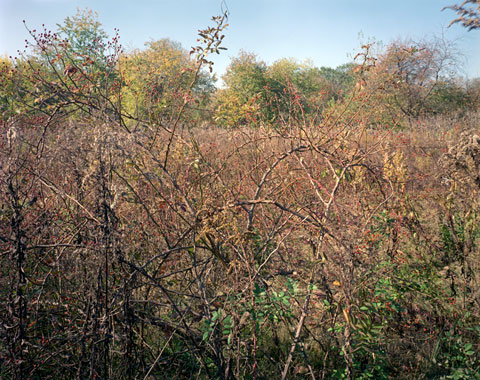
The Bronx, 1985 — © Brian Rose (4×5 film)
Personally, I do. I don’t know about other people, but I cannot look at the world without referring to the vision of all those painters who have taken apart and reassembled the world for us over the past century. From Cezanne who saw structure underlying everything to Mondriaan or Rothko whose reductive canvasses–in radically different ways–tested the connection of painting to the real world out there and the psychological or spiritual world inside. In recent years those who have questioned the utility of photography as description of the real have forced us to alter our understanding and connection to that which we perceive around us. All of this stuff gets assimilated into one’s thinking–though once I hit the street with my camera I am more lizard brain than art historian.
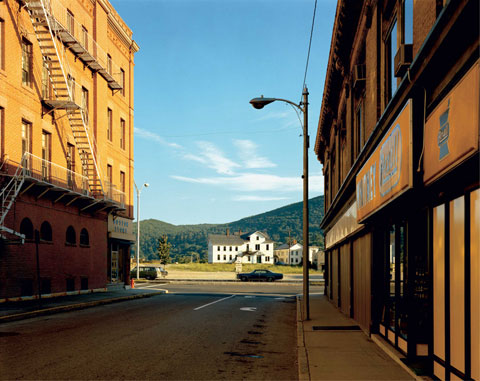
Stephen Shore, Holden Street, North Adams, Massachusetts, 1974
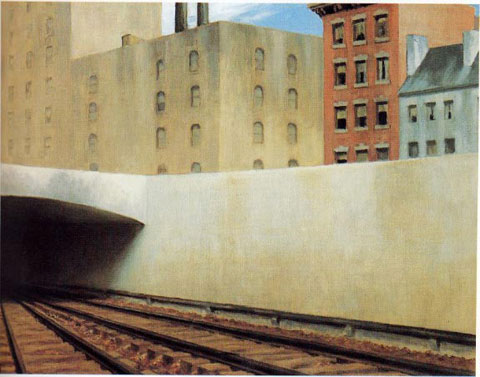
Edward Hopper, Approaching a City, 1946
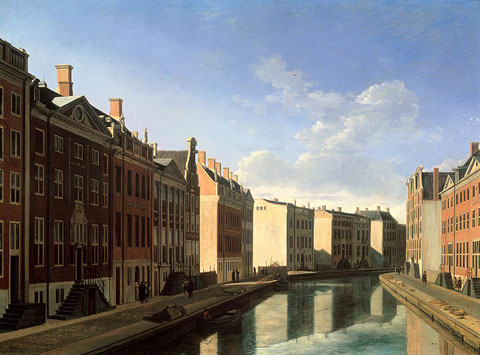
Gerrit Berckheyde, The Golden Bend in the Herengracht in Amsterdam, c. 1672
I have no doubt that the photographers shown in the Fraenkel Gallery have looked at Hopper, and possibly thought about him quite deeply. But the fact that Hopper paintings look a lot like certain kinds of contemporary photographs does not necessarily make them more relevant to photographers than paintings by other kinds of artists. If you go down a few posts, I wrote about looking at the Dutch landscapes of the Golden Age, and how they reminded me of the way the view camera takes in the world–the breadth of the landscape and the smallest details from foreground to background. But I could just as easily talk about the way Robert Rauschenberg integrated found objects, printed images, and seemingly random detritus into his paintings–and as a result I noticed that the real world was often like that, too. The list goes on.
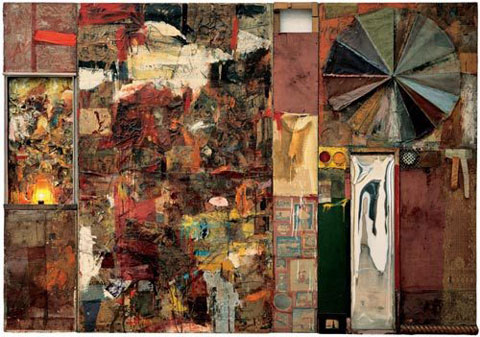
Robert Rauschenberg, Charlene, 1954
Here’s Fraenkel again at the end of the Times piece:
“It may just be me — it may just be my imagination — but I believe in this enough to put it out there,” Mr. Fraenkel said. “There may be dissenting viewpoints, and you can’t just say a light post near a house means influence. It’s much more complex than that.”
More complex, indeed.
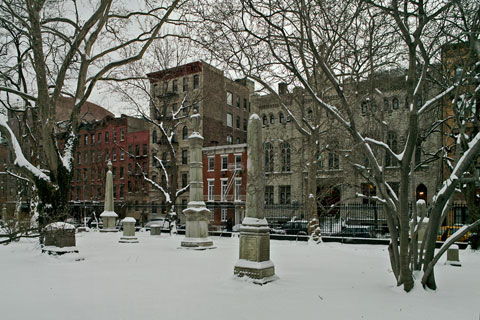
New York City Marble Cemetery, E2nd Street — © Brian Rose
New York got hit by a large snowstorm last night that continued throughout much of the day. It was cold for March, and the snow was drifting. Schools were cancelled–a rare occurrence in this city–and I was obliged to spend the day with my ten-year-old son Brendan.
I decided to go out in the snow with my view camera with Brendan in tow, something we have done many times. I am still adding to my Lower East Side project, so we took a short walk from my Stanton Street apartment/office up Second Avenue. Conditions were difficult at first–wind and blowing snow–with some snow still falling. The photos above and below were made with my Sigma DP1, which I usually carry with me when I go out with the 4×5 camera.
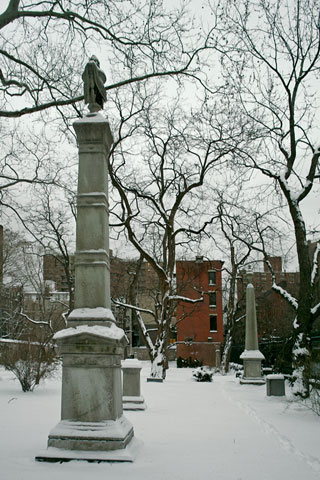
Marble Cemetery — © Brian Rose
At Second Street I turned east and walked opposite the New York City Marble Cemetery, a tree-filled oasis amid the tenements of the Lower East Side. I’d walked by it many time, but never gotten a photograph of it. It is almost always closed to the public. Today, the cemetery’s gardener was cleaning snow from the sidewalk, and he allowed me to enter the gate to take pictures.
Brendan volunteered to help clear snow–the gardener insisted on compensating him $5 for his work–while I navigated around the cemetery in sometimes knee-deep drifts for about an hour. The snow stopped, the wind let up, and I was able to make a half dozen photographs as dusk approached.
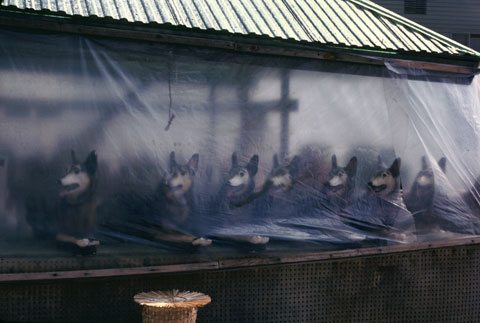
Williamsburg, Virginia, late ’70s — © Brian Rose (35mm slide)
Another early color photograph from my archive. I recall this being taken at the Williamsburg Pottery, a huge outlet mall for everything from dishes to garden gnomes. Where kitsch and the sublime collide.
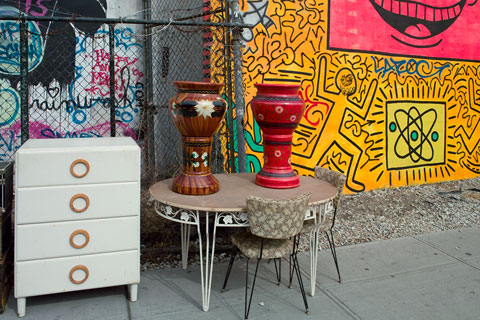
Houston Street — © Brian Rose
Billy’s Antiques and Props meets Keith Haring on Houston Street near the Bowery. I walk by here almost every day and can’t help every now and then snapping a picture.
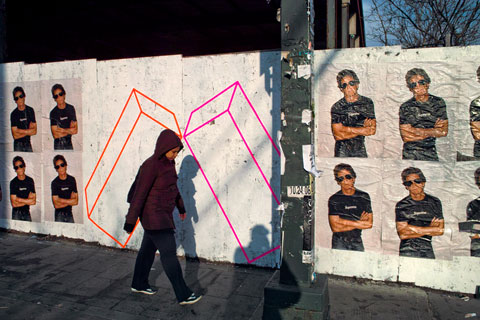
Bedford Avenue, Williamsburg, Brooklyn — © Brian Rose
Without comment.
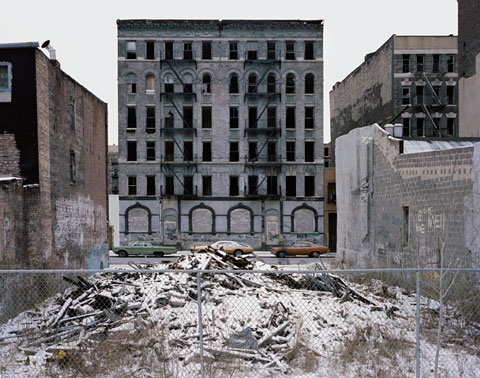
E8th Street, 1980 — © Brian Rose/Ed Fausty (4×5 film)
One of the Lower East Side images never printed before. I vaguely recall that this was one of the earliest pictures Ed and I made. Might even have been at the end of 1979. This building is still there, now renovated and fully occupied.
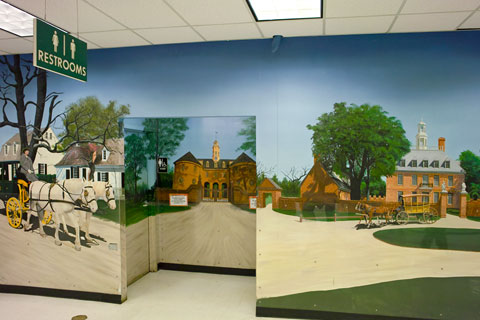
Williamsburg, Virginia — © Brian Rose
Visited my father in Williamsburg, Virginia, still cruising along at 87, albeit in an assisted living residence. I did some shopping for him at the nearby Farm Fresh complete with local visual reference–in case one is overcome with that “lost in the supermarket” feeling.
Back in New York.
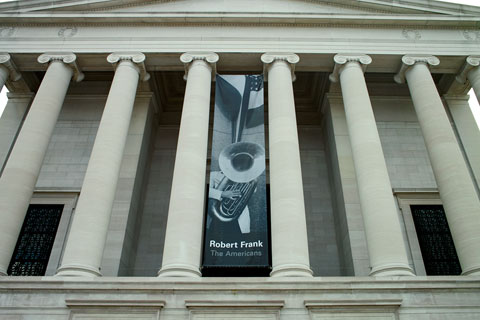
The National Gallery of Art and Robert Frank banner — © Brian Rose
I managed to see two exhibits at the National Gallery of Art in the whirlwind visit to Washington, D.C. made with my 10 year old son Brendan–Robert Frank’s the Americans and Pride of Place, Dutch Cityscapes of the Golden Age. I don’t know which show to recommend more; they are both fabulous.
The first examines the making of Robert Frank’s book The Americans, in my estimation the greatest of all photography books. Since The Americans deserves a more thorough review than I’m prepared to do now, I’ll leave it for another time. It’s worth going out of your way to visit D.C.to see it, but if you can’t, the museum’s website provides a nice taste. I’ve only glanced at the accompanying book, but will probably buy it the next time I’m at the Strand in New York.
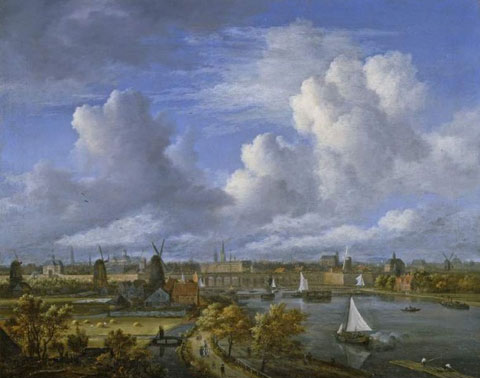
Jacob van Ruisdael, View on the Amstel looking towards Amsterdam
Cambridge, Fitzwilliam Museum
The second exhibition looks at the way in which cities and their surrounding landscapes were depicted by Dutch painters and mapmakers. Many of the paintings combine the sweep of the horizontal Dutch landscape punctuated by church spires and windmills with meticulous detail from foreground to background, at once expressing pride in civic achievement while taking note of ordinary citizens in city squares and at the threshhold between public and private life.
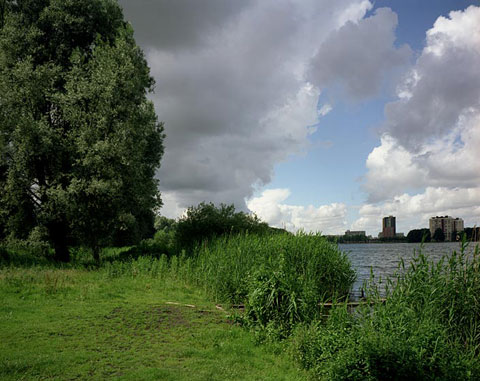
Sloterplas, Amsterdam — © Brian Rose
These paintings always make me think of the way a view camera can be used to take in breadth and detail–and in that regard I have always found these Dutch paintings inspiring–something I have kept in mind, in particular, while photographing the periphery of Amsterdam.
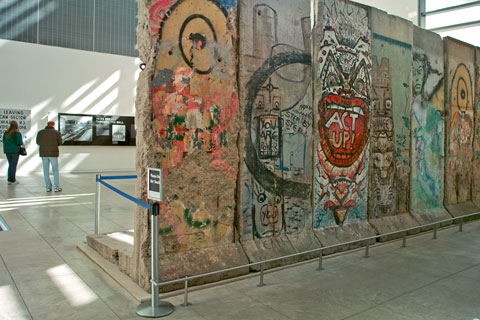
Berlin Wall exhibit at the Newseum — © Brian Rose
For obvious reasons, I was especially interested in seeing the Berlin Wall exhibit at the Newseum, a new institution dedicated to the history of journalism and freedom of the press. It’s located on Pennsylvania Avenue just across from the National Gallery. The Wall installation includes a number of original concrete sections placed next to each other to form a stretch of wall about 25 feet across. It looks incomplete to me, however, without the slotted pipe along the top, which was used to make climbing over more difficult. There is also an original guard tower, typical of those used in Berlin and elsewhere along the East/West German border rising up several stories in the exhibit space adjacent to the museum’s glass elevators.
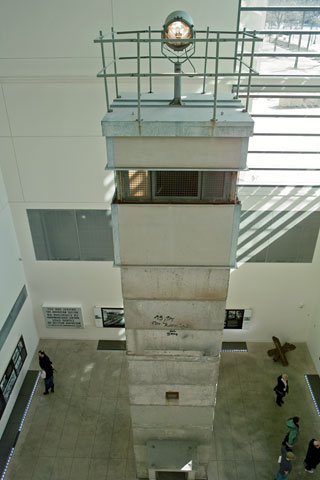
East German guard tower — © Brian Rose
As is so often the case, the fact that fortifications extended most of the way across Europe is largely left out. Meaning that most people do not understand that Berlin was a separate enclave within East Germany surrounded by the Wall, and not part of the continuous line of fences and walls that ran along the East German, Czech, and Hungarian borders–with a heavily guarded Yugoslav border completing the partioning of Europe down to the Adriatic Sea.
That complaint aside, I am happy to see the Newseum give the Wall so much attention. It was the most potent symbol of the Cold War–and, in retrospect, hard to believe that such a thing could have existed. The Newseum is a pretty glitzy place full of multi-media and interactive displays, but my son loved it, and there was enough serious content to offset the fluff. I was also pleased to see a memorial to journalists killed in the line of their unique and important duty–reporting the news and disseminating the truth. Such a memorial deserves a place of honor on the Mall along with all the others.