Category: Photographers/Photography

  • Berlin/Wall Remnants


    Remnant of 1961 Berlin Wall

    ⁣In a small wooded area tucked in behind the S-Bahn tracks in the north of the city is the only remaining stretch of the original 1961 Berlin Wall. It was discovered recently — hidden in plain sight — and confirmed by historians. You can just make out the Y-shaped brackets for stringing barbed wire to the left. ⁣ ⁣⁣ ⁣

    The wall ruins are now fenced off to protect the historic landmark from damage, and moreover, the terrain is very rugged and full of holes hidden by the overgrowth. With my Berlin friend Anamarie —the two of us creative comrades-in-arms over the years — we slipped in through a gap in the fence and I made photographs.⁣


    Berlin Wall remnants

    To the south of the city along Pushkinallee I came across two slabs of the Berlin Wall overgrown with vines. This was a stretch of the border that followed a canal connected to the Spree River. Below is a view of the Spree with the sculpture, Molecule Man, by Jonathan Borofsky.


    The Spree River

  • Berlin/30th Anniversary

    The Berlin Wall — © Brian Rose

    I am in Berin for the 30th anniversary of the opening of the Wall. As many of you know, the former East/West border was the subject of one of my books — The Lost Border — and I have continued to photograph the transformation of Berlin since the Wall opened.

    Billboard announcing 30th-anniversary events — © Brian Rose

    I won’t be attempting to photograph any specific events relating to the anniversary — peripherally, yes — there are all kinds of exhibitions and installations around the city, both serious and kitschy.

    Postdamer Platz — © Brian Rose
    Topography of Terror — © Brian Rose

    In a steady drizzle, I took pictures most of the day. Above is the former Nazi Lluftfahrtministerium (Air Ministry) with the Berlin Wall and the foundation wall of the former Gestapo/SS headquarters. This has always been a compelling view — and I have a similar picture of it from 1987 when the Wall was very much a real barrier — it is particularly arresting now because the exhibition panels have been temporarily removed from along the walkway below.

  • New York/MoMA


    The Museum of Modern Art — Picasso and Ringgold — © Brian Rose

    The Modern’s core collection of paintings from Van Gogh to Cezanne is presented in the newly renovated museum more or less as it was before, with the grand procession leading to Les Demoiselles d’Avignon by Picasso, a painting I have always regarded as one of the most radical breaks in the history of art. It remains a shocking presence — formally, conceptually, psychologically. Adjacent to the Picasso in the same gallery is a larger canvas by Faith Ringgold vividly depicting a 1960s race riot loosely based on the composition of Guernica, the monmumental anti-war painting by Picasso that once hung in the museum.

    It’s the first moment in the recently re-opened MoMA where the curators introduce a disjunction in the traditional narrative of the development of modern art. It’s intended — presumably — as a symbolic stand-in for Guernica and a signal of a more inclusionary attitude about race, gender, and politics. It’s the only non-Picasso in this particular gallery.


    Stieglitz photos and architectural articles — © Brian Rose

    The museum was often criticized in the past for presenting a canon of modernism that was white male and Euro/American-centric. While the path forward remains chronological, the curators have boldly mixed everything together. Photography, film, architecture, painting, and sculpture are all displayed in the same galleries. So, next to late 19th century paintings there is a wall of early photography. Below a series of Stieglitz images of Manhattan skyscrapers there are architectural journals from Germany and the Soviet Union, and in the same gallery,  models and drawings of early 20th century skyscrapers. There are large video screens showing early silent films in the midst of paintings and photographs.

    By breaking up the traditional silos and mixing and matching media, the curators are freed from the old constraints and can present a more diverse and discursive narrative of the development of modern art. That’s the idea, anyway. But the reality, for me, is that a team of curators has taken over the museum. Didacticism rules over discovery. Diversity overwhelms individual achievement. And one kind of orthodoxy has been replaced with another.


    The Museum of Modern Art —  Hopper painting and Burkhardt photos — © Brian Rose

    Photography, in particular, is missing in action in the new Modern. One of the things that kept me going back to the museum was to visit the photography department where one could see the touchstones of the medium’s development, where individual exhibitions were often mounted adjacent to the permanent collection. That’s gone now. One has to navigate the entire museum to find the photographs on display. Something I have no intention of doing in the future. There are no architecture galleries either — a great loss.

    I was enormously pleased, however,  to see the series of Rudy Burkhardt photographs of the landscape of Astoria and Long Island City. This body of work, made in 1940 depicting vacant lots, gas stations and urban bric-a-brac, I have long regarded as important and largely overlooked. What I don’t need to see is a glowing Hopper painting of a gas station next to Burkhardt’s more astringent views of a similar scene. It’s a false equivalency, or at least a strained one.

    While it’s true that photography and architecture — any of the various media — are not islands unto themselves, it is also true that each has its own history and its own unique integrity. The photography department of MoMA, a historically important entity, has been instrumental in bringing the medium into the mainstream of the art world. But it did that to a great extent by cultivating its own garden within the larger landscape. Technology and conceptual shifts in thinking about art have softened the garden boundaries for sure – photography is now cringingly referred to as lens-based art — but it would seem that the curators of MoMA by blurring all the lines, are diminishing everything. We are now in a multi-disiplinary world of competing narratives, and we are nowhere.

    Going back to the Faith Ringgold painting adjacent to Les Demoiselles D’Avignon. I admire the intention, but I resist the heavy-handed curatorial statement behind it. I’d rather come across the Ringgold somewhere else in the museum — with the reference to Guernica in the caption — and be allowed to make the visual connection back to Picasso, back to the Guernica and its history in MoMA, on my own terms.

  • New York/Atlantic City


    Atlantic City, abandoned Trump Plaza

    As far back as 1981, Louis Malle said that his film “Atlantic City could be a metaphor for things going wrong all over America.” And recently the New Republic opined that “The closure of Trump Taj Mahal casino is a giant metaphor for Trump’s America.”

    The New Republic

    Atlantic City is a metaphor for America at large. That is one of the principal themes of my book about this fabled – and troubled – resort city. Corruption has long been at the heart of the enterprise going all the way back to Prohibition. Although Atlantic City may have invented the idea of the speakeasy where illicit activities are hidden in back rooms, the reality is that everyone knew what was going on, especially local law enforcement — and politicians — who were in on the scheme.


    The Knife and Fork Inn

    Standing where Atlantic, Pacific and Albany Avenues converge, the Knife & Fork was originally established in 1912 by then Atlantic City Mayor William Riddle, the Commodore Louis Kuehnle, and their cronies as an exclusive men’s drinking and dining club. 

    Knife and Fork Inn website

    When casinos were legalized in Atlantic City, the graft went big time and mobbed-up real estate developers like Donald Trump moved in, sucked out money, and left the city littered with abandoned buildings and vacant lots. Everyone knew who Donald Trump was then and now. But it didn’t matter as long as the politicians and corporate thieves benefited.


    City Hall, Atlantic City

    Mr. Gilliam joins a long list of Atlantic City politicians who have criminal records. Among them, former Mayor Robert Levy pleaded guilty in 2007 to lying to the government about his military record to increase his veterans benefits.

    The Wall Street Journal

    Atlantic City became an institutionalized kleptocracy. When Donald Trump made his astonishing leap from reality TV star to President, he brought the casino ethos of Atlantic City with him trashing the ideals of democracy along the way. Those ideals now stand abandoned like the rubble of Atlantic City while Trump’s supporters, mesmerized, play the slots all night long, taking their momentary gains, while knowing, ultimately, they will lose everything before the morning comes. If it comes at all.


    Playground Pier

    In January of 2016, after a winter storm flooded parts of the Jersey coastline, New Jersey Governor Chris Christie, then a candidate for president, sarcastically asked whether he should “pick up a mop” to help with flooding—a remark that was criticized by environmentalists for being out of touch with the gravity of the situation. Christie accepts that human activity contributes to climate change, but contends that the issue “is not a crisis.”

    National Geographic

    Meanwhile, back in the real Atlantic City things go on as before. The mayor gets in a brawl in a casino parking garage. The mayor is convicted of embezzling money from a youth basketball program. The mayor resigns and is replaced by a rival with an arrest record. Revenue is up over last year in the casinos because of the introduction of sports betting. Hooray! And the Atlantic Ocean waves creep ever closer to the boardwalk.

     Atlantic City — available for purchase on Amazon

  • Brian Rose/Atlantic City


    Trump Human Resources Office, Atlantic City

    Today, September 24th, 2019 will be remembered as the day Donald Trump’s stolen presidency began to crumble. The president himself is holed up in Trump Tower — after his desultory appearance at the UN — as Nancy Pelosi announces the initiation of impeachment proceedings.

    Just a short time ago I began photographing Atlantic City and Trump’s failed legacy. The pictures in my book describe a damaged urban landscape — extreme poverty and extreme wealth juxtaposed. The blame goes first to the politicians who concocted the casino gambling model as a way to save the crumbling resort city. It was never a serious solution. It was a kleptocracy disguised as a solution.

    That’s where Trump came in — as a modern-day robber baron propped up by Russian mafia money. When he left his casino empire around 2014 to 2016, Atlantic City had a higher unemployment rate than it did when he arrived. It had fewer homeowners than when he arrived. Crime had worsened. Property taxes had gone up, and abandoned houses and vacant lots littered the landscape.

    Despite the glaring evidence of his failure in Atlantic City, along with his clear obligations to shadowy foreign leaders, the American public — not a majority, but enough — voted for someone who would forever stain the honor of this country. They gambled away the American dream on a charlatan and a traitor.

    Atlantic City — available for purchase on Amazon.

  • New York/Robert Frank


    © Brian Rose

    It was a poignant day for me in New York — a series of small events against the backdrop of the anniversary of 911. I went by Robert Frank’s studio on Bleecker Street and did a series of photographs of the impromptu memorial in the front of his building. A steady stream of visitors came, stood silently, snapped a few pictures, or left flowers or mementos. I exchanged a few remarks with passersby and ended up explaining to some tourists what was going on and who Robert Frank was.


    © Brian Rose

    I then walked a few blocks up the Bowery to see Alex Harsely in his storefront gallery on East 4th Street. Alex is an amazing photographer whose work spans roughly the same time period as Frank’s. Alex’s gallery door is always open to friends and visitors, and Frank used to drop in fairly frequently. Alex and I chatted a while about Robert Frank, and then a man walked in who as it turned out worked for Frank as a driver and general helper. He told us that Frank had fallen in his house in Nova Scotia, had gone to the hospital, and did not recover. Frank, of course, was 94 and quite frail.

    © Brian Rose

    I actually never knew Robert Frank, though I’d met him once and seen him walking around the neighborhood a number of times. A few years ago I was passing by his studio after a heavy snowfall. I was walking in the street because the plows had piled the snow up into small mountains along the sidewalks. I noticed that an elderly couple was struggling to get over one of the snowbanks. It was Robert Frank and his wife June Leaf. I helped them climb over the snow and escorted them to their door. Like a true New Yorker, I never let on that I recognized them.

  • New York/Washington, D.C.


    Jahi Chikwendiu/The Washington Post

    The image above, taken a few days ago, is the way Trump wants to be seen — from a low angle — powerfully commanding the spotlight, microphones thrust forward to record his pronouncements, alone on the White House lawn, half shouting over the clatter of helicopter rotors.

    Alex Wong/Getty Images

    All the pictures tend to look more or less the same. The president orchestrating the press gaggle assembled in front of him, unseen out of frame except for the boom mics. Even as he admonishes them as fake news, he basks in the attention, the warm bath of power and glory. The press at once resistive and complicit. The boundary between real and reality TV erased in perfect symbiosis.


    Stephanie Grisham/White House Press Secretary

    Here’s a different, perhaps more truthful, view of the same moment, a view that breaks the fourth wall of reality TV. It was taken, ironically, by Stephanie Grisham, the newly anointed press secretary, twice arrested drunk driver, replacement for the execrable Sarah Huckabee Sanders who has moved over to Fox News, the propaganda organ of the Trump regime.

    From her somewhat distant remove she captures the whole sun-dappled scene peering through the trunks of a tree on the White House grounds. The tree introduces a slightly voyeuristic note as if we are spying, partly obscuring our view of the proceedings. One can almost hear Trump barking, the reporters shouting out questions, the camera shutters chattering.

    The members of the press are assembled on a tiered grandstand — there are three rows — the sound recorders squatting on the first rung arms outstretched thrusting their mics forward. The videographers, photographers, and scribes are mixed together on the next two levels. Trump, who has just exited Marine One, stands close to his interlocutors, perhaps the better to hear and be heard, or perhaps, to physically crowd the space between him, the media, and his unseen millions of viewers. Trump stands so close, pitched awkwardly forward in his shoe-lifts, that the photographers have to go wide with their zooms which exaggerate Trump’s size in relation to the sylvan landscape beyond.

    The reality is that the president’s stature diminishes daily. We are, possibly, in the waning days of Trump’s stolen presidency. His words ramble, his mind meanders, his anger boils, his voracious hunger for validation remains unsatisfied, and his grip on reality slips inexorably toward oblivion.


  • New York/TWA

    TWA Hotel, JFK airport, New York — © Brian Rose

    Returning from a week’s vacation in Amsterdam, we visited the newly restored TWA Terminal at JFK airport. At least once, decades ago, I passed through this glorious survivor of the early days of air travel. I remember it then as a bit shabby with numerous visual intrusions grafted onto Aero Saarinen’s flowing architecture. The terminal has now reopened as a hotel connected to JetBlue’s JFK hub.

    TWA Hotel, JFK airport, New York — © Brian Rose

    The exterior of the terminal has been beautifully preserved, but the dark-windowed hotel structures standing between TWA and the surrounding JetBlue terminal create a claustrophobic space for Saarinen’s sculptural masterpiece, which once stood open to the tarmac and the sky.

    TWA Hotel, JFK airport, New York — © Brian Rose

    Half of the rooms appear to face JetBlue, and the other face inward toward TWA. Some rooms look out onto the airfield — those are the rooms to get. The architects were obviously trying to make the hotel wings neutral and unobtrusive. They are neutral, but not exactly unobtrusive.

    TWA Hotel, JFK airport, New York — © Brian Rose

    The curving driveway out front still allows for cars to pick up and drop off in proper 1960s style. Above, my son Brendan, wearing an appropriately themed NASA shirt,  and my wife Renee pose before a vintage Lincoln Continental.


    TWA Hotel, JFK airport, New York — © Brian Rose


    TWA Hotel, JFK airport, New York — © Brian Rose

    TWA was, of course, originally an airport terminal, not a hotel. So, one has to accept the tradeoffs involved. Nevertheless, I could do with fewer theme-y gestures like the uniformed greeters in the main hall and a bank of ’70s era phone booths. The place felt a little under-populated while we were there during lunchtime, and I worry that the hotel will fail to draw enough business. The slender tubes that once led to the TWA gates, now serve as connectors to JetBlue’s terminal. But the entrances are hard to find, and the signage inadequate.


    TWA Hotel, JFK airport, New York — © Brian Rose

    The TWA Terminal is one of the masterpieces of 20th-century architecture. It should probably be a memorial to the golden age of aeronautics instead of a hotel. But if a hotel, drop the kitsch and run it like a real place.

    Don’t miss it. It’s well worth a special trip or a detour before or after your next JFK flight.

  • New York/Brothers II

    A few weeks ago I wrote about the apparent business connections between Jeffrey Epstein and his brother Mark, the former chairman of the Cooper Union board of trustees. Obviously, with the shocking death of Jeffrey in federal detention, the story has mushroomed and attention has shifted to the orbit of figures surrounding Jeffrey including his brother Mark.

    My suspicions about Mark have been confirmed now by multiple reporters working for Crain’s, Business Insider, the Daily Beast, New York Magazine and the Wall Street Journal. Gretchen Morgenson, the Pulitzer Prize winning journalist is on the story for the Journal and vows “to get to the bottom of it.”

    From the Journal article:

    “Mark Epstein started a number of businesses, including a silk-screen T-shirt company, called Izmo, that he created in 1986, incorporation records show. There was Atelier Enterprises Inc., a charter/leasing company he headed in 1984; Epstein Acquisitions, set up in 1987 and dissolved in 2015; and Saint Model and Talent, incorporated in 2005. He has previously said he began investing in New York real estate in the early 1990s.”

    “By the late 2000s, he became a major donor to Cooper Union, the New York art, architecture and engineering college from which he graduated in 1976. By 2009, he had donated between $500,000 and $999,000 to the school, according to a donor report published by the college. That year, he was named chairman of its board of trustees; he resigned from the board in 2015, following the board’s controversial decision to drop the school’s longstanding policy of full tuition scholarships for all students.”

    How one goes from silk screening T-shirts to owning multiple buildings in Manhattan remains a mystery that none of the articles solve. The one thing that is clear, Mark’s building on East 66th Street was a nexus of Jeffrey’s nefarious activities.

    A tenant of East 66th Street quoted in the Daily Beast:

    “The only person that I remember for sure being here was Jeffrey,” said the tenant, who said she later called Jeffrey Epstein about a building maintenance matter, assuming he was the owner. “I do not actually remember ever meeting Mark Epstein.”


  • New York/D.A. Pennebaker

    Director D.A. Pennebaker in 2000.Kathy Willens/AP

    D.A. Pennebaker, one of the leaders of cinema verite, and the maker of “Don’t Look Back,” the groundbreaking documentary about Bob Dylan, died yesterday at 94. I was privileged to take a class from Pennebaker while at Cooper Union in the late 70s. He was one of a number of extraordinary, inspiring professors I encountered there — influences that I carry with me always.

    Pennebaker wasn’t exactly a great teacher. The class was held in his studio, and he mostly showed films and talked non-stop. I remember trying to interject comments into the stream of his monologues without success. Even questions were hard to get in. But what he had to say was worth paying attention to. He was intense, but at the same time warm and likable.

    The kind of filmmaking he espoused, cinema verite, or direct cinema, was still relatively new at that time and had its detractors. The question was, and remains,  is it possible to maintain a neutral stance as an observer — to be a fly-on-the-wall and nothing more. The same goes for still photography. It’s a question I continue to wrestle with.

    Some years later, my friend Suzanne Vega, the songwriter,  was working with Pennebaker on a promotional film. She was doing a special appearance at Speakeasy, the tiny folk club in Greenwich Village. At one point she took me aside and said “Brian let me introduce you to D.A. Pennebaker,” assuming that I would be thrilled to meet the esteemed documentarist. I reminded him that I was one of his former students at Cooper and we yakked for several minutes as if we were old friends. Suzanne was a bit stunned, as I recall.

    I realized at that moment, talking with him in a closet-sized dressing room at Speakeasy, that someone with a personality as voluble as Pennebaker’s could never have been a true fly-on-the-wall. He was hardly the invisible cameraman that I had imagined trailing Dylan on tour in England. That revelation does not necessarily detract from my admiration of “Don’t Look Back,” but I now understand better the contradictions and complexities of that film and others like it.

  • New York/Atlantic City


    Atlantic City, 2017 — © Brian Rose

    It does not take much imagination to see Atlantic City with its extreme juxtaposition of wealth and poverty as a metaphor for much of what is going on in the country as a whole. The casino hotels rise up above wooden row houses and churches like the old steel mills of the nation’s heartland. Where the factories of the past once forged the raw goods that fed the might and power of a great nation, the massive casinos of Atlantic City represent the industrialization of tourism and the exploitation of the shrinking hopes and dreams of the American middle class.


  • New York/Brothers


    © Brian Rose

    SECOND UPDATE BELOW
    MAJOR UPDATE BELOW

    I did not know until a few days ago that Mark Epstein, former chairman of the Cooper Union board of trustees, is the brother of Jeffrey Epstein, the convicted pedophile, who was arrested by the FBI on Saturday. I also did not know that Jeffrey attended Cooper for two years, studied math and science – I assume admitted to the engineering school – and dropped out in 1971. (I’ve been told that he may have been in the physics degree program.)

    Mark also attended Cooper in the art school graduating in 1976 just before I got there in 1977. I knew that Mark was in NYC real estate, owning buildings in Hudson Square and elsewhere. What I found out today was that he owns a building on the Upper East Side that is connected to his brother Jeffrey’s activities.

    Mark Epstein was one of the key villains of Cooper Union’s recent history. As Felix Salmon wrote in Reuters in 2013: “Epstein… was intimately involved in most of Cooper Union’s worst decisions,” the most major of which was the $175 million mortgage to build the New Academic Building, a move that almost bankrupted the school, necessitating the imposition of tuition for the first time since its founding by Peter Cooper in 1859. He then publicly blamed the alumni for not doing enough, comparing Cooper’s alumni giving numbers unfavorably with Princeton University, an institution of vastly different scale and purpose.

    I became involved with the Cooper Union alumni association at that time and wrote frequently on my blog and on Facebook about the existential crisis consuming the school. At one point, I received an anonymous comment on my blog from an individual who noted that many of the most vocal critics of the board and administration had not previously been financial supporters of the school. Suggesting that we had no business complaining. With a little internet sleuthing I was able to trace the comment to Mark Epstein. So, the chairman of the board of trustees was anonymously trolling an outspoken alumnus. Epstein’s pettiness was a minor event, but indicative of a downward spiral that eventually led to the alumni association being kicked off the campus by school president Jamshed Bharucha.

    The Bharucha/Epstein reign of terror was short lived, however. There were student protests, a lawsuit, the intercession of the state Attorney General, and as a result, Bharucha, Epstein and other board members left the school under a cloud of opprobrium. Things have turned around positively at Cooper since their departure with the college now looking to a return to free tuition in the foreseeable future, and I hadn’t heard Mark Epstein’s name in a long time.

    Until yesterday’s Crain’s business magazine. The article by Will Bredderman begins, “The epicenter of the scandal engulfing wealthy pedophile Jeffrey Epstein is his mansion on East 71st Street, but real estate records show he also has been involved in his billionaire neighbor’s house and another East Side property belonging to his brother.” It gets complicated, but it appears that the company set up as owner of Jeffrey’s mansion has its mailing address in a building owned by his brother Mark.

    The article continues: “On the deed, the Nine East 71st Street Corp. listed as its address unit 10F at 301 E. 66th St. Both the unit and the building, records show, belong to 301/66 Owners Corp, an affiliate of Ossa Properties—the real estate company belonging to Mark Epstein, formerly the board chairman at Cooper Union. Numerous news reports have identified Mark as Jeffrey Epstein’s brother, including a 2009 New York Post article that quoted an attorney for several of the underage girls who accused the financier of sexual assault. The lawyer, Brad Edwards, asserted at the time that Jeffrey Epstein had rented apartments at 301 E. 66th St. for the accusers.”

    In other words, as this article and the Post article suggest, the two brothers may have colluded in providing housing for underage girls who were part of Jeffrey’s horrific rape and sex trafficking scheme. The Post article from 2009 quotes Jeffrey’s lawyer saying, “Jeffrey rents several apartments there where he keeps his girls, alleged models for the MC2 agency he owns,” Edwards said. “But Mark acts like he doesn’t even know his brother. He was extremely angry and rude and cursed me out.”

    That same year — 2009 — Mark Epstein was named chairman of the Cooper Union board of trustees. In 2013 at the end of his term, Epstein was granted the honorific Chairman Emeritus. He continued as a board member until his resignation in 2015 when the Attorney General imposed a settlement stemming from the lawsuit brought against the board by students, faculty, and alumni.

    Given the rebirth of Cooper Union since that time, it is unfortunate that the school is now tainted by an association with the Epstein brothers. But the stench of the Epstein scandal has seeped into our body politic, and while the full extent of the rot remains unknown, it is embodied no less than by the pestilent figure now occupying the White House.

    UPDATE

    An article in the NY Times in 1993 mentions Ossa Properties and two partners in the firm, Jonathan and Anthony Barrett. There is no mention in the article of Mark Epstein, but Epstein’s LinkedIn page indicates that he was owner of Ossa from 1992 to the present. In a 2004 document related to the Harlem Charter School Barrett is listed as a proposed trustee of the school, and his bio states the following:

    “…he spent four years at NYC based investment management firm, J Epstein & Co. (Wexner Investment Company) and Ossa Properties, an affiliated NYC real estate investment company.”

    There it is. Wexner was Jeffrey Epstein’s principle client — or only known client. Ossa, Mark’s company, was affiliated with Wexner/Jeffrey. That’s where his money came from. 

    Cooper Union should have known this.

    SECOND UPDATE

    Business Insider has dug further into the relationship between the Epstein brothers, and I know that the Wall Street Journal is working on this story as well. So, stay tuned for that. As I suspected, Mark Epstein’s real estate empire was acquired with money from Jeffrey, and circumstantial evidence points to Mark being aware of, and possibly working with his brother, in the phony modeling agencies set up to procure young women and girls.

    According to Business Insider “…records show at least two 1991 filings where Ossa’s (Mark’s real estate company) address is listed as “475 Madison Avenue” — the home of J. Epstein & Co. and a charitable foundation named “Epstein Interests.” It’s also the same office where Jeffrey Epstein’s attorney, Darren Indyke, first registered a company called E Management. According to court documents, E Management was operated by Brunel, the owner of MC2.” MC2 is the modeling agency alleged to have been a source of young girls for Jeffrey Epstein.

    Business Insider quotes a classmate of Jeffrey Epstein in the book “Filthy Rich” by James Patterson that “He was a diamond in the rough, you see,” Gary Grossberg told Patterson. “People recognized Jeffrey’s brilliance very early on. But he had a gift for recognizing opportunities very quickly. He started buying properties in Manhattan, including 301 East 66th St. He asked his brother — did Mark want to join him? He did.”

    More will come out.


    © Brian Rose


  • New York/West Side Highway


    West Side Highway at 59th Street, 1985 — © Brian Rose

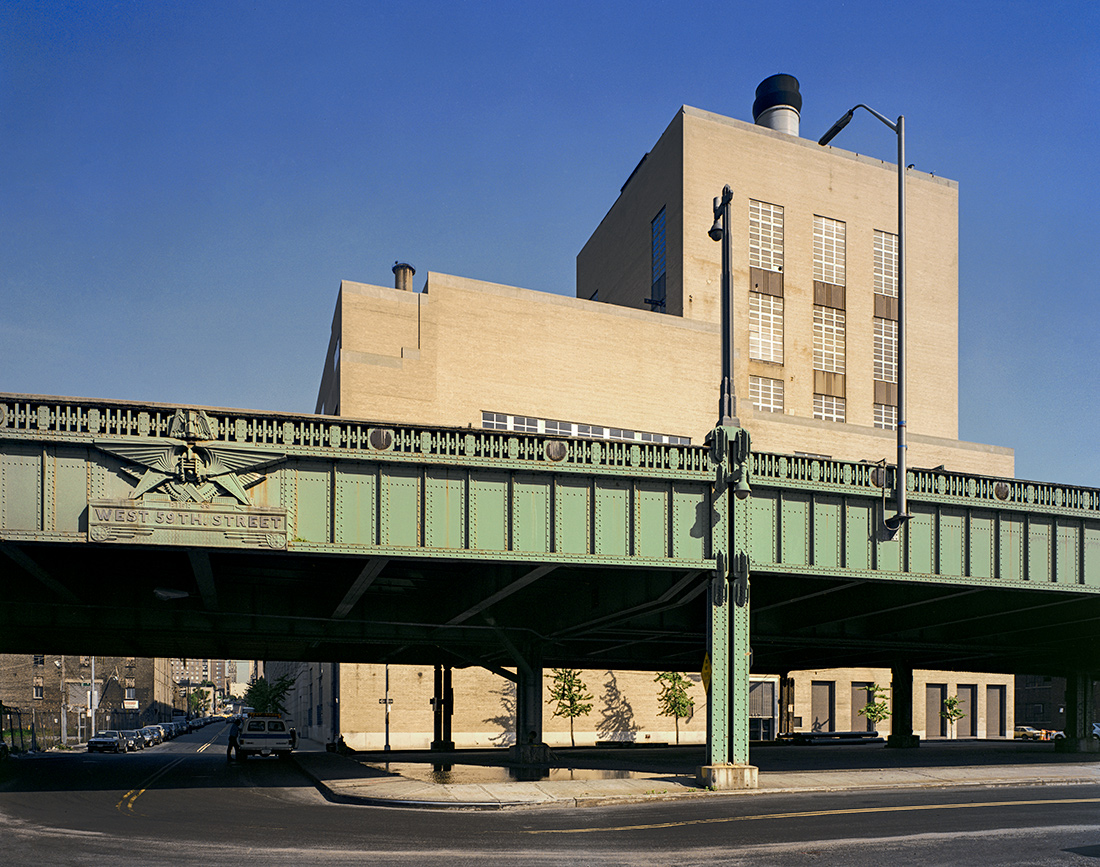
    Two new scanned images from around 1985 when I roamed up the west side of Manhattan. The West Side Highway was torn down after a collapse of one section of the elevated viaduct. I remember walking it during the late 70s. I have a few 35mm slides taken from it. Only a few of the Art Deco details of the structure were saved when it was torn down.


    West Side Highway remnants, 2009 — © Brian Rose

    A few years ago, I discovered a couple of discarded concrete pieces of the highway behind some fencing in lower Manhattan.


    George Washington Bridge, 1985 — © Brian Rose

    I remember doing this photograph as part of an assignment having to do with the George Washington Bridge. Not exactly a classic view of the bridge, but the image does give a sense of the beautifully wild, if forbidding, urban landscape of the time period.

  • Atlantic City


    Atlantic City — © Brian Rose

    I returned to the scene of the crime the other day — Atlantic City that is — where I documented the legacy of Donald Trump’s failed casinos. The city skyline can be seen at a distance from the Garden State Parkway, a row of towers hovering above Absecon Bay. At a glance, it could be Miami Beach, but one swiftly becomes aware of the difference once over the bridge and onto the ragged streets of the city.


    Susan Wallner, producer, on the street in Atlantic City — © Brian Rose

    I was traveling with a TV crew doing a piece about my book for a show called State of the Arts, which looks at creative life in New Jersey and airs on public television. As a photographer, I am usually looking through the camera, but having done a lot of interviews and presentations in recent years, I’m not too uncomfortable on the subject side of the camera. We visited various locations around Atlantic City where my book images were made, wheeling around a little cart containing camera gear, and occasionally jumping into an SUV when the distances were too far to walk.


    Pacific Avenue, Atlantic City — © Brian Rose

    On this bright sunny day in mid-May, Atlantic City appeared, at first, rather upbeat compared to the mood of the pictures in my book. But that cheeriness soon was dissipated by a rather threatening individual, tall and muscular and obviously high as a kite, who wanted to make sure we weren’t photographing him. And then a man came up who said he was running for city council, pointing to a storefront with his name displayed on it, and I asked him about the current mayor who recently got into a fistfight at 2 am in the parking garage of one of the casinos. He said he was a crook who had to go. Which reminded me that Atlantic City’s history has been rife with various kinds of crooks at all levels, from drug addicts to mayors, from numbers runners to mafioso, from party bosses to casino tycoons. That’s why were here. The biggest conman of them all, Donald Trump, had come and gone, and was now scamming the entire country.


    The White House Sub Shop celebrity wall — © Brian Rose

    We went to lunch at The White House Sub Shop, which features a portrait of Donald Trump on its celebrity wall with an inscription and signature in gold ink. It’s a younger, somewhat raffish Donald in the photo, and one is reminded that Trump was the most important figure in this town for more than two decades. The White House website has a menu for its outlet in the Hard Rock Casino, which took over the Trump Taj Mahal, stripping off the onion domes and minarets, replacing the faux Indian/Russian theme with electric guitars. If you click on the link for the Hard Rock White House, you go to a menu that still says Trump Taj Mahal. It’s been several years since the final departure of Trump from Atlantic City, but his ghost still haunts the place.


    The White House menu/Hard Rock Casino — © Brian Rose


    Trump Plaza — © Brian Rose
    Just a block from the White House there’s a vast expanse of blank wall festooned with a golden cartouche, which was once accompanied by a giant red Trump Plaza sign. All the Trump logos have been removed, but you can still just make out the letters for Trump Plaza formed by the brackets embedded in the wall. I call it Trump’s wall.


    Caesars parking structure — © Brian Rose

    Next to the abandoned Trump Plaza is Caesars, which is still going strong among the casinos that front the boardwalk. I’m often asked in interviews what has changed in Atlantic City since I finished making the photographs for the book, and I have to remind them that the most recent images were done only last year. Not much has changed since I started the project in November of 2016, just a few weeks after Trump’s election.

    The official boosters of Atlantic City have been touting the city’s comeback now that the Trump Taj Mahal and the Revel have reopened under new owners. But the reality is that Atlantic City remains a one-industry town, and the basic equation between the glitzy casinos and the impoverished city remains unchanged. I liken the gargantuan out-of-scale casinos to the steel mills that used to hover over rowhouses in old factory towns. The casinos are an extreme example of the industrialization of tourism. The steel of yesteryear built America’s infrastructure, which is now crumbling, while the casinos offer entertainment, and the money gets shipped straight to Wall Street. Or into the pockets of grifters like Donald Trump.


  • Atlantic City/An Update


    Atlantic City in the Tate Modern bookstore

    An update on my book Atlantic City. I’ve gotten a number of excellent articles, and most recently a review by Blake Andrews in Photo-Eye. I am expecting a couple of more reviews to appear soon, and I just did a podcast interview on Monocle, an online magazine.

    Here are links to the various articles, interviews, and podcasts:


    Monocle – Podcast


    Photo-Eye – Review


    Route 40 Article


    The Guardian – Article


    Wired – Article


    Untapped Cities – Article


    Based On A True Story… – Review


    Fast Company – Article

  • New York/God Bless America

    Smith Street, Brooklyn — © Brian Rose

    I always knew there was a problem with Kate Smith and her campy version of “God Bless America” imposed upon us during the 7th inning stretch at every Yankee home game. I always knew that it was George Steinbrenner, the former Yankee owner, who demanded that it be played after the 911 attacks. Kate Smith’s recording of it had, for him, the desired jingoistic flavor. And I also knew that Woody Guthrie wrote “This Land is Your Land” as a reaction to the patriotic treacle of Irving Berlin’s song. Berlin, of course, was a Jewish Russian immigrant, and the song was written in 1918 during World War I, and it was revived by Kate Smith in 1938 as war loomed once again in Europe.


    Mount Vernon, Virginia — © Brian Rose

    It all gets complicated, really. Berlin wrote numerous enduring Broadway classics, and Guthrie wrote as many enduring songs of protest and social commentary. But there’s something about the way Kate Smith sang “God Bless America” that epitomized a certain kind of patriotism — the sort of patriotism that reeked of an uncritical sense of cultural superiority. So, I was not surprised when it was revealed that Kate Smith had also recorded the racist classics “That’s Why Darkies were Born” and “Pickaninny Heaven.”


    Wiliamsburg, Virginia — © Brian Rose

    There’s a video on YouTube of Irving Berlin himself singing “God Bless America.” It starts off with him alone on the stage, his wavering voice just barely able to reach the high notes, and I thought, okay, I can live with this. But then the curtains behind him open, the music swells, and a uniformed choir of boy scouts and girl scouts takes over in full-throated fervor, turning what started as a sentimental hymn to America into a bombastic, almost militaristic anthem. This performance was on the Ed Sullivan Show in May of 1968, the year of the My Lai massacre in Vietnam, the Prague Spring uprising in Czechoslovakia, the assassination of Robert Kennedy,  and the wave of riots that swept across American cities after the assassination of Martin Luther King, Jr.

    So, let us just say that “God Bless America” has a certain history, and it is not a safe, uncontroversial, paean to mountains and prairies. Kate Smith’s contralto, after 18 years of residence, is no longer welcome at Yankee Stadium. Good riddance.


    Coney Island, New York — © Brian Rose

  • New York/1985


    West 51st Street and the Westside Highway, 1985 — © Brian Rose


    West 28th Street and 11th Avenue, 1985 — © Brian Rose

    Two images of the west side of Manhattan in 1985 with Empire State Building. Today, the ESB has lost its primacy on the skyline, though not its architectural presence. For me, it will always be New York’s greatest skyscraper.

  • New York/Atlantic City

    Atlantic Casino — © Brian Rose

    A few outtakes from Atlantic City. Pictures that for one reason or another did not make the cut. The main reason being that I wanted a really tight series of pictures without too many digressions or repetitions. You can purchase Atlantic City here.


    Atlantic Avenue — © Brian Rose

    Hotel on the boardwalk — © Brian Rose

    Atlantic City boardwalk — © Brian RoseFormer Trump Taj Mahal — © Brian Rose

    The Trump Taj Mahal was stripped of its faux Indian/Russian onion domes and minarets, and the new owner, Hard Rock International, pasted on their guitars. The picture above catches things in between. Although there are still the traditional hand-pushed rolling carts on the boardwalk, there are now a number of these little buses that take tourists up and down the beach.

    You can purchase Atlantic City here.