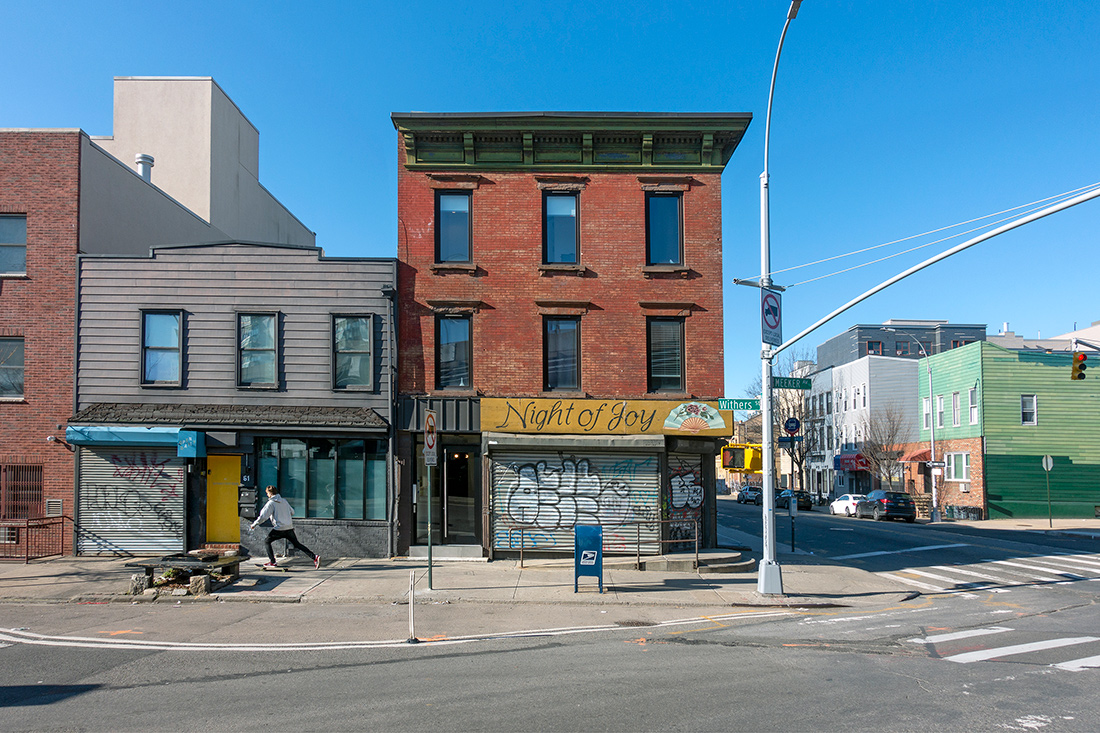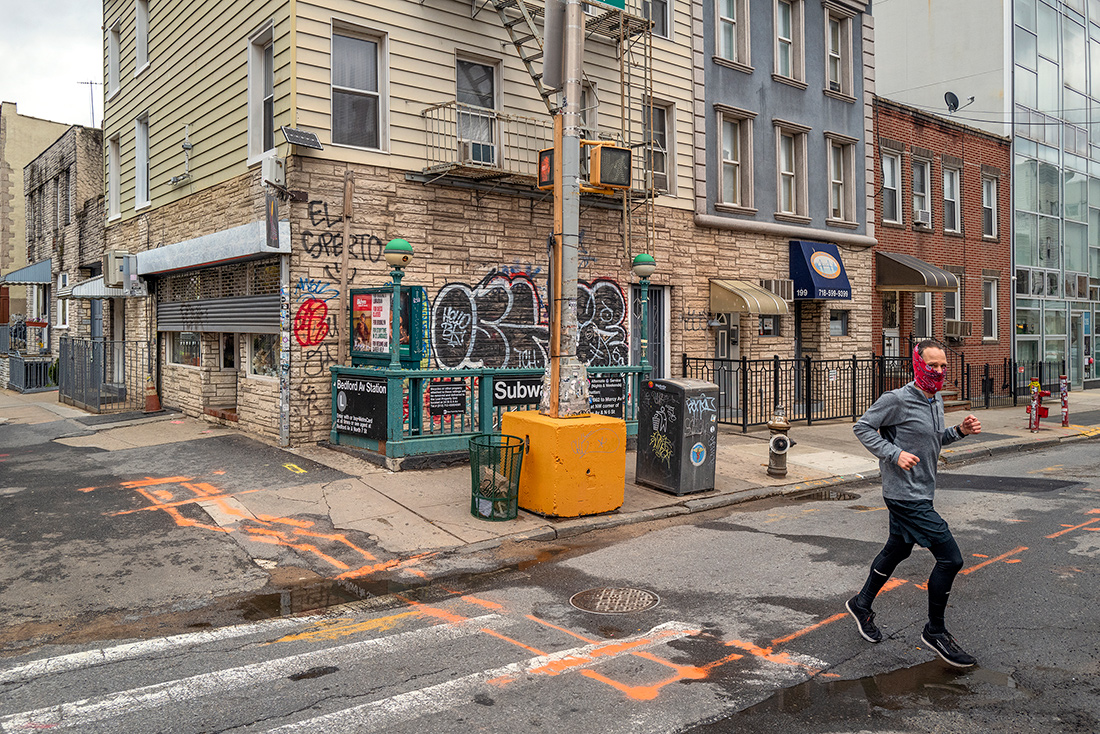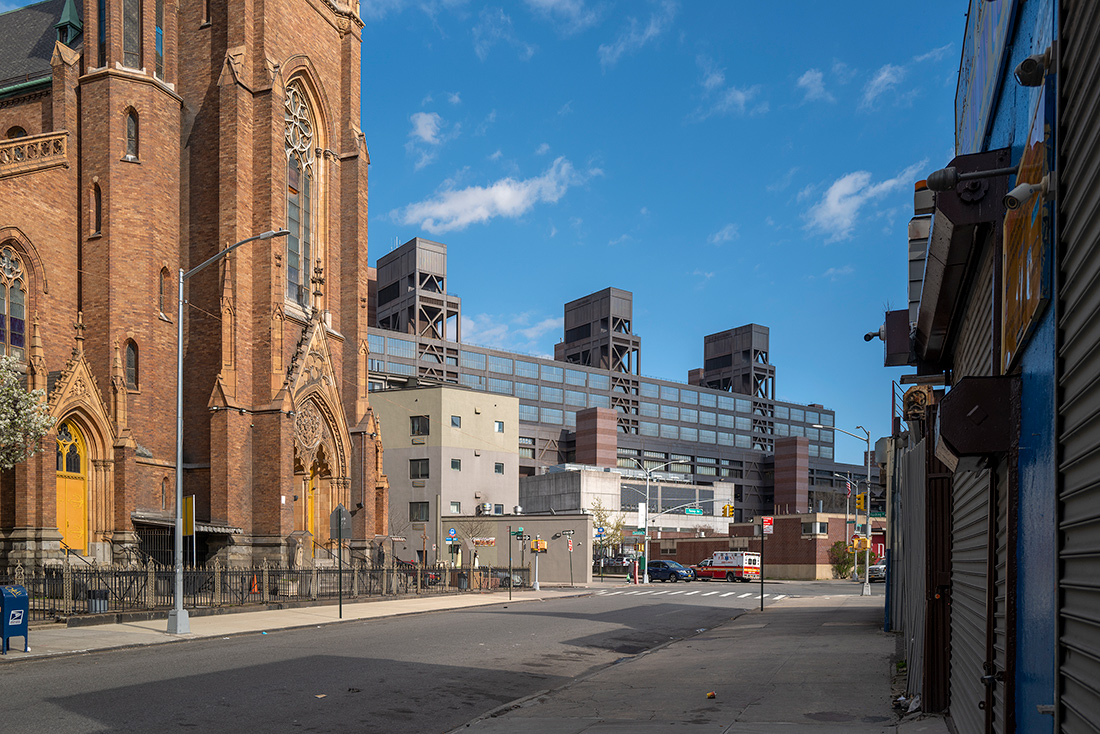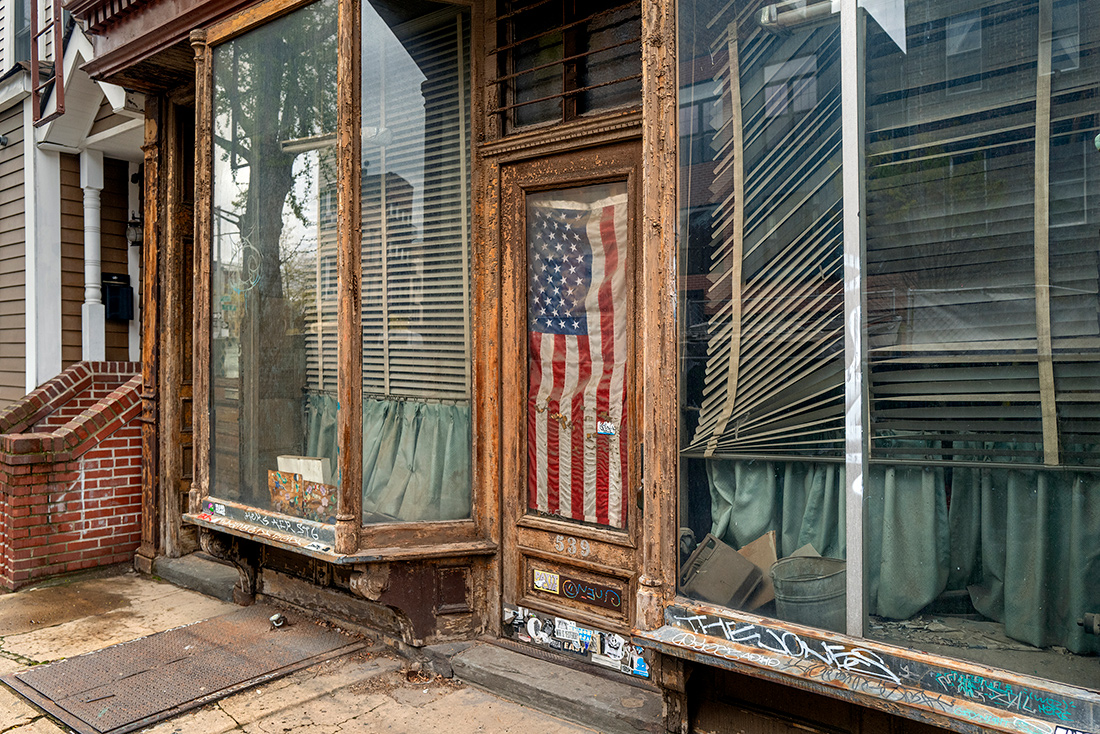
Category: Photographers/Photography

  • New York/Thanksgiving

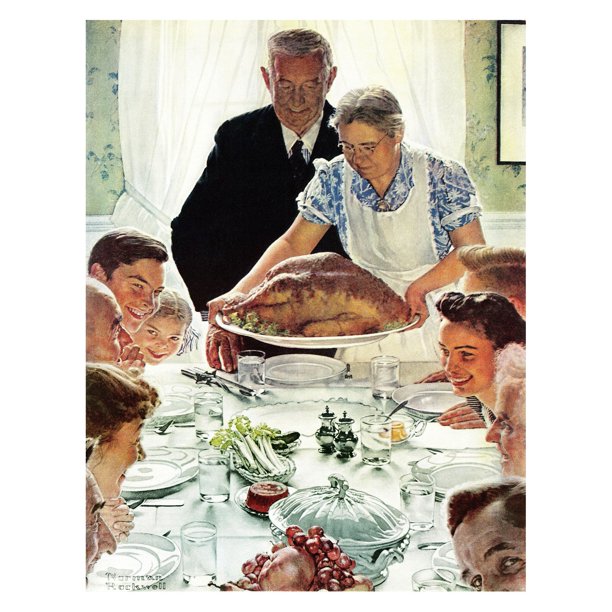
    We had a very nice Thanksgiving yesterday with friends from overseas. We had a traditional turkey dinner, though not with a bird anywhere near the size of Norman Rockwell’s amazing levitating monster in “Freedom from Want.”

    I am reminded of the time a group of students from my high school, a Catholic school in Virginia, delivered a turkey to a poor Black family living in a house on the outskirts of town. It was a gesture of goodwill, wildly misguided. Perhaps, even offensive.

    When we arrived at the house – a bunch of fresh-faced White kids in school uniforms – it was obvious that our giant frozen turkey would not fit into the refrigerator, nor would it fit into the small oven, of this tiny shack with a cinderblock step at the front door, toys scattered on the bare earth around the yard. Nevertheless, the young mother who lived there, maintaining her dignity, graciously accepted the gift.

  • New York/High Line Scape

    W19th Street, NYC – © Brian Rose

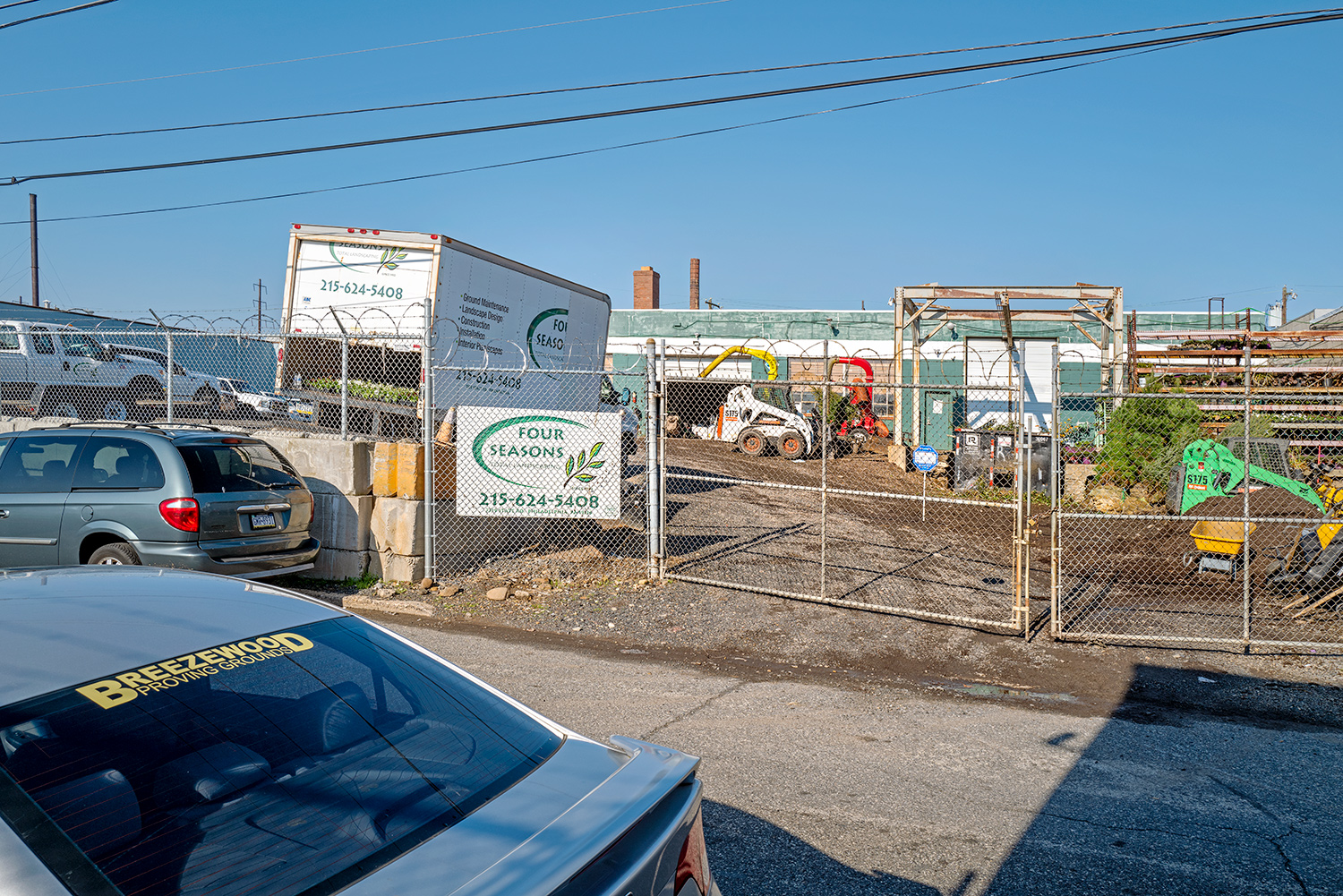
    Just before the pandemic hit, I was working on a project about the High Line and its surrounding urban landscape in Manhattan. Not wanting to take the subway during the spring of 2020, I began shooting my neighborhood of Williamsburg in Brooklyn. When the George Floyd demonstrations broke out, I made a couple of trips south to Richmond to witness the last days of the Confederate statues on Monument Avenue. And I did a quick trip to Philadelphia to document the neighborhood around Four Seasons Landscaping, the weird and wacky location of a Rudy Giuliani press conference that symbolically ended the Trump presidency.

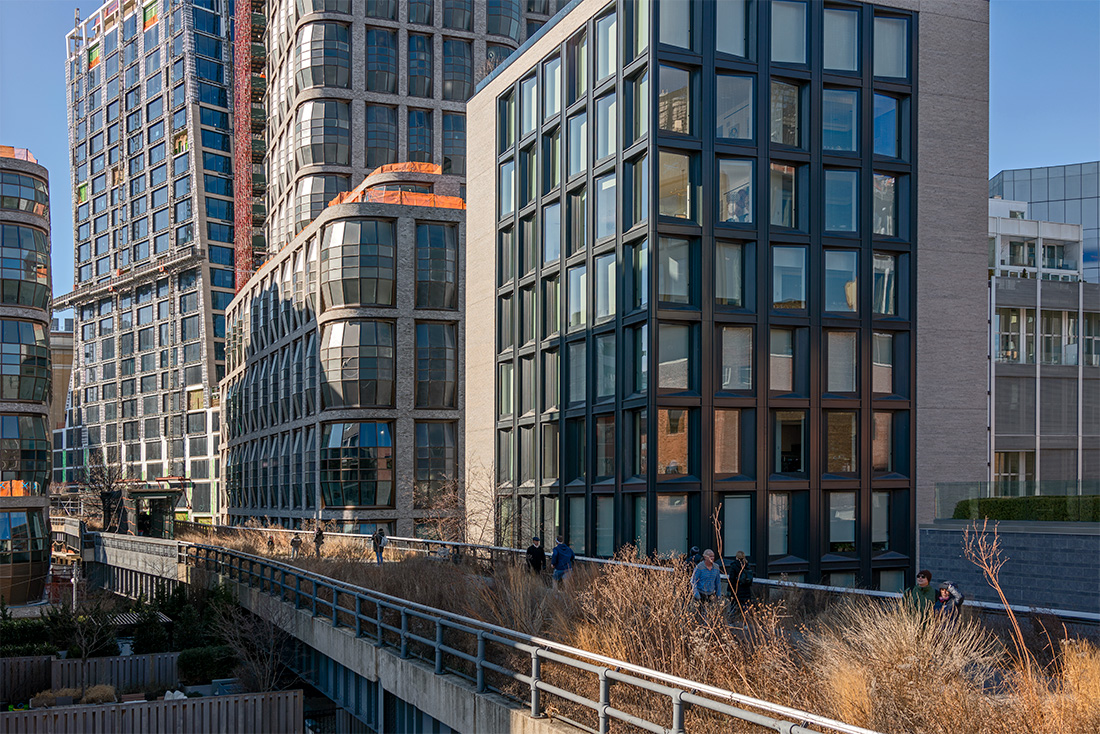
    Now, I’m back riding the subway, have a new camera, this Fujifilm medium format beast, and have decided to pick up where I left off photographing the High Line. The High Line, as is well-known, is a rail viaduct running along the west side of Manhattan. It stood abandoned for years after shipping moved to containers and the more spacious wetlands of New Jersey. Joel Sternfeld made stunning view camera images of the High Line, which helped spur the repurposing of the viaduct as a pedestrian promenade.
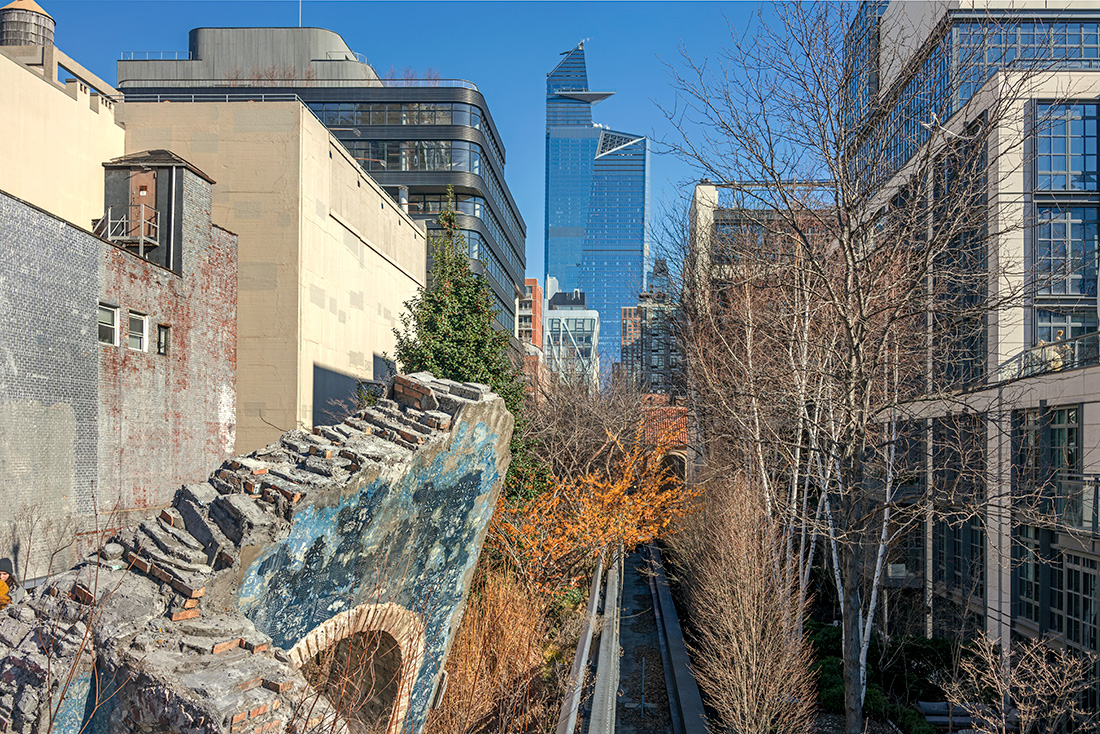
    Whether you like it or hate it, it is an amazing urban presence passing through a landscape of old industrial structures now interspersed with a panoply of modern architectural styles.

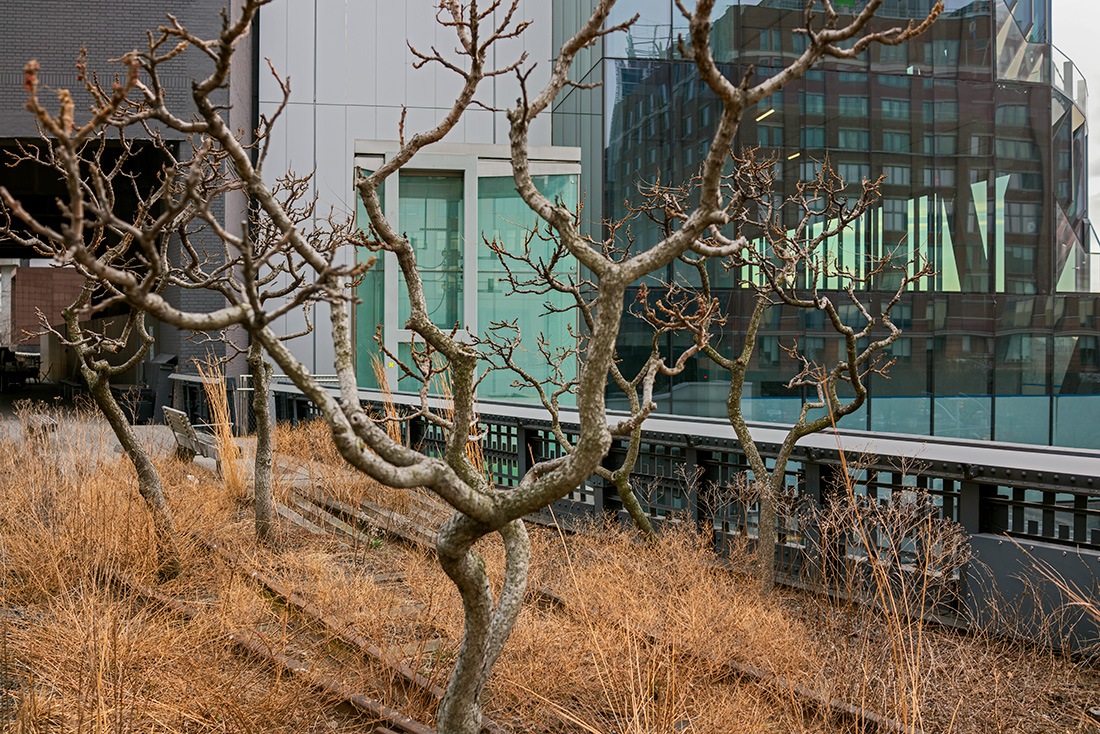
    The High Line, W20th Street, NYC – © Brian Rose

    The weeds and wildflowers grew in the thin layer of accumulated dirt between the tracks – even a few small trees sprouted up. Joel Sternfeld’s images eloquently revealed the tenacity of nature in an inhospitable environment. The landscape designers charged with transforming the rail viaduct into a pedestrian pathway sought to evoke the nascent wilderness of the abandoned high line. From certain angles, like in my picture above, the paved walkway disappears and visitors appear to be wading through a meadow of wildflowers, albeit constrained by the dense urban landscape of Manhattan.

  • New York/Richmond

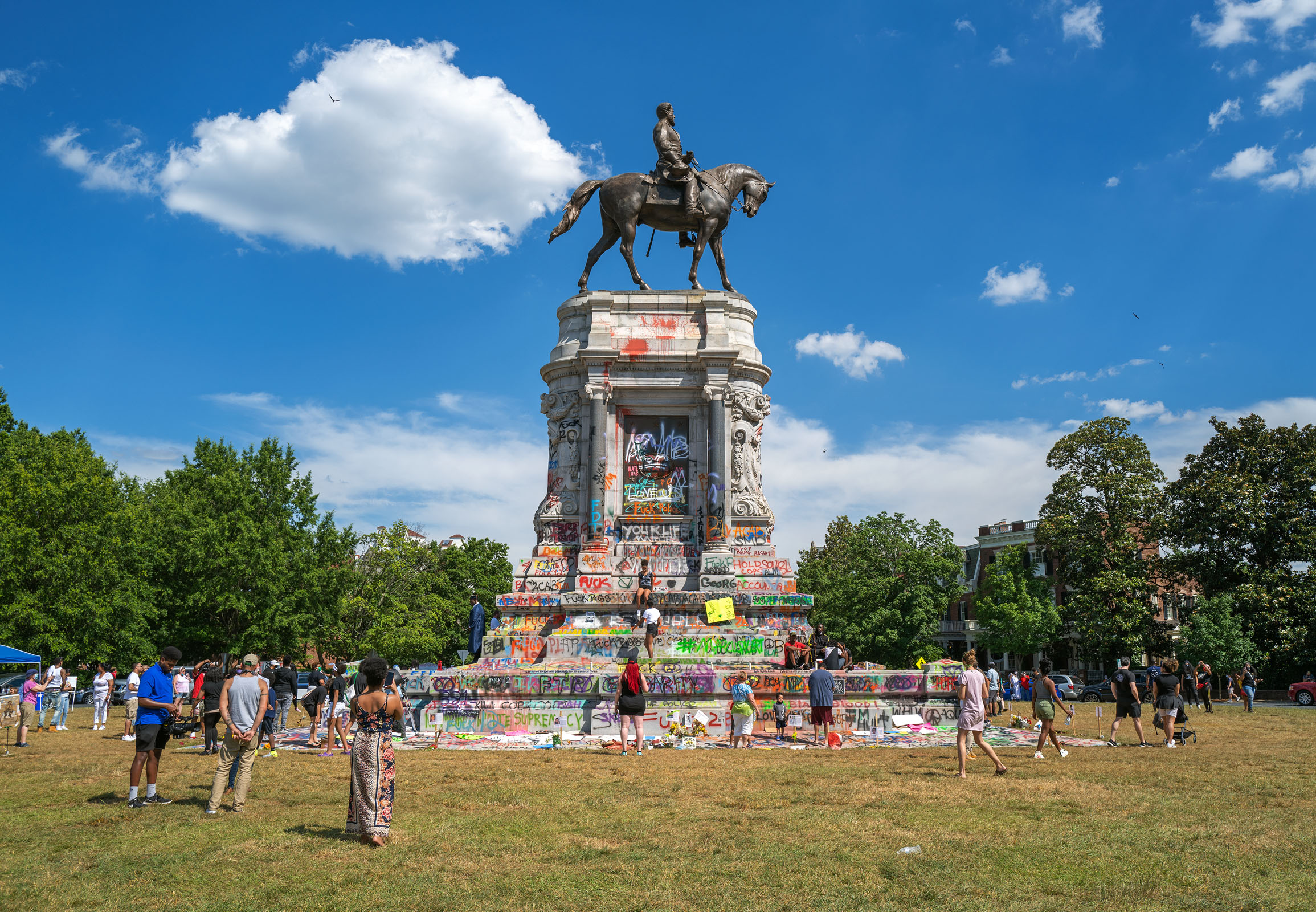
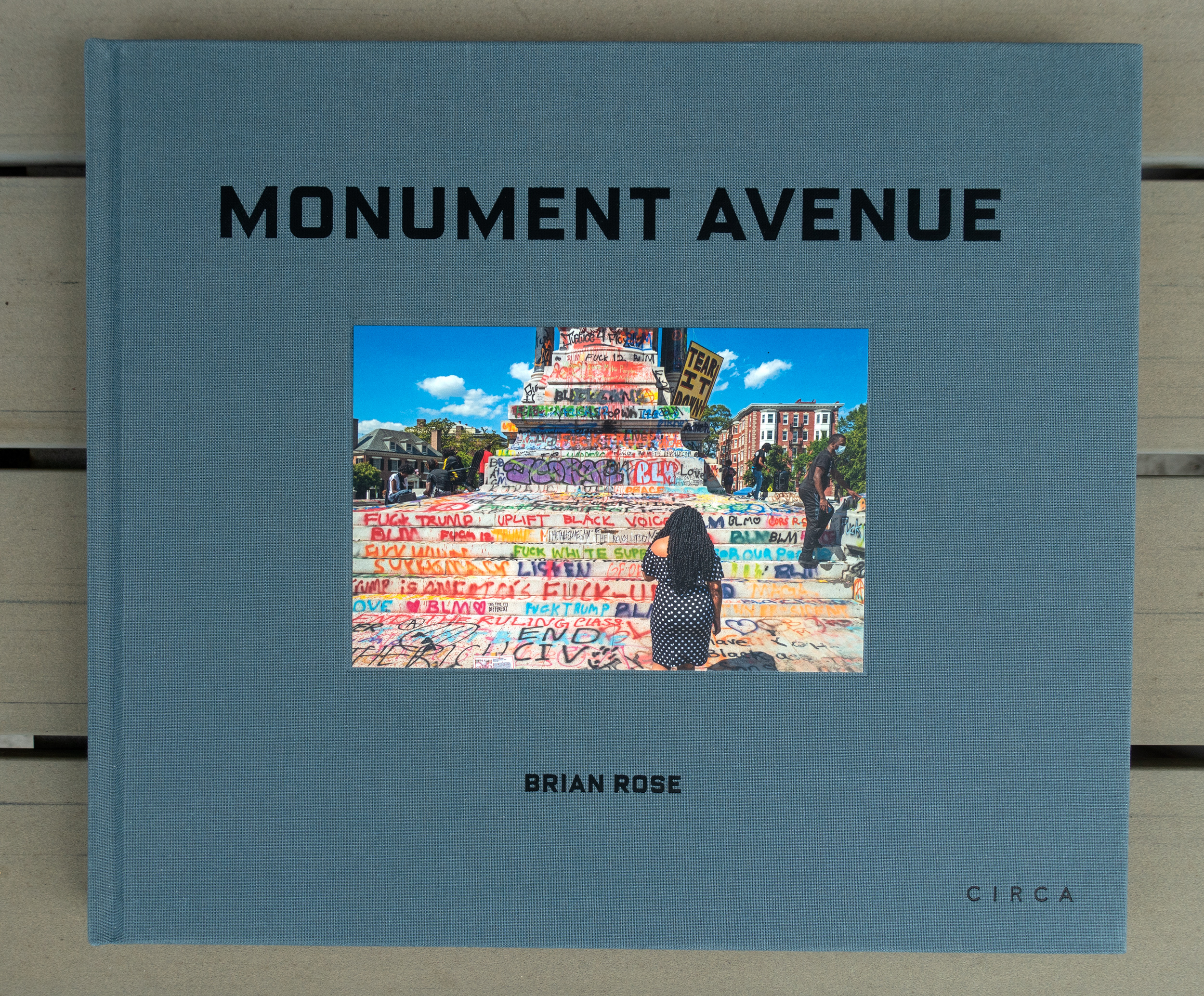
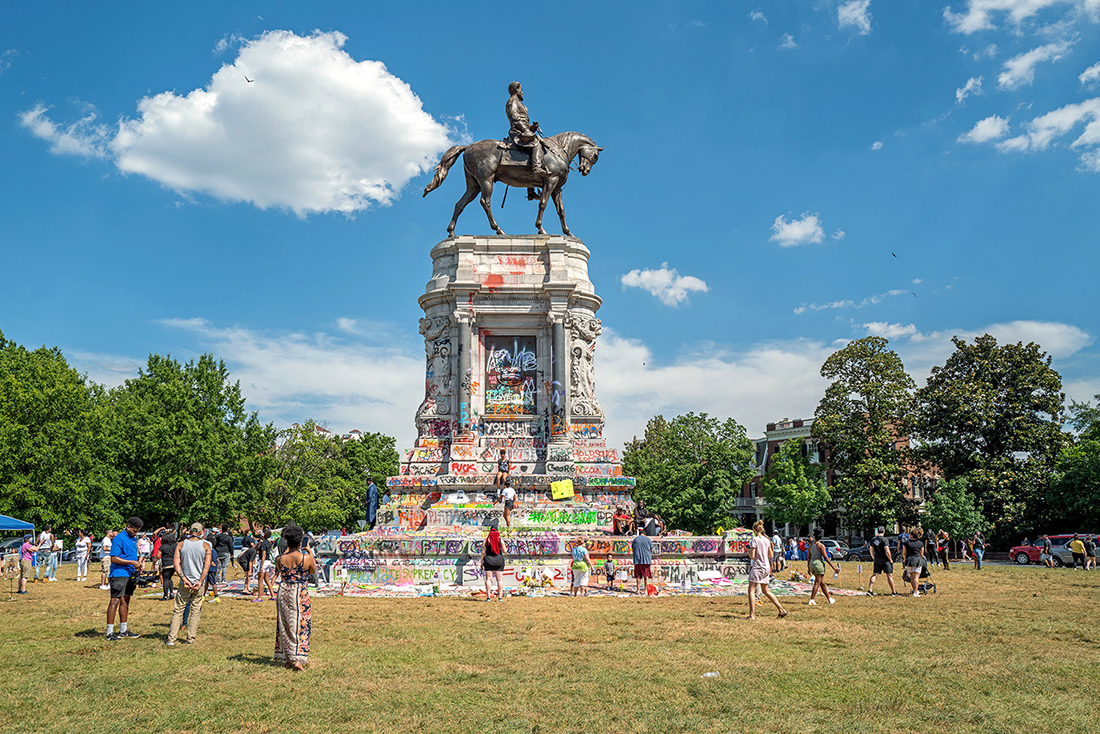
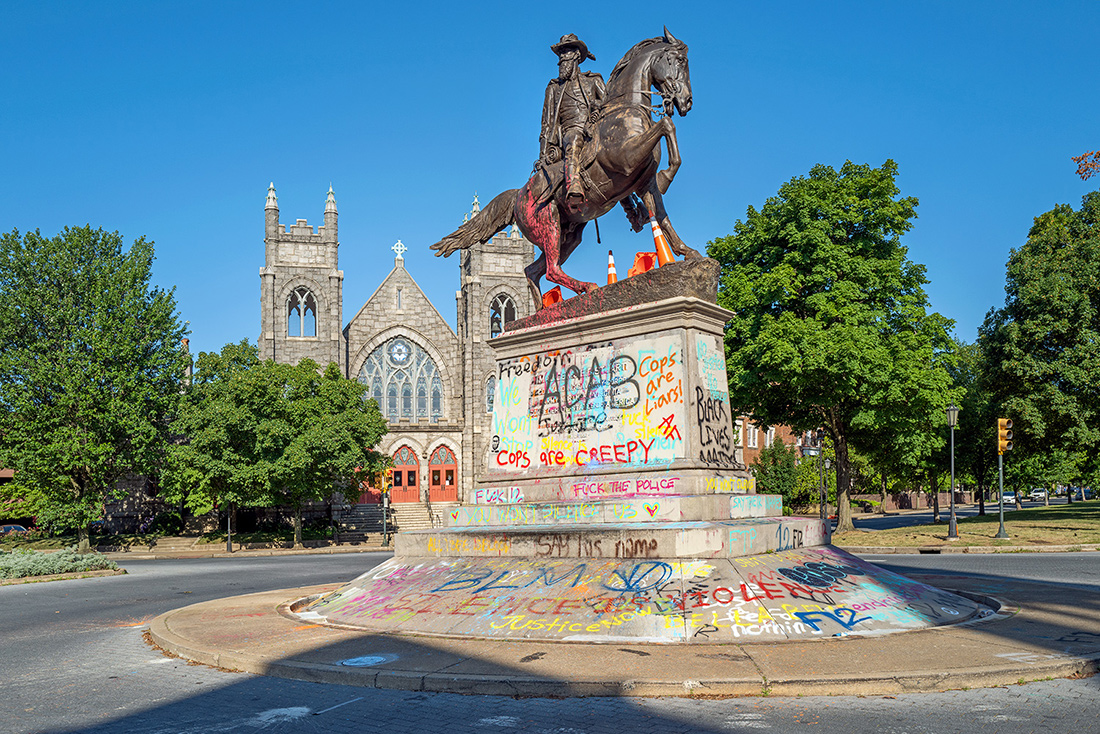
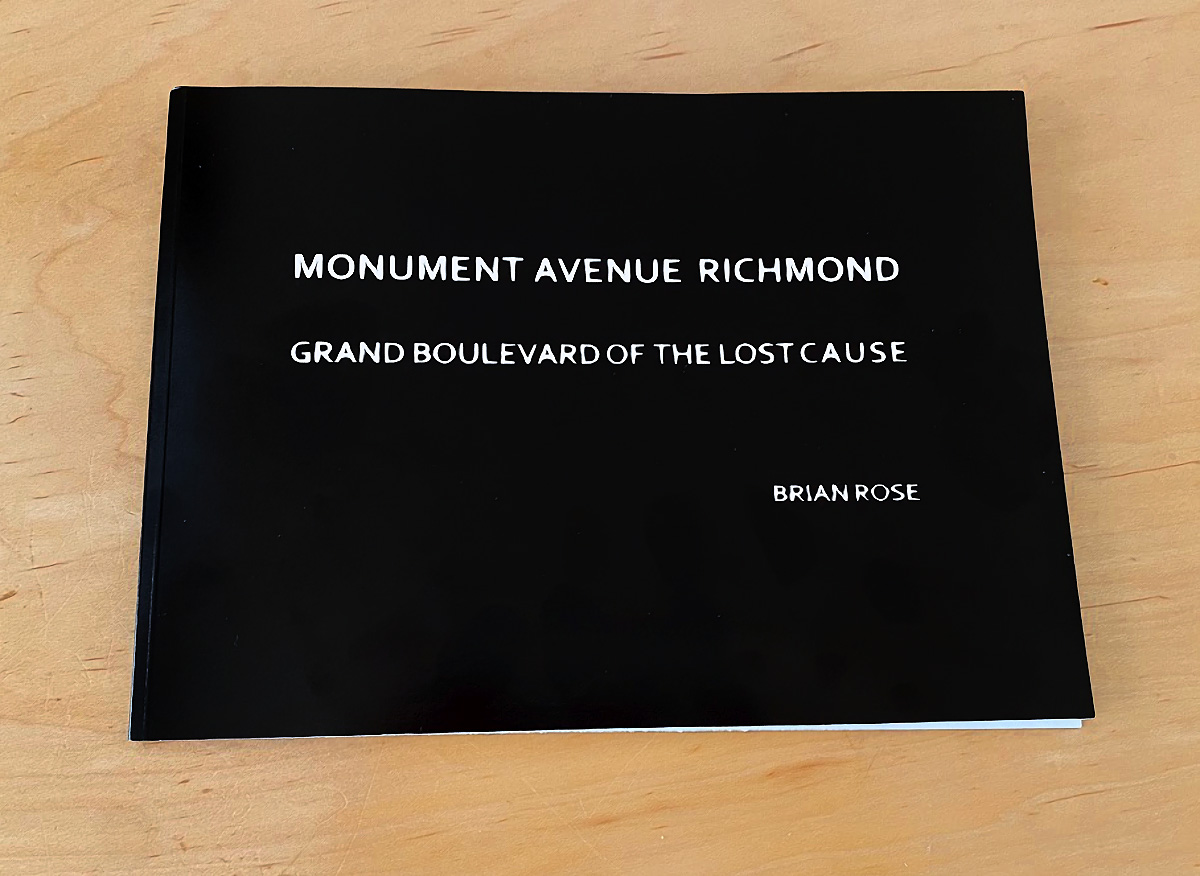
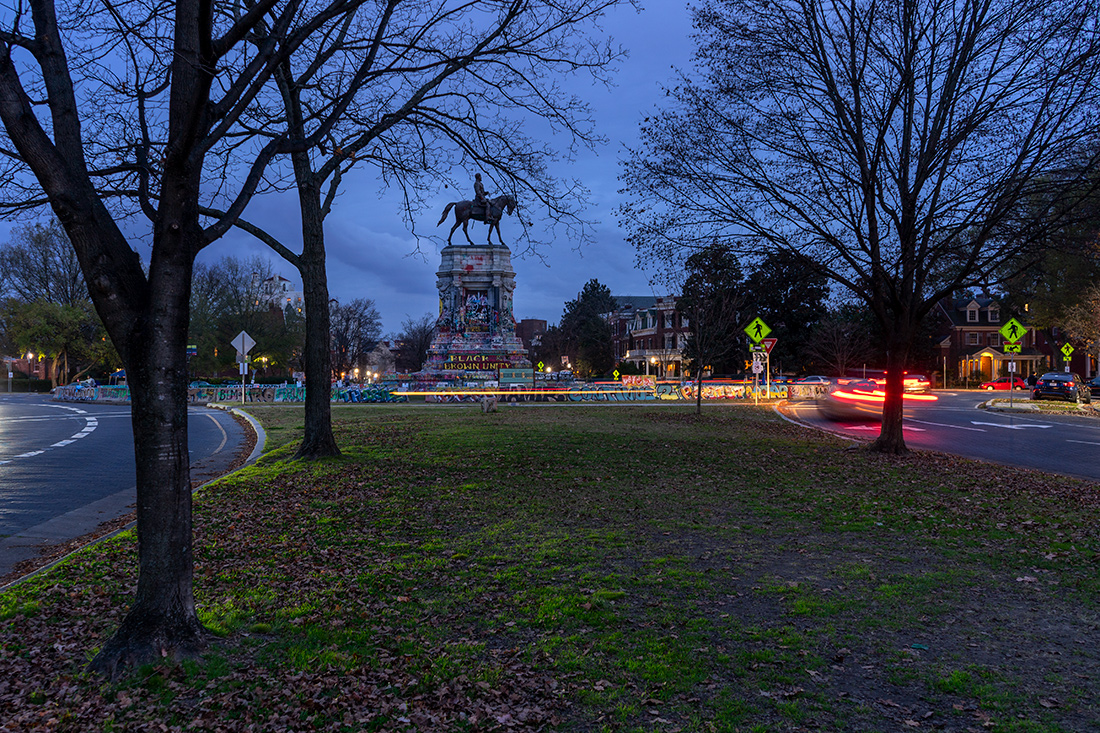
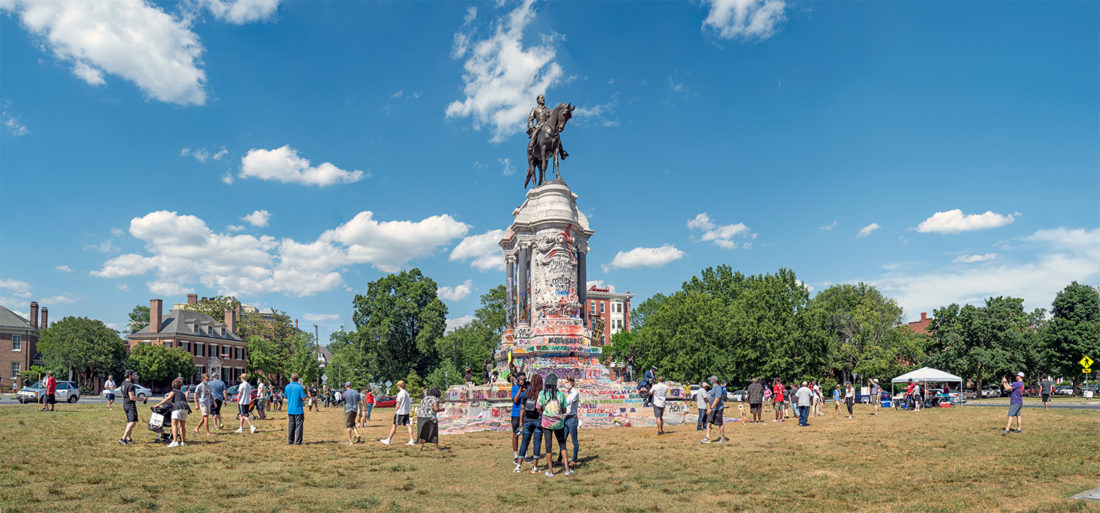
    Today, the Robert E. Lee statue in Richmond came down. My book, Monument Avenue, documents the brief moment when protesters took possession of the Confederate statues along the grand boulevard of the Lost Cause. The Lee statue was the centerpiece of the ensemble of statues arrayed along Monument Avenue, and with a broad grassy circle surrounding it, became the natural location for demonstrations, performances, and occasionally, confrontrations.

     
    I’ve had mixed feelings about the necessity for removing all vestiges of Lost Cause imagery, but I will give the last word to W.E.B. Du Bois, who wrote in 1931:
     

    The most terrible thing about war, I am convinced, is the monuments – the awful things we are compelled to build in order to remember the victims. In the South, particularly, human ingenuity has been put to it to explain the Confederacy on its war monuments. Of course, the plain truth of the matter would be an inscription something like this: “Sacred to the memory of those who fought to Perpetuate Human Slavery.”

  • New York/Four Seasons


    2020 was for most of us a traumatic year of pandemic and protest culminating in the defeat of Donald Trump in November. Directly after election day, we waited nervously for the media to make the call for Joe Biden. Rudy Giuliani held a press conference in Philadelphia at the Four Seasons – it turned out not to be the hotel in Center City – but rather Four Seasons Total Landscaping in a forlorn part of northeast Philly. In the middle of the press conference in which he and Trump spokesperson Corey Lewandowski made unproven charges of fraud, the Associated Press called the election for Biden. Chaos and much hilarity followed.

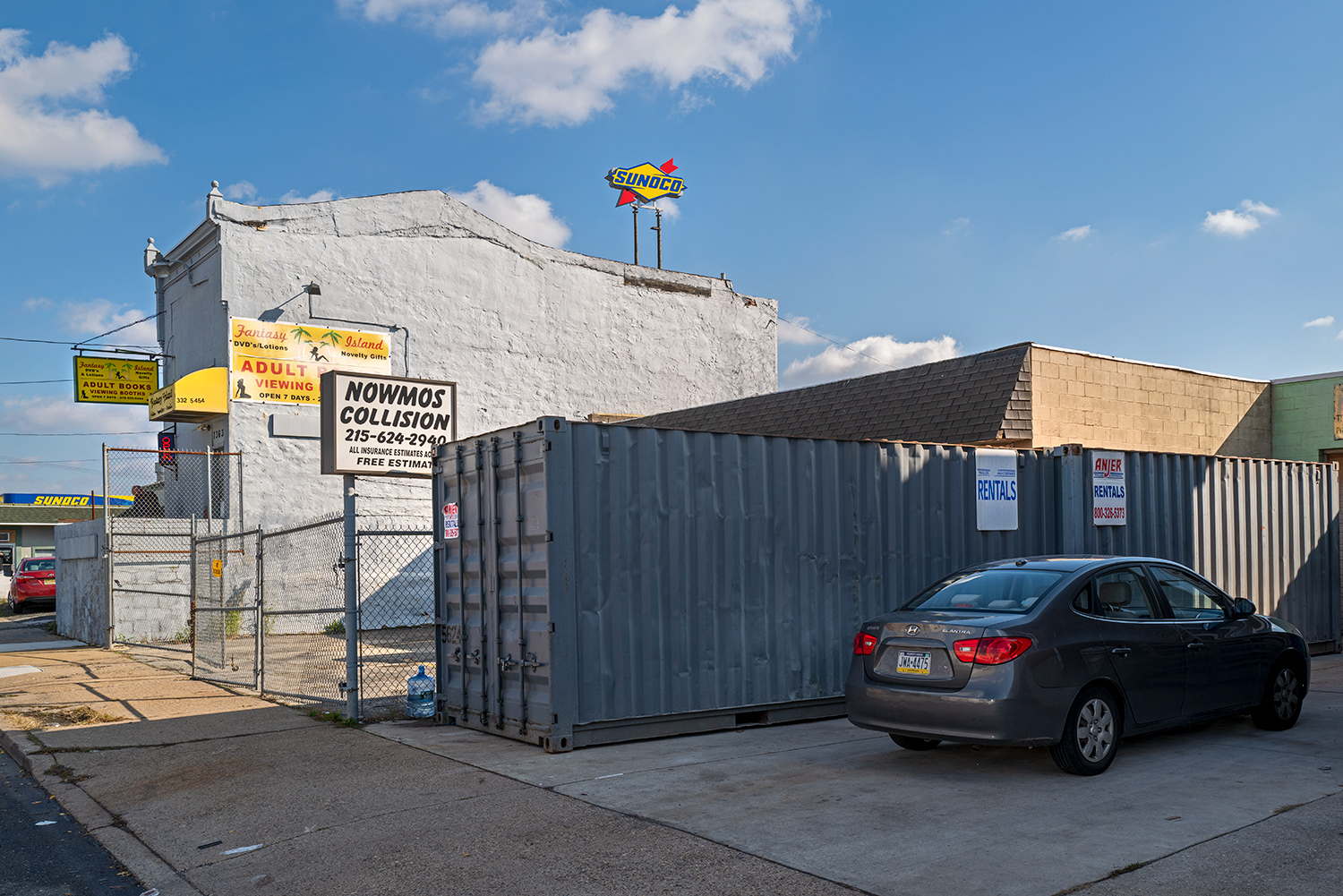
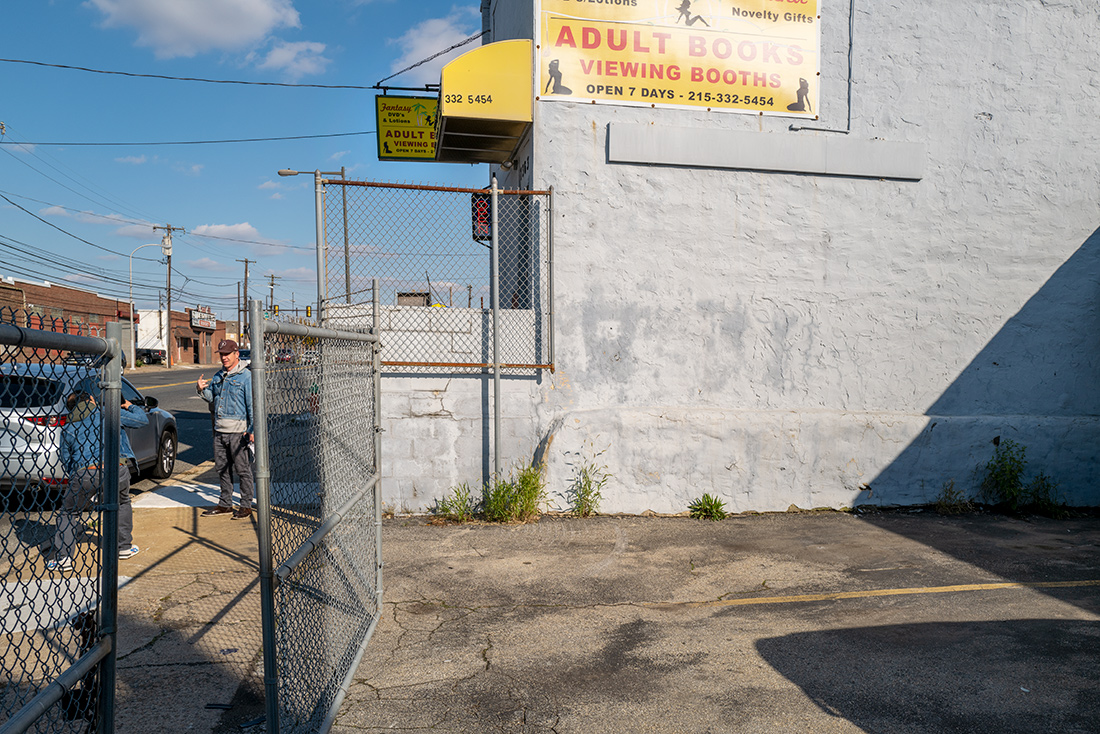
    Many of the reporters dashed off while others decided to visit the immediate area, which included a crematorium and a sex shop called Fantasy Island.

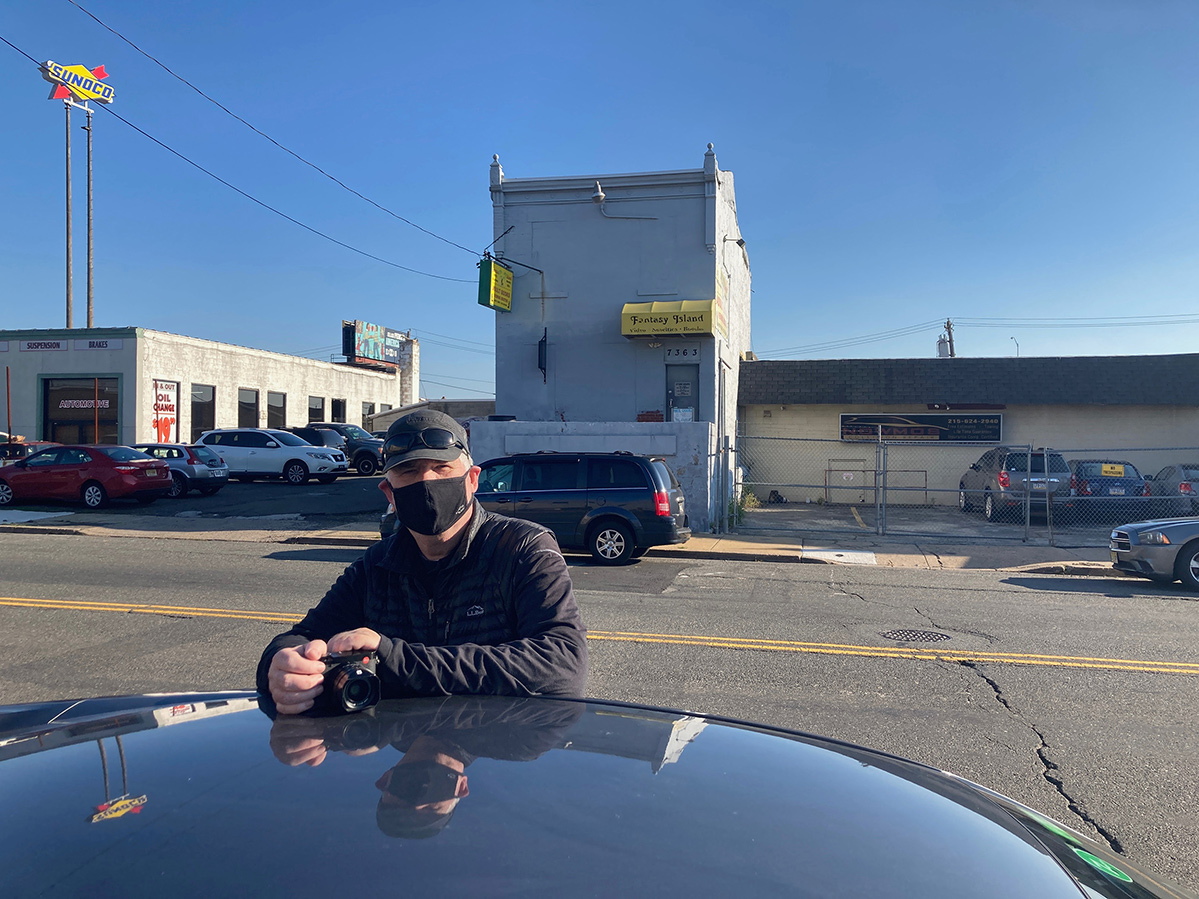
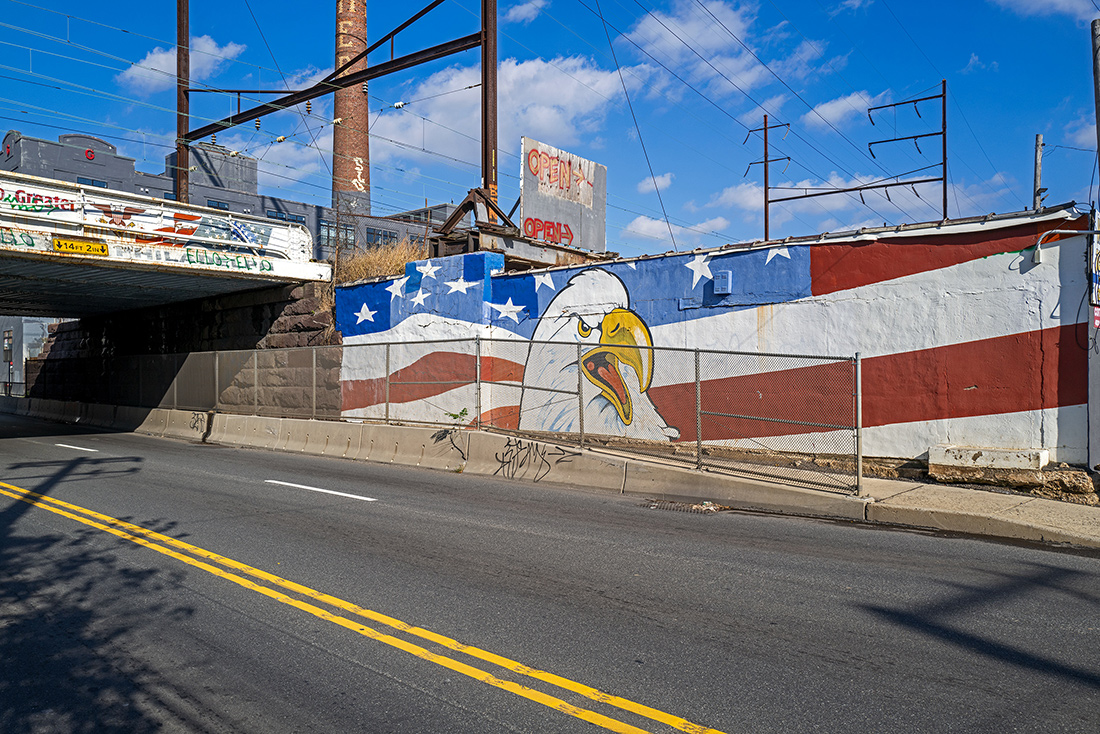
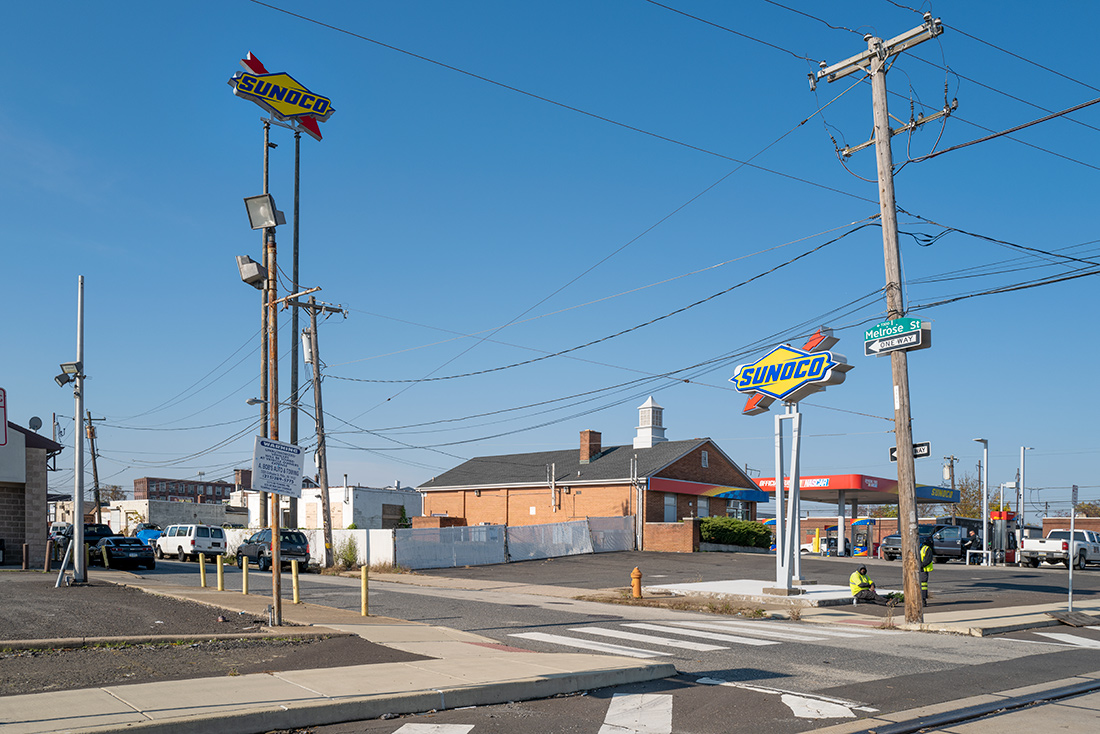
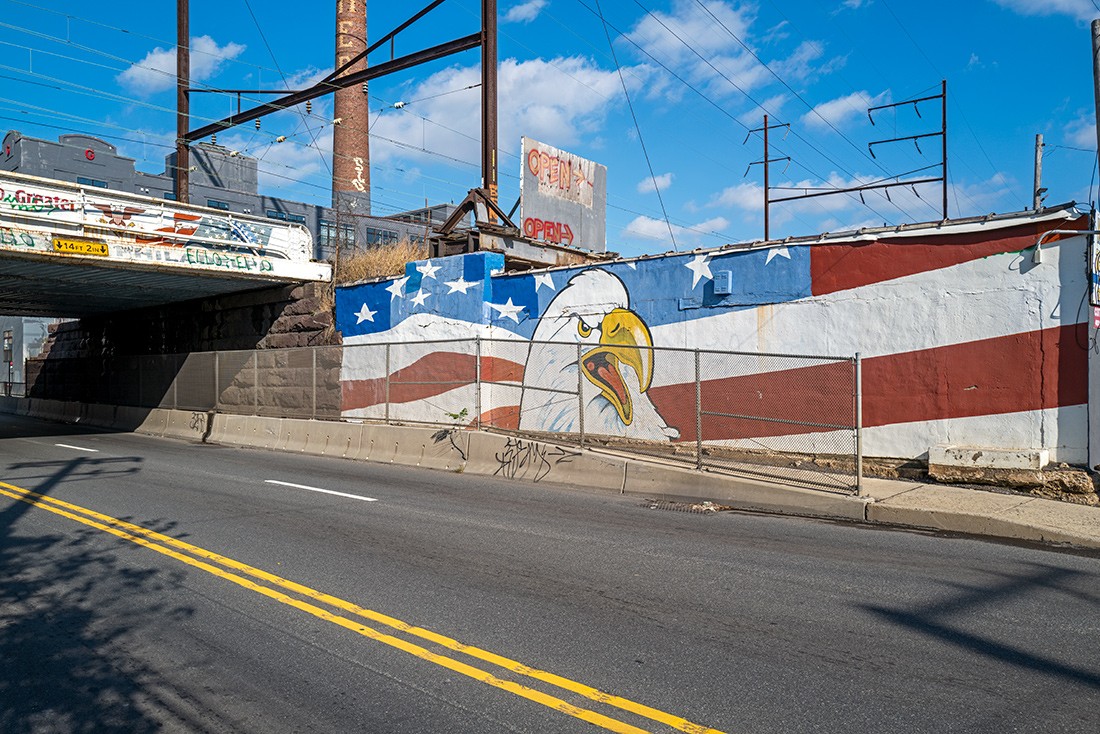
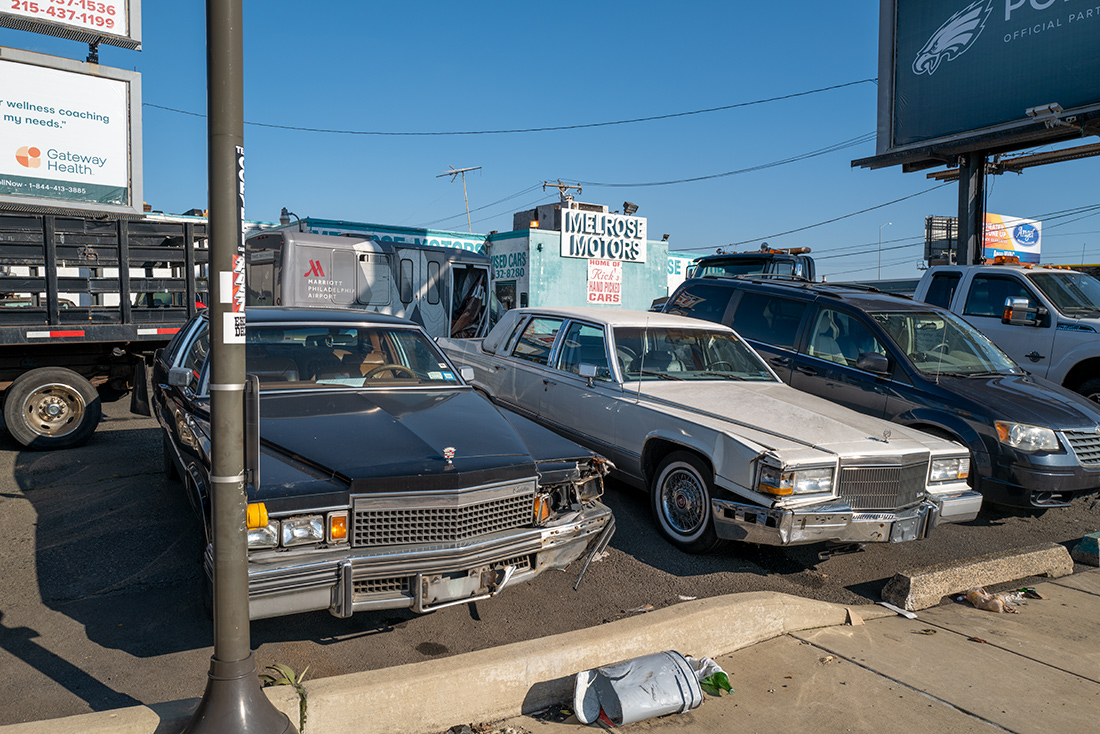
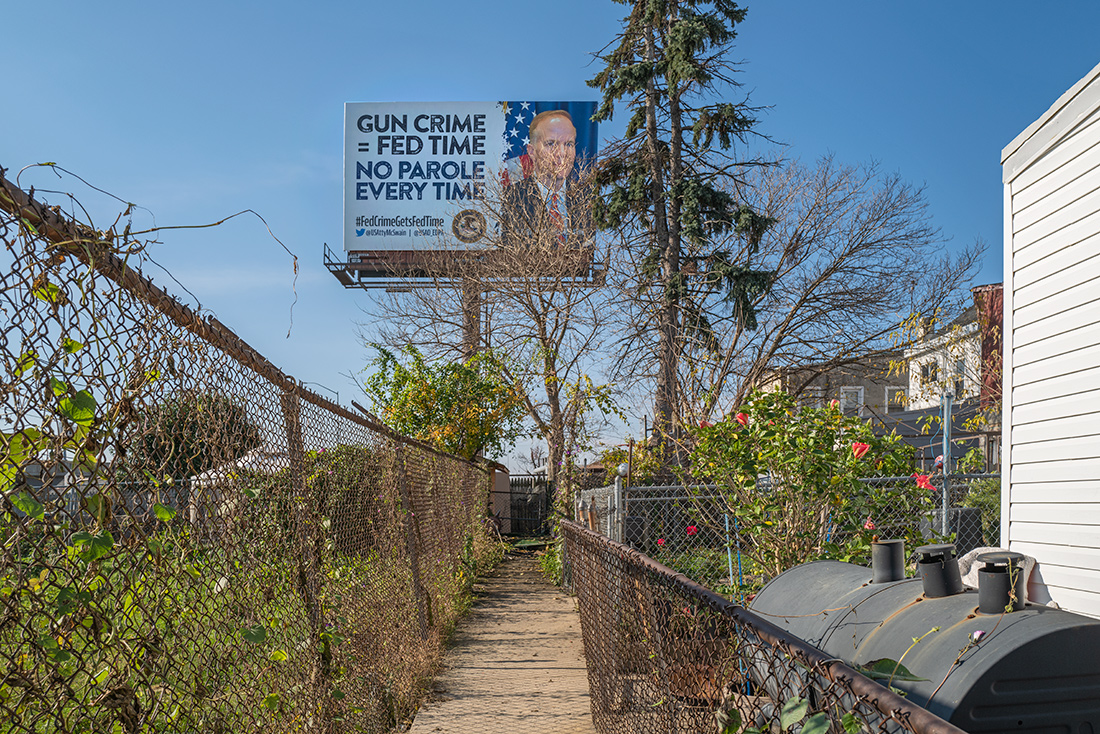
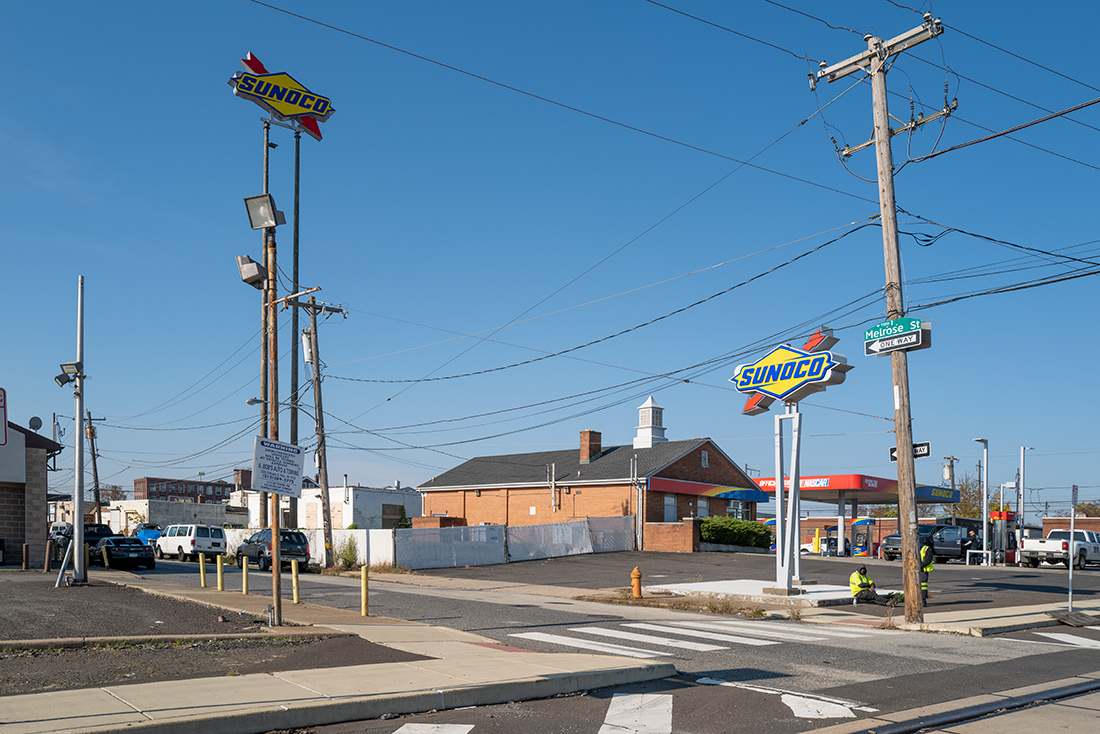
    I knew immediately that I needed to go to Philadelphia and photograph the landscape surrounding Four Seasons Total Landscaping. So, I rented a car, dragged my 22-year-old son along as bodyguard, and drove down, about 2 hours away from New York. The day was beautiful, the environment stunningly rich. At least rich to me. Wedged between Interstate 95 and the Amtrak Northeast Corridor tracks, it’s an area full of chop shops, small factories, warehouses, a scattering of houses, and a superfund site. Tall billboards punctuated the sky adjacent to I-95, and a Sunoco logo with an insistent arrow pointing down as if intentionally saying this is the place.

    I’ve put the pictures up on my website, and everyone is invited to enjoy this strange landscape, a portrait of America’s underside, often glimpsed only from a train window. I am considering doing a book as well.  Four Seasons Total Landscaping

  • New York/Virginia Roots


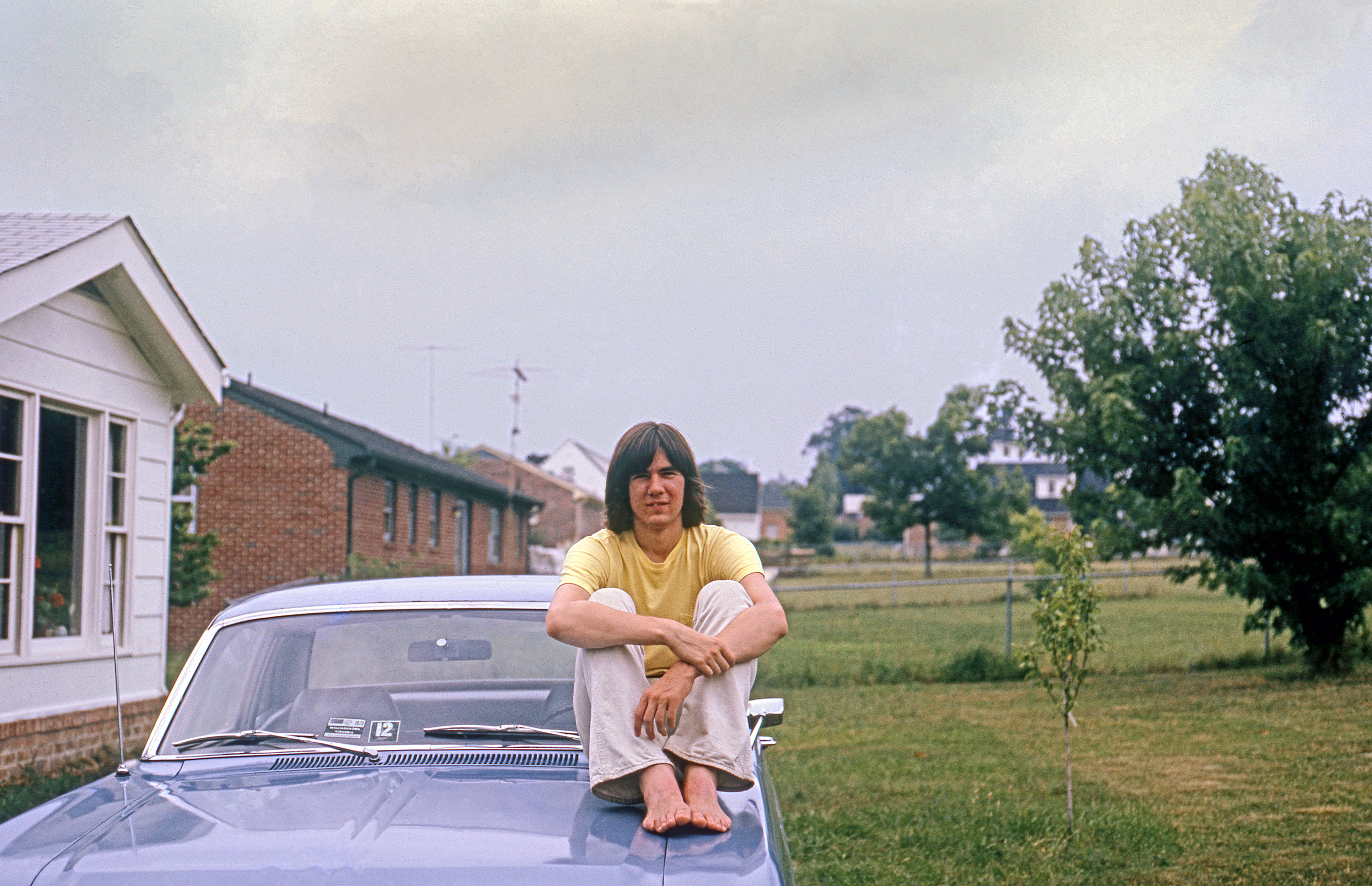
    Brian Rose 1974

    Virginia Roots

    I am a New Yorker, a self-identification that presupposes the likelihood that one may have come from somewhere else, from another state, or from anywhere in the world. My work as a photographer and musician emerged from the rubble and creative ferment of New York City in the late ’70s and early ’80s. But I was born and raised in Tidewater, Virginia, a place steeped in history, where English settlers in 1607 established a colony on the swampy shore of the James River, and the place where Africans first arrived on a Dutch ship as human chattel in 1619. The British surrender at Yorktown, 12 miles from where my family lived, effectively ended the Revolutionary War, and after the Civil War, Jefferson Davis, the president of the Confederacy, was imprisoned at nearby Fort Monroe, where my father worked at the end of his career with the army.

    While it is possible to live in Virginia and remain relatively untouched by the existence of this powerful and ubiquitous backstory, that was certainly not the case for me. My family lived in Williamsburg, the former colonial capital, now a tourist destination, and as a child, the restored area with its manicured streets and gardens was my playground. It was a carefully buffed recreation of the 18th century suspended between reality and imagination, between document and myth. Ada Louise Huxtable, the architecture critic, once wrote: “What the perfect fake or impeccable restoration lacks are the hallmarks of time and place. They deny imperfections, alterations, and accommodations; they wipe out all the incidents of life and change.”
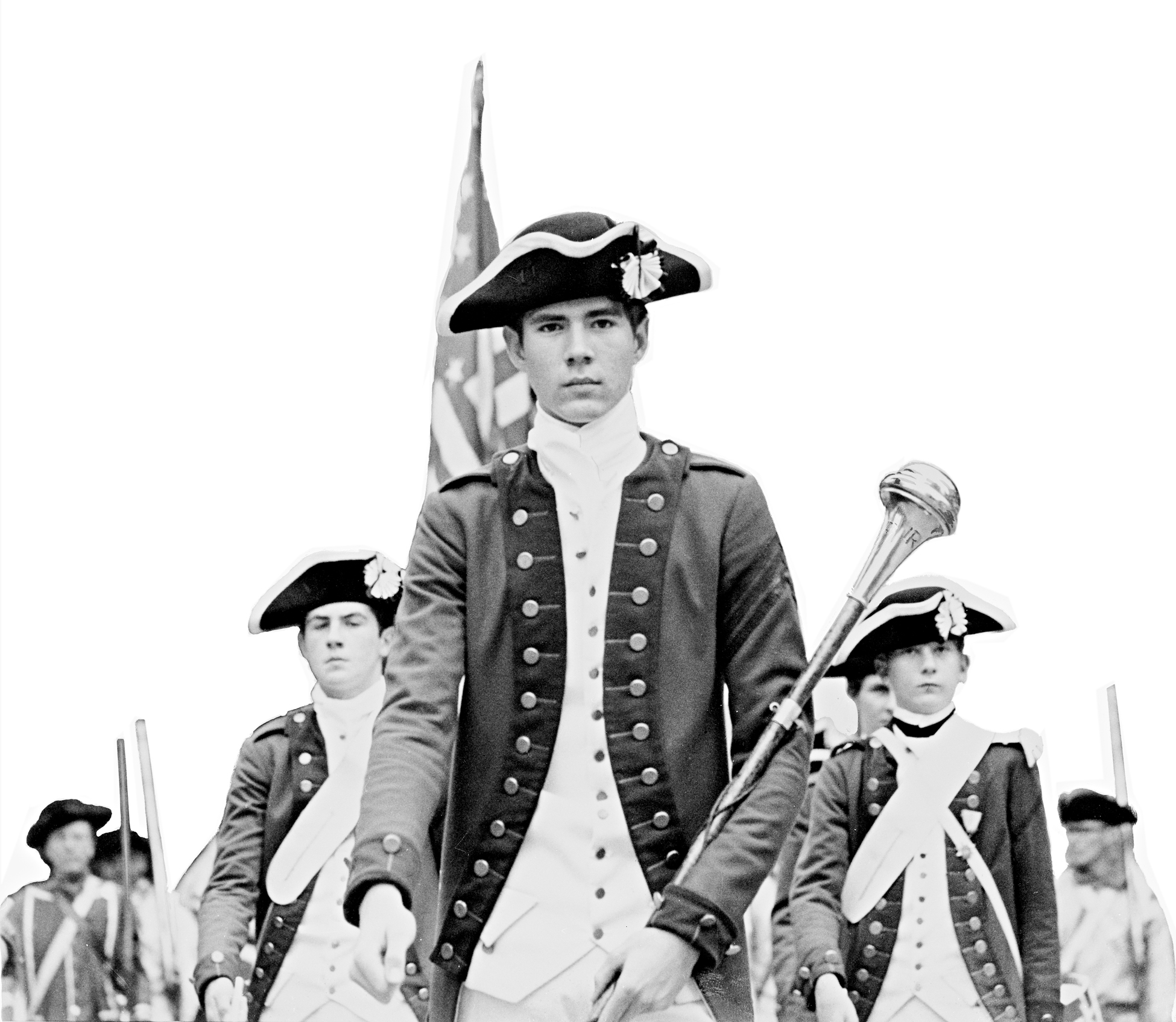

    B
    rian Rose leading the Colonial Williamsburg Fifes and Drums, 1970

    This ephemeral world – of neither here nor there – was, however, the actual location of my upbringing. I joined the fife and drum corps at nine years old, wore a costume with a three-cornered hat, and performed for thousands of visitors as well as two presidents of the United States. I attended church services with my father at Bruton Parish Church and was present at the noteworthy, but dimly remembered moment when Lyndon Johnson was challenged from the pulpit by our minister who called into question the president’s Vietnam policy. And when Nixon came to town for a conference, the fife and drum corps played patriotic tunes while protesters heckled from across the street. The church with its original 18th-century bell tower sat directly next door to the distinguished brick home of George Wythe, signer of the Declaration of Independence, and friend and mentor of Thomas Jefferson. Past and present were, improbably melded together, all of a piece. Yes, Williamsburg occupies a surreal performative space, but I came to understand that the kind of authenticity Huxtable pined for was, perhaps, a dubious concept in the meta-reality of modern America.
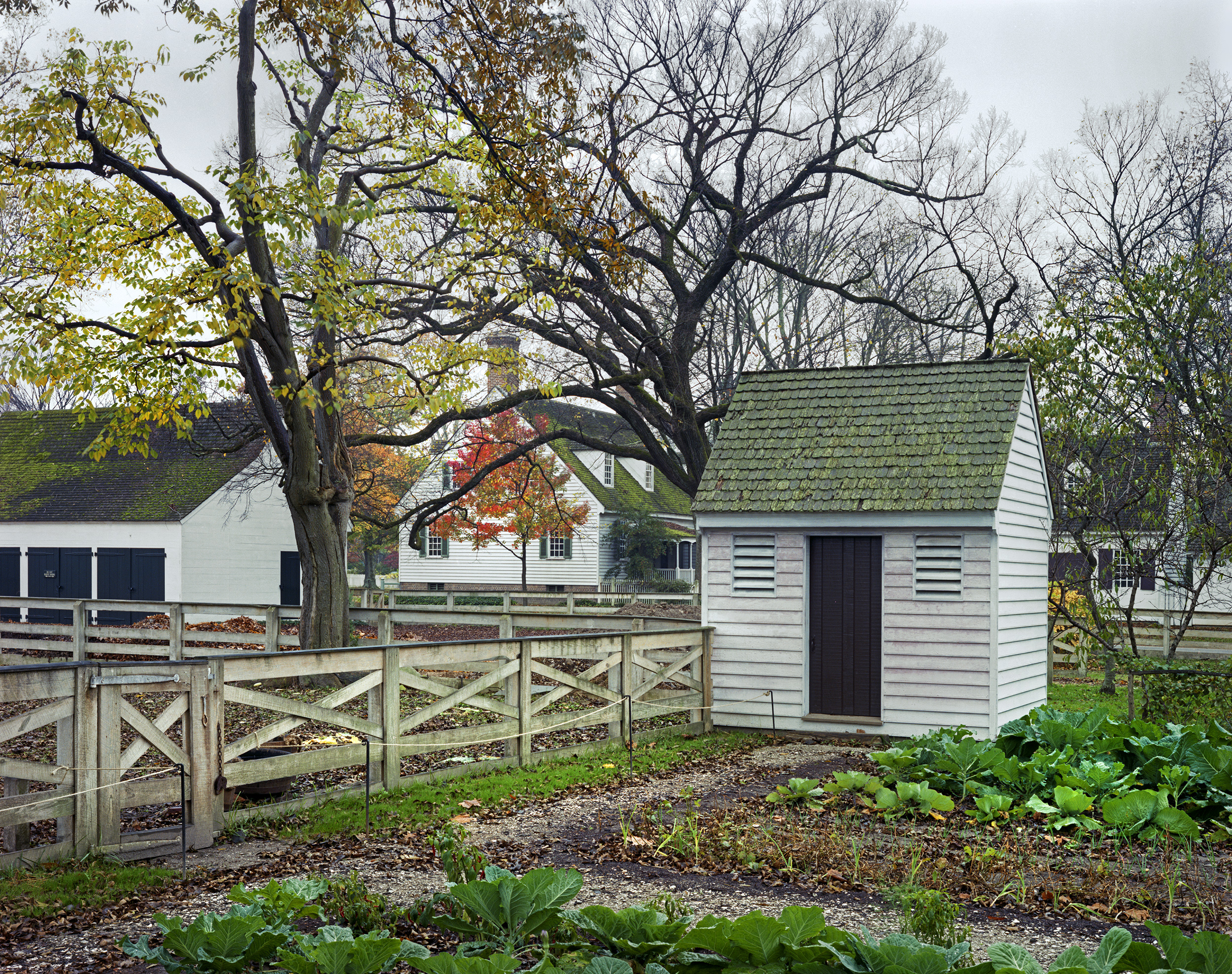

    Colonial Williamsburg – © Brian Rose

    Williamsburg, both the restoration and the present-day town, is dominated by its colonial-era trappings, but the Civil War’s lingering presence is never far away. There were earthen fortifications in the woods behind my house, weathered trenches, and I once found a metal uniform button hidden in the dirt. Richmond, the state and former Confederate capital, is only an hour up Route 5, a scenic two-lane highway that parallels the James River with its gracious tobacco plantations dating back to the 17th and 18th centuries. Richmond, during my youth, was a city struggling to preserve its image as a genteel southern capital. Middle-class whites were fleeing to the suburbs leaving an increasingly Black inner city, the cigarette companies had moved their plants out of town, and newly built freeways slashed through old neighborhoods and snaked through the industrial riverfront downtown. But the statues of Confederate generals loomed undisturbed on their pedestals along Monument Avenue, and the good old boys’ network carried on in the Jefferson Hotel and the Commonwealth Club. The South may have lost the war, but the honor of Robert E. Lee, the patron saint of the Lost Cause, remained undisputed.
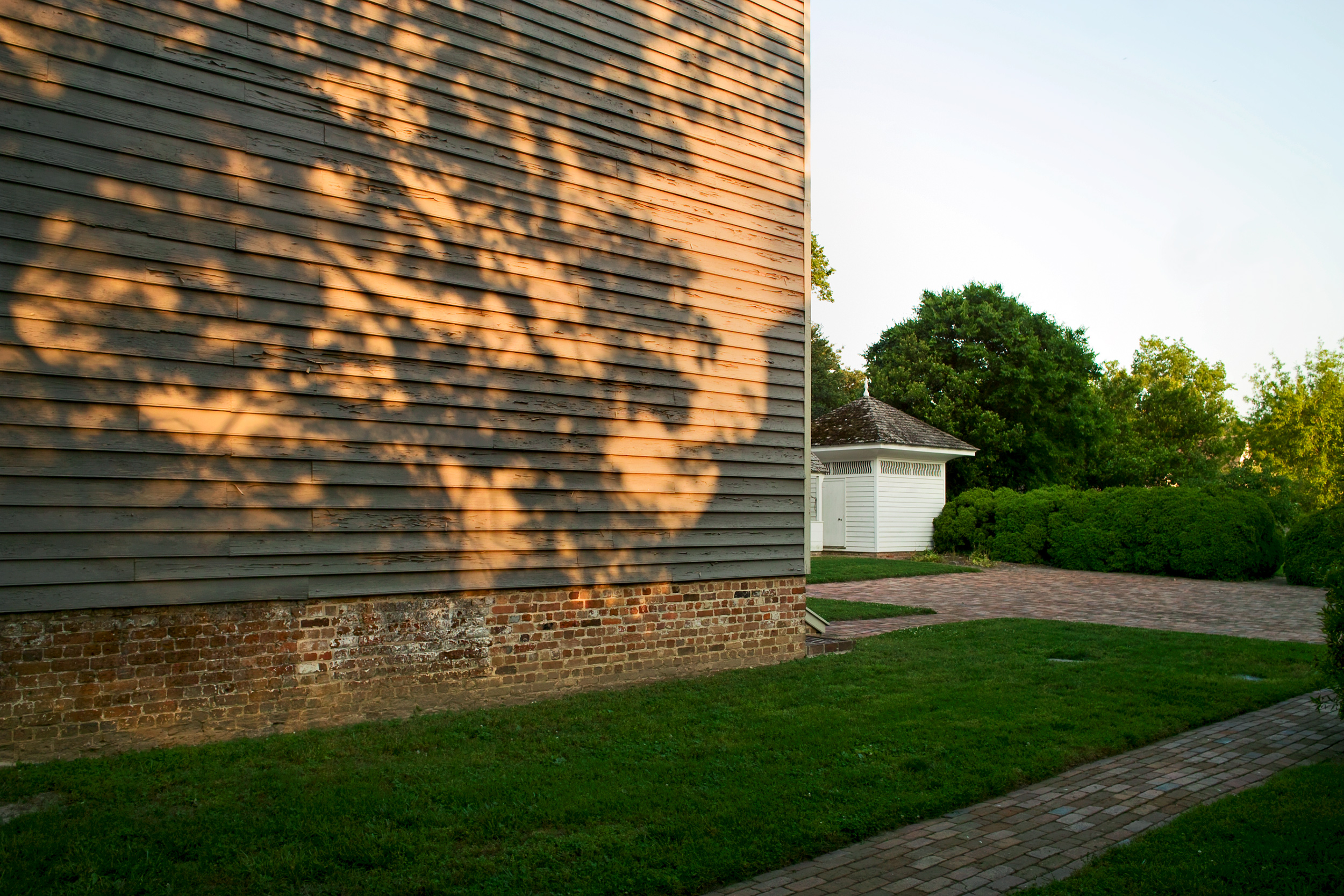

    Colonial Williamsburg – © Brian Rose

    Despite the penumbra of history I lived under in Virginia, I felt oddly disconnected from the past on a more intimate level. In short, I had no grandparents. My father’s parents had died young, leaving him in the care of an older sibling, and on my mother’s side – it was less clear what happened. It seems that she had fled from an abusive home environment after graduating from high school at age 16, and never went back, never had any contact with her family. My father grew up on the southside of the James River among farmers and merchants in a small town surrounded by peanut and cotton fields not far from the scene of Nat Turner’s 1831 slave uprising. He once told me that as a child, he woke up in terror one night as a cross burned in their front yard. But he never provided any context for the story, any explanation for why they were targeted, apparently, by the Klan.
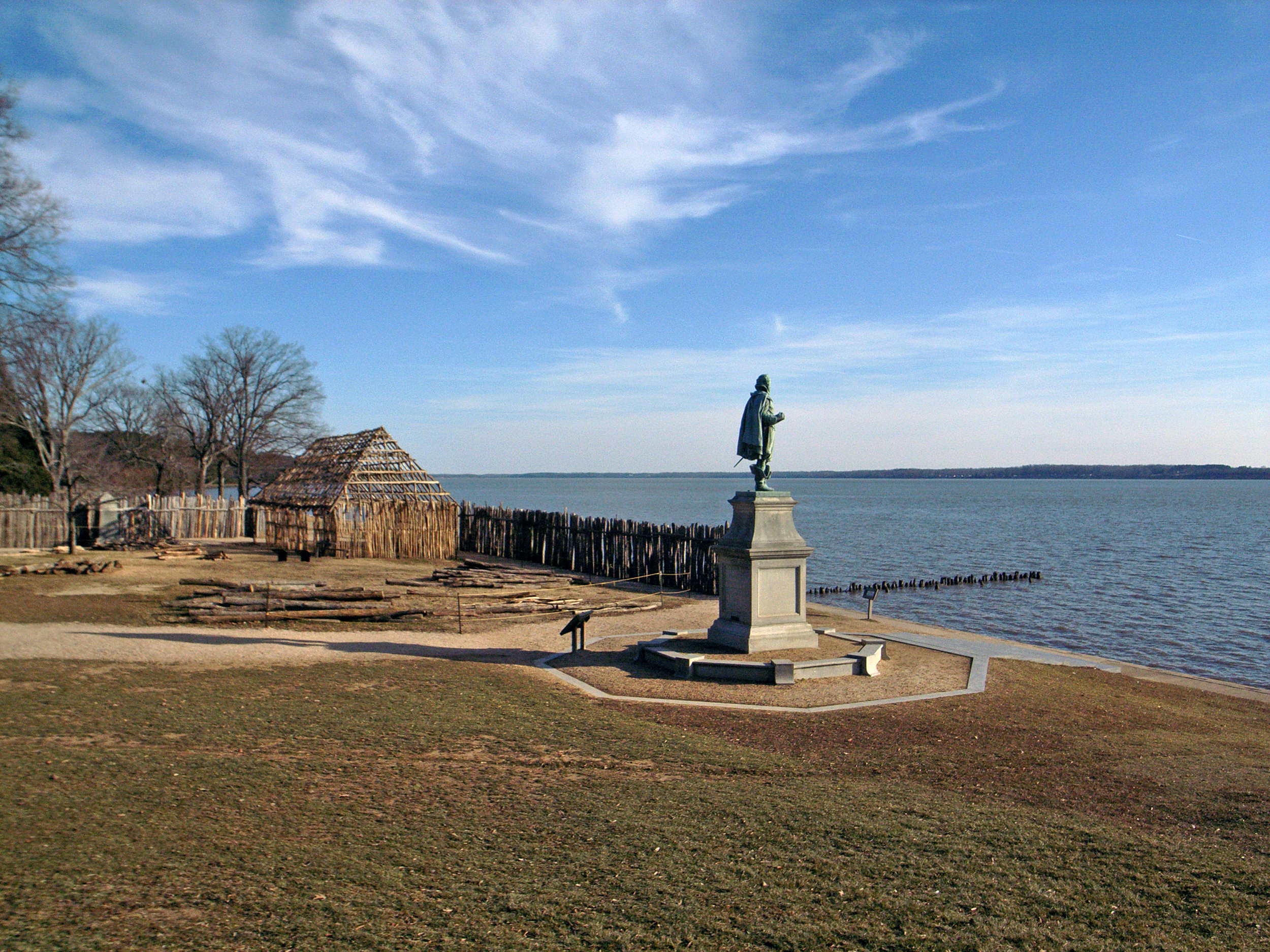

    Captain John Smith statue, Jamestown, Virginia – © Brian Rose

    Quite simply, I could not place myself mentally or physically in that landscape. It did not have anything to do with me, or so I believed. My father, in his own way, rebelled by leaving home to attend the University of Virginia. He was the first Rose to go to college. When my father died, my sister and I scattered his ashes in Gray’s Creek, a small tributary of the James River. We understood instinctively that the James was the central element of his life. The journey he had made from one side of the river to the other was not far as the crow flies, but it represented a more profound journey of personal renewal from country to city, from the old South to the new. My mother, always strong-willed and fiercely independent, with a statuesque bearing that made her seem taller than she was, vaguely used to talk about coming from broken down aristocracy – that it was all lost in the Great Depression she said – but there was no family to interact with, no one to confirm the story, and no homestead. I shrugged it off.

    Over the years, I wondered about the history I never had, but I was determined to create a new identity for myself untethered to my Virginia roots. Like my father, I attended UVA, briefly studying urban design, and eventually graduated from New York’s Cooper Union. After school, I pursued a career focused on the documentation of cultural and historical landscapes. Most notably, I photographed the Lower East Side, the famous immigrant neighborhood of New York, and then in 1985 began photographing the Iron Curtain, the Berlin Wall, and the subsequent rebuilding of Berlin. In 2016, I responded to the unexpected and alarming election of Donald Trump by photographing Atlantic City with its ravaged streets and bankrupt casinos as a metaphor for America as a whole.
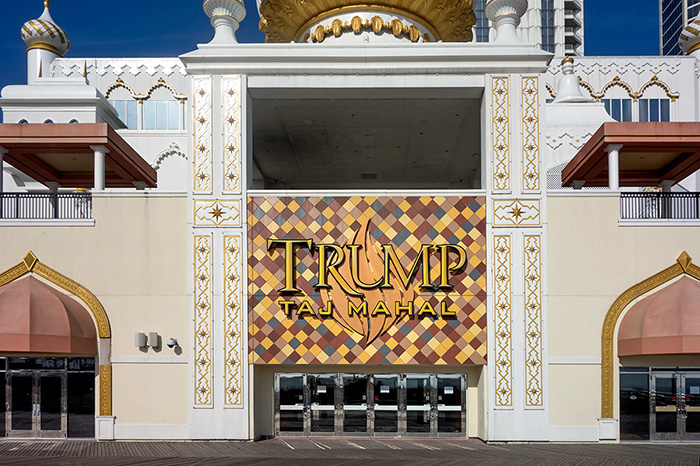

    TrumpTaj Mahal, Atlantic City – © Brian Rose

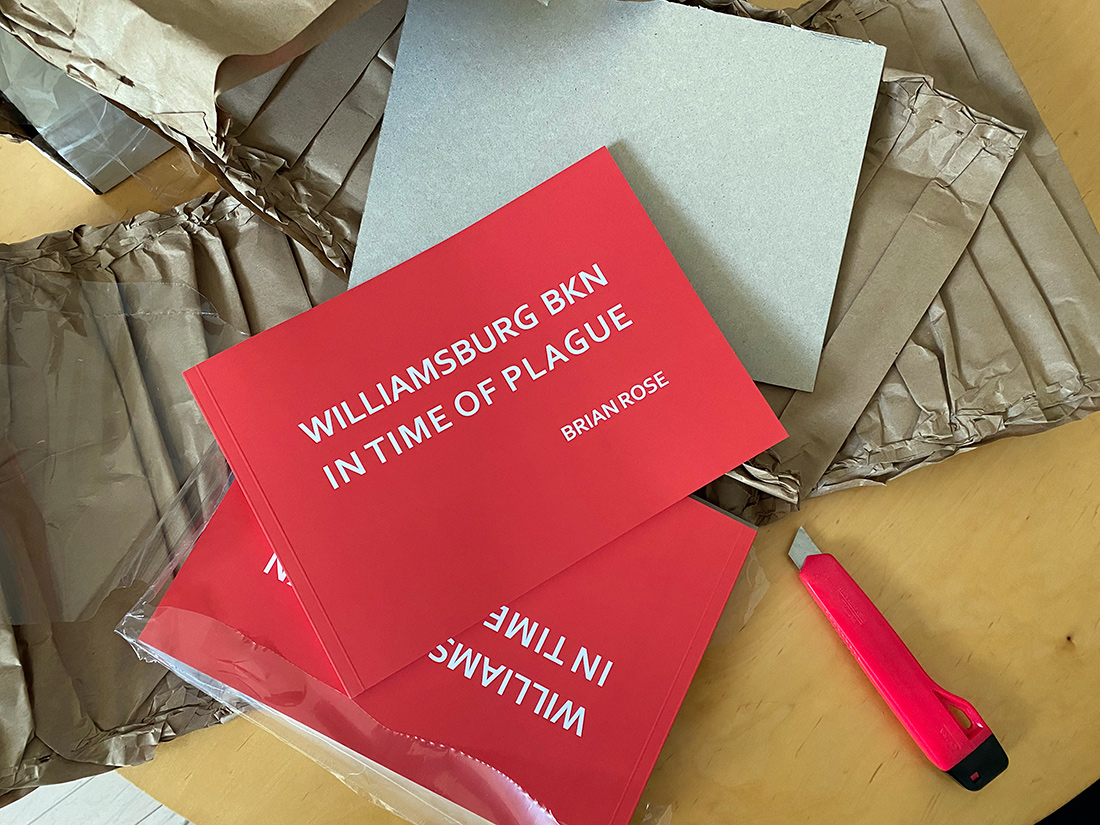
    In the spring of 2020, the Covid-19 pandemic swept across the country, hitting New York especially hard, and the city was placed on lockdown by Governor Cuomo. In March and April, I wandered through the neighborhood of Williamsburg, Brooklyn, its empty streets bare and frozen – as if time had stopped for my camera – keeping a safe distance from the few others who ventured out. I self-published a book called  “Williamsburg: In Time of Plague,” marketing it on Kickstarter. And I used the quarantine time at home to begin investigating my missing Virginia roots on various genealogy websites.

    What I discovered left me dumbfounded. I peeled back the family’s layers on my mother’s side all the way to Jamestown – to the first supply ship that arrived in 1608, showing up just in time to save the few dozen colonists still alive but near starvation. One of those survivors was Temperance Flowerdew who married my 12th great grandfather, George Yeardley, the second royal governor of colonial Virginia. In 1619, fifteen of the first 25 enslaved Africans resided at Flowerdew Hundred, Yeardley’s plantation on the James River.

    Another of my earliest ancestors may well have been present when Pocahontas and John Rolfe were married, an event that paused the ongoing war with the Indians, and a few years later, when the census of 1624 was taken, was found living on a plantation called Jordan’s Journey on the James River just south of Richmond. There were only 1,200 people of European descent in all of Virginia at that time. My later ancestors settled in Georgia and Mississippi – my 4th great-grandmother was a Creek Indian, and my 3rd great-grandfather died in the battle of Vicksburg fighting for the South. For unknown reasons, my grandparents migrated to Washington, D.C., and then back to Virginia. My immediate family ultimately ended up in a suburban-style ranch house on the outskirts of Williamsburg, precisely four miles from the excavations of the original fort at Jamestown.
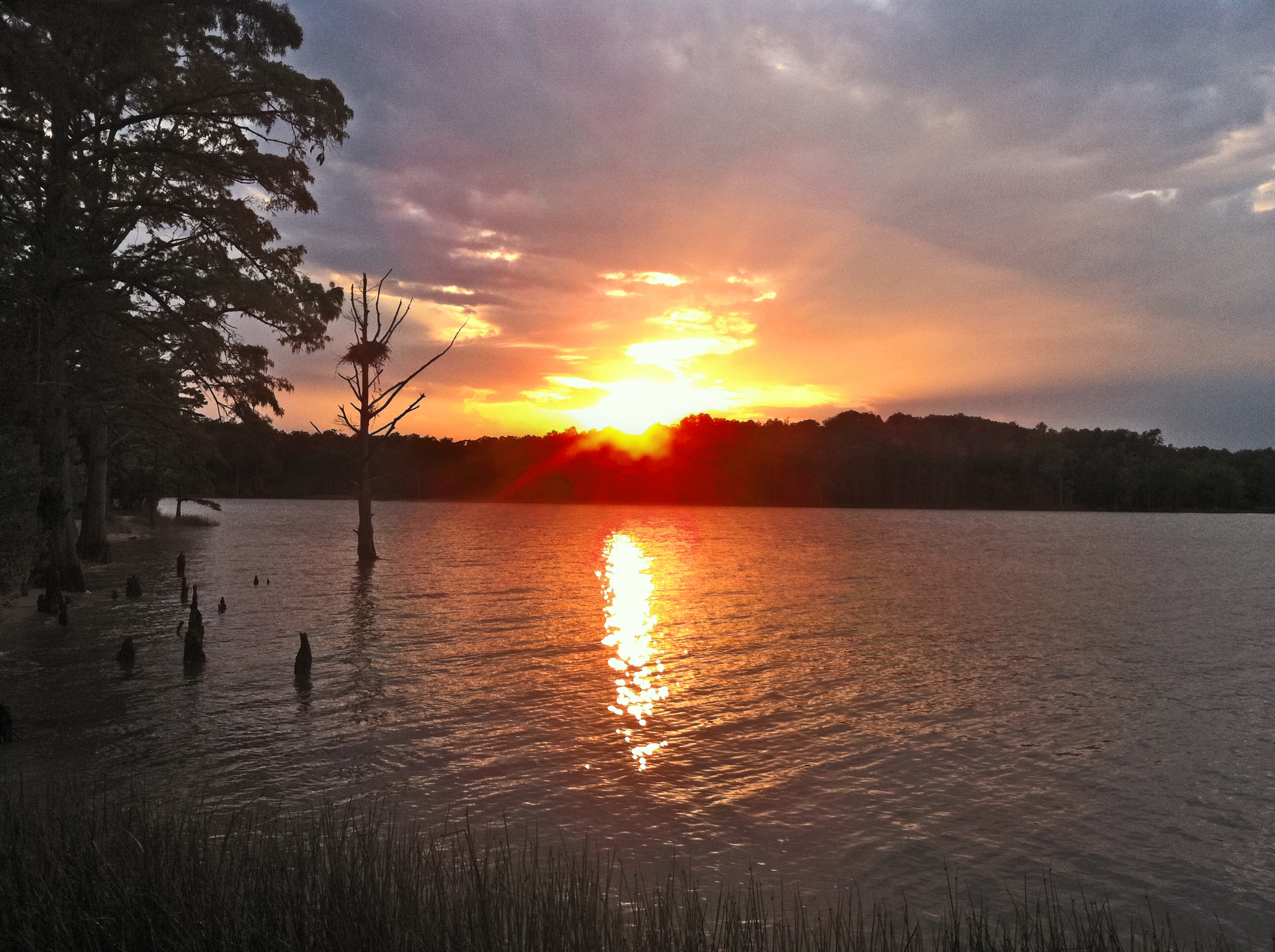

    Grays Creek, the spot where my father’s ashes were scattered – © Brian Rose

    The Rose side of the family also traces its roots to Jamestown, to Surry County, directly across the river. My 7th great-grandfather, William Rose, settled in 1650 on the property adjacent to Smith’s Fort, land given to John Rolfe and Pocahontas by Chief Powhatan, precisely at the spot on Gray’s Creek where my sister and I had scattered our father’s ashes. It was as if we were all homing pigeons, somehow tuned to the way back, over centuries of time.

    To a great extent, the revelation of this missing history was exhilarating, but it was distressing as well. These early Virginians were well-to-do planters, with much of their wealth derived from slave labor, not to mention that the land they claimed was essentially stolen from native people. At the same time, however, these first Virginia families were the catalysts for American democracy, and they espoused the enlightenment ideals that underpin the Declaration of Independence and the Constitution, among the most remarkable achievements in western civilization. I still regard Thomas Jefferson’s UVA campus with its Roman Pantheon-inspired dome and classical colonnades as one of the greatest works of architecture in North America, an audaciously conceived beacon of learning perched on the edge of the Appalachian wilderness. This epitome of American idealism was built, however, largely by enslaved labor, and a circular granite memorial echoing the nearby Rotunda now acknowledges this integral and sobering fact.
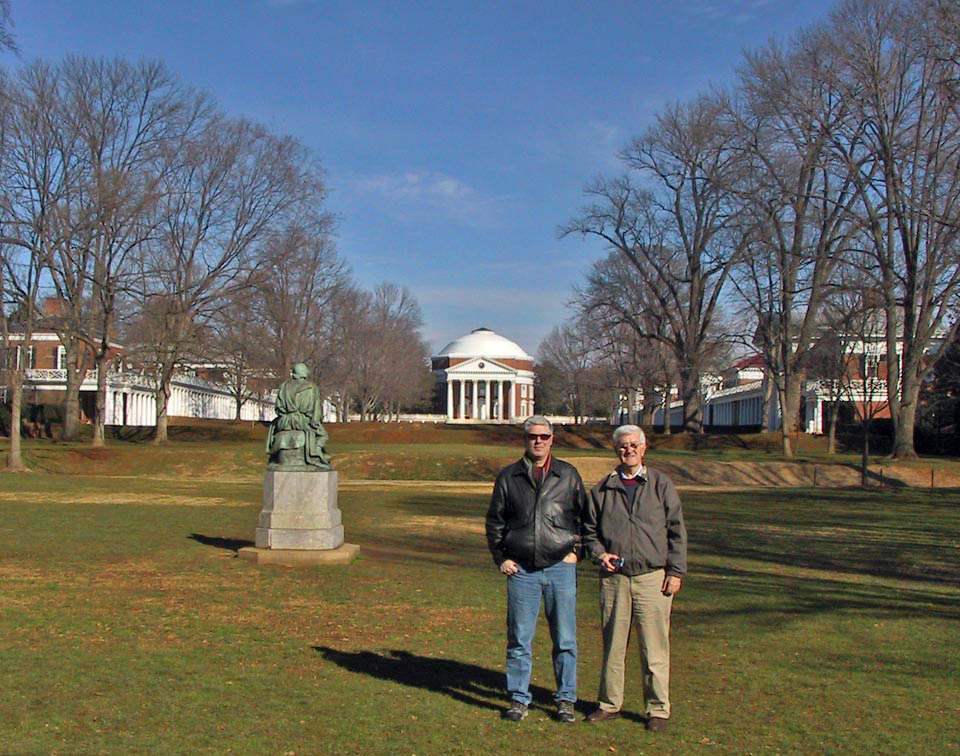

    The University of Virginia with my father, Leroy Rose

    One of my great, great, great grandfathers was awarded 486 acres of land by Jefferson in appreciation for his service in the Revolutionary War. He was also, like Jefferson, the owner of slaves. And most remarkable was the story of my 3rd great uncle, who departed the Tidewater region of Virginia, like a Faulkner character, to set up a sugar plantation in Louisiana. His plantation, known as Hard Times, was in 1850 the most prosperous in the Mississippi Delta, with as many as 350 enslaved laborers working the fields and operating the sugar mill. The Civil War brought ruin and an end to the plantation economy. It did not, of course, do away with the racism underlying American society both in the South and the North. Not by a long shot.

    In New York, the Covid pandemic continued, but the city’s crisis eased as people masked up and maintained social distancing. Donald Trump, unwilling to accept responsibility or listen to the advice of experts, recklessly encouraged Americans to shop, eat out, and carry on as usual as the death toll from the virus mounted across the country. Then, on May 25th, George Floyd, a Black man living in Minneapolis, was killed by a white police officer while under arrest for allegedly passing a counterfeit $20 bill. The next day a cell phone video of Floyd’s arrest was made public, the officer’s knee pressing against his throat, his gasping, repeated last words, “I can’t breathe.” The video went viral, sending shockwaves through the body politic, shattering the preternatural calm of the pandemic’s previous two months. Protesters took to the streets in Minneapolis and were met by tear gas and rubber bullets. Over the following weeks, millions throughout the U.S. marched against racism and police violence, and “Black Lives Matter” became a rallying cry taken up by a diverse cross-section of the public.
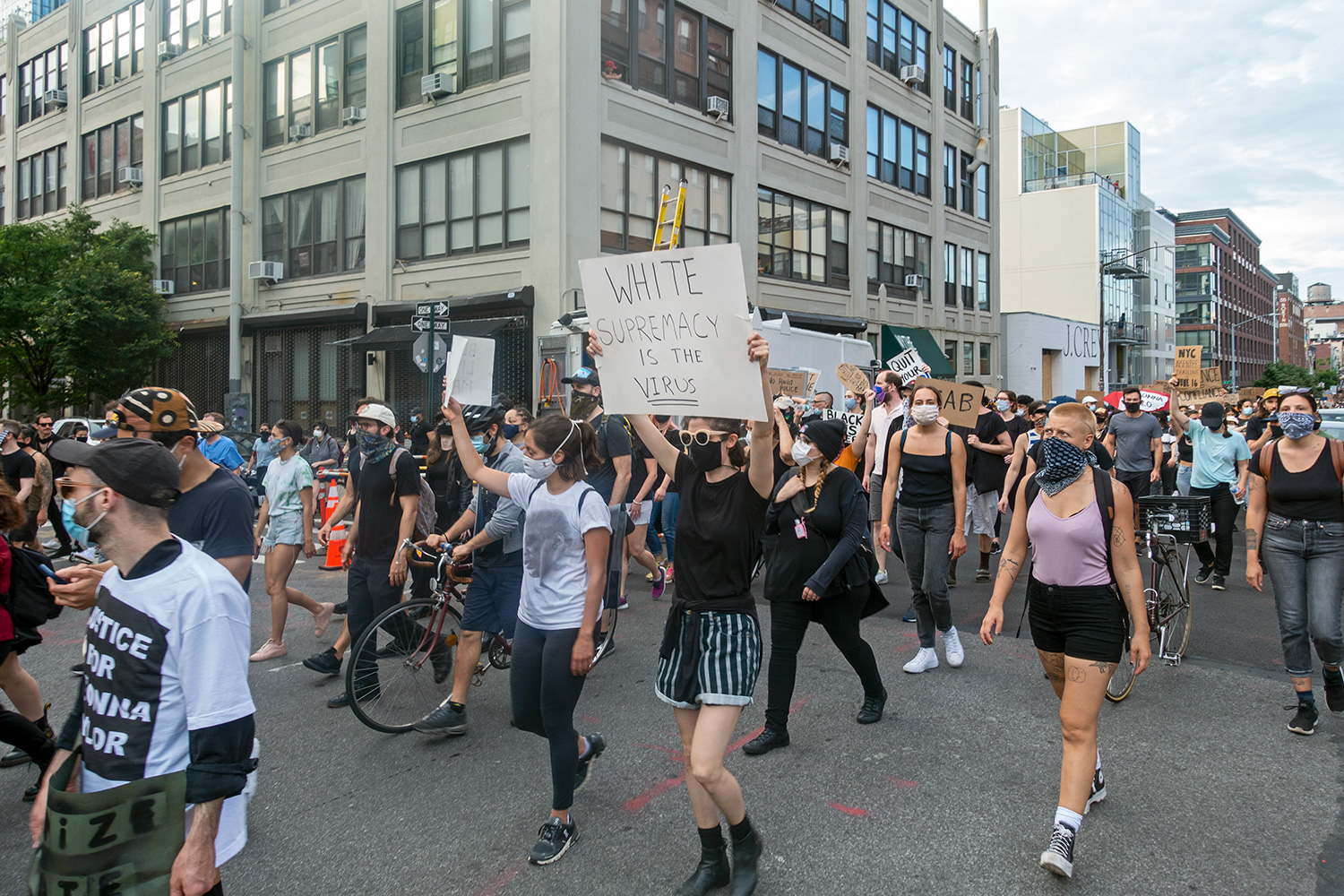

    BLM protest, Williamsburg, Brooklyn – © Brian Rose

    In Richmond, demonstrations focused on Monument Avenue with its statues of generals and other Confederate luminaries. These stolid ghosts of the past were suddenly reanimated in the passion of the BLM movement, and the longstanding debate surrounding these totems of the Confederacy – whether they should be removed or maintained with some sort of historic contextualization – now appeared moot. In early July, it became clear that the end of the road was approaching for Monument Avenue. On July 10th, protesters pulled Jefferson Davis from his pedestal, and two days later, I drove down to Richmond to document the last days of the grand boulevard of the Lost Cause.
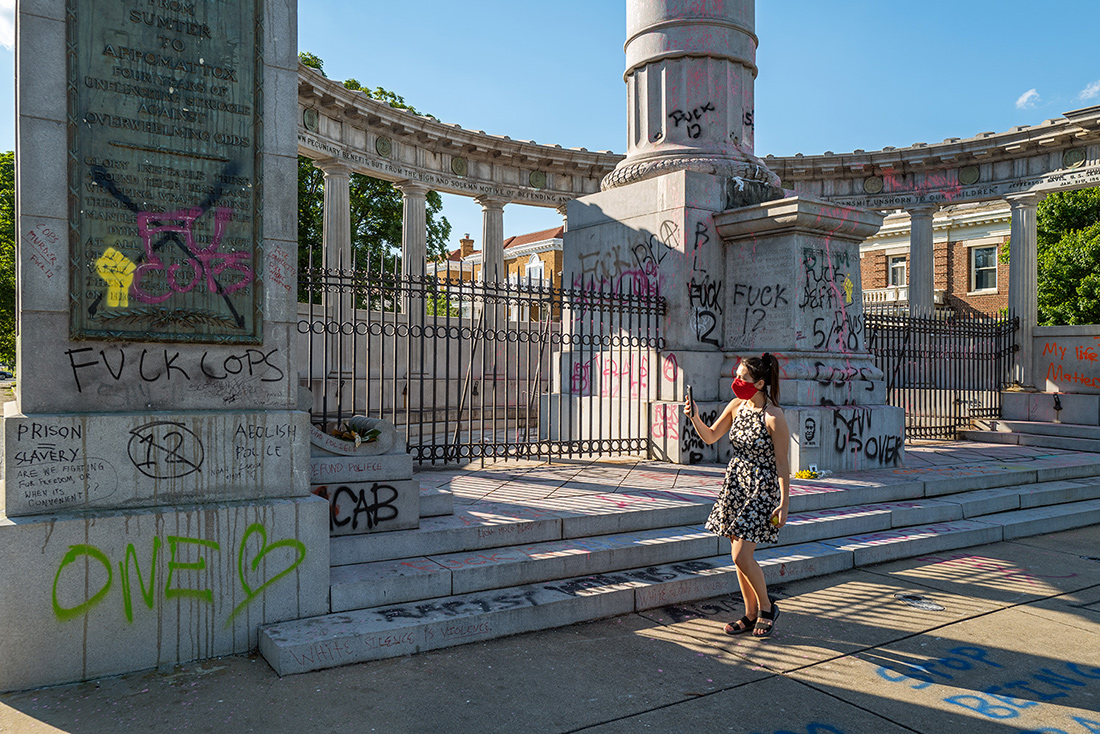

    J
    efferson Davis Monument, Monument Avenue – © Brian Rose

    In traveling to Richmond, I should point out that I have not been a total stranger to my home state since moving to New York. Over the years, I made dozens of trips to visit my parents, rendezvoused there with my sister who flew in from San Francisco and on several occasions marched down the Duke of Gloucester Street with the alumni of the Colonial Williamsburg Fifes and Drums. But this time, it felt different. I was on a mission to repossess, on my own terms, my birthright and heritage. It was not about atonement for a history I was not responsible for, but it was about seizing the moment when the past connected to the present in a circle of time, memory, and place. It felt purposeful, conscious, and I could see arrayed before me a palimpsest of genetic code and geography, like a map, like personal destiny revealed.
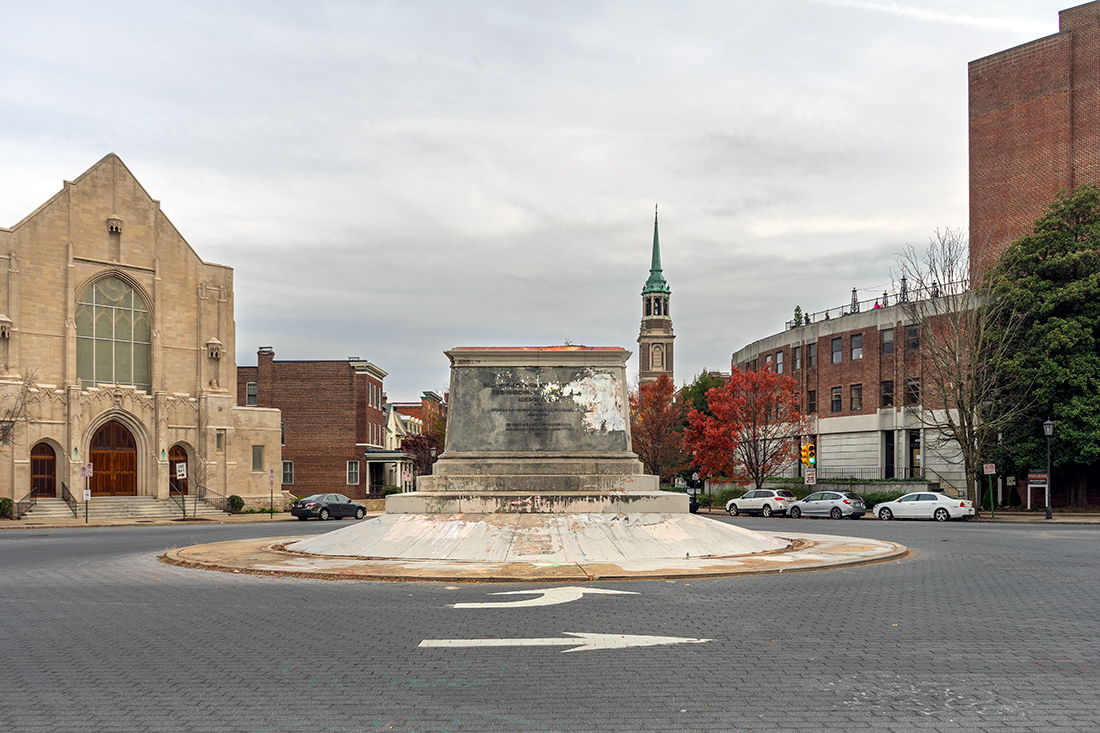

    J.E.B. Stuart pedestal, Monument Avenue – © Brian Rose

    As I stood on Monument Avenue in the low winter sun surveying the pedestals that once elevated J.E.B. Stuart and Stonewall Jackson above the crowd, and the brazenly, triumphantly, desecrated plinth of Robert E. Lee, I thought about how American democracy had nearly collapsed in a tawdry display of banner-waving, cult-like allegiance to a wannabe dictator, in a spasm of racial animus. Our better angels prevailed, just barely. We are left now with empty pedestals on Monument Avenue and a sense of loss. Not, of course, for the bronze idols promoted by the United Daughters of the Confederacy, not for the Lost Cause. And certainly, we can learn to accept, though not excuse, the imperfections of the Founding Fathers, men of their time, who arrived at Jamestown and sought to create a new world. But there is loss, nevertheless, for the pantheon of heroes we once revered, their icons now toppled or tarnished, and there is the corresponding loss of ideals displaced by voices of demagoguery and bigotry. We are left with empty pedestals on Monument Avenue as the sun comes up and I point my car north on I-95 back home to New York City.
  • New York/Mother’s Day


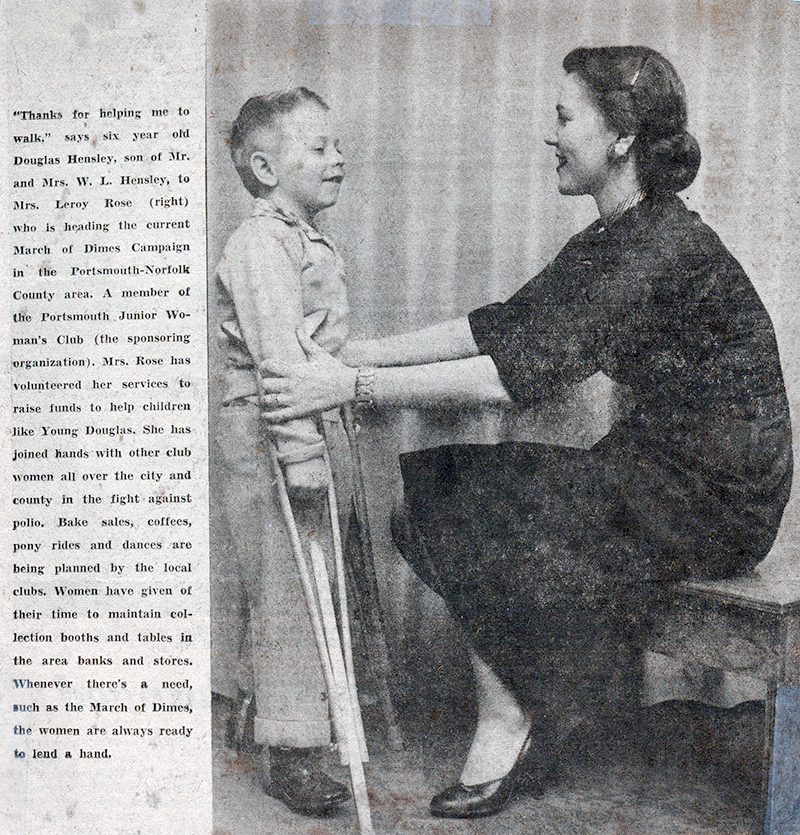
    Louise Rose, Portsmouth, Virginia, 1957

    Since my mother passed away on January 16th, I have spent more time with the scrapbook she left behind that documents her work in the fight against polio in the mid-1950s. It is a remarkable collection of articles and letters that pieced together provides a narrative of events leading to what appears to be the first polio mass vaccination clinics in the United States.

    One of the letters is an invitation for my mother to attend a March of Dimes meeting at its headquarters in New York to give a presentation of the program she organized in Virginia. She was 28 years old and we lived in a tiny house in a working-class section of Portsmouth near the navy shipyard. She probably made the trip alone with me and my father staying at home.

    Another of the letters comes from Basil O’Connor who had been one of Franklin Roosevelt’s top advisers and the founder of the March of Dimes. He also served several years as the head of the Red Cross. O’Connor was aware of my mother’s extraordinary vaccination initiative and her fundraising prowess.

    He wrote:

    “Please extend my warmest thanks to each and every member of the corps of volunteers who worked so determinedly with you in the 1957 March of Dimes. I wish it were possible to express these sentiments directly and individually, because only in that way could I feel them to be completely adequate. Surely the effort that went into the campaign just past completely overshadows anything that has ever been done.”
    I look back in wonderment at this letter and others like it in our archive. I was just 3 years old at the time, and my sister was not yet born, though well on the way. She arrived in August of 1957. That my mother did all of this with me, a toddler, and pregnant with my sister, is nothing less than astonishing.


  • New York/McGraw-Hill Lobby


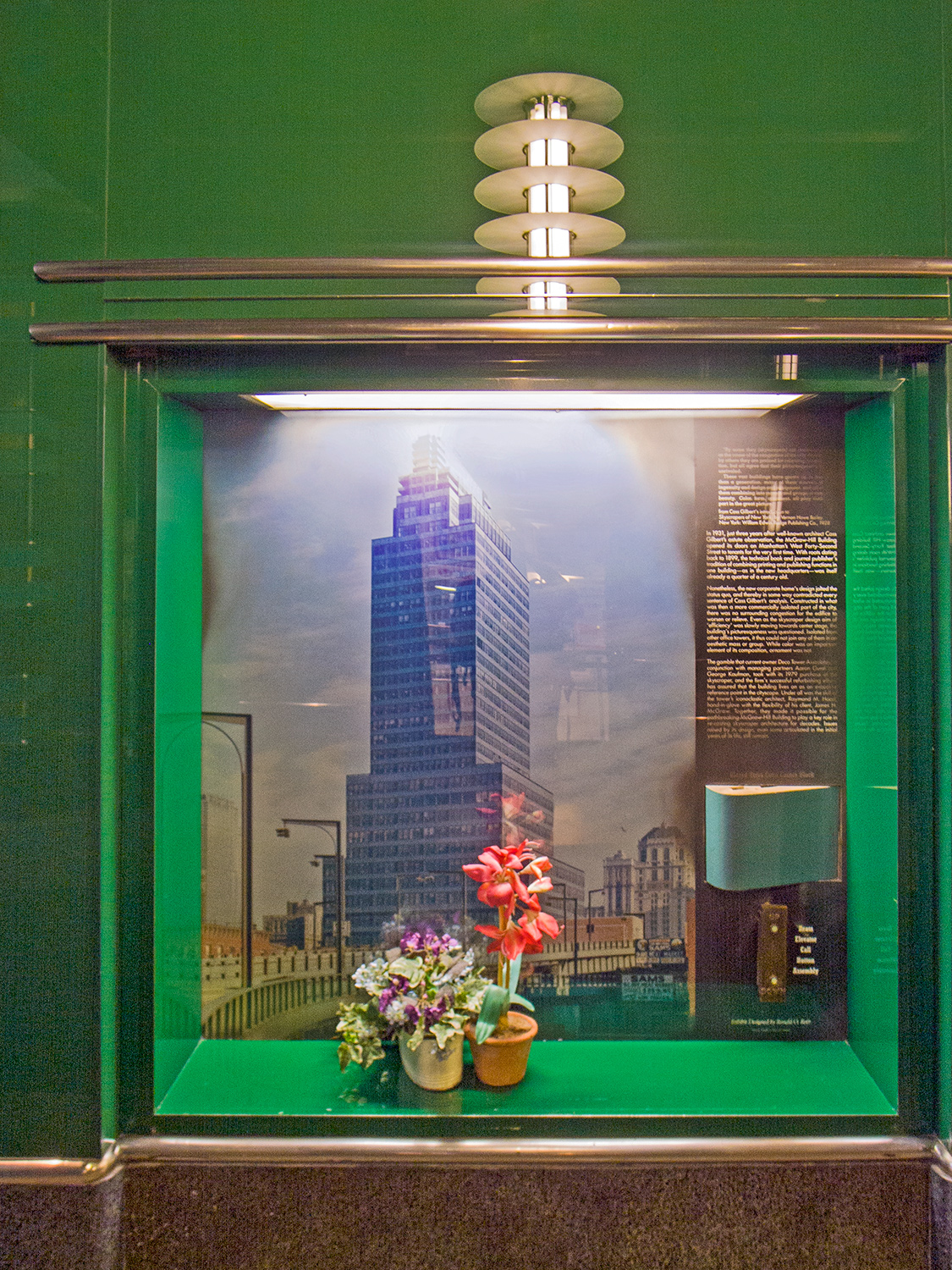
    McGraw-Hill Lobby, West 42nd Street, NYC – © Brian Rose

    A great crime against culture and architecture has been commited by the owners of the McGraw-Hill Building. The magnificent Art Deco lobby designed by Raymond Hood has been destroyed.

    https://w42st.com/post/art-deco-lobby-mcgraw-hill-tower-demolished-landmark-commission-feckless/

  • New York/Sunset Park


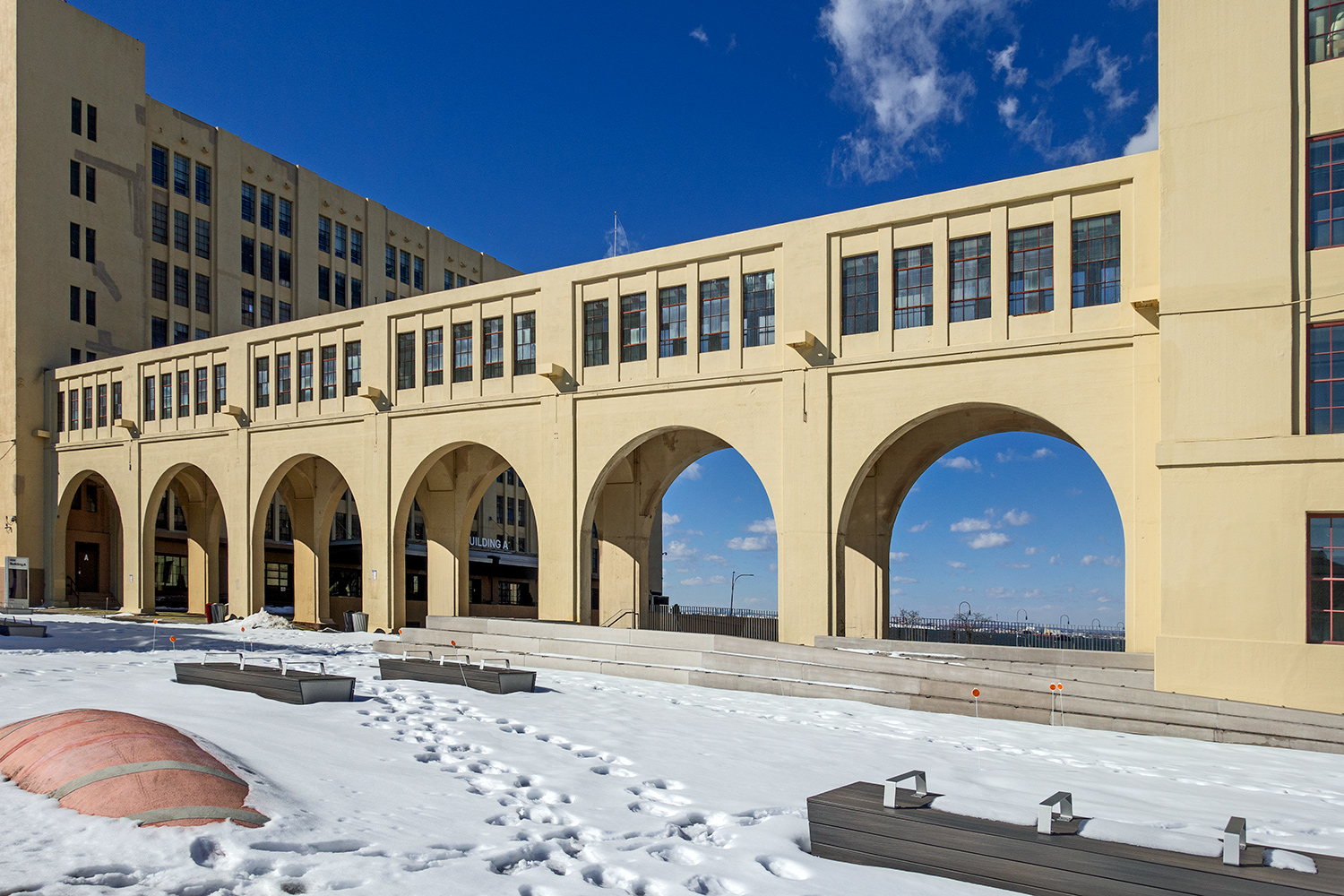
    Brooklyn Army Terminal – © Brian Rose

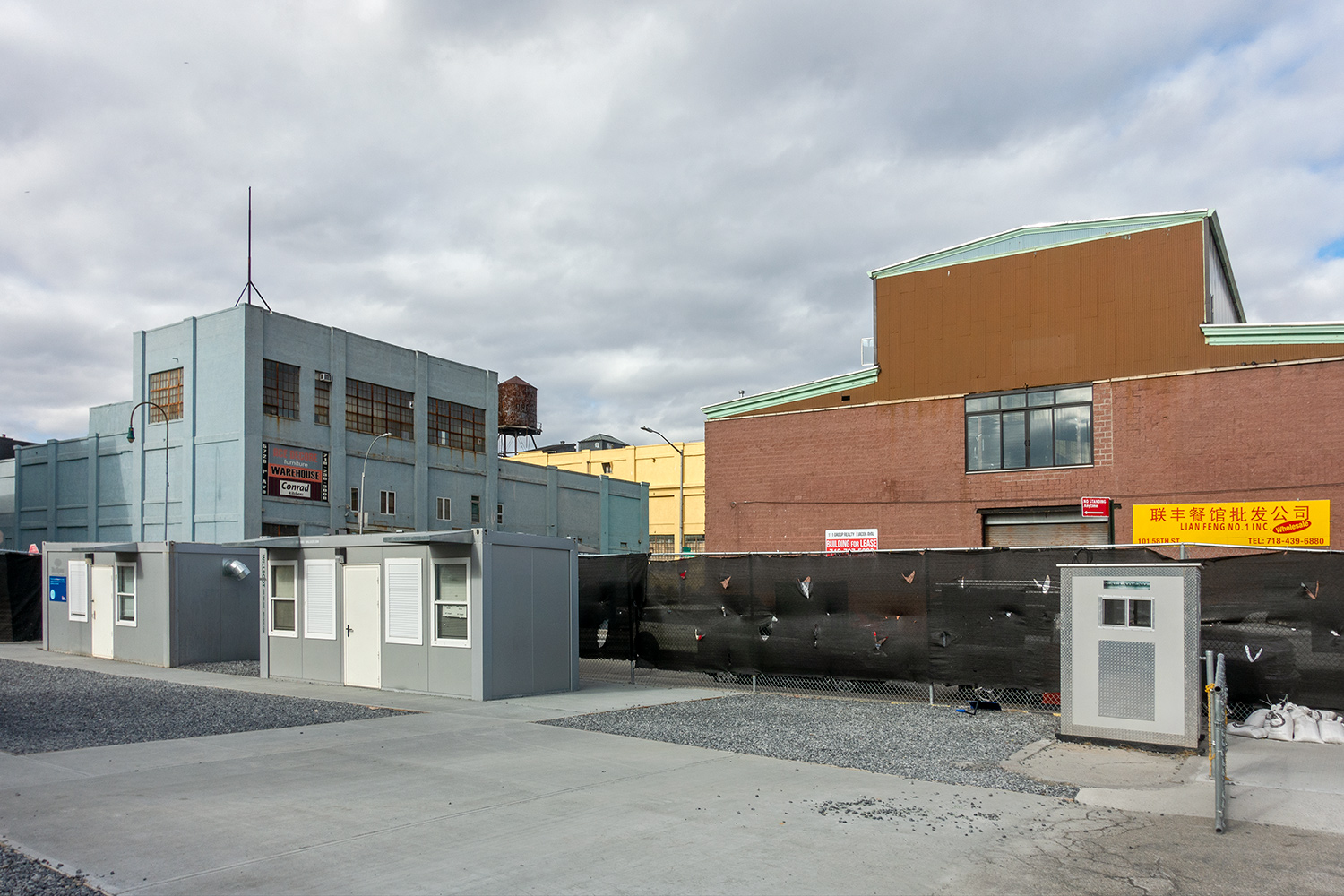
    A month ago in the midst of a snowy February, I made the trek down to the Brooklyn Army Terminal to receive the first of two Covid-19 vaccines. I was eligible at 66 years of age and eager to get vaccinated. It took some doing – repeatedly logging into the city’s web portal over the course of two weeks – until, boom, a date, and location popped up. I immediately jumped on it even though it was far from my part of Brooklyn.


    Vaccination pods, Brooklyn Army Terminal – © Brian Rose

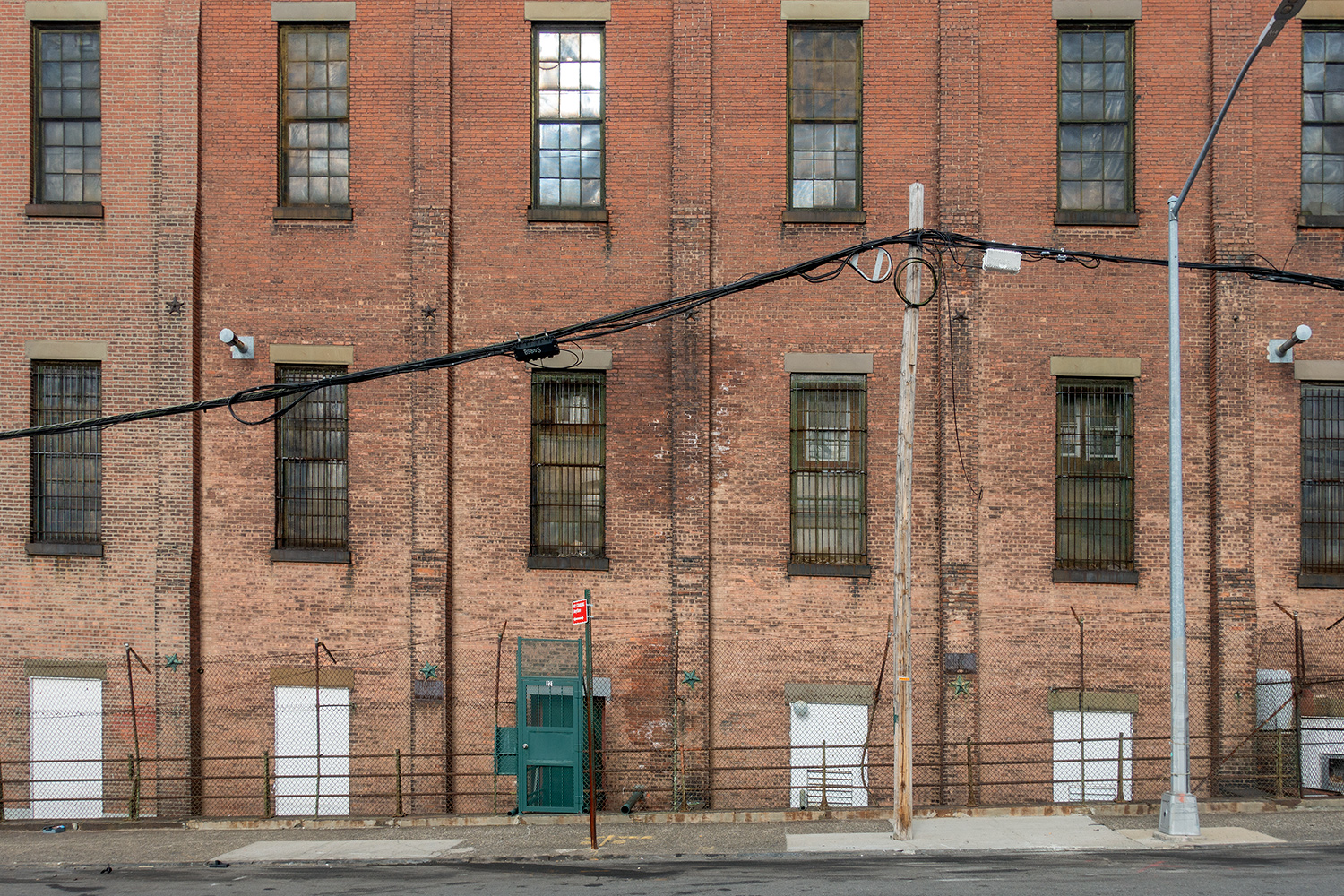
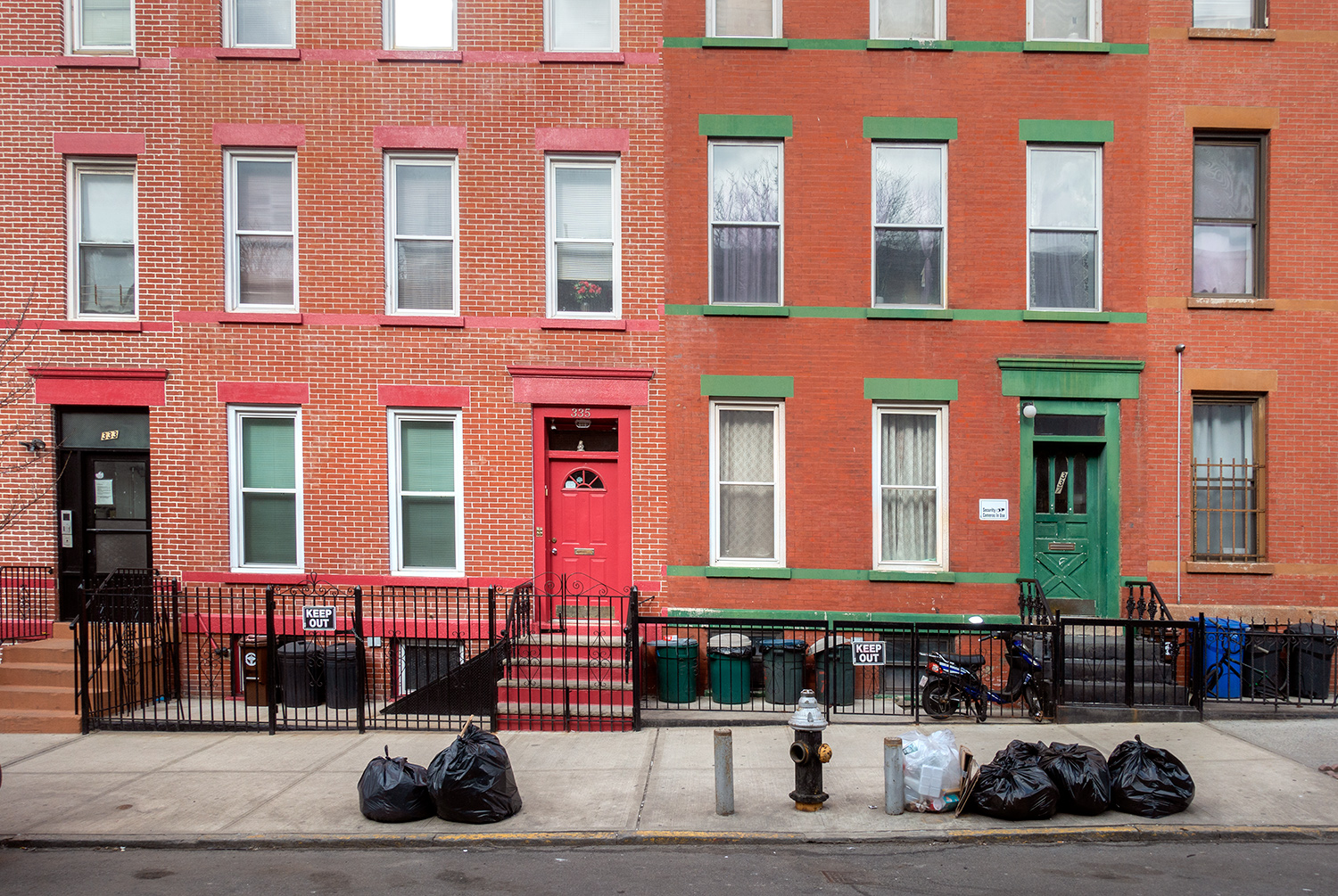
    The Brooklyn Army Terminal is a massive complex, no longer used for military purposes, that now houses light manufacturing, technology companies, media, the kind of thing that dominates the new economy of New York. It was designed by Cass Gilbert, best known for the Woolworth Building and the Supreme Court in Washington, D.C. The area around it is called Sunset Park and includes both industrial architecture and row houses. The transition from one to the other is abrupt as you walk inland away from the waterfront.


    59th Street, Sunset Park, Brooklyn – © Brian Rose


    59th Street, Sunset Park, Brooklyn – © Brian Rose

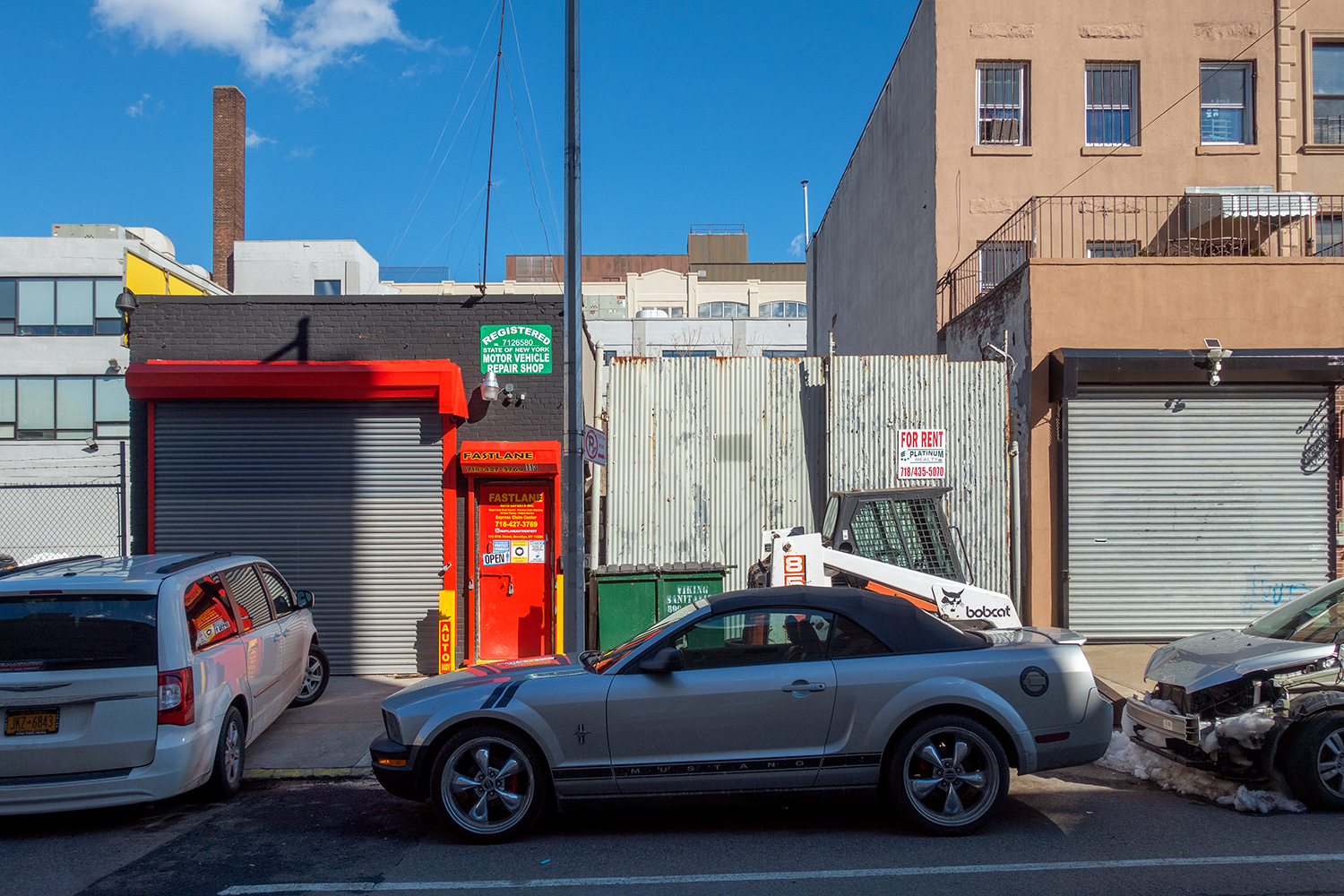
    Although it was a long trip down to Sunset Park, I was excited about getting vaccinated, and yesterday I returned for the second of two doses of the high tech mRNA Moderna vaccine. Although the snow was mostly gone, it was a frigid day, and we had to wait outside in the cold before entering one of the vaccination pods. But I was happy, and it gave me the chance to wander briefly around this interesting part of the city.


    Sunset Park, Brooklyn – © Brian Rose


    Sunset Park, Brooklyn – © Brian Rose


  • New York/Varick Street


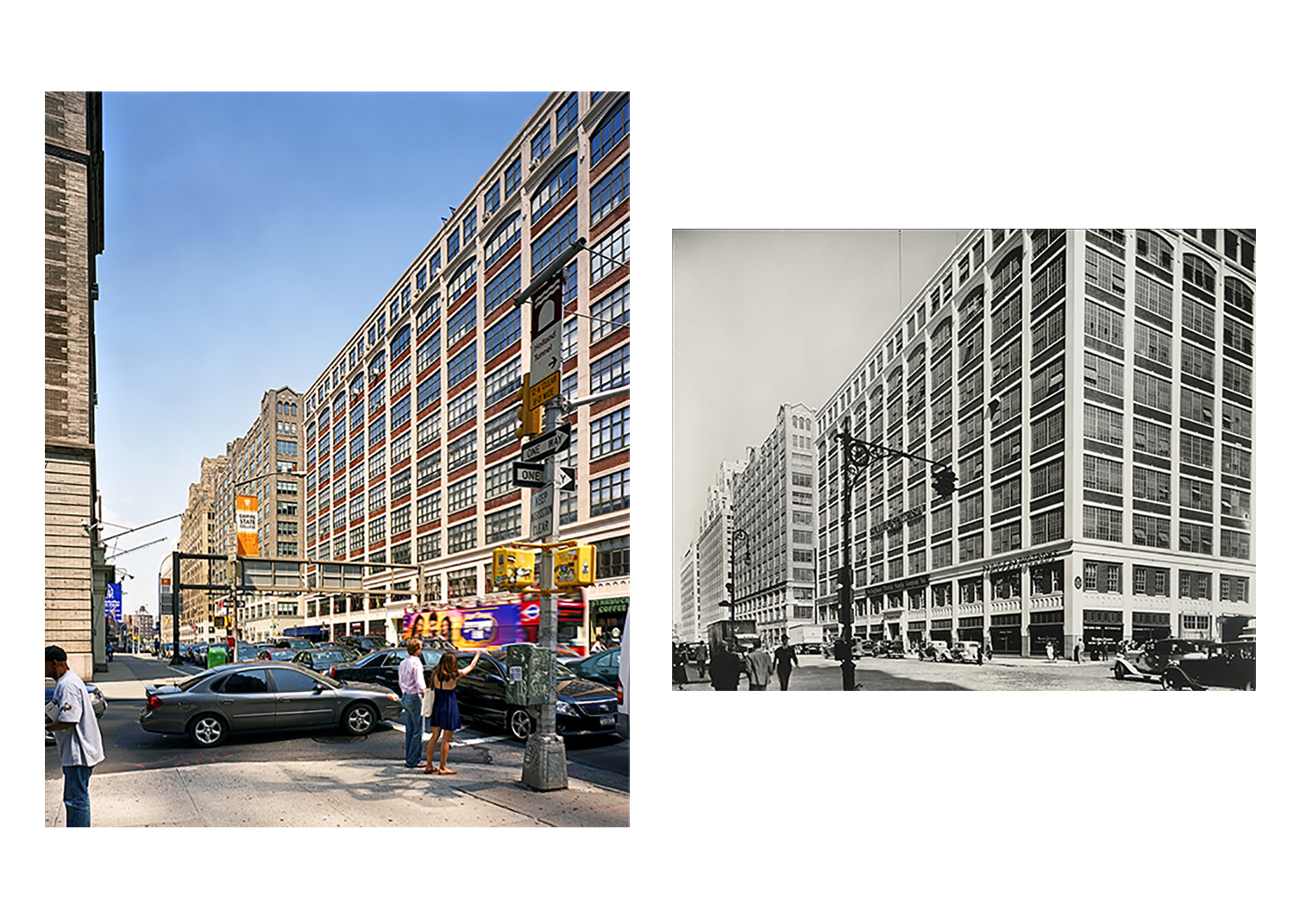
    150 Varick Street, NYC – Brian Rose and Berenice Abbot

    In 2009 I had an assignment to photograph the Hudson Square neighborhood of lower Manhattan. Hudson Square was once known as the Printing District because of the large number of printing businesses that occupied the massive loft buildings along Hudson and Varick Streets just north of Canal Street.

    One of the photographs I made, on the left above, shows the impressive street wall along Varick. I printed it 4×5 feet, and it was hung on the client’s office wall.

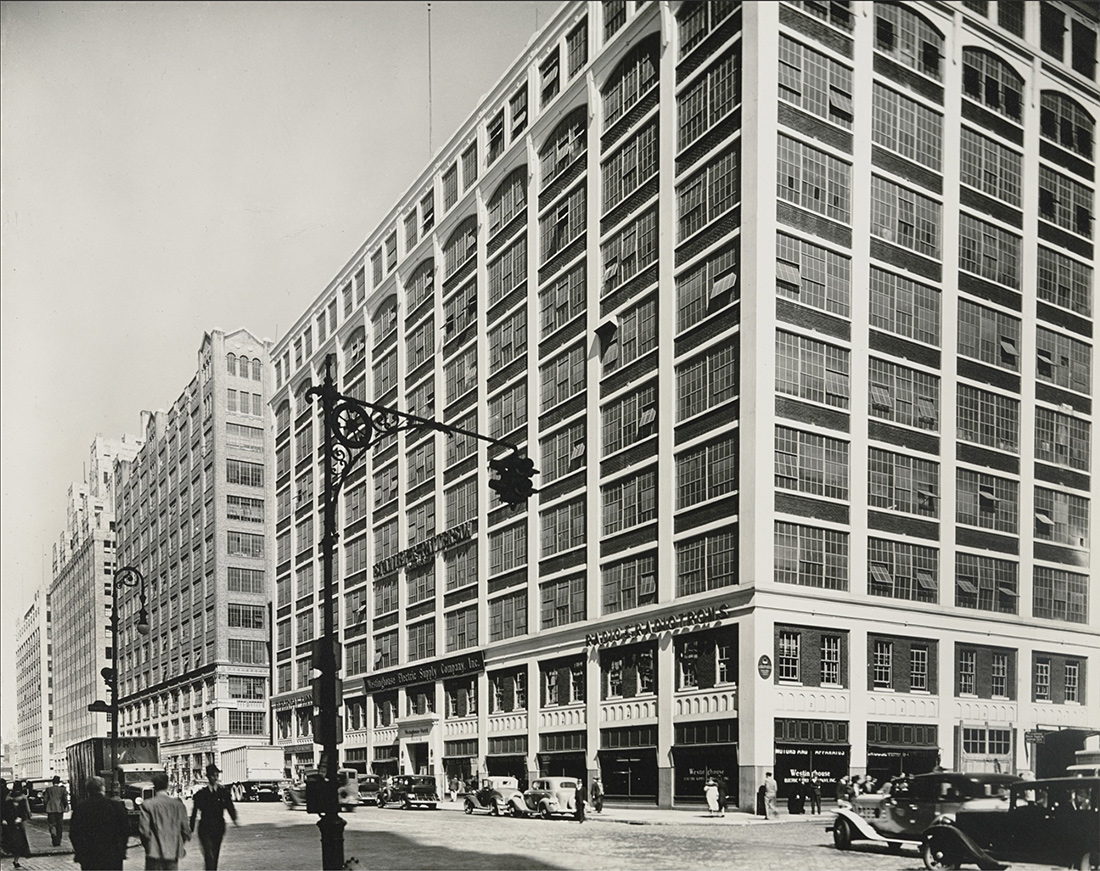
    What I didn’t know until very recently, was that Berenice Abbott had made a photograph from a similar perspective in 1935. I am familiar, of course, with Abbott’s work, especially her “Changing New York” book. I have always admired her photographs – even had a chance to meet her in 1980 – but have tended to look through her, probably unfairly, to Eugene Atget, whose documentation of Paris in transition is, for me, one of the pinnacles in the history of photography. Abbott, additionally, is responsible for bringing Atget’s work to the public, and his influence on her own work is widely acknowledged.


    Varick Street 1935 – Berenice Abbot

    I’ve been looking at the two photographs of Varick Street side by side. They appear, at first, to be near twins. But looking further, subtle differences multiply. Abbott was aware of the same receding street wall as I was, but she aimed her camera more squarely on the building at the corner, 150  Varick Street. It was built in 1926, just nine years before her photo was taken, an early example of Deco architecture, which was a style in full swing in 1935 when Abbott was roaming the city. To her, this building expressed modernity, beautifully juxtaposed against the elegant street lamp from an earlier era. The sign above the main entrance says Westinghouse Electronics, and the lettering near the corner says Radios and Radiotrons. The buildings beyond march to the edge of the frame as if in an endless parade, while a handful of cars and trucks occupy the wide thoroughfare. This is New York of the 1930s, a burgeoning metropolis emerging from the Great Depression, a city at the forefront of all that was new and forward-looking.


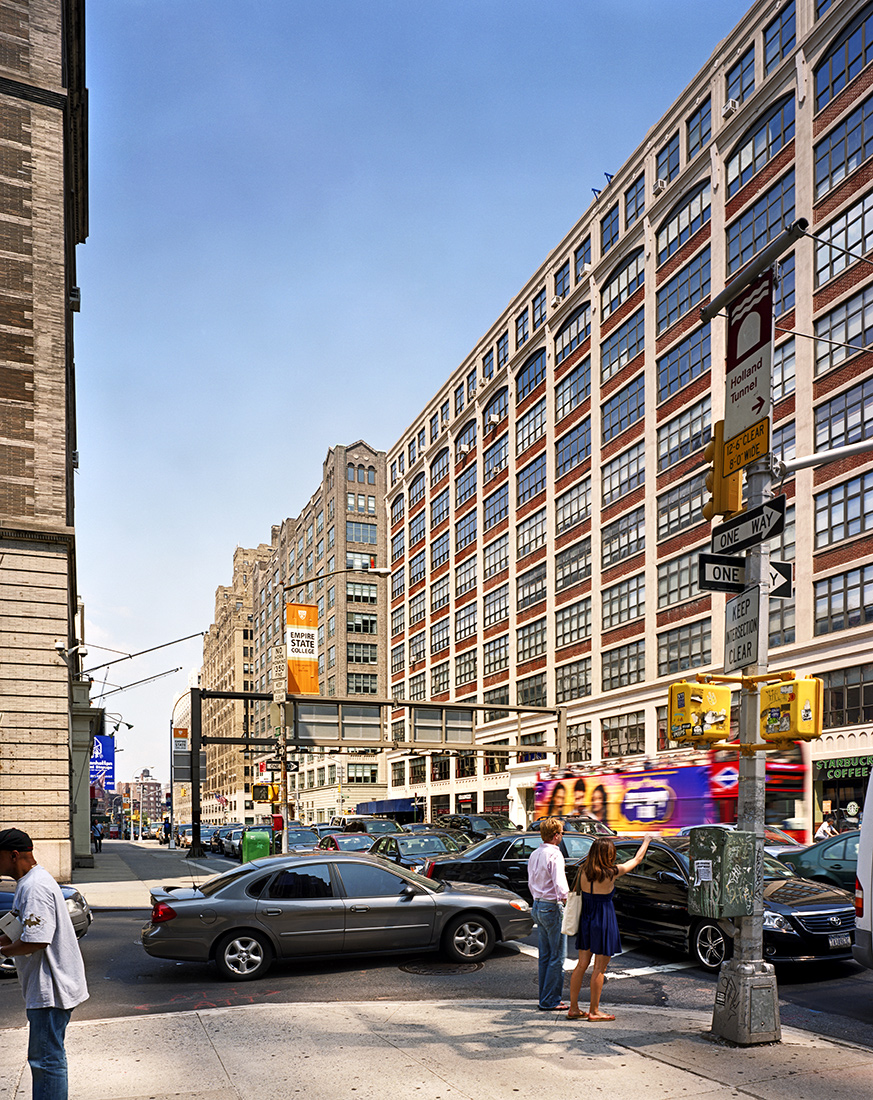
    Varick Street 2009 – © Brian Rose

    In my picture, I have pointed my camera up the avenue, including the line of receding buildings, but not focused on any of them individually. The street is jammed with vehicles barely moving as they approach the entrance to the Holland Tunnel. The flood of traffic suggests that the city has grown since 1935, and the automobile has taken over, and a previously two-way street is now purposed as a conduit funneling cars into the maw of the tunnel. My photograph differs from Abbott’s obviously by the presence of color. The composition is held together by a number of visual details – the couple at the center with the woman’s arm upraised – the double-decker tourist bus directly behind, slightly blurred, while everything else is still – the man almost falling out of the frame at the bottom left corner. And there are spots of color stretching across the frame – the blue banner, orange banner, and yellow walk/don’t walk boxes echoing the colors of the tour bus.

    Despite the superficial similarities between the two pictures, they are not simply “then and now,” a popular photographic meme. They each express different intentions and different sensibilities, both anchored to the same precise spot in the city, an 86 year span of photographic history, and the ongoing evolution of New York.

  • New York/2020 (part 2)

    After a horrendous early spring, the pandemic began easing in New York, but the overall mood remained tense, much as it had been during the past three years of the Trump presidency. On May 25th, in Minneapolis, George Floyd was murdered by police officers while under arrest. The killing set off a wave of protests across the country, and in NYC there were massive demonstrations, largely peaceful, throughout the city. At any given moment, multiple marches sprang up almost organically in one part of the city or another, often crossing the bridges between  Manhattan and Brooklyn. I made the photograph above as several thousand marchers paraded up Wythe Avenue just down the block from my apartment in Williamsburg.

    The pandemic lockdown was over, ready or not, though most people masked up and kept their distance. I followed events closely, not certain what I might do next photographically. I’m not a photojournalist, though I stay tuned to current events. I do not chase ambulances. I stay back and take in the whole horizon.

    In July I became aware that protests in Richmond in my home state of Virginia were focused on the Confederate statues on Monument Avenue. I realized immediately that this was something I needed to photograph. On July 10th the statue of Jefferson Davis, former president of the Confederacy, was toppled by protesters. Two days later I left for Richmond.

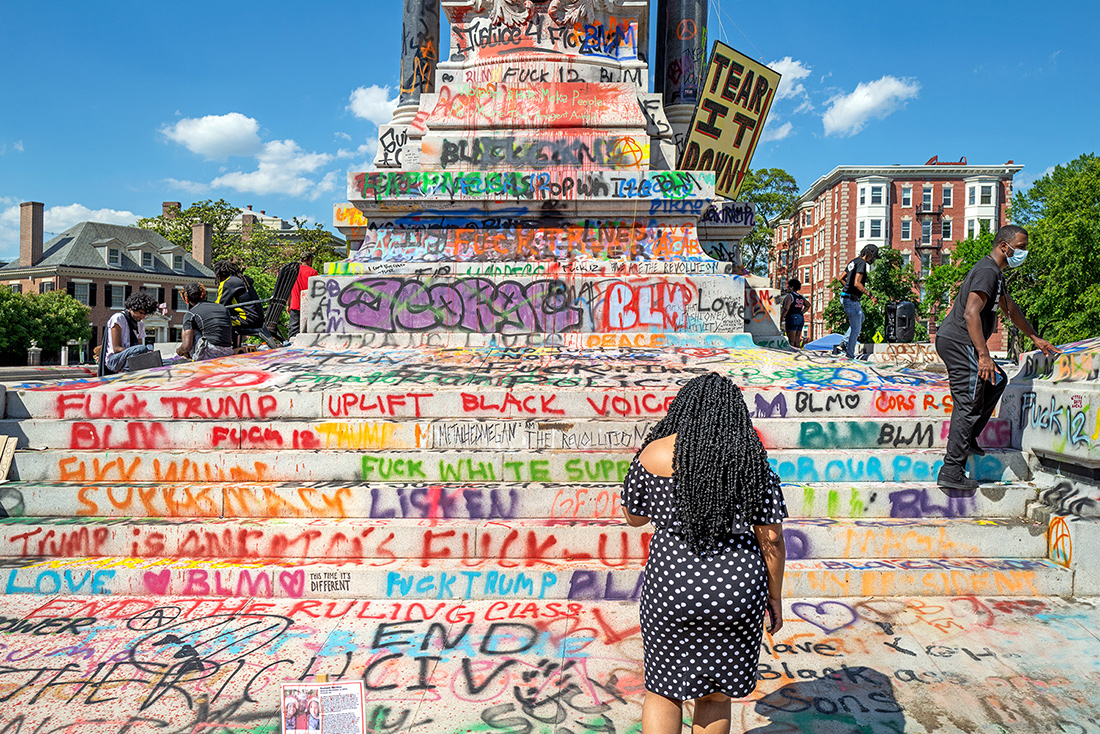
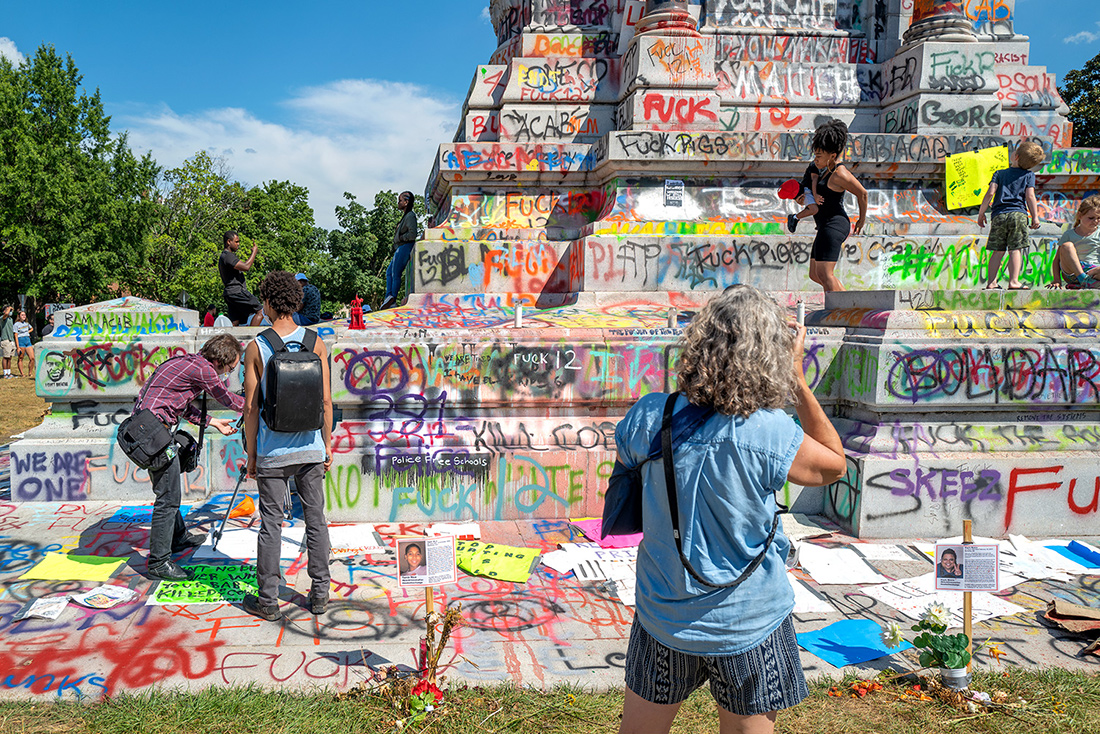
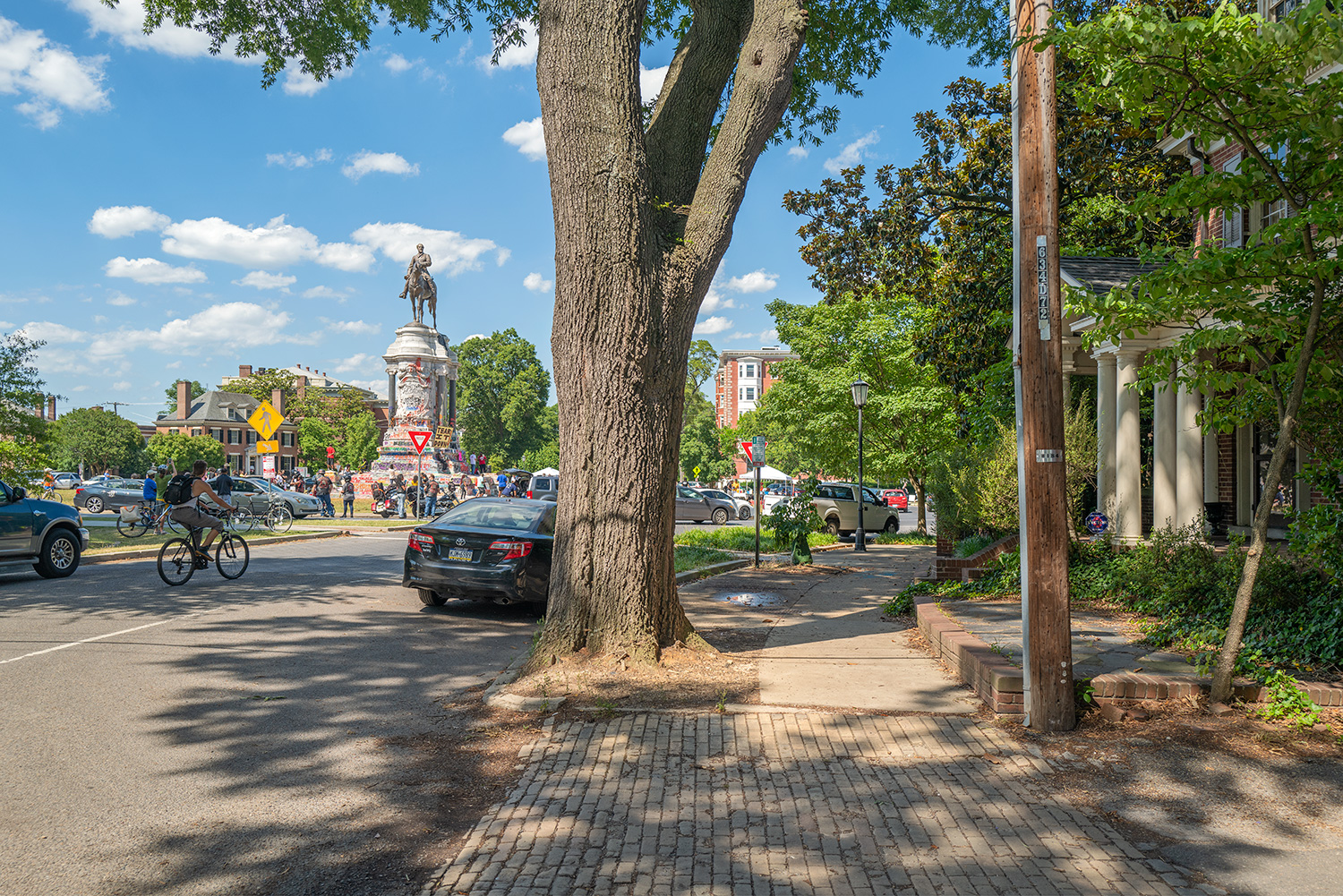
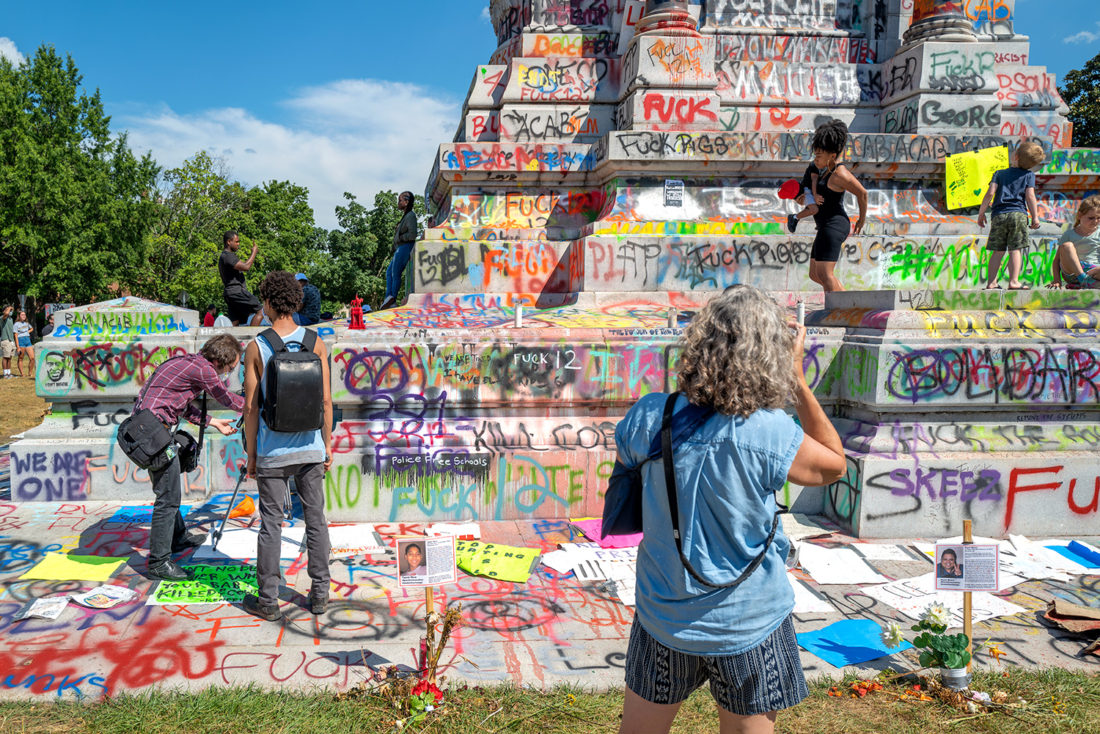
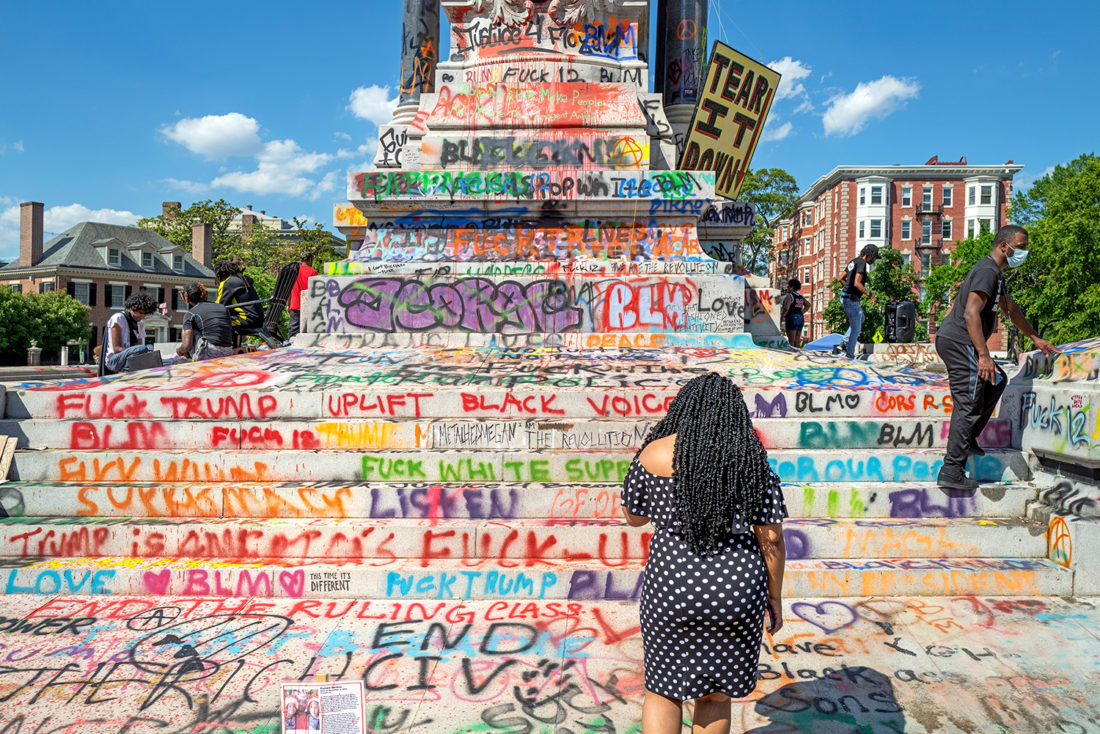
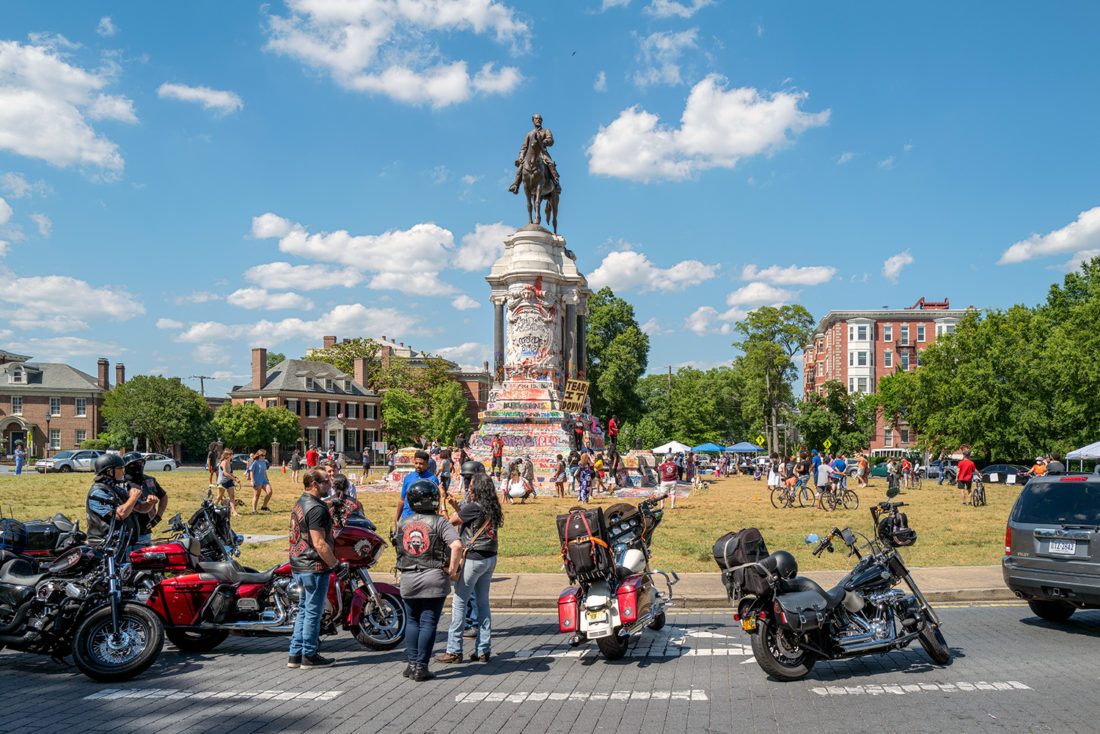
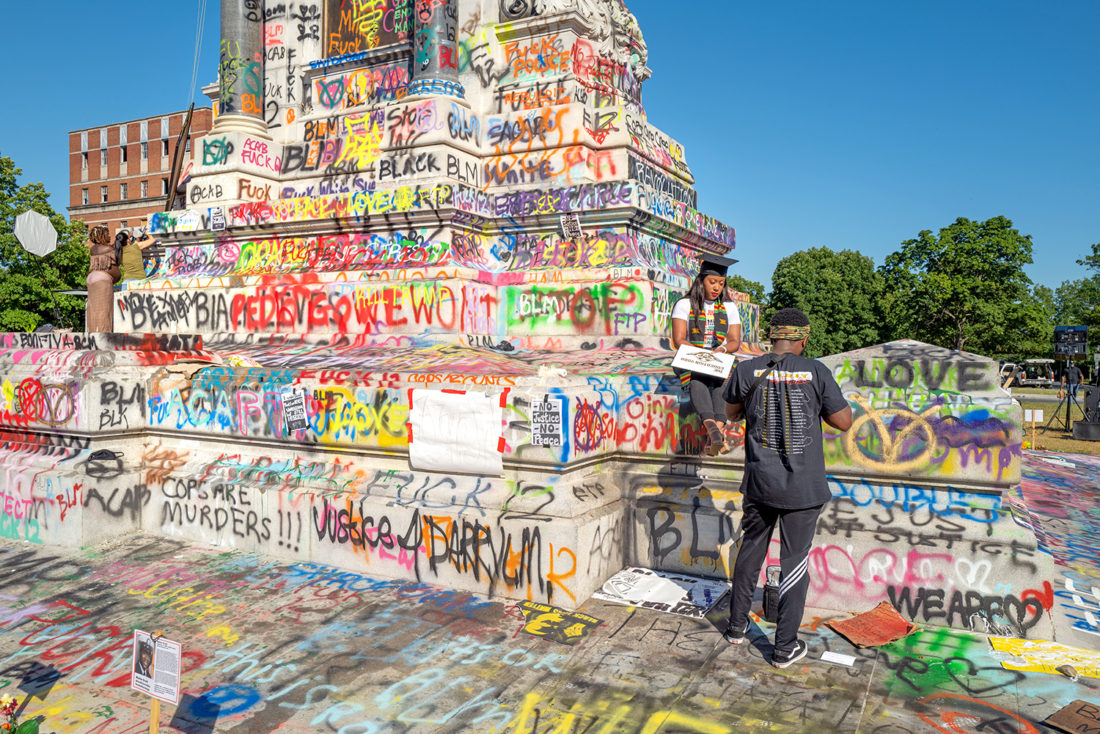
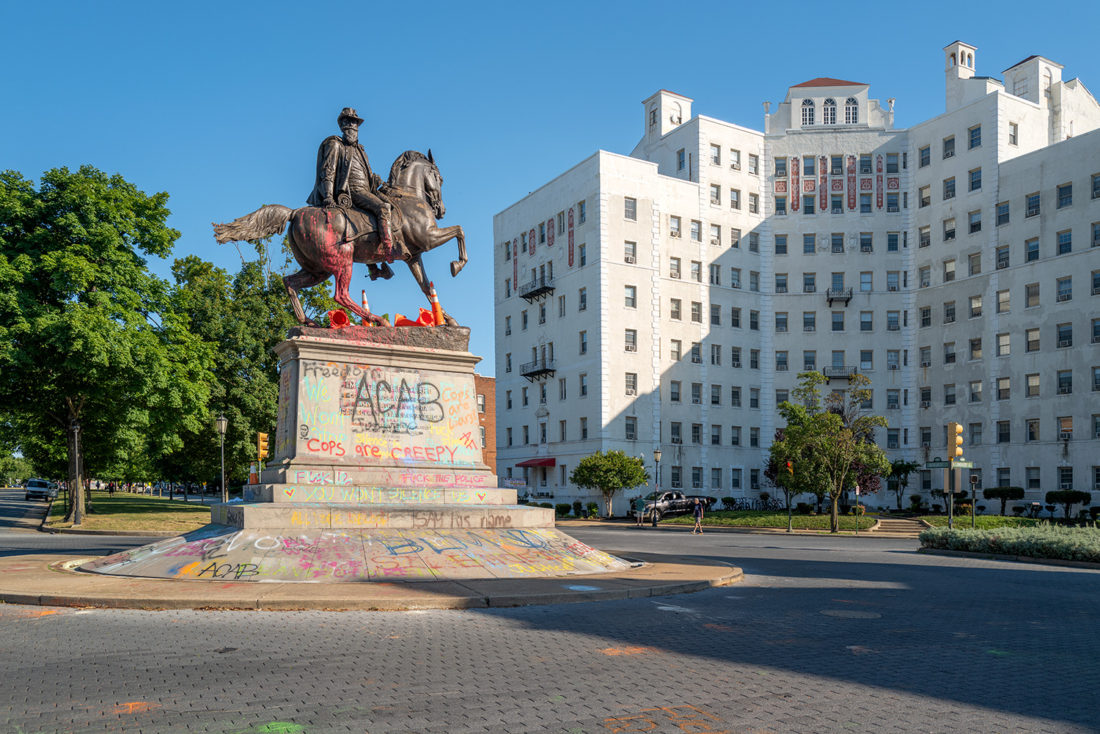
    The discussion about whether they should be maintained or removed had been going on for years, and suddenly the debate became moot as protesters took ownership of the statues, especially the immense monument to Robert E. Lee, covering their pedestals with graffiti, staging events, and various performances in the large grassy traffic circle around Lee.

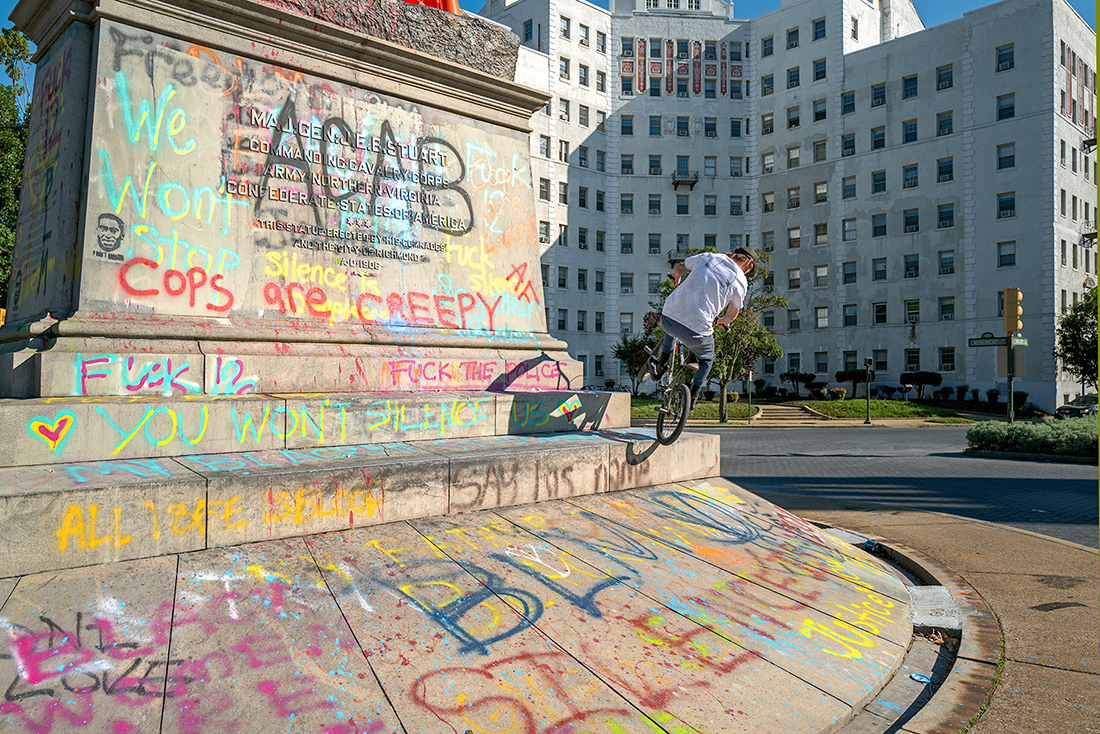
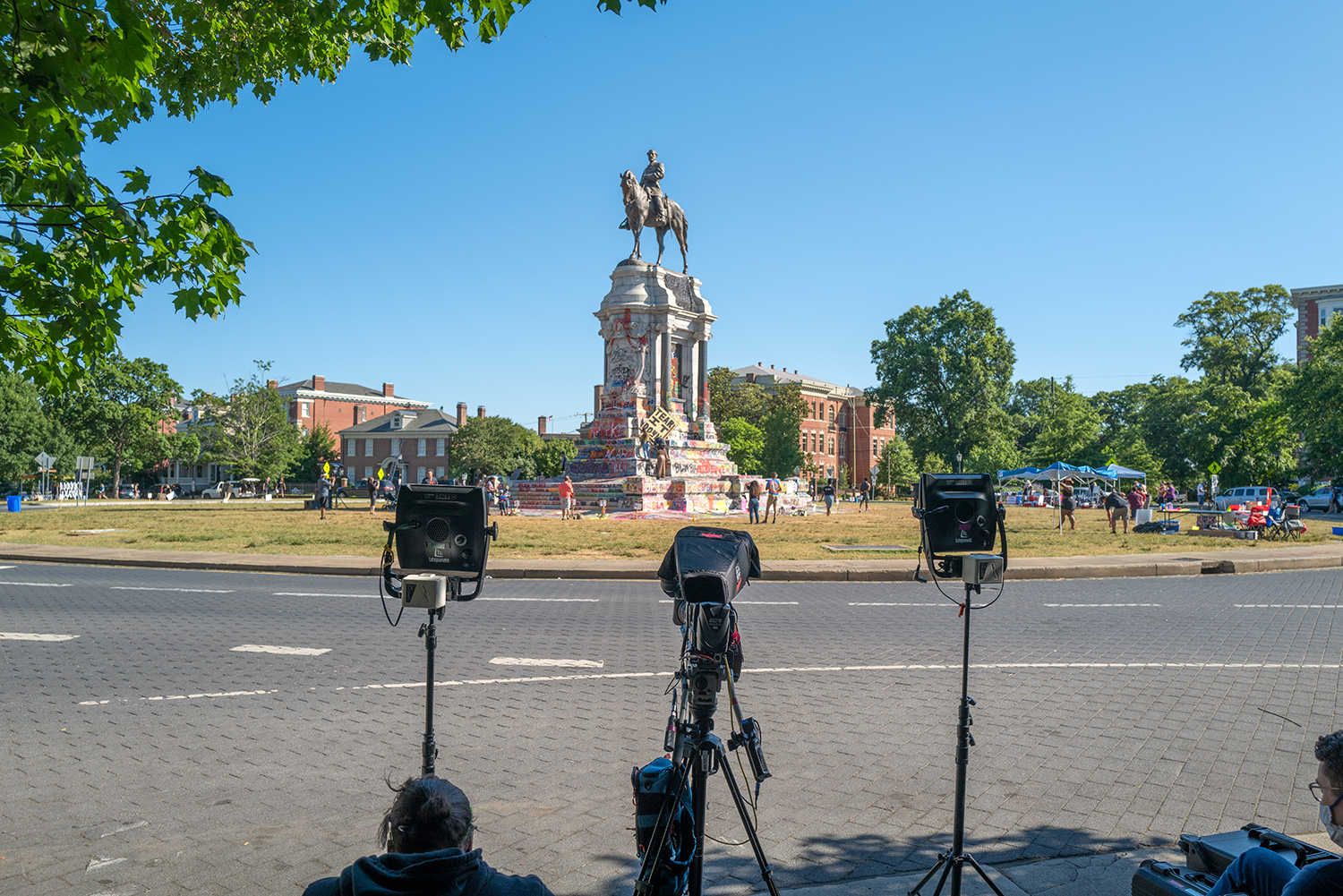
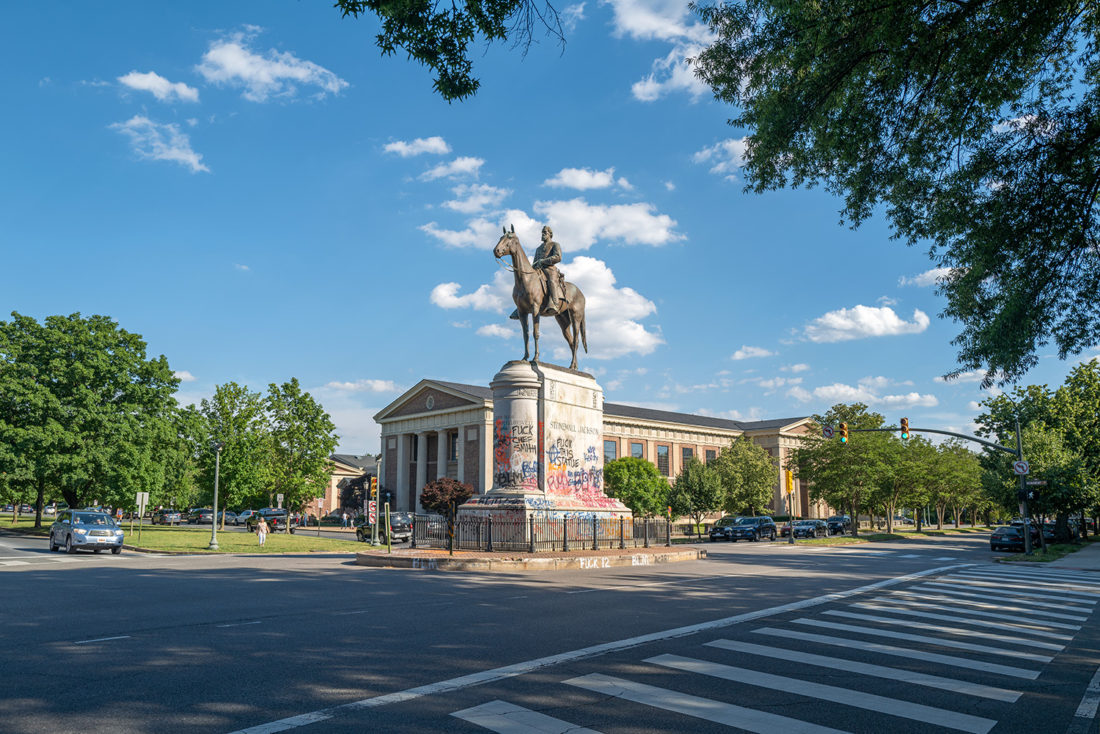
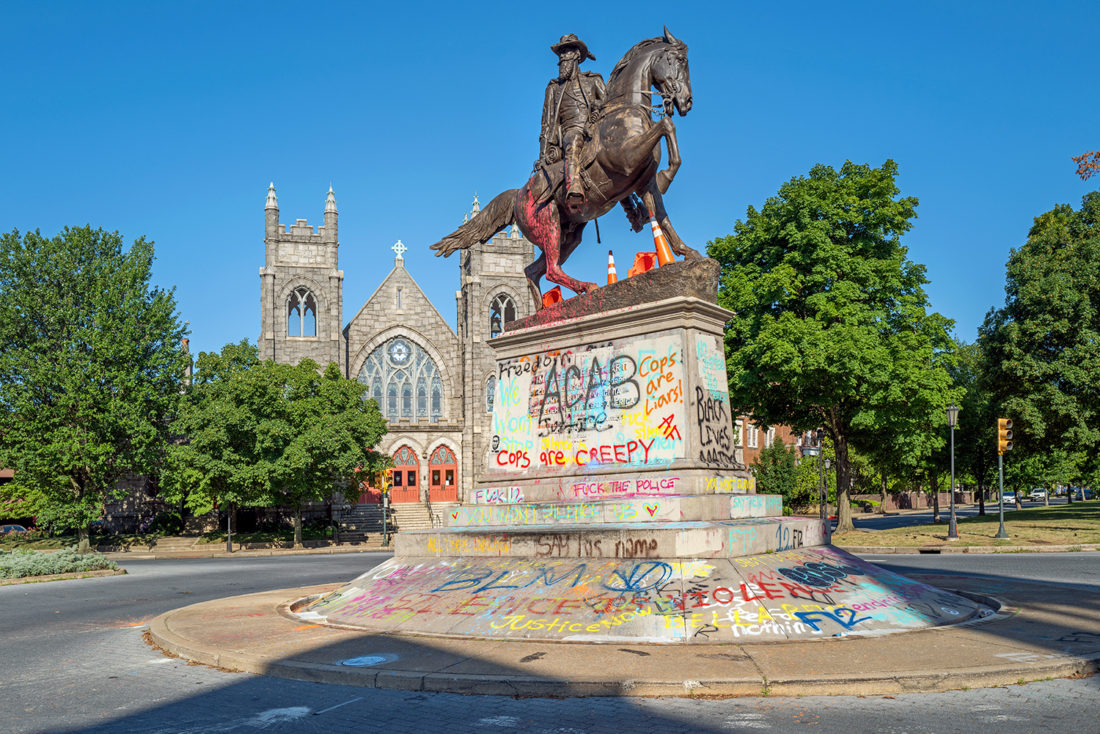
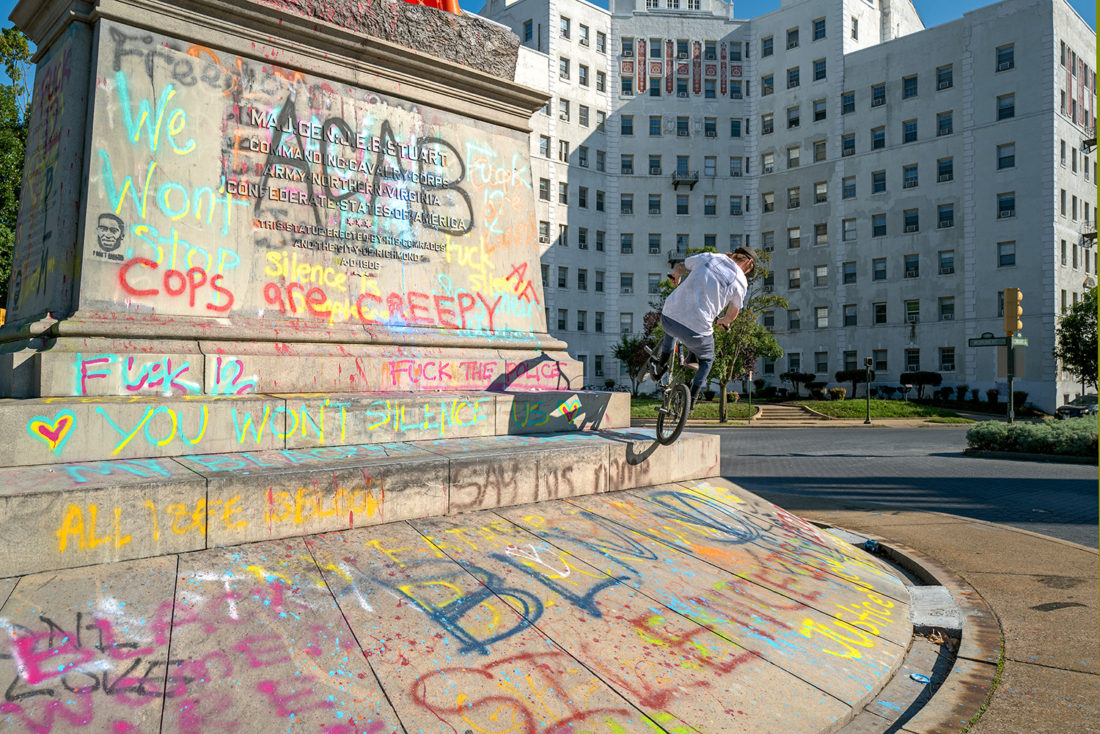
    While the focus was on the Robert E. Lee statue, all of the monuments were covered with graffiti. Skateboarders took advantage of the sloping base of the J.E.B. Stuart statue, and people walked up and down the boulevard, taking snapshots. Many of the houses along Monument Avenue had signs expressing support for Black Lives Matter.  I noticed that I was not the only serious photographer documenting the scene. TV cameras were set up next to the Robert E. Lee statue as well.

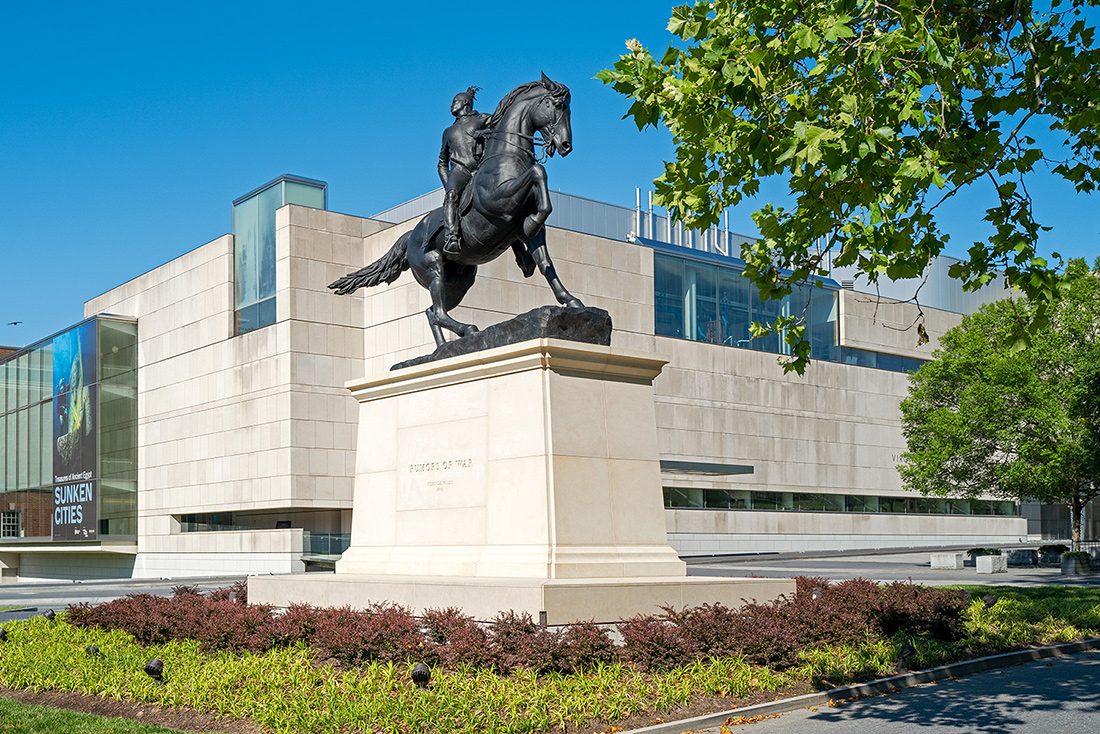
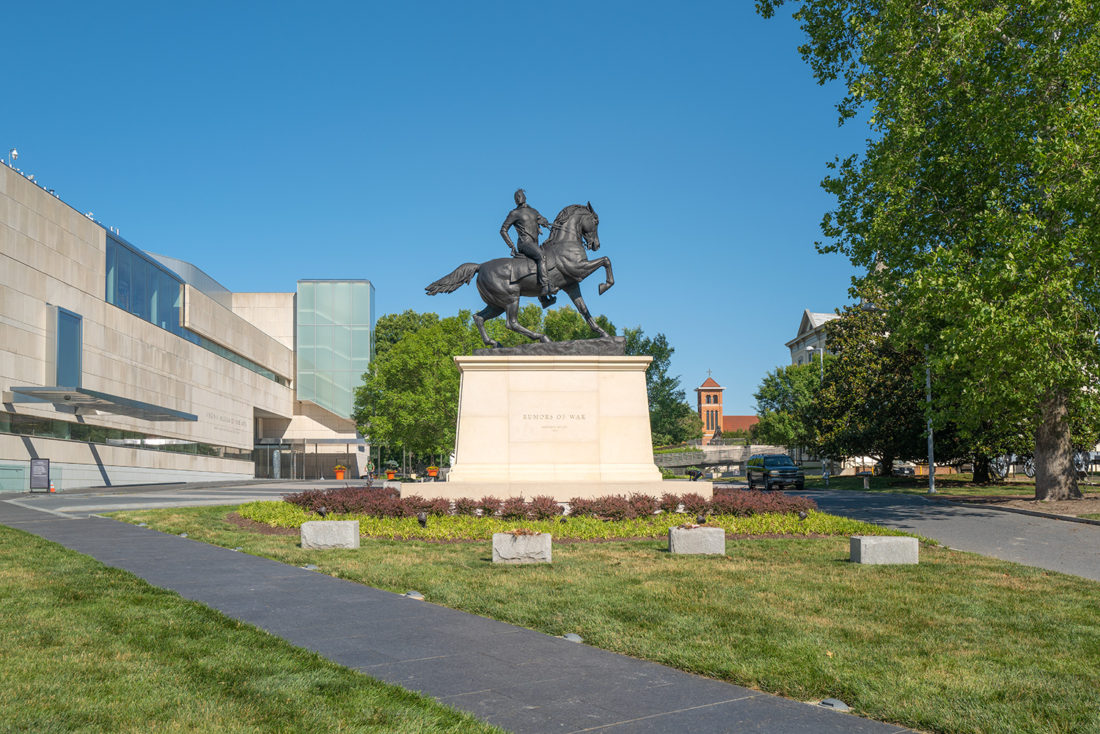
    Just off of Monument Avenue on Arthur Ashe Boulevard is a statue by the African American artist Kehinde Wiley. Wiley has been doing interesting work for years, but he became something close to a household name when he was commissioned by Barack Obama to do the official White House portrait. Many of his images, whether paintings or photographs, make use of historic, classical antecedents, often depicting contemporary Black men posing in a consciously stylized manner.

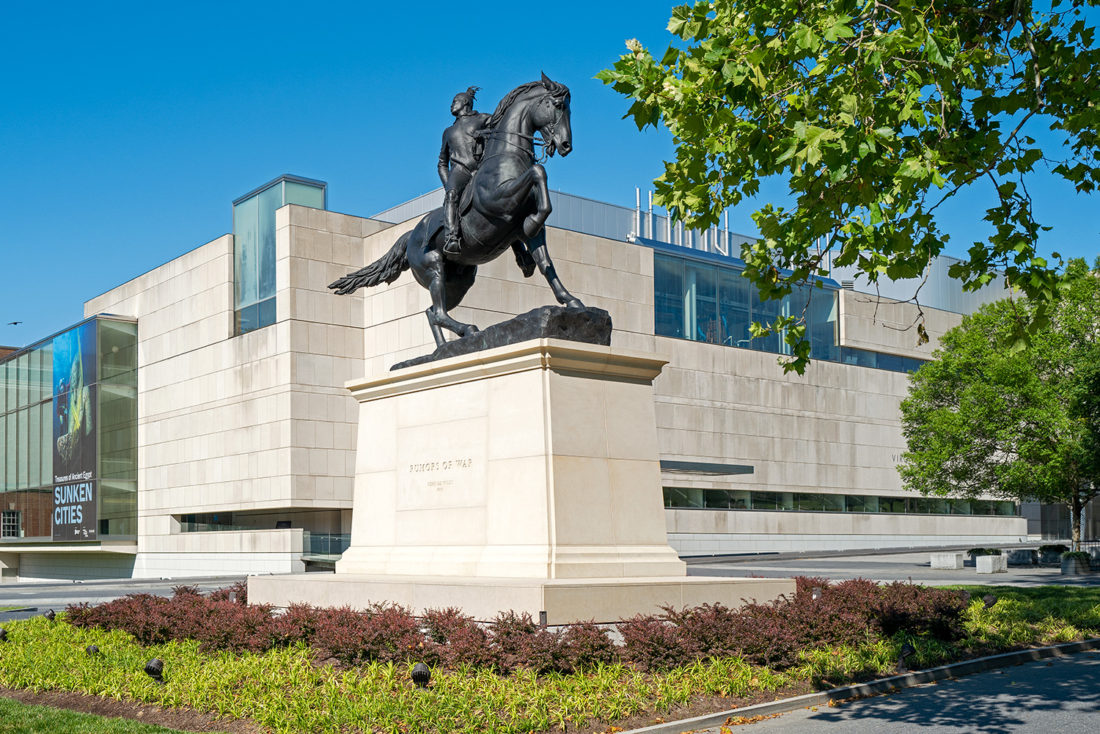
    In Richmond, Wiley has created an equestrian statue modeled after the J.E.B. Stuart figure on Monument Avenue. In this piece, however, the swashbuckling general has been replaced by a contemporary Black youth astride a rearing horse, posed as if in the throes of battle. Seeing the two together, albeit at opposite ends of Monument Avenue, makes for a powerful juxtaposition.

    As I worked on the Monument Avenue pictures I realized that this was a book I needed to make – quite different in concept from the Williamsburg book, which was more of an open-ended exploration of a landscape, but very much a part of the ongoing story of 2020. So, I ran another Kickstarter campaign, a little worried that following up so soon with a second campaign was not a good idea. But it went well, and I raised the money I needed to do Monument Avenue Richmond

    Trump madness continued through the summer into the fall, and unsurprisingly, Trump refused to accept the decisive results of the November election. His campaign in 2016 began with a regal glide down the escalator of Trump Tower on Fifth Avenue but ended (at least symbolically) ignominiously in the work yard of a landscaping company in Northeast Philadelphia.  While the 2020 votes were still being counted, the campaign announced on Twitter a press conference at the Four Seasons, which Trump assumed was the Four Seasons hotel in Center City Philadelphia. It was actually Four Seasons Total Landscaping. Why this location was chosen remains a mystery.

    The media raced to the site, and Rudy Giuliani began his press conference, amid gardening equipment,  only to be interrupted by the announcement that the networks had called the election for Joe Biden. Many of the reporters dashed off while others decided to visit the immediate area, which included a crematorium and a sex shop called Fantasy Island.

    I knew immediately that I needed to go to Philadelphia and photograph the landscape surrounding Four Seasons Total Landscaping. So, I rented a car, dragged my 22-year-old son along as bodyguard, and drove down, about 2 hours away from New York. The day was beautiful, the environment stunningly rich. At least rich to me. Wedged between Interstate 95 and the Amtrak tracks, it’s an area full of chop shops, small factories, warehouses, a scattering of houses, and a superfund site. Tall billboards punctuated the sky adjacent to I-95, and a Sunoco logo with an insistent arrow pointing down as if intentionally saying this is the place.

    I would love to do a book of these images – a one day wonder – that documents this strange urban landscape off the beaten track where, somehow, the Trump campaign ended up. But I’ve already done two self-published books this year. Maybe I’ll do a Blurb book for me.

    A few days after my impromptu trip to Philadelphia, I headed down to Richmond, Virginia. Since I was last there, the statues of J.E.B. Stuart, Stonewall Jackson, and Fontaine Maury have been removed from their pedestals, and the Jefferson Davis monument has been stripped of its commemorative plagues and the figure of Vindicatrix, representing the vindication of the Lost Cause, perched high on the central column, brought down. Robert E. Lee remains standing in legal limbo, and as result, continues to act as a magnet for political activities. Those behind the lawsuit to keep Lee on his pedestal are, unintentionally, maintaining the centrality of the transformed Lee statue as a symbol of Black Lives Matter and resistance to white supremacy.

    In the meantime, I am pleased to announce that I have signed a contract with Circa Press, the publisher of my book, Atlantic City, to bring out Monument Avenue Richmond next fall. The book will include the new photographs of the empty pedestals.

    It has been quite a year.

  • New York/2020 (part 1)

    2020 has been an extraordinary year, to say the least, and it is not over yet. Despite all the derangement and turpitude of Trump, and despite the Covid-19 pandemic with its toll of death and social isolation, it has been a productive time for me as an artist and photographer.

    This period of time actually begins for me in November of 2019 when I traveled to Berlin for the 30th anniversary of the opening of the Berlin Wall. The documentation of the former East/West border has been a lifelong project for me, and I have continued to follow developments in Berlin, particularly along the path of the Wall and the swath of no man’s land that once divided the city and surrounded its western half.

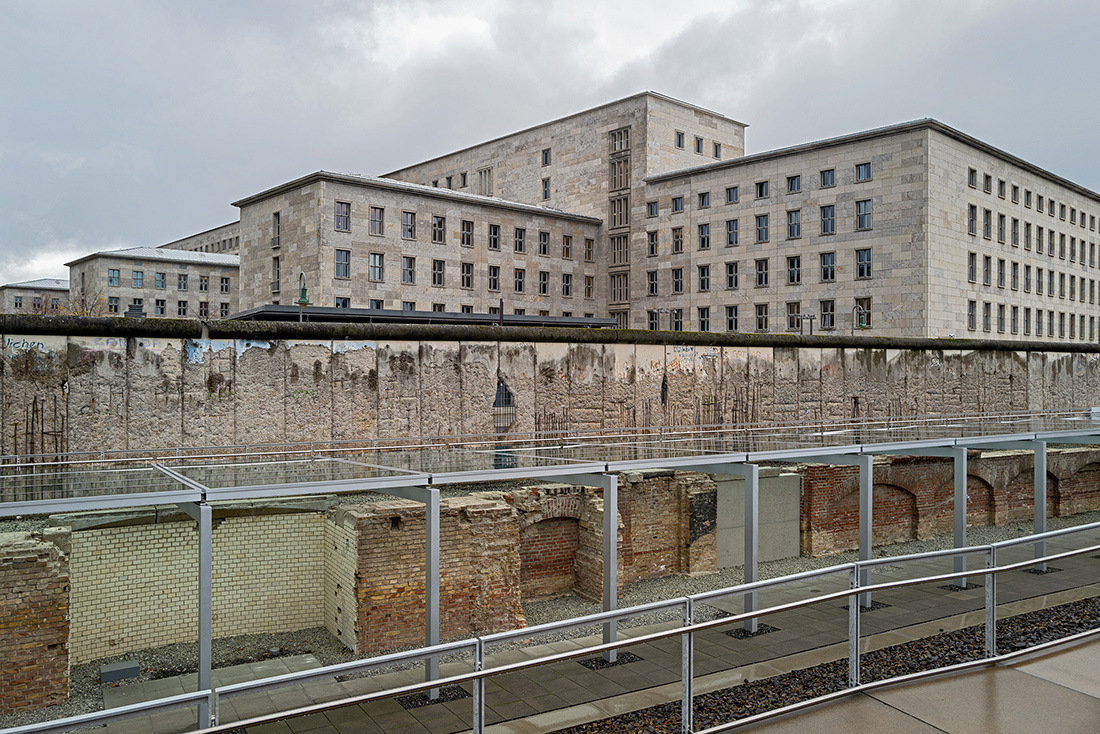
    Although most of the Berlin Wall was torn down within months of its opening on 9 November 1989, there were several stretches that remained, most notably adjacent to the Topography of Terror site with its below-grade view of the foundation walls of the SS/Gestapo headquarters. Looming just beyond the Wall is the former Nazi air ministry headquarters. It’s a visual compression of history that I have photographed several times over the years – this time, the exhibition panels mounted against the brick wall were temporarily down, which I think makes the image stronger.

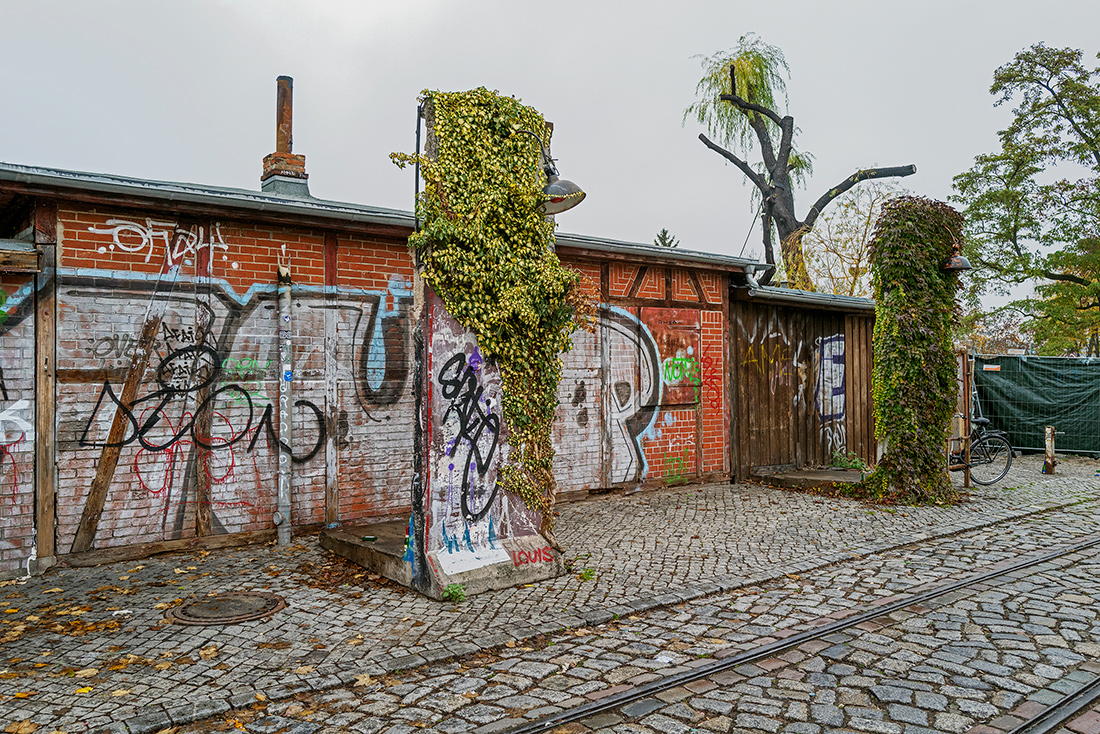
    There are individual slabs of Wall still standing scattered about the city. Some moved a slight distance from their original positions like the two ivy-covered pieces above.

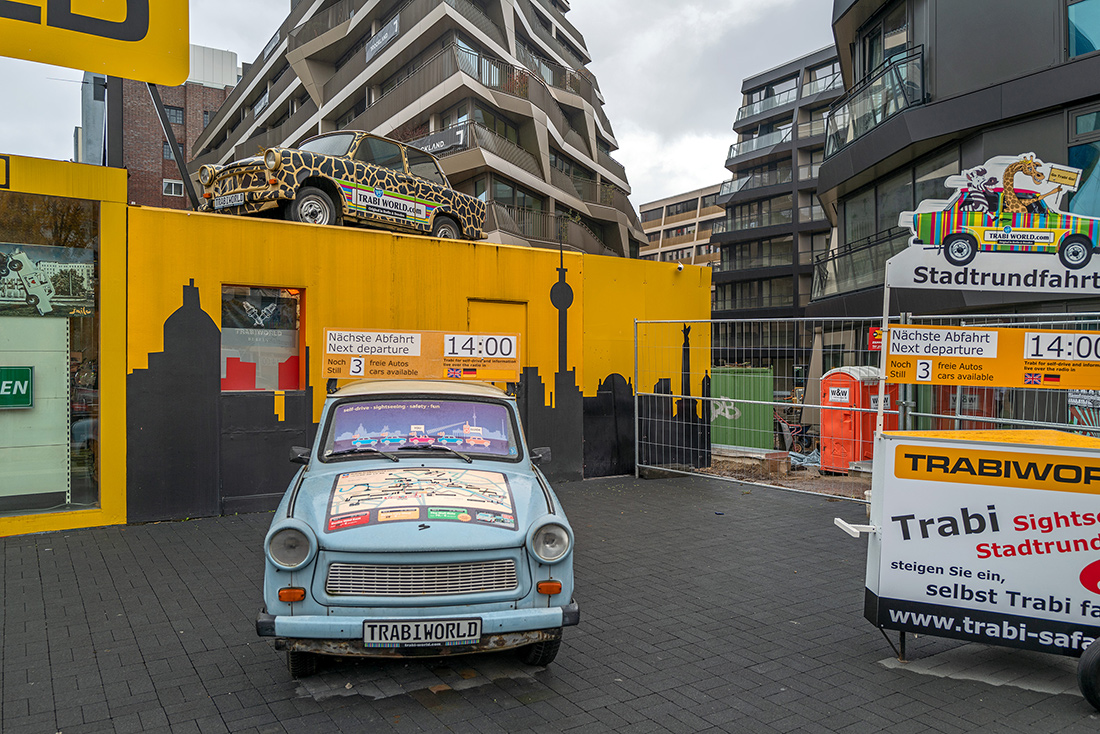
    Berlin has much gravitas as a city possessing the weight of history, but it has also surrendered to a baffling amount of kitsch. Artifacts of its communist DDR days, mostly fake, are plied by vendors, and you can ride in an original East German Trabant at Trabiworld just across the street from the Topography of Terror. I guess it’s possible for the silly and the serious to coexist peacefully, but the juxtaposition is jarring, nevertheless.

    Although I have already had some of this work published in “The Lost Border,” back in 2004, which includes pictures of the landscape of the Iron Curtain, there is another book here that focuses on Berlin alone. Very little of this work has been seen, and I hope to eventually do something with it.

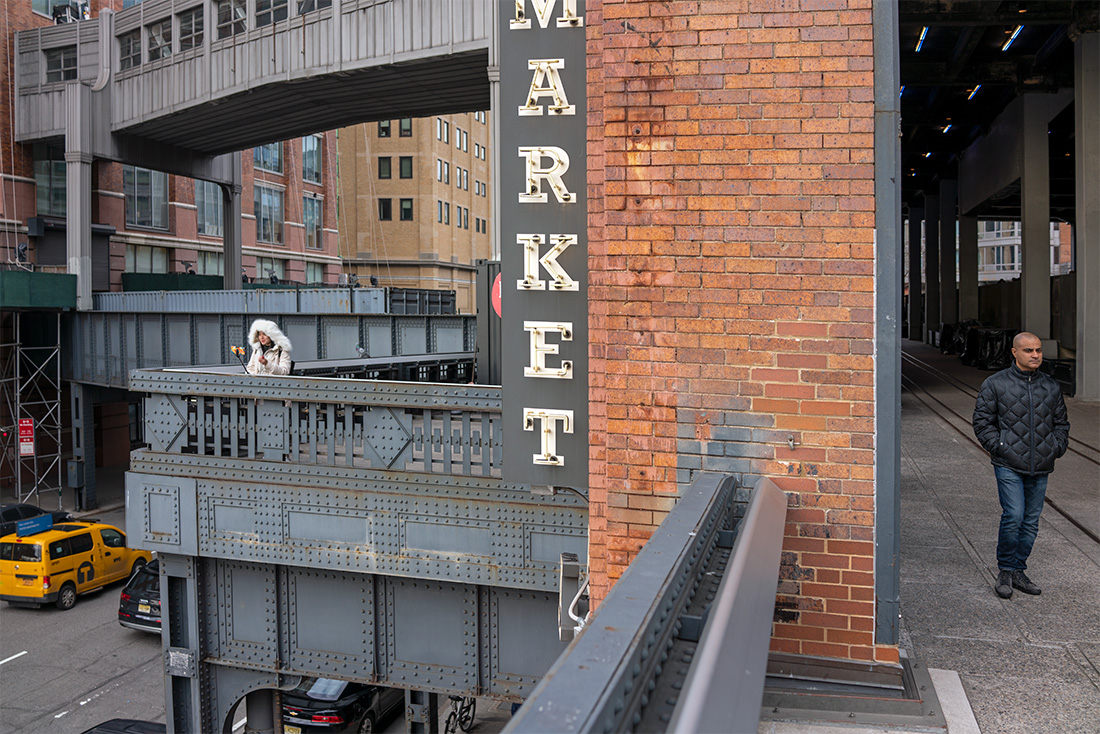
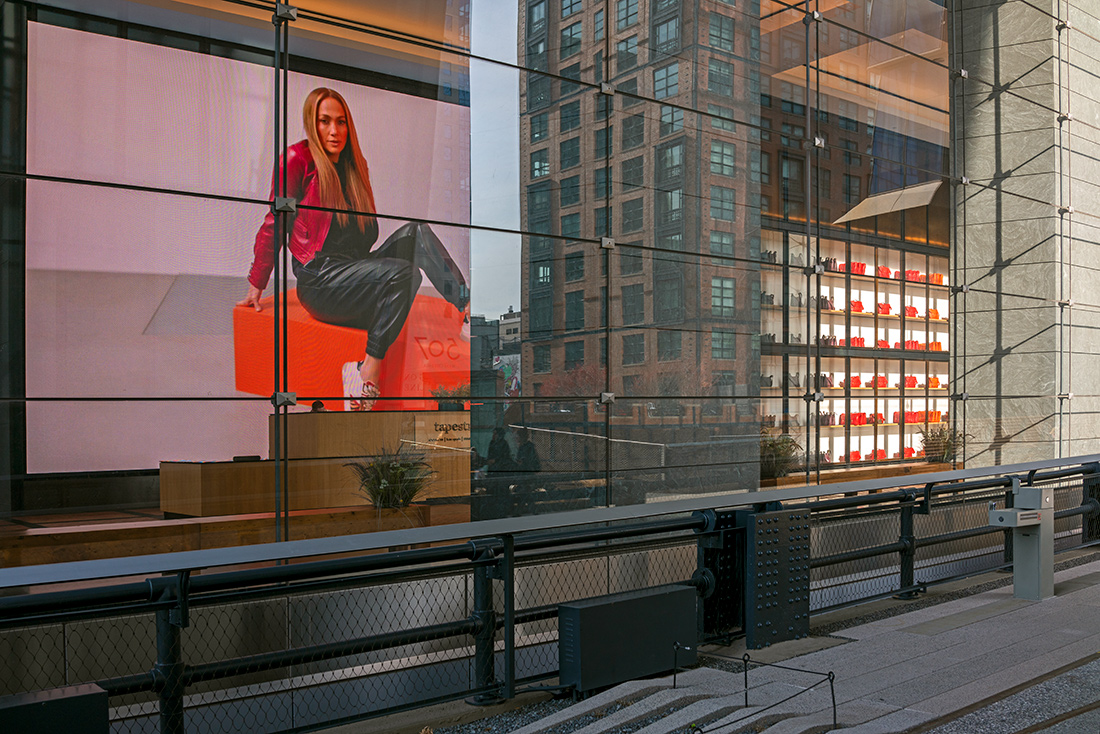
    During the winter months, I began adding to a body of work I’ve been gradually accumulating, of photographs of the High Line and the urban landscape surrounding it. I also have about 20 or 30 photographs of the area taken in 1985. The new pictures are not so much about the former rail viaduct itself, which was brilliantly reinterpreted by architects Diller Scofideo & Renfro, but about the way in which the elevated structure cuts through the fabric of the city, redefining space and architectural relationships. The High Line has, of course, also become a tourist attraction, and its presence has spurred development and gentrification, ironically, given the fact that real estate interests were originally against it. The story of the High Line is complex, but as a dynamic intervention in the urban landscape, it is fascinating and a visually rich subject.

    I was just getting some momentum going on my HIgh Line project when the coronavirus pandemic hit. I remember sitting in a cafe with a friend showing him 8×10 work prints of my pictures realizing that this might be the last time we’d be able to do something like this for a while. He was planning on leaving town, and I was unsure what to expect going forward.

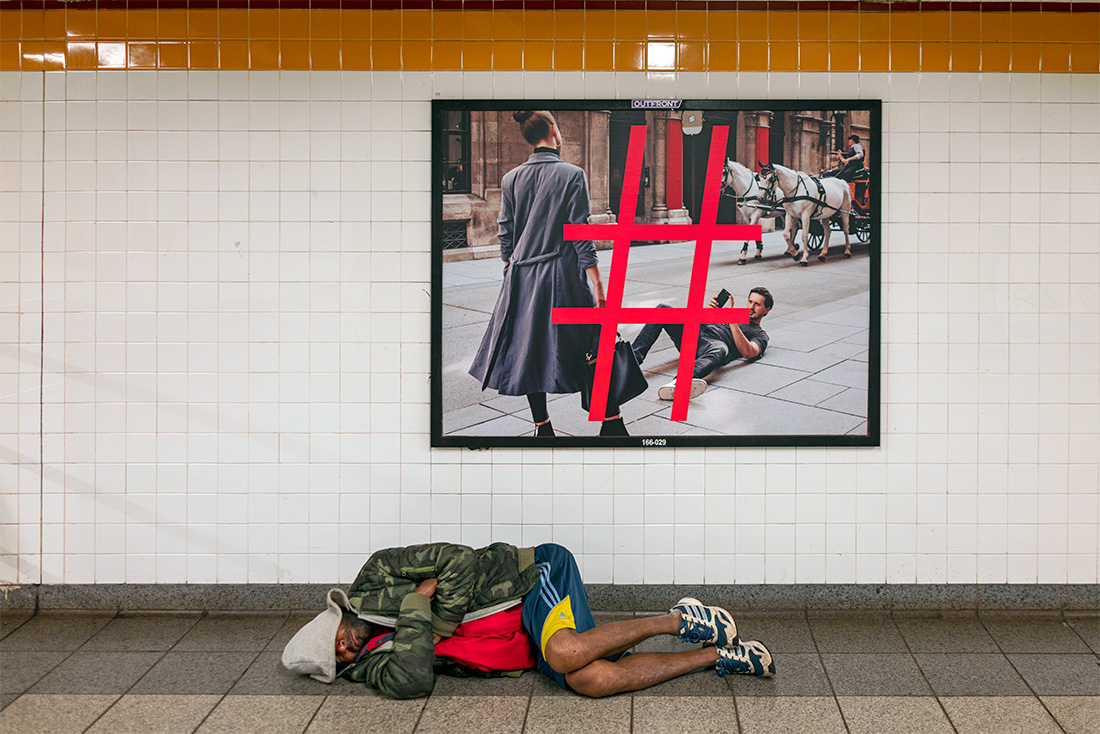
    One of the last pictures I took during the winter before the Covid lockdown began was an image of a homeless man in the subway station at 8th Avenue and 14th Street. As a general rule, I do not seek out people in distress to photograph. Nor do I photograph people who are completely unaware of my presence. It’s not a hard and fast rule, exactly, but a self-enforced guideline I follow.

    In this case, I walked by, noting the man out the corner of my eye, but within a split second came to a quick stop and circled back. I’m not sure how much of the details of this image I was able to process in the moment, but I knew there was something here besides a homeless man lying on the floor. The prostrate man was echoed by a man lying on the ground in the advertisement above. There was a hashtag, or number sign, in red floating over the image, which echoed the red worn by the homeless man. The grid of the hashtag echoed the grid of the sidewalk, the tiles of the subway station, and the tiles of the floor. The prosperous appearance of the men in the ad accentuated the difference seen in the man attempting to sleep on the floor of the subway. While two horses pulling a carriage approached from the right of the advertisement. It’s an enigmatic image – a little disturbing, perhaps.

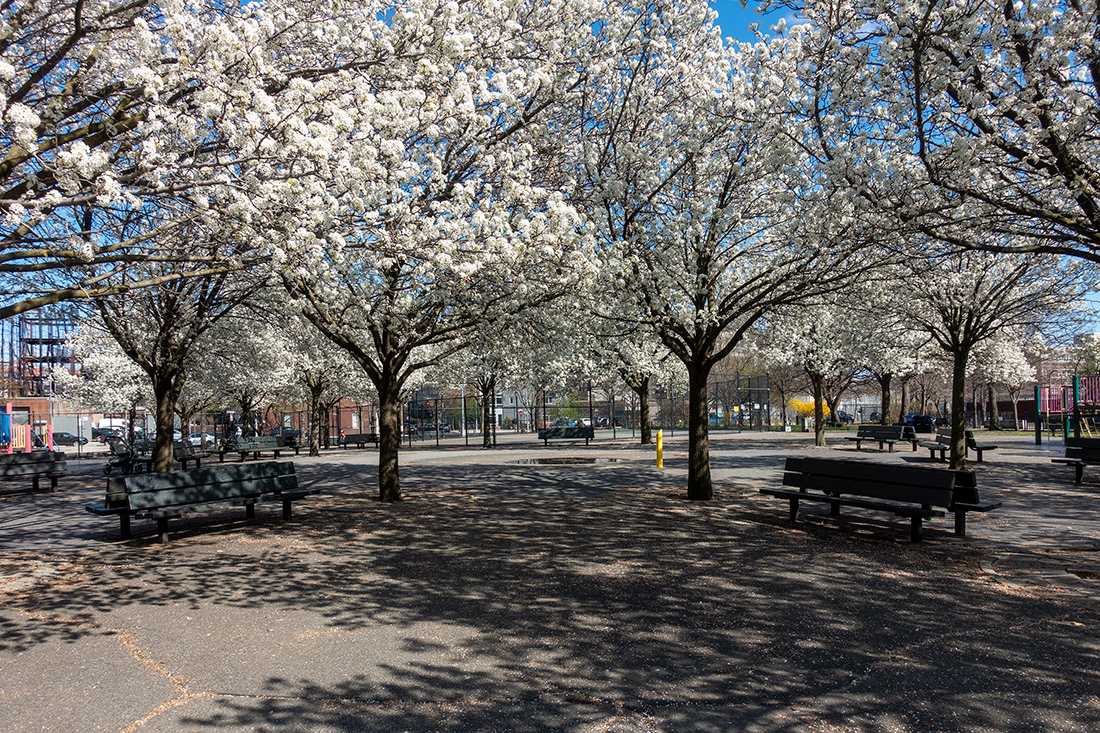
    In March the pandemic swept over the city. Most businesses and restaurants were forced to close, takeout and groceries excepted, schools closed, and what would normally be a time of release with people pouring into the parks as the weather warmed up, was, instead, a period of frozen suspended animation. The photograph above was taken during the first days of the lockdown. Trees flowering, empty streets and parks. Like nothing I’d ever seen in all my years in the city.

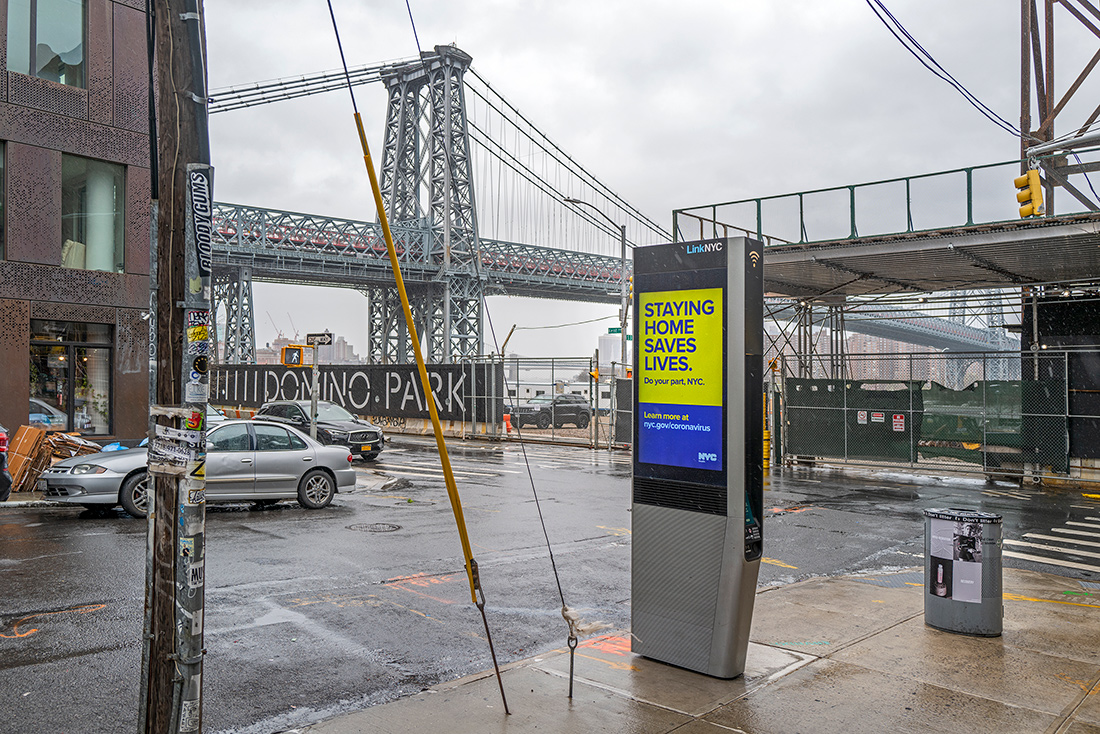
    At the height of the lockdown it was still possible to take walks, and I began going out with my camera regularly. What started out as a casual bit of picture taking morphed into a full-blown project. I ended up making 16 walks through our neighborhood of Williamsburg, Brooklyn from about March 20th to April 20th. I realized while doing the project, that no one had really photographed Williamsburg, as famous a place as it is, in a comprehensive way.

    What I found on the streets of Williamsburg was a city more diverse and idiosyncratic than I expected. The gentrification of the neighborhood was obvious, especially closest to Manhattan. But the photographs also show a place bedraggled and graffiti-covered, multi-ethnic, and often poor. There are distinct quarters: the orthodox Jewish enclave to the south where maskless crowds continued to congregate, and the adjacent Latino tenements and low-income projects. The streets around the massive Woodhull Medical Center on Broadway were littered with people who obviously had nowhere to go, also maskless. I often walked in the street to avoid this flotsam of downtrodden human beings. Ambulances passed frequently, sirens piercing the pandemic quiet.

    At some point, I realized that this body of work was developing into something more deeply resonant than a simple documentation of a well-known place. I made a couple of attempts to find a publisher but quickly realized that I would have to do this on my own. I put together a Kickstarter campaign and raised the money I needed to print the book and get it out. The book is called “Williamsburg: In Time of Plague.”

    To be continued…

  • Philadelphia/Four Seasons Landscaping


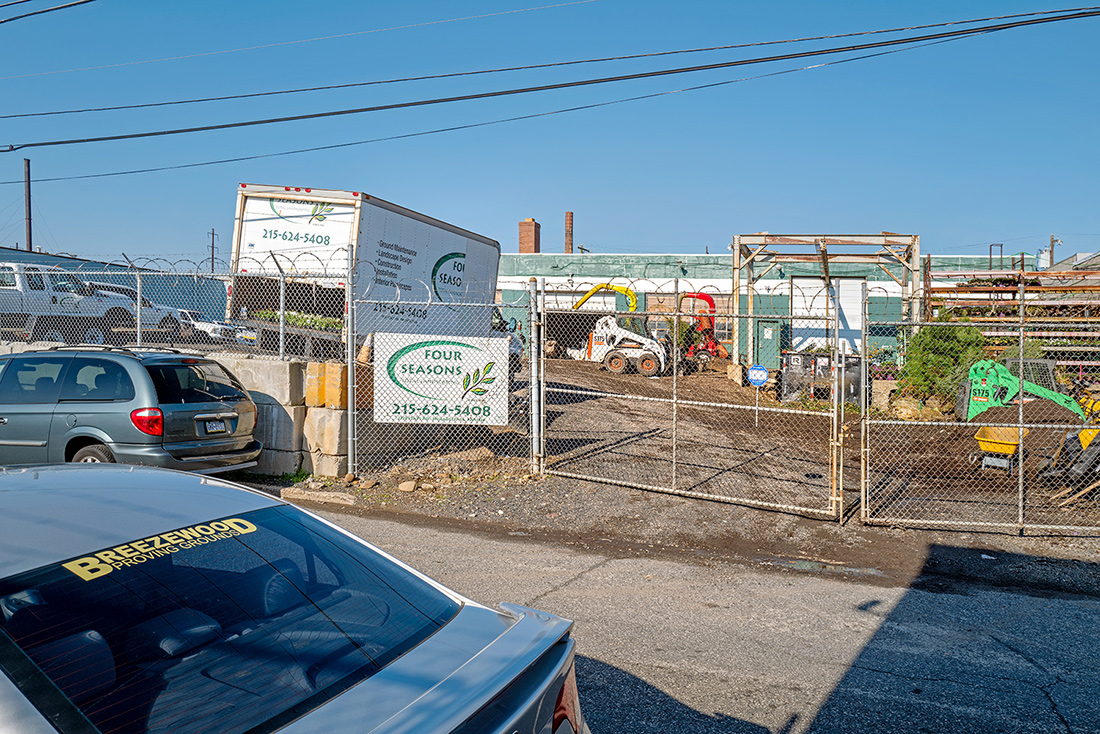
    Four Seasons Total Landscaping, Philadelphia, Pennsylvania – © Brian Rose

    Trump’s campaign began with the candidate regally gliding down an escalator in his eponymously named tower on Fifth Avenue in New York, and his bid for re-election ended, so to speak, with a bizarre Rudy Giuliani press conference at Four Seasons Total Landscaping in northeast Philadelphia. The reason for the venue still not fully understood.

    When I saw images of the locale and its immediate neighborhood with a sex shop and crematorium, I knew that this was a job for me – to explore this urban wilderness wedged between I-95 and the Amtrak mainline. Here begins a series of photographs of a richly forlorn place, the final resting place of a failed presidency.


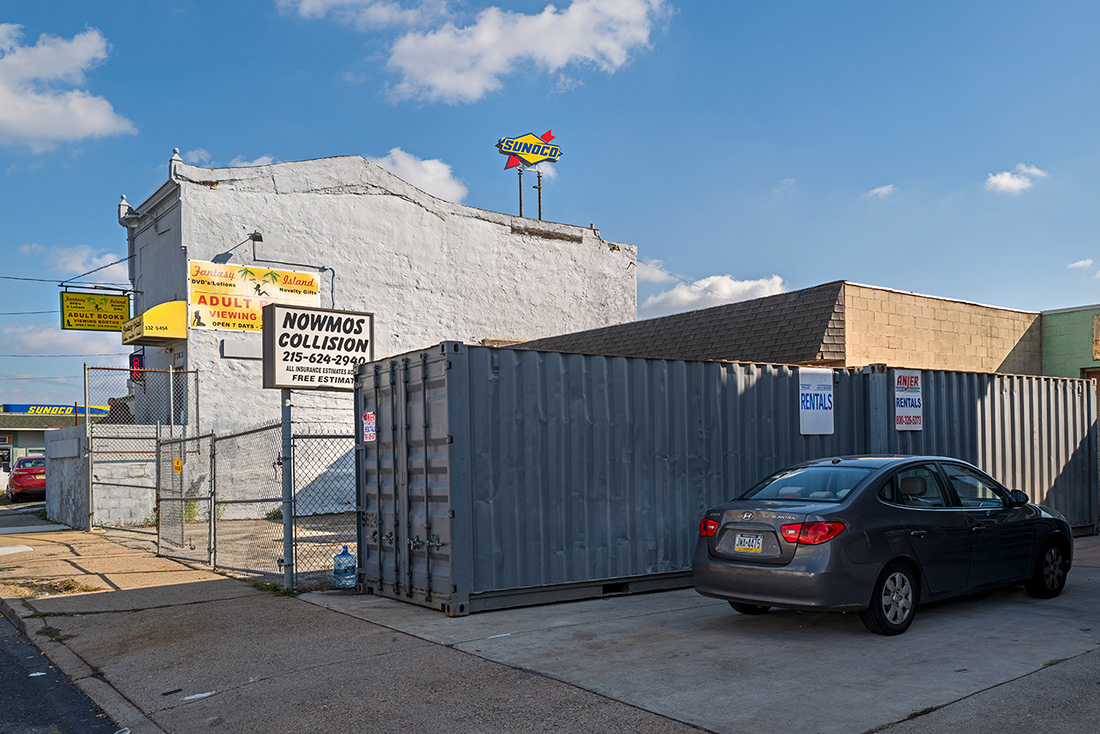
    Fantasy Island, Philadelphia, Pennsylvania – © Brian Rose


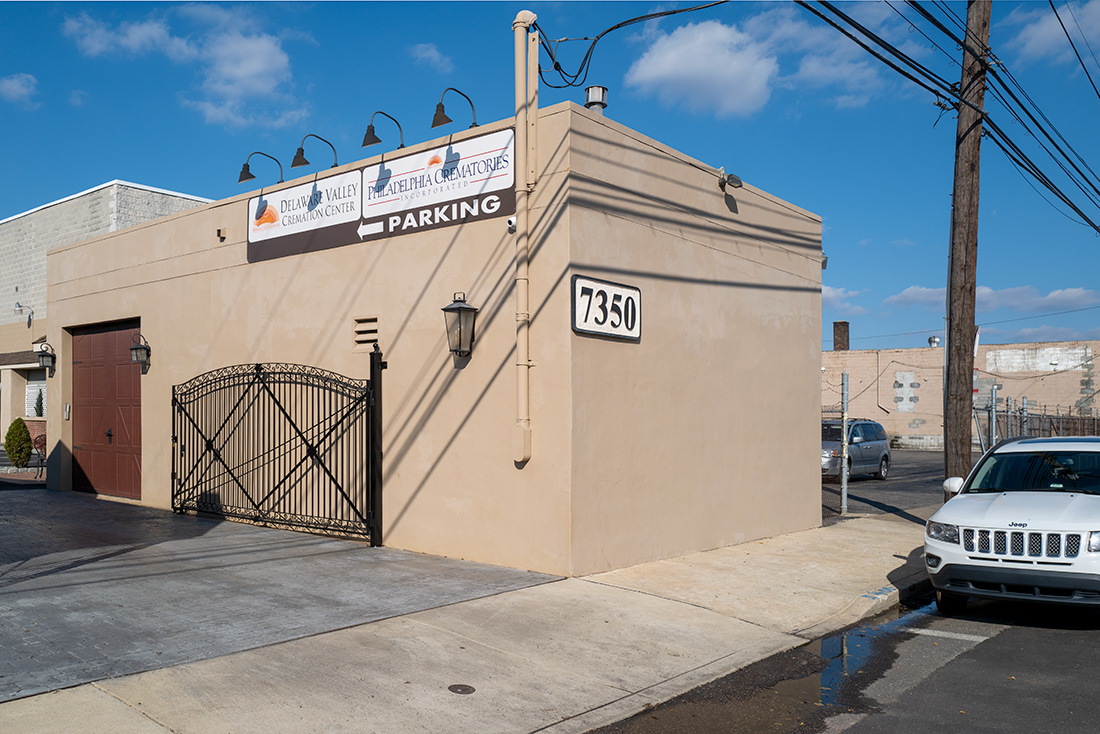
    Delaware Valley Cremation Center, Philadelphia, Pennsylvania – © Brian Rose

    Justin Davidson’s wrote in Curbed: “The end of an administration marked by episodes of sordid sex, wishful thinking, and mass death took place next door to a dildo-and-porn store named Fantasy Island and across the street from a crematorium. If you were hunting for such a symbolically rich stage, how would you even Google it?

    The photos that emerged from the event had the tawdriness of America’s worst cityscapes and the richness of an allegorical painting.”


    Fantasy Island, Philadelphia, Pennsylvania – © Brian Rose

    On Saturday, a steady trickle of gawkers stopped by on State Road for snapshots and selfies in front of  Four Seasons Total Landscaping and Fantasy Island. We noticed a few people in running gear, and one stopped to tell us that he was taking part in the “Fraud Street Run,” a pun on Broad Street Run, an annual event in Philadelphia. This one followed a course along the Delaware River from Four Seasons Landscaping to the Four Seasons hotel in Center City. Event organizer, Jeff Lyons said, “What Guiliani did was so crazy and hard to grasp, and with Trump bad-mouthing Philly, I thought it would be fun to turn it into something positive for Philly and raise some money for a good cause,”
    We have clearly reached peak madness as the Trump reign of error disintegrates into a screwball comedy on the streets of Philadelphia.


    Philadelphia, Pennsylvania – © Brian Rose

    It was a brilliant fall day, crisp and comfortably cool. I didn’t cover the 11 miles of the Fraud Street run, but I did manage 4 or 5 miles around this weird corner of the city, the kind of place that exists only in America. It is a place that is at once richly evocative, colorful, and yet at the same time, a blown-out dead-end landscape, There are gas stations, body shops, an automobile auction, an archery center, baseball batting cages, a mattress outlet, a check casher, a chemical plant, metal recyclers, storefront churches, a smattering of clapboard houses, an abandoned Catholic orphanage, a superfund site, a marble stone cutter, and, of course, a sex shop, crematorium, and landscaper. It is not, generally, an area suited for pedestrians. It’s even a little dangerous.

  • New York/Monument Avenue Richmond

    A very nice write-up about Monument Avenue Richmond in Architects + Artisans.

    But they’re all symbols of a mindset that’s no longer credible. “The statues were erected after the Civil War, in a period of denial,” he says. “It certainly felt like this was a historic moment and needed to be documented.

    ”Rose had been in Berlin in 1989 when the wall there came down, and photographed it. Richmond, he thought, was on the cusp of the same kind of change. “There was a short moment when they took down the wall, before it moved into another period,” he says. “And this was similar.”

    It feels like we’ve crossed a threshold to another era, but I worry that this moment will be as fleeting as that one. The opening of the Berlin Wall, and what it represented – the breaking down of political and cultural barriers – was obliterated a decade later in the fire and dust of the World Trade Center in New York – another threshold to a new, darker, chapter in history.


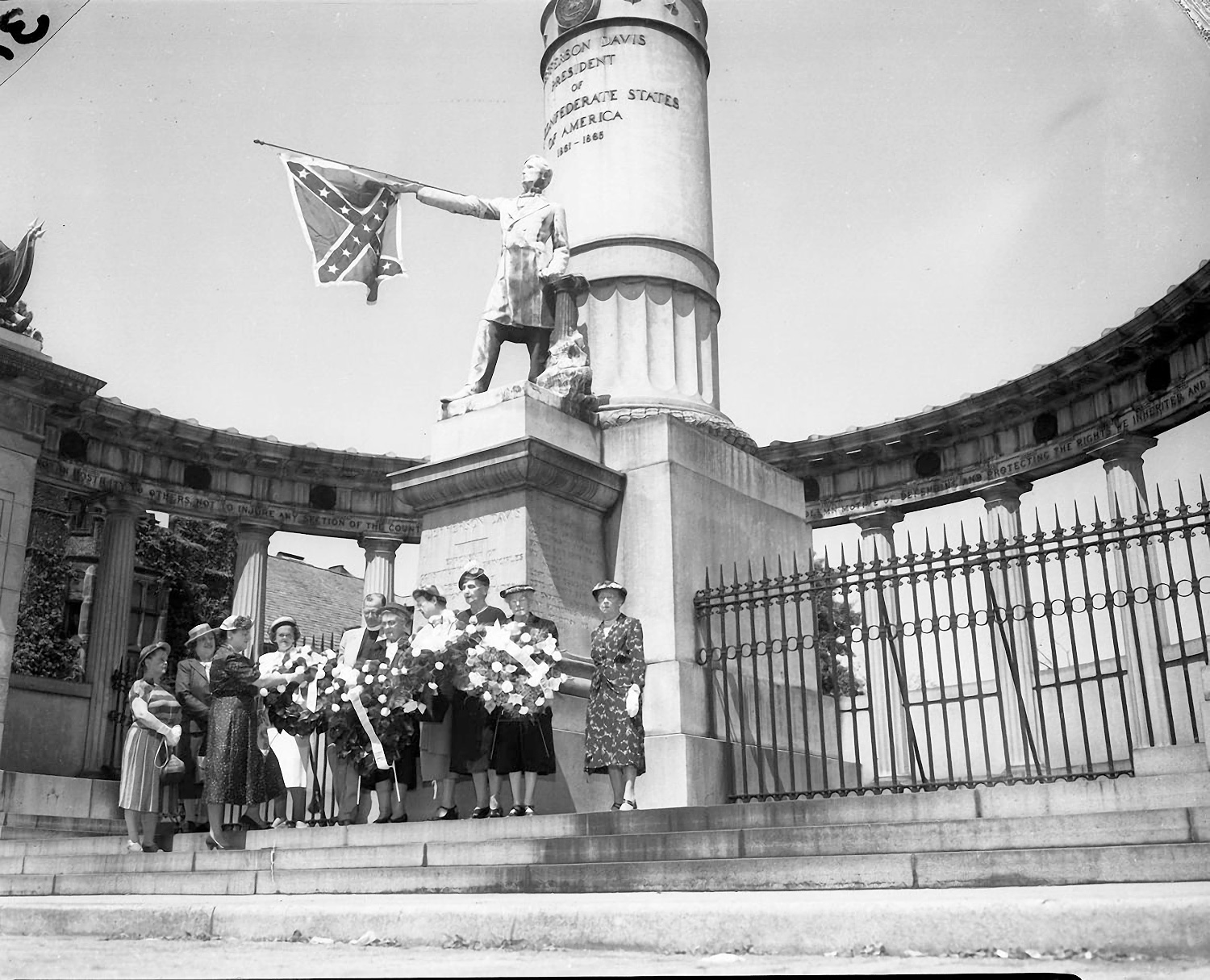
    Jefferson Davis monument with members of the Daughters of the Confederacy

    The Black Lives Matter movement and the removal of symbols of hatred and oppression – and necessarily the removal of Donald Trump – could signal a move forward to greater awareness of ongoing intolerance and injustice, and toward a more diverse, more inclusive society. Undoubtedly, the struggle will continue.
    Their Lost Cause myths now exploded, their monuments’ time, too, has come and gone, though Rose is ambivalent on that subject. “I’m sympathetic to the desire to remove these things, but I’d almost like to see these symbols of evil remain in the center of Richmond, because removing them doesn’t remove the root cause,” he says.

    The most powerful memorials to injustice disturb the status quo. They don’t aestheticize evil by abstracting it or normalizing it. We need reminders of our capacity to do harm manifest, visible, in the public square, not just entombed in museums. Richmond now has an opportunity to reconsider its past, and its role in the present, as former capital of the Confederacy, capital of Virginia, and, perhaps, emerging symbol of civic rebirth.


    Rumor of War by Kehinde Wiley – © Brian Rose

  • New York/Monument Avenue Richmond

    When I made the trip down to Richmond at the beginning of July to photograph the last days of the Confederate statues on Monument Avenue, I had mixed feelings about their impending removal. I was, to some extent, under the mistaken impression that these pompous generals on horseback were merely cartoonish caricatures from the past that no longer had much power to offend. But almost immediately after the police killing of George Floyd in Minneapolis, protests in Richmond focused on Monument Avenue’s statues, and these totems of the Lost Cause became charged, if they weren’t already, with significance and symbolism.


    Robert E. Lee statue, Monument Avenue, Richmond – © Brian Rose

    Preorder Monument Avenue Richmond on Kickstarter

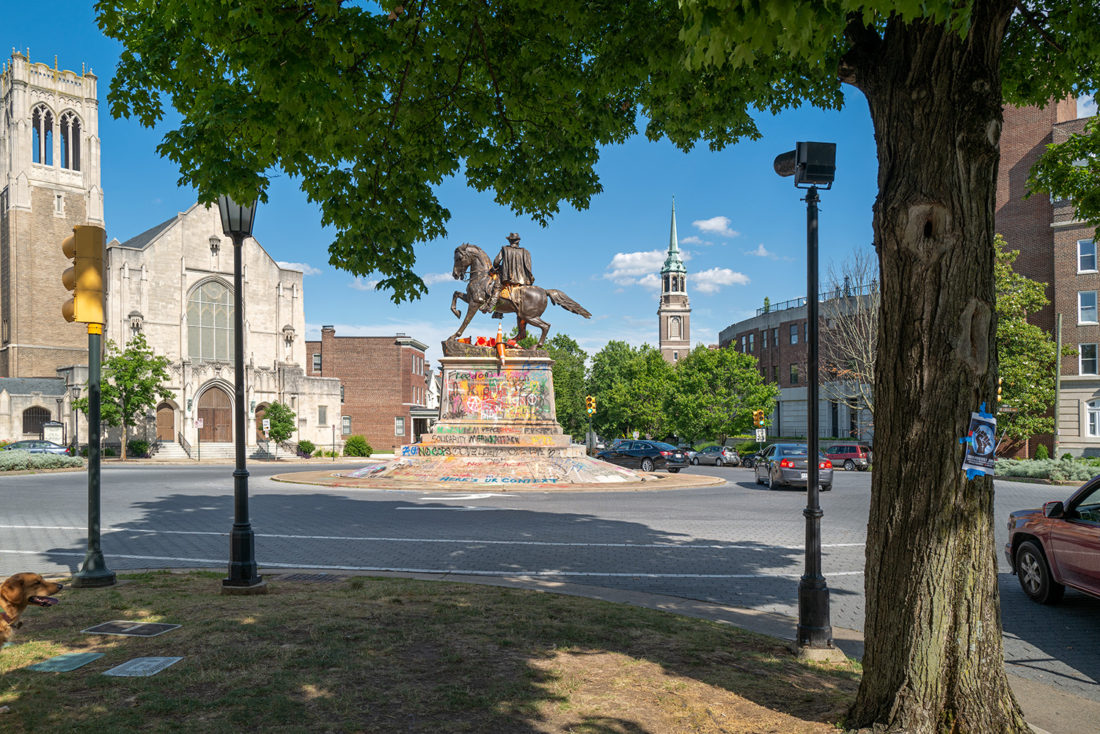
    The scene around the Robert E. Lee statue, which stood in a large circular traffic island, was festive, its pedestal covered in graffiti, dozens of people talking with one another, making signs, manning information tables, I even saw dancers perform. Although there had been some pretty ugly confrontations with the police earlier, law enforcement was nowhere in sight while I was there. One of the national TV news networks had set up on the traffic circle with their camera, lights and folding chairs. Down the street, another TV reporter was broadcasting live from the J.E.B. Stuart statue.


    Robert E. Lee statue, Monument Avenue, Richmond – © Brian Rose

    Once again I found myself photographing something that would soon cease to exist. As of this writing, all the Confederate statues have all been removed except for Lee who remains astride his horse Traveller, maintaining, so it seems, his dignity atop a plinth splashed with Day-Glo color and emblazoned with slogans and epithets. Such is the extent of the mythology around Lee that we remember his horse’s name 155 years since the end of the Civil War.


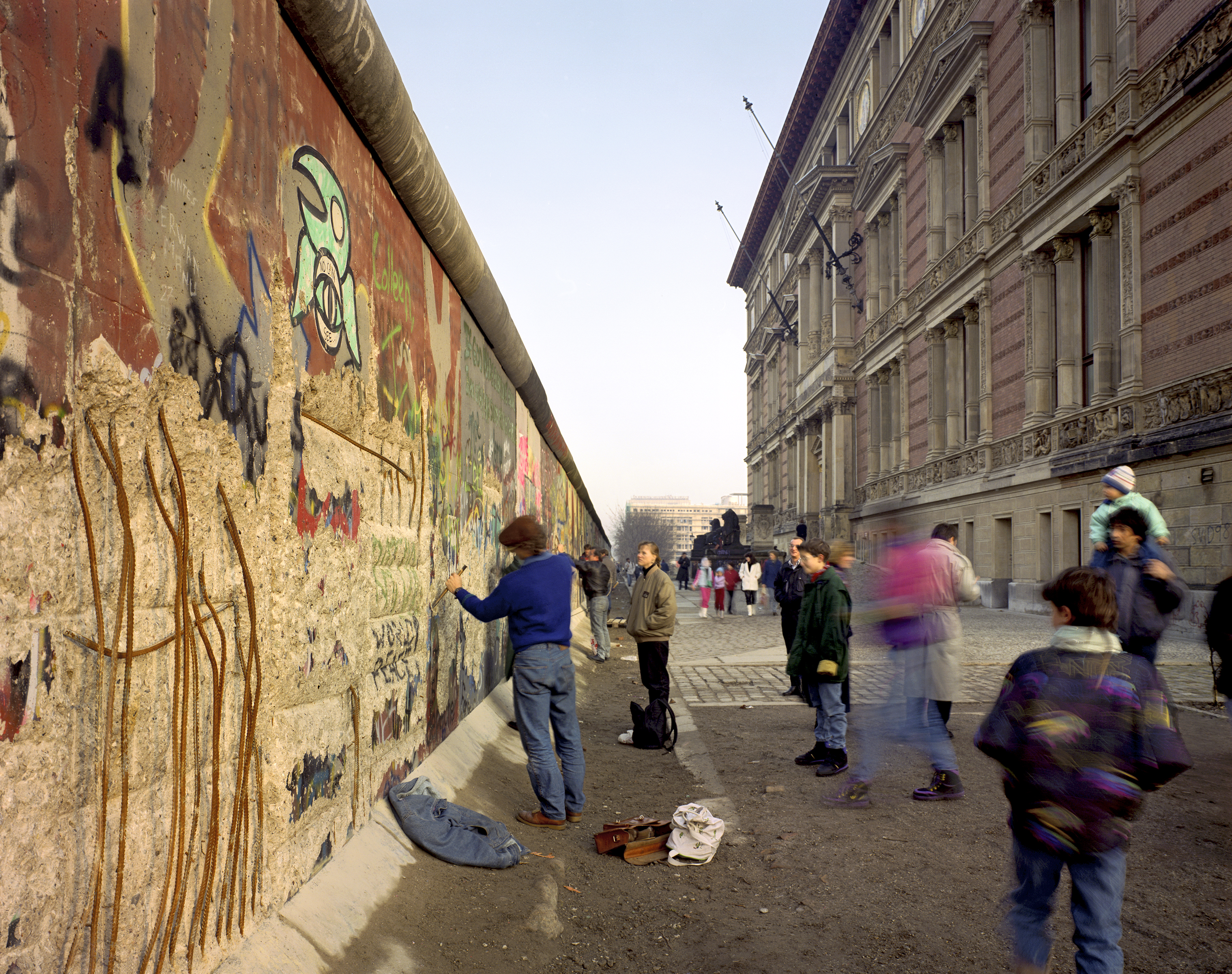
    The Berlin Wall, 1989 – © Brian Rose

    Preorder Monument Avenue Richmond on Kickstarter

    The Confederate monuments in Richmond had been appropriated, taken possession of by the public – or at least a significant portion of the pubic – as interactive objets d’art. The performative aspect of it reminded me of the scene along the Berlin Wall in the weeks after its opening in 1989. That potent symbol of oppression had been transformed by crowds of people, Berliners and foreigners alike, chipping at the Wall, posing with East German guards who in the blink of an eye were no longer a menacing presence. As in Berlin, this transitory period of grace was short-lived. The once-powerful generals, emasculated, embarrased, in their spray-painted finery were unceremoniously carted away leaving behind abandoned plinths. The next chapter of the story remains to be written.

    Preorder Monument Avenue Richmond on Kickstarter

  • New York/Richmond, Virginia

    “Monument Avenue Richmond,” a follow-up to “In Time of Plague,” will be available soon for presales on Kickstarter. The two books share the same design elements and comprise a kind of diptych that frames the Covid-19 pandemic and the Black Lives Matter protests that overlapped each other in the spring and summer of 2020.

    This video takes the viewer from the empty streets of Williamsburg, Brooklyn to the final days of the Confederate statues in Richmond.

  • New York/Paul Fusco

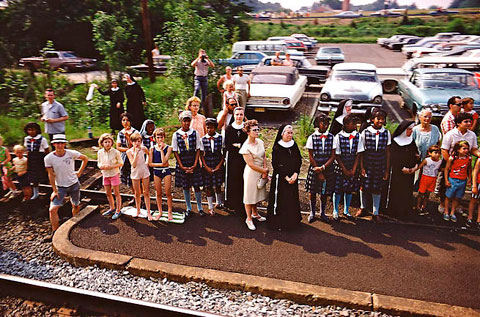
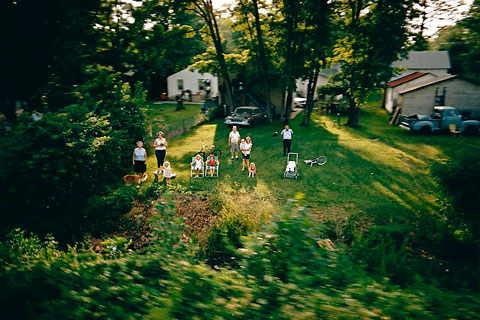
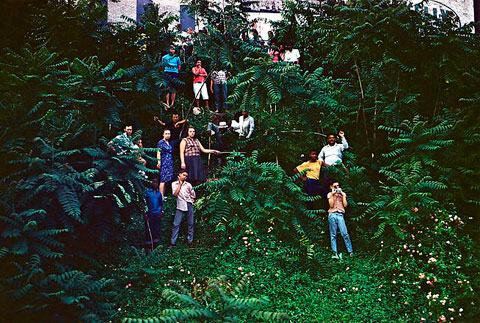
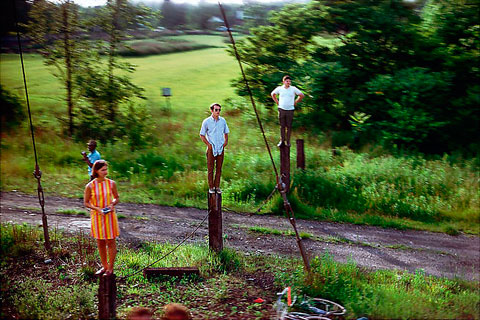
    Just heard that the photographer Paul Fusco passed away. Back in 2008, I posted the following essay about his photographs made while traveling on the Robert Kennedy funeral train. It is a powerful series of images that have always resonated deeply with me.

    Paul Fusco, RFK funeral train, 1968

    I was 14 years old in 1968, undoubtedly the most tumultuous year since World War II–at least in the western world. Although I was too young to be seriously engaged in what was going on, I was acutely aware of the epic events occurring–Vietnam, civil rights, the assassinations of Martin Luther King, Jr. and Robert F. Kennedy, and the violent end to Prague Spring in Czechoslovakia.

    Two exhibits I visited recently in New York touch on events of 1968: Paul Fusco at Danziger Projects (show closed October 4) and Josef Koudelka at Aperture. Fusco photographed Robert Kennedy’s viewers of the funeral train as it made its way from New York to Washington, D.C.

    I remember well watching the railroad cortege on television as it passed the thousands of people who lined the tracks. I also have a distinct memory of a brief bit of video shown once, in which a train coming from the opposite direction mowed down a number of people standing on the tracks adjacent to the funeral train.


    Paul Fusco, RFK funeral train, 1968

    When I first saw the Fusco pictures, I was immediately swept back to the sorrow and apprehension of that time, to the fear and uncertainty that I have never been able to shake, a fear that rises to the surface today as a black man carrying the hope embodied in the Kennedy brothers nears the presidency, as earthshaking economic events rumble around us.

    Fusco’s photographs were very simply made. On assignment from Look magazine, he rode the funeral train and did what he could from a fixed vantage point. He aimed his camera at the crowds and small knots of people standing at relaxed attention, some waving, some saluting, troubled, saddened faces, staring, transfixed, as the rail coaches slid by.


    Paul Fusco, RFK funeral train, 1968

    Fusco made his photos on 35mm Kodachrome, a vibrant slide film that stands up well over time unlike early color negative film, which tends to shift color and fade. As a result, these images from 40 years ago seem fresh and immediate, which makes them emotionally all the more jarring. The people depicted came “as-they-were” in a colorful array of flowered prints and decidedly unfunereal stripes and plaids. It was June and people came in shorts, bathing suits, sandals and bare feet. And although it was 1968, one sees scant evidence of the psychedelic trappings that so dominate our collective memory of the era.

    The train passed through rural areas, small cities like Trenton, and big ones like Philadelphia and Baltimore where the faces are mostly black, people standing in scruffy backyards and vacant areas along the tracks. Some of these neighborhoods were in the midst of violent upheaval as racial frustrations boiled over after the murder of Martin Luther King. Fusco’s pictures, while freezing the momentary unity of grief, also reveal the racially segregated nature of a society coming apart at the seams.


    Paul Fusco, RFK funeral train, 1968

    Because the train remained in motion, most of Fusco’s photographs were necessarily made on the fly. They are fleeting glimpses, poignant, abbreviated moments of individual solitude among crowds. Fusco focused on the motionless people, rotating his head and camera slightly to stay fixed on his subjects, as the train moved horizontally. The blurring of the surrounding landscape further isolates the figures and creates a model-like hyper-reality, akin to recent narrow focus imagery created in Photoshop.

    The images have a posed quality as well, due to the fact that people had staked out viewing positions, sometimes awkwardly balancing on steep embankments or even standing on elevated objects. As the train went by they looked intently at the coaches and often their eyes met the gaze of the photographer. In Fusco’s photographs this relationship creates a strange and compelling phenomenon–they seem to look at us as we look at them. Do we recognize ourselves?

    ***

    Paul Fusco’s photographs have been collected in a handsome book, RFK, published by Aperture. It tries to be both a tribute to Bobby Kennedy and an art photo book, which I think is a little forced. The book starts with pictures not taken from the train of the memorial service held in St. Patrick’s Cathedral and ends with the funeral in Washington. I would be happier without these bookends.


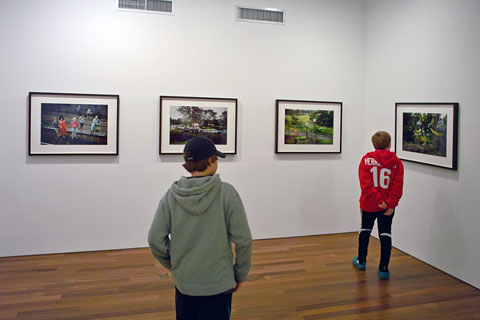
    Paul Fusco at Danziger Projects • Brendan, my son, at left (digital)

    The images as printed in the book, however, are nicer than the gallery prints, which are somewhat harsh and over saturated. The slightly more muted tones in the book seem more natural to me. Kodachrome is a punchy color material, but I don’t think prints have to mimic the straight slide film.

  • Richmond/Monument Avenue

    Monument Avenue: Grand Boulevard of the Lost Cause

    The mysteries of my family history haunt me to this day. At times I have confronted my southern heritage directly, at other times I have run from it. Tomorrow I confront. I am driving to Richmond with my son to photograph the final days of the Confederate statues on Monument Avenue.


    Robert E. Lee statue, Monument Avenue, Richmond, Virginia – © Brian Rose

    The scene I found in Richmond was extraordinary. Only a week earlier peaceful protesters surrounding the Lee monument were attacked with tear gas, pepper spray and pellets. Now, the protesters had, at least for the moment, occupied the circular park around Lee and appropriated the statue both physically and symbolically, altering its meaning. The atmosphere was jubilant.

    Robert E. Lee statue, Monument Avenue, Richmond, Virginia – © Brian Rose

    Robert E. Lee statue, Monument Avenue, Richmond, Virginia – © Brian Rose


    Robert E. Lee statue, Monument Avenue, Richmond, Virginia – © Brian Rose

    At one point, a rather fierce-looking motorcycle gang roared up and parked adjacent to the Robert E. Lee statue, and my first thought was “this is trouble.” But they turned out to be the Redrum Motorcycle Club, a Native American club, based in Brooklyn, there to show solidarity with the Black Lives Matter protesters.


    Robert E. Lee statue, Monument Avenue, Richmond, Virginia – © Brian Rose

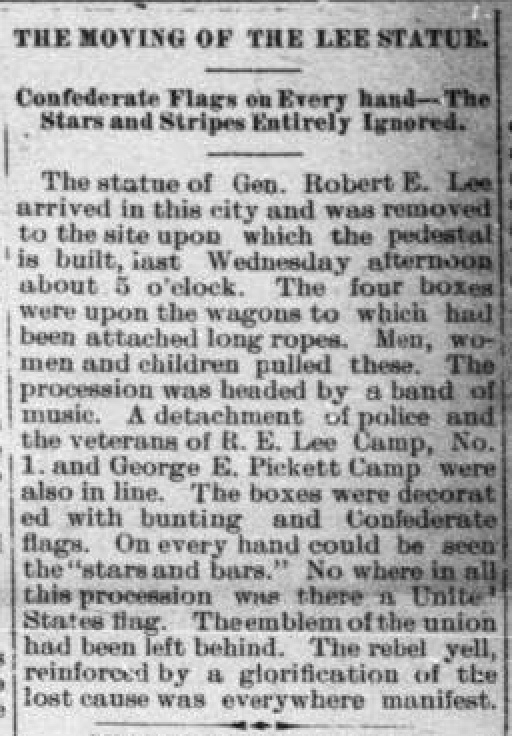
    When the Lee statue was unveiled in 1890, thousands applauded the honoring of the South’s greatest hero. Black citizens were not among them. The black-owned Richmond Planet wrote at the time: “This glorification of States Rights Doctrine – the right of secession, and the honoring of men who represented that cause…will ultimately result in handing down to generations unborn a legacy of treason and blood…”


    Robert E. Lee statue, Monument Avenue, Richmond, Virginia – © Brian Rose

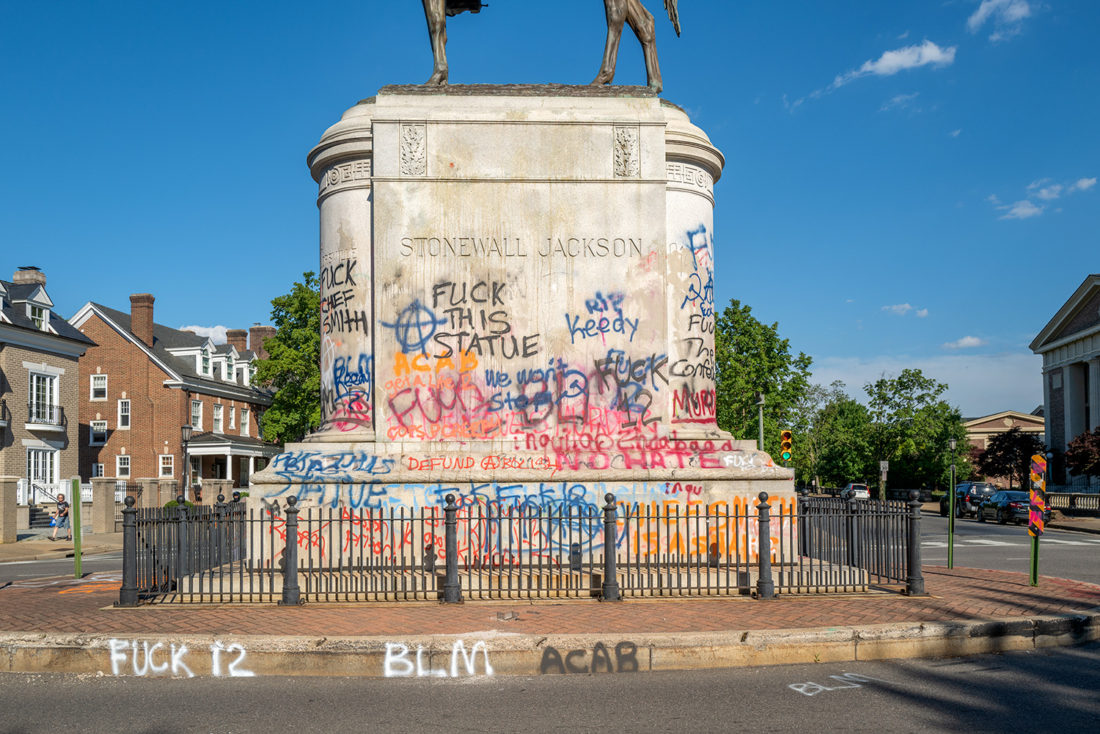
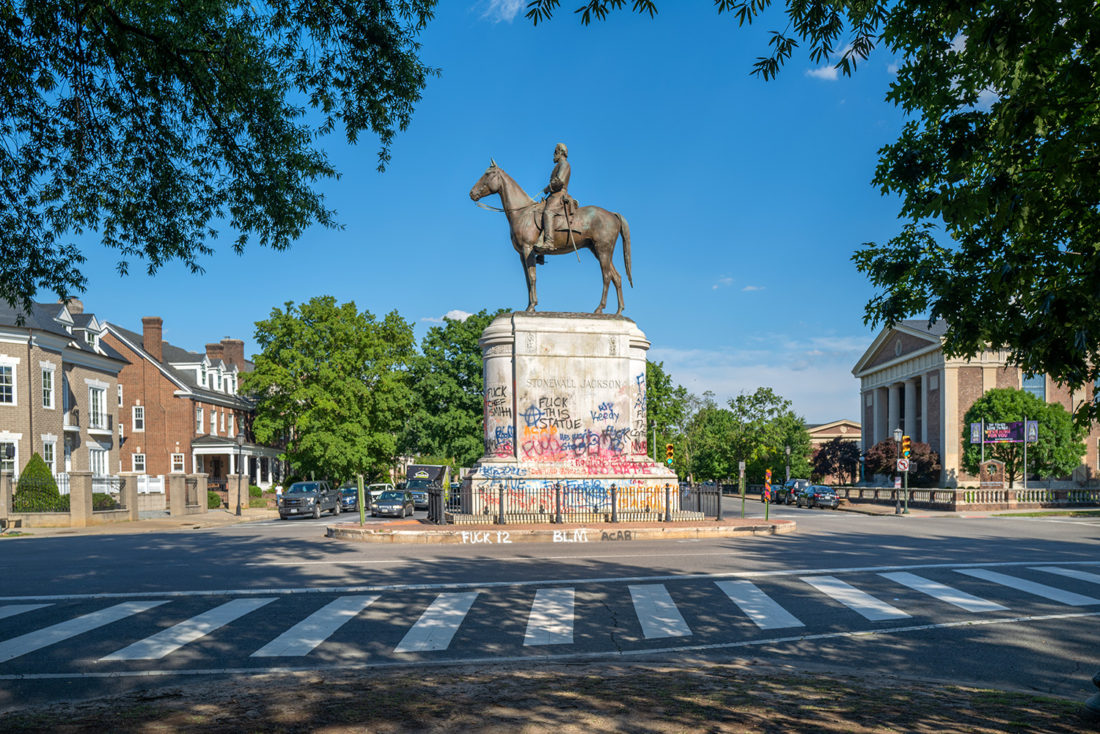
    A statue of Confederate general Stonewall Jackson stands to the west of Lee on Monument Avenue. Jackson was one of the most venerated of Confederate heroes – the notion that the war might have turned out differently had he not been killed by friendly fire at Chancellorsville has long been a key point of speculation in Lost Cause mythology.


    Stonewall Jackson statue, Monument Avenue, Richmond, Virginia – © Brian Rose

    Just two weeks since I made my trip to Richmond, the city has removed the Stonewall Jackson statue that stood on Monument Avenue and Arthur Ashe Boulevard. My understanding is that the city intends to remove all of the Confederate Civil War statues as soon as possible. The Robert E. Lee monument remains in dispute because of a lawsuit claiming that the deed for the property requires the city to maintain the monument.

    Today, I watched the removal of Jackson live on the internet as riggers swaddled the statue in straps, sawed off the bolts at the base, and lifted the whole thing off the pedestal, setting it gently on the street. Jackson will be placed in storage for the time being.

    Stonewall Jackson statue, Monument Avenue, Richmond, Virginia – © Brian Rose

    Last paragraph of a letter to Richmond Mayor Levar Stoney in 2017:

    While we do not purport to speak for all of Stonewall’s kin, our sense of justice leads us to believe that removing the Stonewall statue and other monuments should be part of a larger project of actively mending the racial disparities that hundreds of years of white supremacy have wrought. We hope other descendants of Confederate generals will stand with us.

    As cities all over the South are realizing now, we are not in need of added context. We are in need of a new context—one in which the statues have been taken down.
    Respectfully,

    William Jackson Christian
    Warren Edmund Christian
    Great-great-grandsons of Thomas Jonathan “Stonewall” Jackson


    J.E.B. Stuart, Frederick Moynihan, Monument Avenue, Richmond, Virginia – © Brian Rose

    The most animated of the statues along Monument Avenue is that of Confederate general J.E.B. Stuart. It stands in a small traffic circle and its sloped base attracts wheeled acrobatics – at least it does now.


    J.E.B. Stuart, Monument Avenue, Richmond, Virginia – © Brian Rose


    J.E.B. Stuart, Frederick Moynihan, Monument Avenue, Richmond, Virginia – © Brian Rose

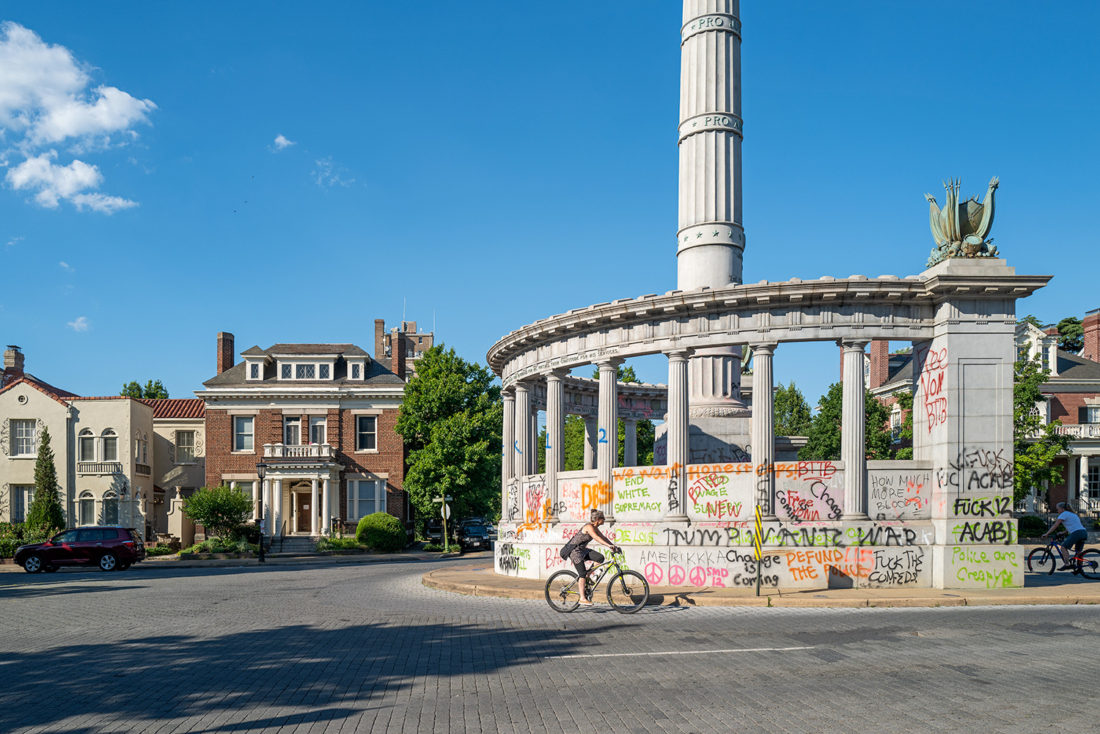
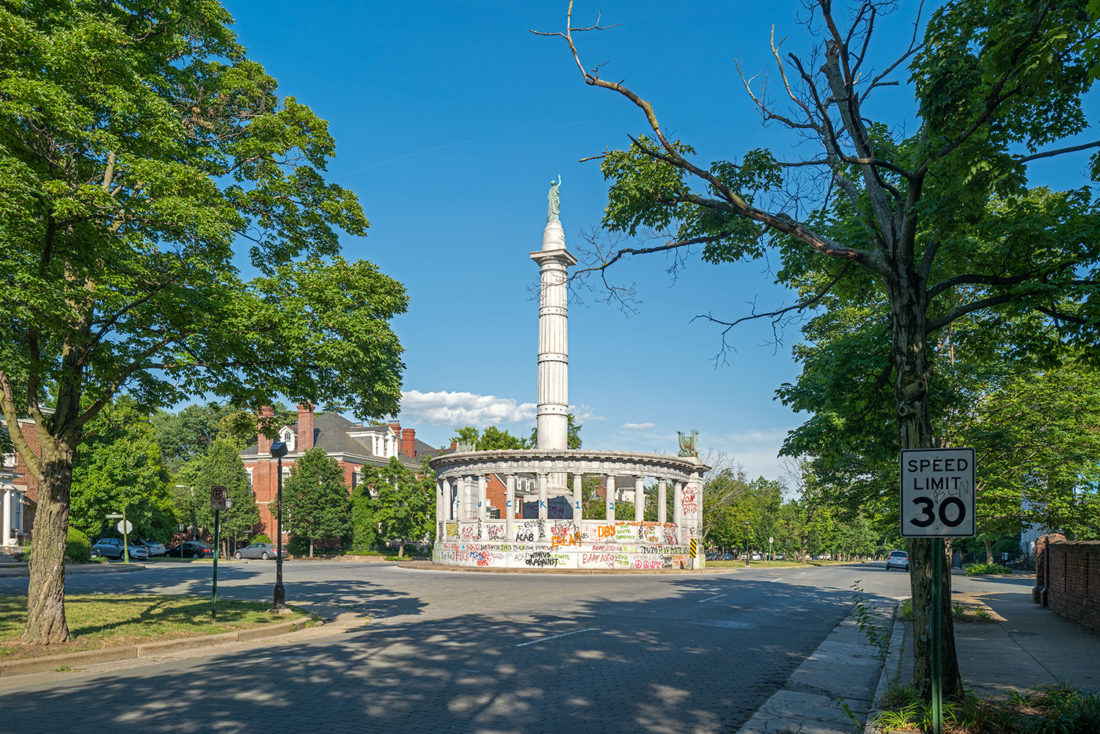
    Jefferson Davis Monument, Monument Avenue, Richmond, Virginia – © Brian Rose

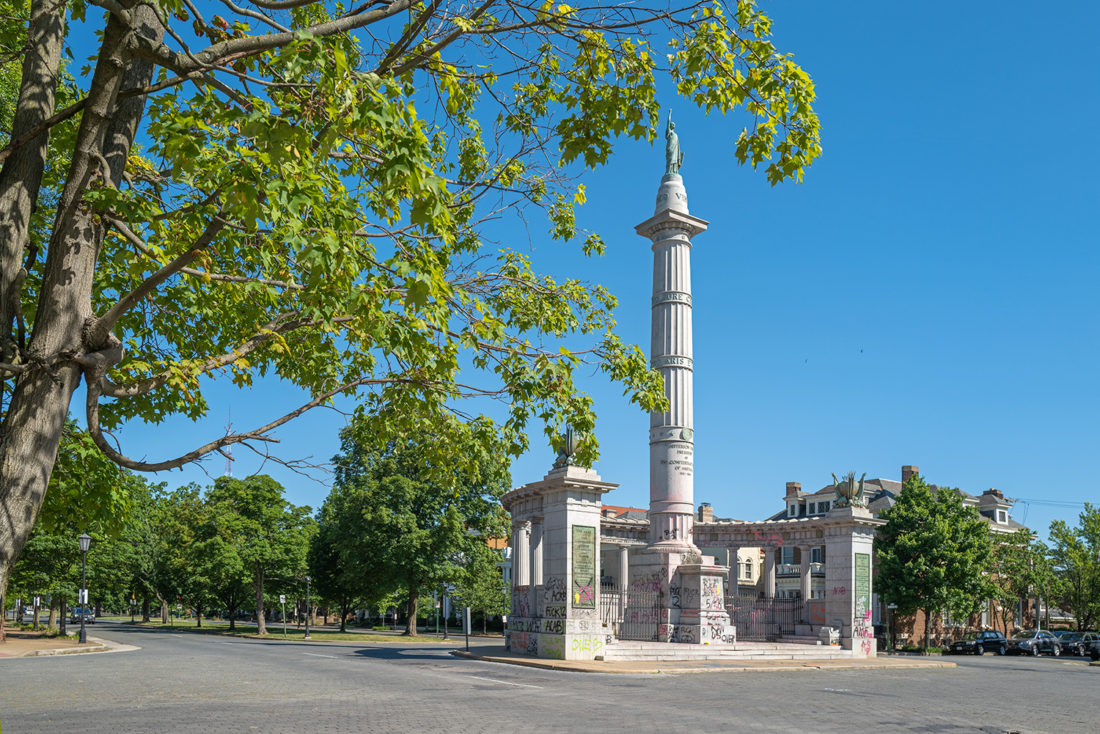
    All the statues along Monument Avenue in Richmond are problematic, but none more so than the Jefferson Davis monument. Two nights before I arrived, protesters pulled down the statue of Davis that stood on a pedestal in the center of an elaborate classical pavilion.

    Inscriptions on the plaques and stone surfaces extoll the heroism of the Confederate army and navy, and Davis, the president of the Confederacy, himself.

    Jefferson Davis Monument, Monument Avenue, Richmond, Virginia – © Brian Rose

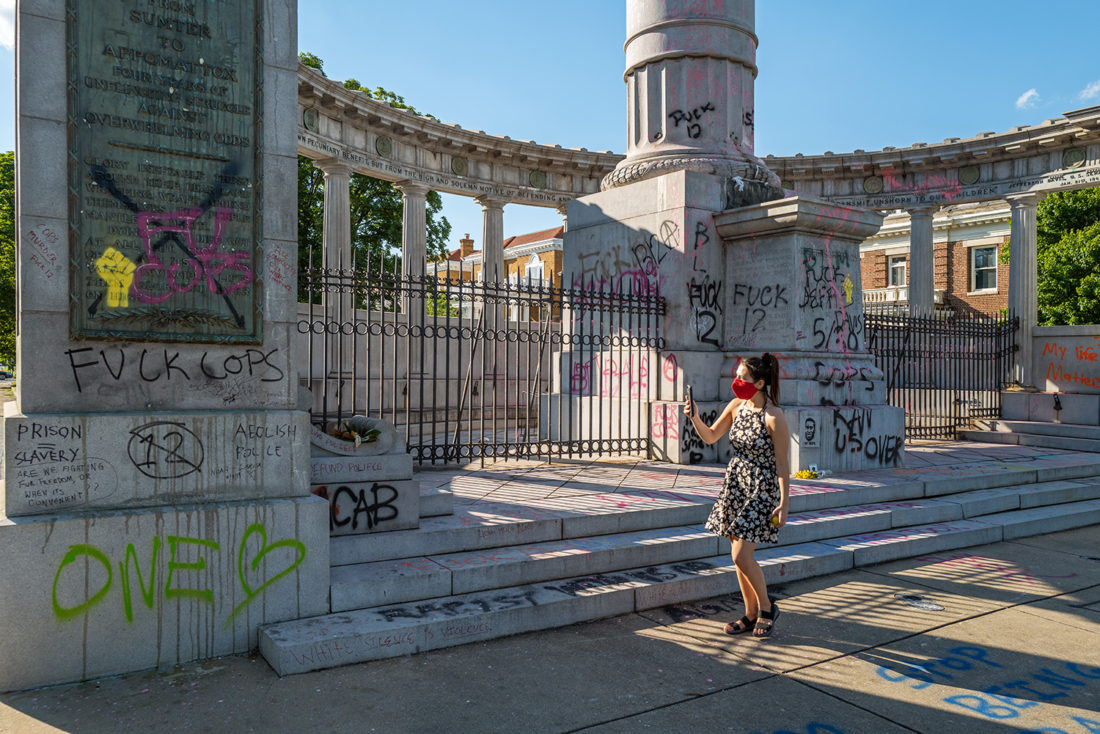
    A woman walks by the empty pedestal where Jefferson Davis statue once stood. The monument as a whole, however, is more than a tribute to Davis. It is a shrine to the Lost Cause of the Confederacy, an ideology based on white supremacy cloaked in words like “freedom” and “rights.” On pillars to the left and right of Davis are tablets inscribed with the poeticized rhetoric of a death cult.

    If to die nobly be ever the proudest glory of virtue, this of all men has fortune greatly granted to them, for yearning with deep desire to clothe their country with freedom now at the last they rest full of an ageless fame.

    Glory ineffable these around their dear land wrapping, wrapt around themselves the purple mantle of death. Dying they died not at all. But from the grave and its shadows valor invincible lifts them glorified ever on high.


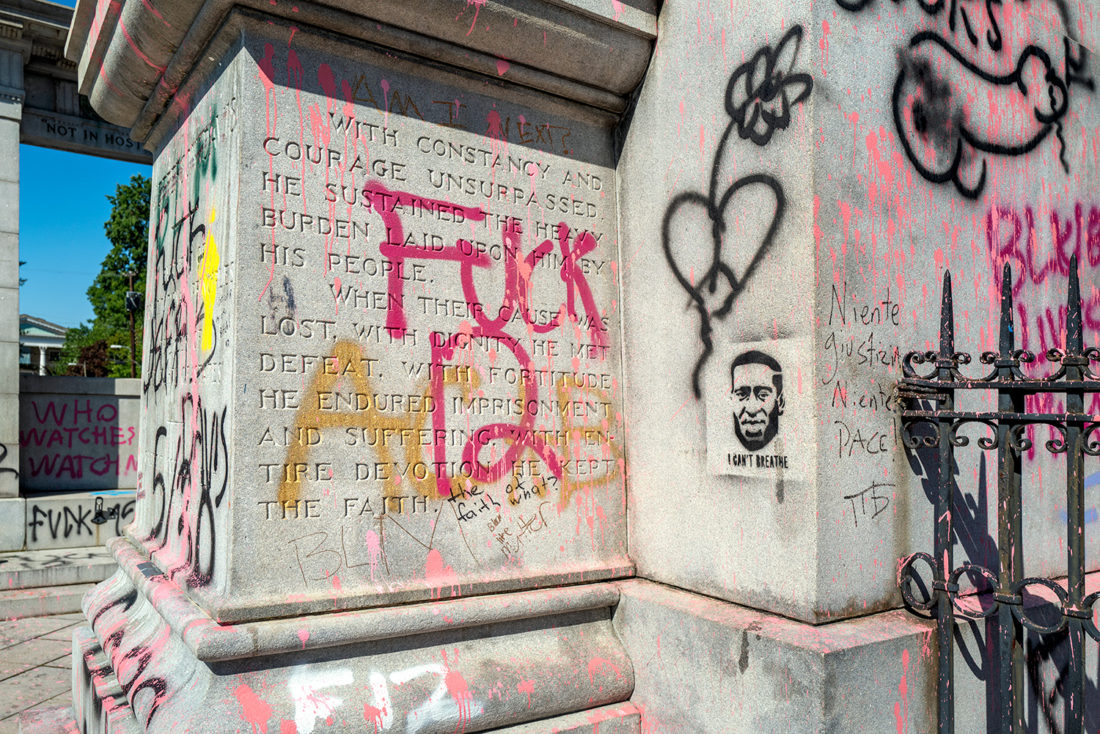
    Jefferson Davis Monument, Monument Avenue, Richmond, Virginia – © Brian Rose

    With constancy and courage unsurpassed he sustained the heavy burden laid upon him by his people. When their cause was lost, with dignity he met defeat. With fortitude he endured imprisonment and suffering. With entire devotion he kept the faith.


    Jefferson Davis Monument, Monument Avenue, Richmond, Virginia – © Brian Rose


    Jefferson Davis Monument, Monument Avenue, Richmond, Virginia – © Brian Rose


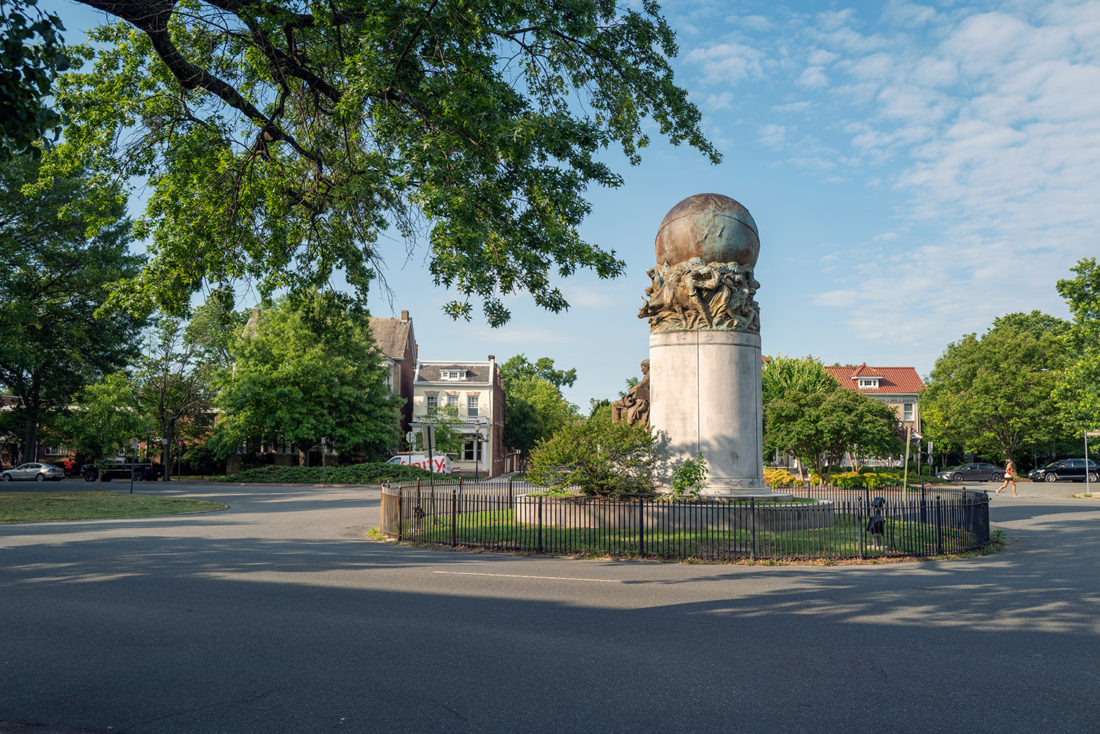
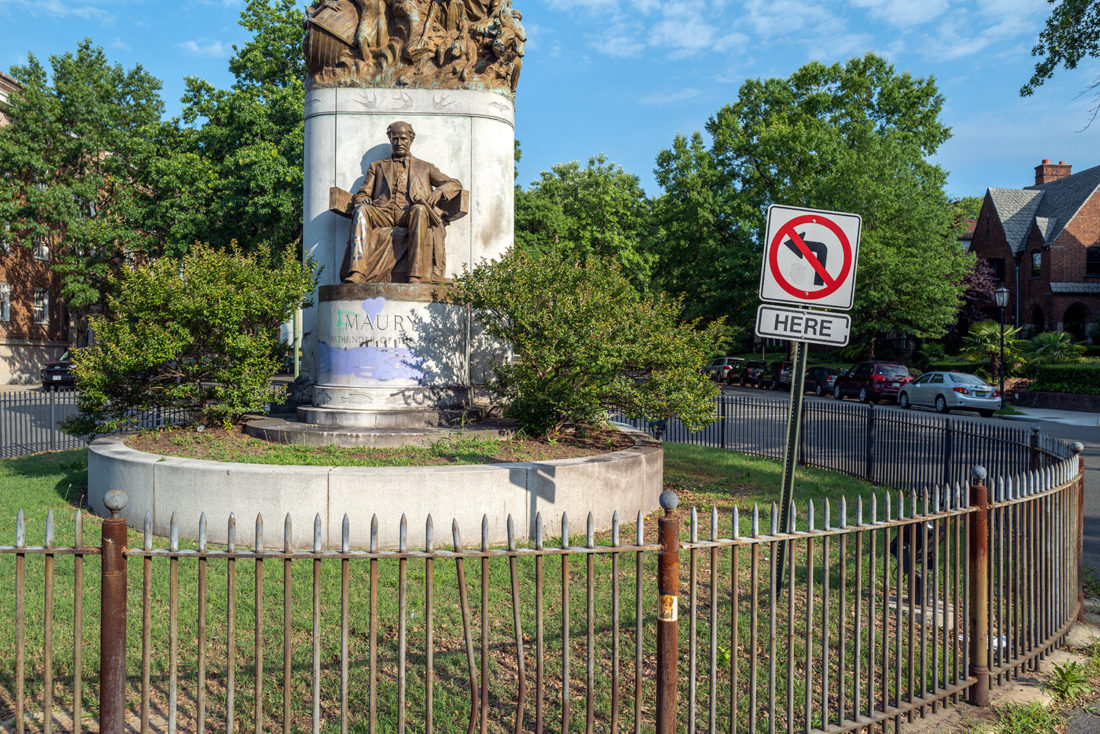
    Matthew Fontaine Maury Monument, Monument Avenue, Richmond, Virginia – Brian Rose

    While Monument Avenue is infamous for its Confederate generals, there are two other statues. The oddest, perhaps, is the statue for Matthew Fontaine Maury, who was one of the leading oceanographers of the 19th century. He served in the Confederate navy, but his role was limited. Unfortunately, his accomplishments have been eclipsed by his allegiance to the Confederacy.


    Matthew Fontaine Maury Monument, Monument Avenue, Richmond, Virginia – Brian Rose

    His statue was done by the same sculptor, Frederick Sievers, as Stonewall Jackson just walking distance away. It shows Maury seated with a globe and various creatures above him.

    When I was there, a swath of purple paint had been applied to his plinth, but I’m guessing the protesters didn’t know quite what to make of this once famous, but now obscure, figure.

    Maury was removed from his pedestal yesterday, July 1, 2020.


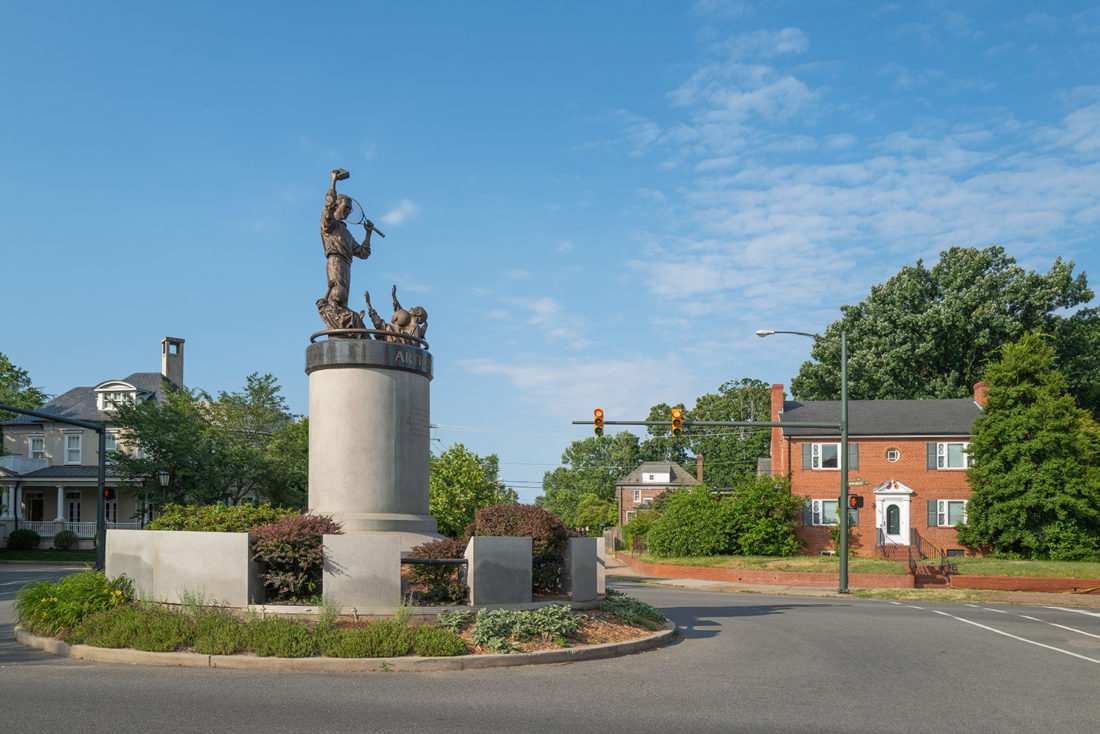
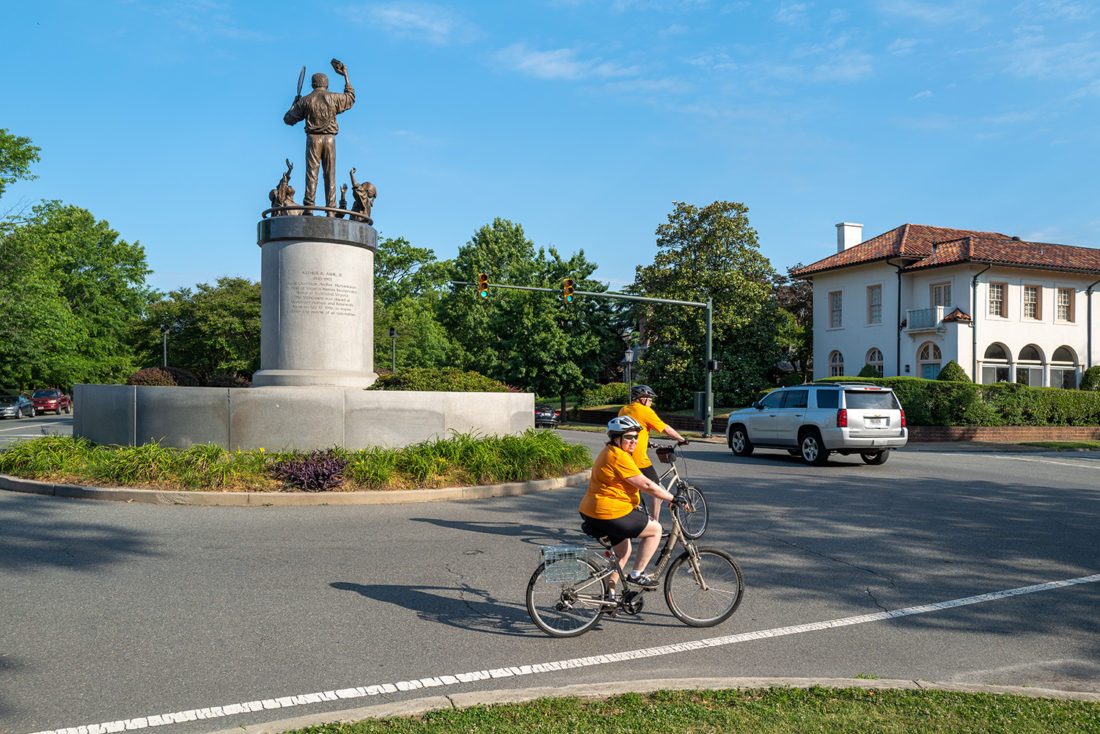
    Arthur Ashe Monument – Monument Avenue, Richmond, Virginia – © Brian Rose

    In 1996 the city erected a statue of Arthur Ashe as a counter-narrative to the glory of the Confederacy. Ashe was a Richmond native, tennis champion, civil rights activist, and advocate for AIDS victims. It was a splendid idea to honor Ashe with a monument.


    Arthur Ashe Monument – Monument Avenue, Richmond, Virginia – © Brian Rose

    Unfortunately, the statue is an aesthetic disaster, and it’s located at the western end of the avenue where the architectural elegance of The Fan District of Richmond has given way to suburban-style houses. Ashe stands at the top of a cylindrical plinth brandishing a book and a tennis racket while several children reach upward as if pleading for mercy. A powerful figure of Ashe against the sky might have worked, or an approachable Ashe closer to ground level might have worked.

    This statue is neither here nor there, and would probably be better not here at all


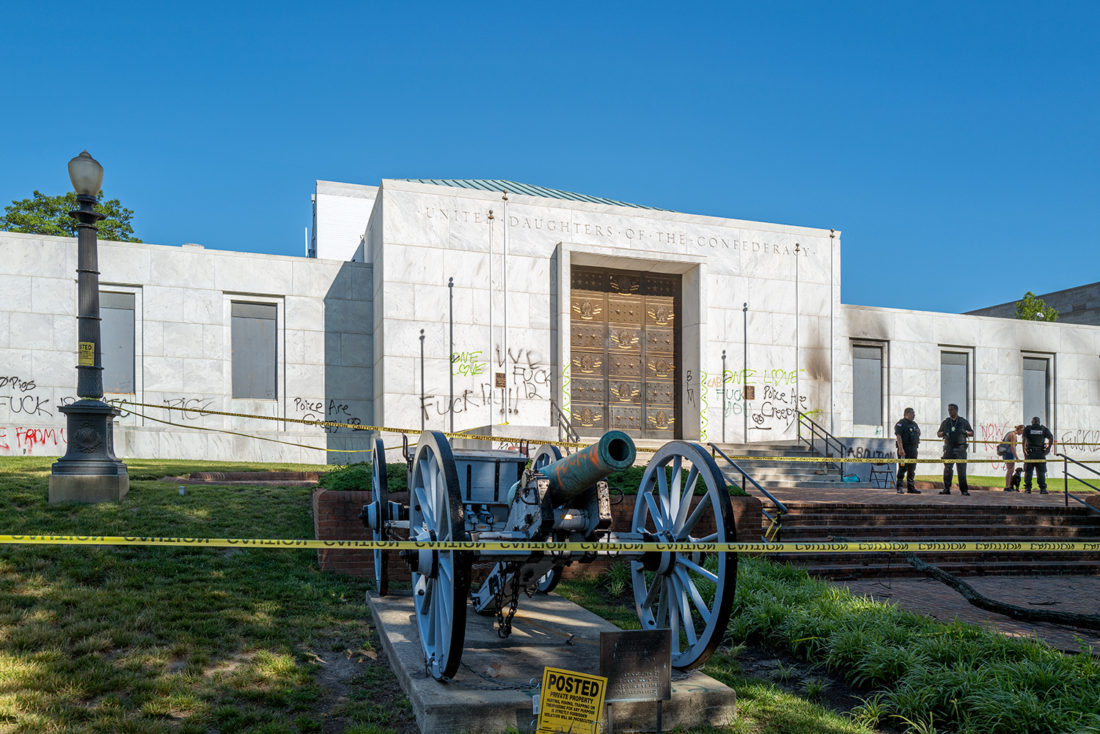
    United Daughters of the Confederacy, Arthur Ashe Boulevard, Richmond, Virginia – © Brian Rose

    Just a few blocks to the south of the intersection of Monument Avenue and Arthur Ashe Boulevard – where the Stonewall Jackson statue stood until recently – the headquarters of the United Daughters of the Confederacy sits aloof like a mausoleum of white Georgia marble. Confederate-era cannons flank the entry with its enormous bronze doors.

    The night before I arrived, protesters attacked the building with incendiary devices setting off a fire that damaged the library inside and left scorch marks – along with graffiti – on the pristine white facade. The grounds in front of the building were cordoned off with yellow police tape, and several security guards patrolled the pathway leading up to the entrance.

    The UDC was the sponsor and defender of many of the Confederate monuments in Richmond and elsewhere. And although their official literature renounces racism and hate groups, their history is highly problematic, to say the least. Through educational outreach and various forms of propaganda, the UDC has done more than any other organization to promote the pernicious myths of the Lost Cause.

    Rumors of War, Kehinde Wiley, Arthur Ashe Boulevard, Richmond, Virginia – © Brian Rose

    The Virginia Museum of Fine Arts stands directly next door to the UDC, and in a grassy space in between, a statue by Kehinde Wiley, very much in the spirit of Confederate generals on Monument Avenue, stands on a pedestal, untouched by BLM protesters.

    From the VMFA website:

    As a direct response to the Confederate statues that line Monument Avenue in Richmond, Wiley conceived the idea for Rumors of War when he visited the city in 2016 for the opening of Kehinde Wiley: A New Republic at VMFA. Rumors of War takes its inspiration from the statue of Confederate Army General James Ewell Brown “J.E.B.” Stuart created by Frederick Moynihan in 1907. As with the original sculpture, the rider strikes a heroic pose while sitting upon a muscular horse. However, in Wiley’s sculpture, the figure is a young African American dressed in urban streetwear. Proudly mounted on its large stone pedestal, the bronze sculpture commemorates African American youth lost to the social and political battles being waged throughout our nation.

    Rumors of War, Kehinde Wiley, Arthur Ashe Boulevard, Richmond, Virginia – © Brian Rose

    J.E.B. Stuart Monument, Frederick Moynihan, Monument Avenue, Richmond, Virginia – © Brian Rose

  • New York/Richmond, Virginia


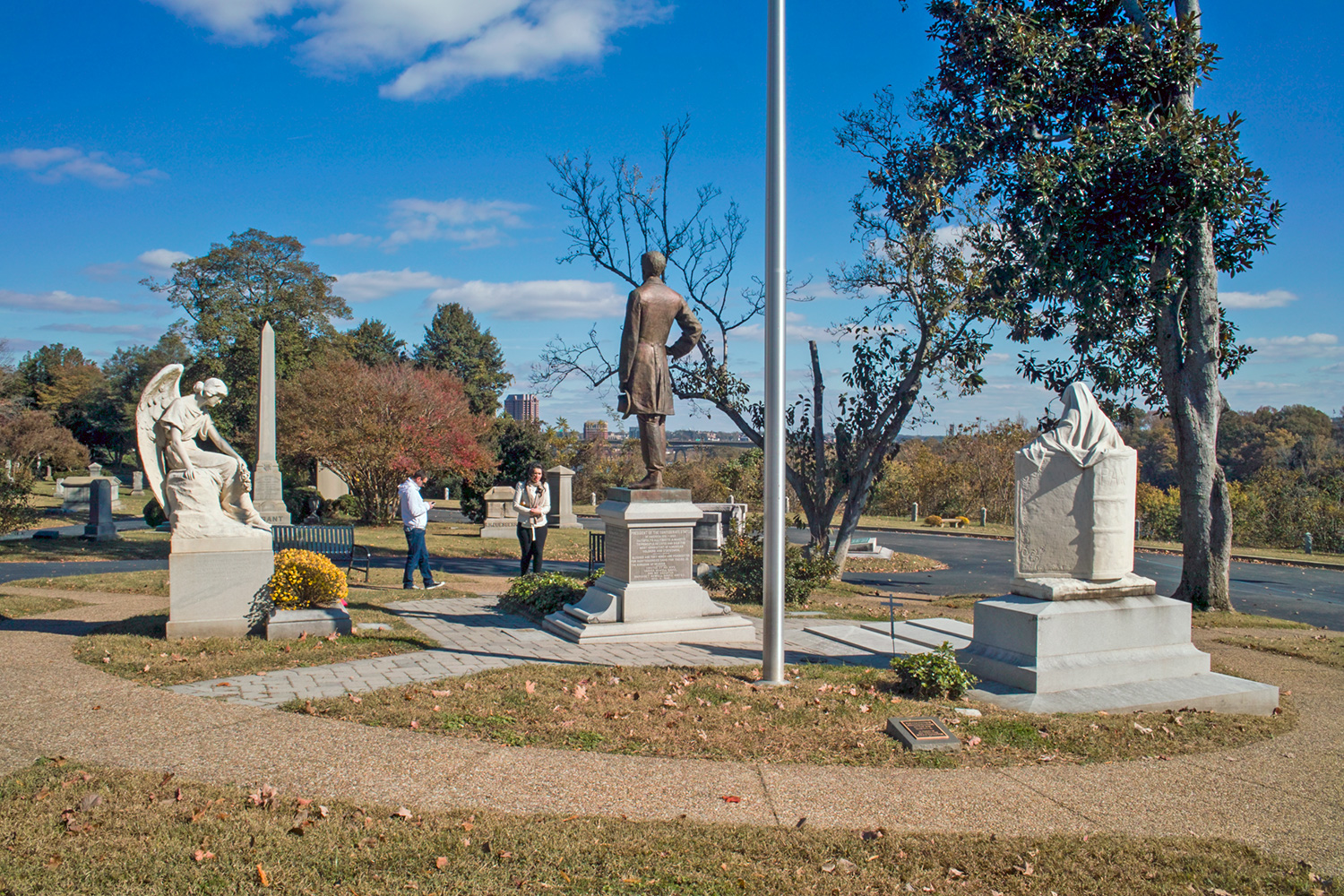
    Jefferson Davis gravesite, Hollywood Cemetery, Richmond, Virginia – © Brian Rose

    I was born and raised in Virginia, and my family lived two years in Richmond. We moved to Williamsburg down the peninsula after that. I attended the University of Virginia before departing for New York where I have lived for most of my life.

    Some of my ancestors were slave owners. One or more of my ancestors were Creek Indians. Some of my ancestors fought in the American Revolution. My great, great, great grandfather on my mother’s side was a corporal in the Confederate army – he died in the Battle of Vicksburg. My uncle had a hog trucking business located in Courtland, Virginia, where Nat Turner led his bloody slave uprising in 1831. My father told me that he once woke in the middle of the night to a cross burning in their front yard. They were targeted by the KKK. I do not know why. The mysteries of my family history haunt me to this day. At times I have confronted my southern heritage directly – at other times I have run from it. Tomorrow I confront.

    I am driving to Richmond with my son to photograph the final days of the Confederate statues on Monument Avenue. Protesters pulled down Jefferson Davis last night. The plinth of Robert E. Lee is covered in graffiti. J.E.B. Stuart and Stonewall Jackson’s days are numbered. I don’t know what to expect but am prepared for anything.