Author: admin

  • New York/Brooklyn Public Library


    Enshrined Memories: Brooklyn and the Civil War at the Brooklyn Public Library

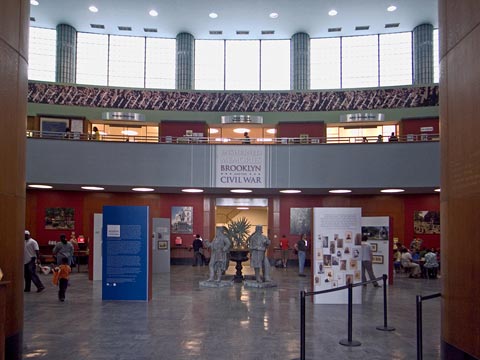
    The Civil War project I worked on this summer is now up at the Brooklyn Public Library on Grand Army Plaza adjacent to Prospect Park. It’s a show I have some mixed feelings about. I knew from the beginning when I was asked to participate that it would not be a “Brian Rose” exhibit, though my photographs would play an important role. That’s the way it has turned out, with perhaps, less emphasis on my pictures than I would prefer.
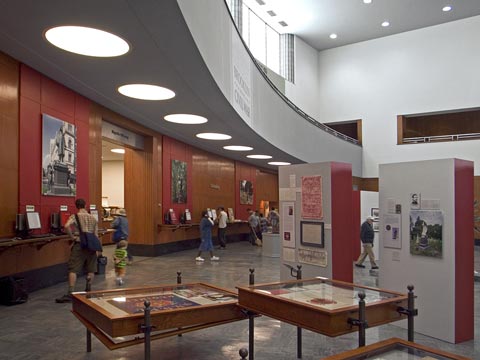

    Brooklyn Public Library

    The library lobby is a highly problematic space for an exhibition. The building is Speer-like in its grandiosity (pomposity), although the recently renovated entry plaza is beautiful, and makes the building welcoming. One enters, however, under the semi-watchful eyes of uniformed rent-a-cops who will never catch a terrorist or serious criminal, but who might make you think twice about stealing a book.
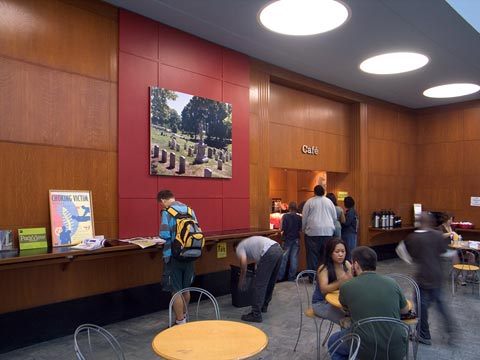

    Brooklyn Public Library

    The lobby is a soaring room that shrinks anything put into it. My 4×5 foot photos hung high along the back wall are greatly diminished in the space. I had hoped with the big prints to bring these heroic Civil War figures down from their plinths and high horses for a closer eye-to-eye view. But hanging them up above the catalog computers doesn’t allow for that. The city is full of monuments that are paid little attention to. There are exceptions, as I’ve pointed out before, like the statue of George Washington in Union Square Park, which served as the focal point of the unofficial memorial to those killed in the World Trade Center attacks. The way in which these historic events are remembered and/or partially forgotten is important and is relevant to how we memorialize contemporary wars and tragedies.
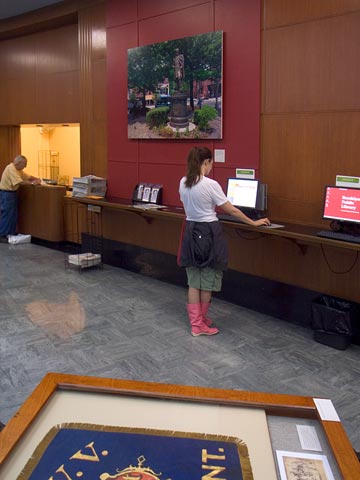

    Brooklyn Public Library

    If you’re not looking specifically for my work, but came for Civil War Brooklyn history, there’s lots to see in the exhibition, which is curated by Jeff Richman, a historian passionately involved with the subject. The exhibit design was done by Art Presson, and despite my complaints, comes off admirably. It would be nice, however, to see the exhibit in a more humanly scaled interior. If nothing else, come for the stereographs of Civil War battlefield scenes, including frighteningly real dead soldiers. Seen through a stereoscope, you will forget the cacophony of the room around you. As Art says, it’s the peep show part of the exhibit.
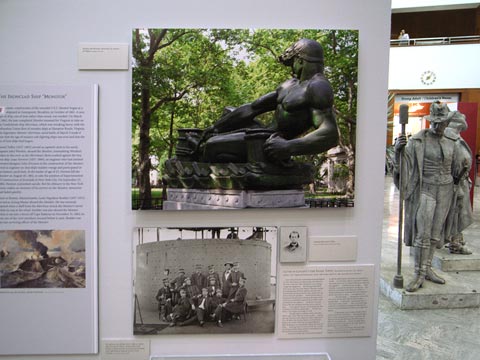

    Exhibit panel with photo of Monitor memorial in Greenpoint
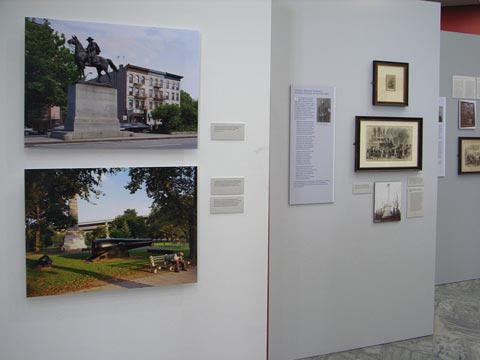

    Grant on horseback and the Rodman gun near the Verazzano Narrows Bridge

    I am hoping that my photographs will be assembled as a print portfolio, which will allow them to be judged on their own terms. I will put the complete set online shortly. Although it is commissioned work, I worked very hard on the images, and even the most straightforward looking photographs were arrived at by careful inspection of the object and its context. Look back through my earlier posts and see the images as they were made.
  • New York/Hudson River Park


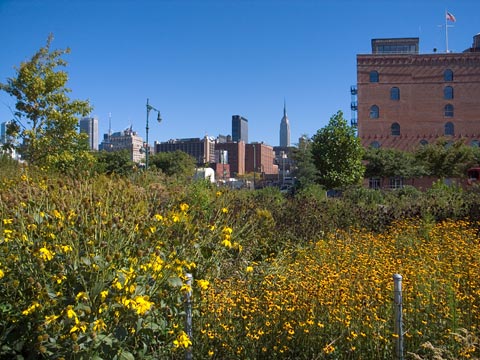
    Hudson River Park

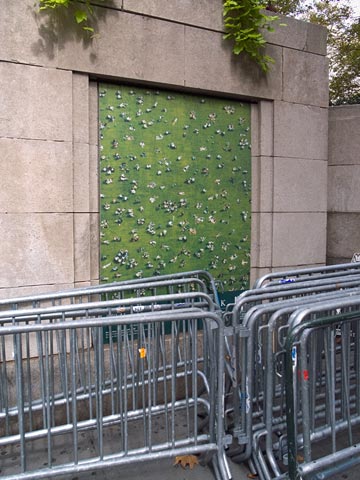
    Beautiful Sunday in New York. A longer post tomorrow.

  • New York/Around Town


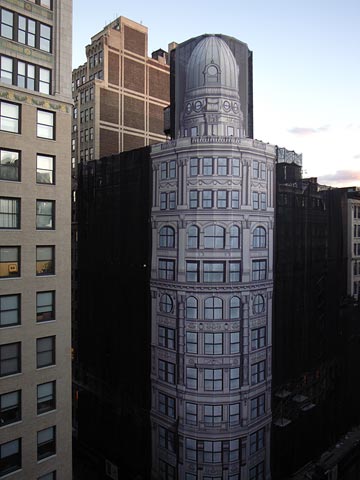
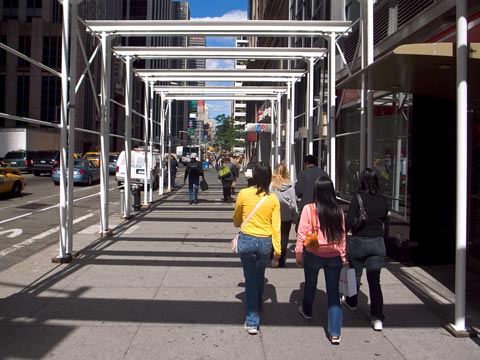
    Sixth Avenue near 42nd Street

    I am still trudging around town taking pictures of various buildings. It’s a never ending assignment. The timing for the sunlight has to be right. There’s always a truck or some other obstruction in front of things. I’ve been to some locations 4 or 5 times without success.

  • New York/Midtown


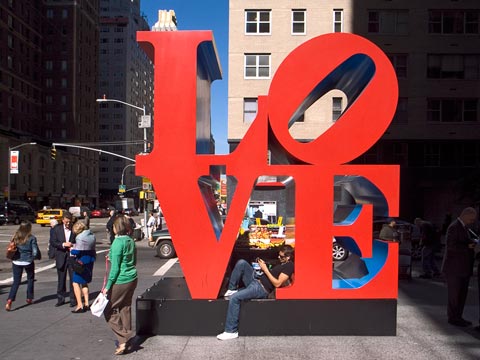
    Midtown, sculpture by Robert Indiana

    Pretty busy these days shooting buildings around the city. Here are a couple of random moments.

    Bryant Park

  • New York/Flatiron District


    Fifth Avenue and 21st Street

    The view out the window while shooting an architectural interior in the Flatiron District.

  • New York/Franklin, Virginia

    UPDATED HERE

    Last weekend I attended the funeral of an aunt in Franklin, Virginia. With the passing of most of my close relatives in the area I don’t expect to be making too many trips down there in the future. My father’s side of the family comes from the area with its peanuts, cotton, and other agricultural products. One of my uncles had a hog trucking business in Courtland (previously known as Jerusalem), a few miles from Franklin, the site of Nat Turner’s 1831 slave uprising. It’s still a predominantly agricultural area, just outside the urban/suburban orbit of Hampton Roads, the metro area centered on Norfolk, Virginia.


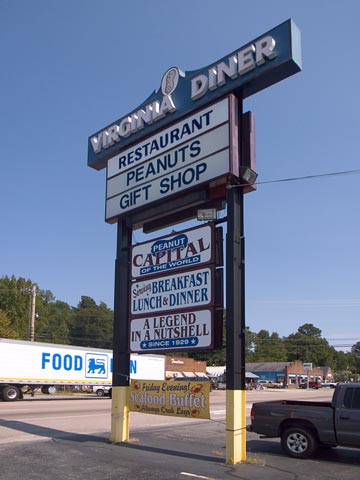
    The Virginia Diner, Wakefield, Virginia

    The southside of the James River is still a conundrum to me, and I have searched there, largely in vain, for the roots of my own self-identity. After crossing the river at Jamestown, we had lunch at the Virginia Diner, a popular restaurant featuring local Smithfield ham, collards, hush puppies, and lots of fried things. Like much of this part of Virginia, Black and White life is still pretty segregated. There were no black faces in the Virginia Diner–other than in the kitchen.


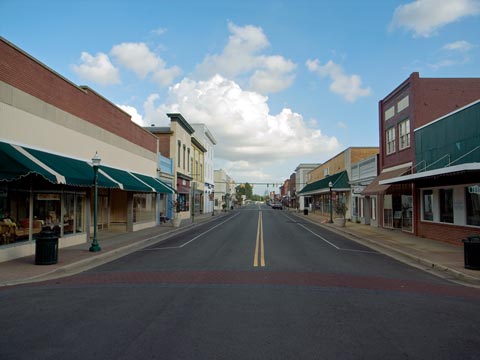
    Main Street, Franklin, Virginia
    Quiet, but well-preserved.

    Franklin exists because of its location on the Blackwater River, which flows south into North Carolina and out to the Albemarle Sound. The river and key rail lines made it a transportation hub for the area. Main Street and a small grid of blocks lies along the river as does a huge paper mill owned by International Paper, formerly Union Camp, which grew from a sawmill on the Blackwater. My aunt Louise worked a good chunk of her 91 years at the mill inspecting paper.


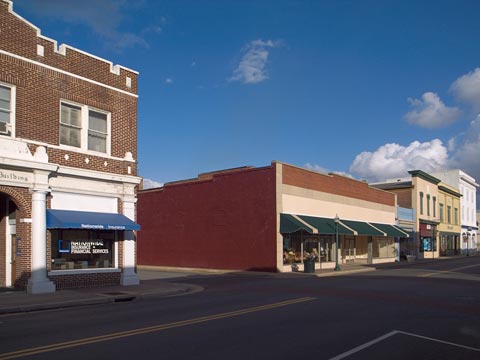
    Main Street, Franklin, Virginia


    Big Tunes, Home of Da Hits
    , Franklin, Virginia

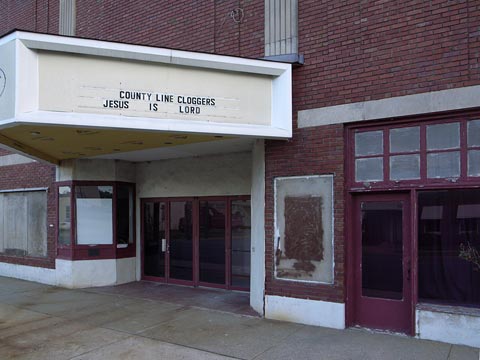
    Franklin’s downtown is well-preserved despite a devastating flood in 1999, and most of its storefronts are cleaned up and freshly painted. Unfortunately, many still await an occupant. After the funeral we met at Fred’s on Main Street where the waitresses wore t-shirts emblazoned with whereinthehellisfranklin? To the north was a music store called Big Tunes, Home of Da’ Hits. To the south was a possibly still used movie theater. The marquee said: County Line Cloggers and Jesus is Lord.


    Franklin, Virginia


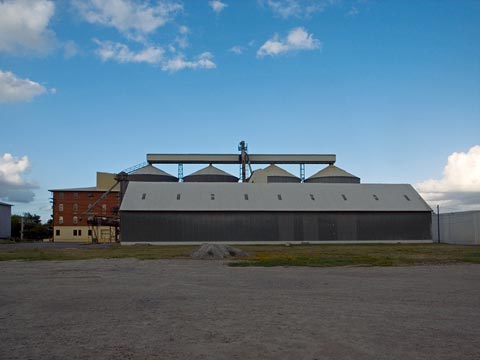
    Peanut silos, Franklin, Virginia

    Freight trains still go right through downtown, and a large complex of peanut silos stood near the tracks. The funeral home was a few blocks away, one of the many grand houses built in the heyday of the town when the Camp family (of the paper mill) was royalty, and money, in general, was more likely to stay in town. Reading up on Franklin, I see that it’s a pretty poor community, slightly more African American than White, and significantly less educated than most of the state. Not much bad happens in Franklin with it’s 8,000 inhabitants, but overall, crime is slightly higher than in the burg from which I am now writing, New York City.

  • New York/LES/Lab


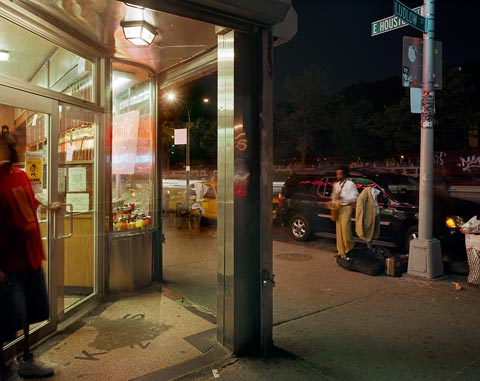
    Katz’s Deli, Ludlow and Houston Streets (4×5 film)

    One of the evening photographs from a couple of weeks ago–from the ongoing Lower East Side project. A saxophone player and a door opener trolling for change as the throngs blur by.


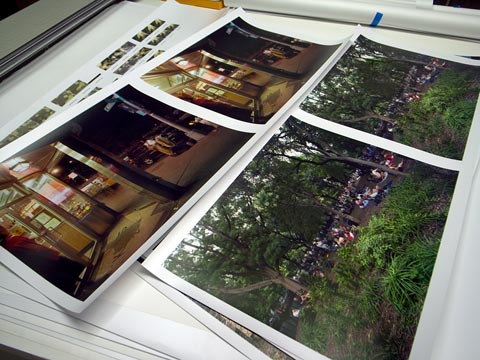
    20×24 inch prints in the lab


    Brendan plays video games in the lab

  • New York/September 11th

    I am back from a short family related trip to Virginia of which I may have some pictures later. Yesterday, I sat in doctor’s office waiting room with my father and sister as video of General Petraeus, the commander in Iraq, played on several overhead TV screens. Fish swam aimlessly in a tank. I drove to Washington, zipped by the Pentagon along I95, ducked beneath the Mall, and easily found–somehow–the Union Station garage entrance where I returned my rental car. I then rode the Acela Express back too New York. Businessmen tapped on their laptops. I did to, working on a short bio for my upcoming Civil War exhibition. A man behind me chatted on his cell phone about a White House briefing he attended.


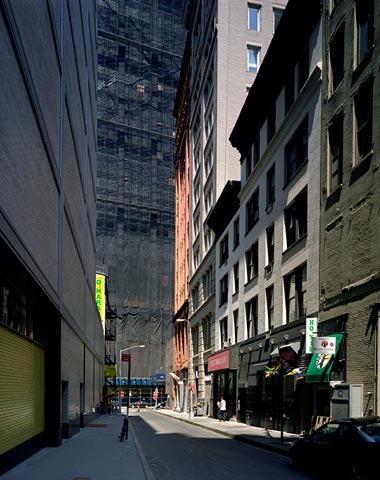
    Deutschebank building, Cedar Street (4×5 film)

    Today is September 11th, and there’s talk about moving on beyond the tragedy of six years ago. Last week, more finished plans for the new buildings around ground zero were released, but just a few weeks ago, two firefighters died after being trapped in a fire in the black shrouded remnant of the Deutschebank building. It’s hard to move on when fireman are still dying at ground zero and soldiers are dying in a war precipitated by 9/11, however falsely linked. I am all for moving forward, and in many ways the city already has, but September 11th will remain an open wound until the war is over, the scar of ground zero is healed, and the dead properly remembered.

  • New York/Stephen Shore


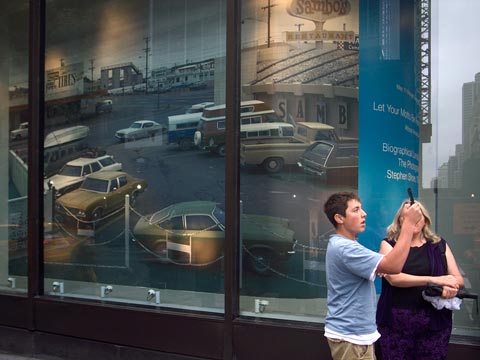
    Stephen Shore exhibit at ICP

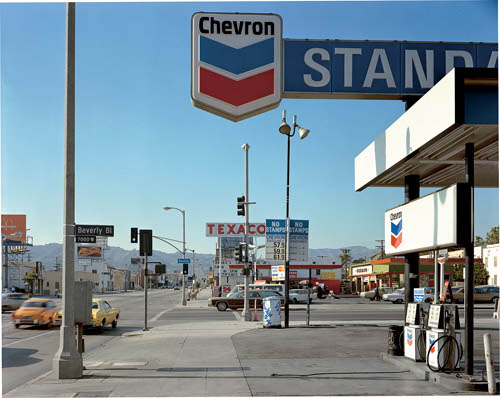
    Closing this week at ICP in New York is Biographical Landscape: The Photography of Stephen Shore, 1969-79. If you are in the city in the next few days, don’t pass up the chance. When I first began shooting color in 1976 Shore was well on the way to completing the work that established his career and public personna. As a student I was aware of only several people shooting color with a serious artistic intent: Joel Meyerowitz, William Eggleston, and Stephen Shore. For me, Meyerowitz was a street photographer (before he began working with the view camera), Eggleston was a visual diarist, and Shore was a documenter of the American landscape.


    Stephen Shore
    Beverly Boulevard and La Brea Avenue, Los Angeles, California, June 21, 1975

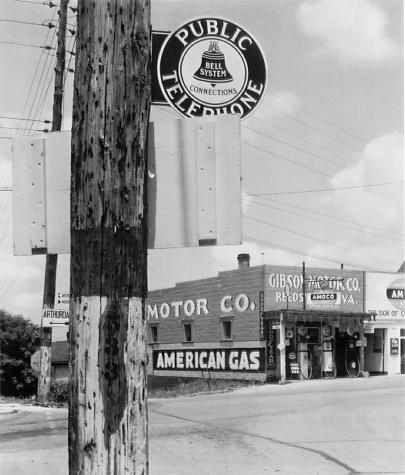
    The landscape that Shore photographed was not the picturesque idealized panoramas of Ansel Adams, Edward Weston, or Carlton Watkins. In fact, as I recall it, many people were angered by Shore’s dystopian view of the American highway. The photographs were bland, random, and lacking a point of view–visually and politically. At the Maryland Institute where I went to school before transferring to Cooper Union, sneering at Shore’s work was the norm, and no one seemed to make the connection to Walker Evans’ pioneering take on the American landscape.


    Walker Evans
    Gas Station, Reedsville, West Virginia, 1936

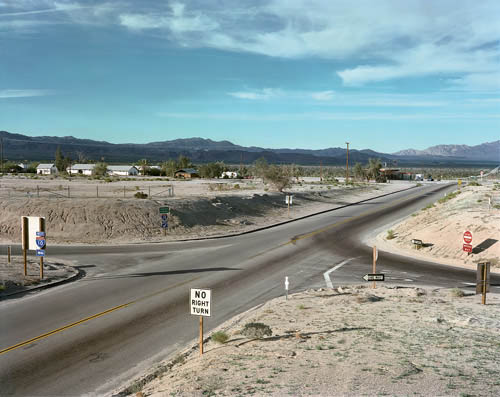
    For me, Shore’s work was revelatory. Having been schooled in the decisive moment, I immediately recognized that Shore was doing exactly the opposite. He was finding timeless, non-moments, and in the process revealing a landscape that was all around us, the outer fringes of cities, parking lots, silent streets, the bric-a-brac of culture and advertising reaching out into the no longer pristine environment of the US and Canada. Ultimately, Shore’s pictures were inclusive and open to interpretation. Less anecdotal, and more about the totality contained within the frame.


    Stephen Shore
    California 177, Desert Center, California, December 8, 1976

    Most of this is obvious now. We’ve become accustomed to seeing this way, thanks to Shore, and others. But at the time this was clearly not work that appealed to the camera club crowd–it was work that challenged the protective boundaries of the photography tribe. The connection to Warhol, the early one man show at the Metropolitan Museum, and the way in which the art world sat up and took notice all contributed to separating him from “regular” photographers.

    In retrospect this all seems like nonsense. Shore is both a regular photographer and a unique artist. Seeing the exhibition at ICP is to realize how beautifully transcendent the 1970s view camera work is. I doubt that the original C prints ever looked as balanced and vivid as the new digitally made prints. I know from printing my own work from the early 80s that time has not been kind to the film. My guess is that Shore’s negatives have been better stored than mine, but even so, I would imagine that scanning and color correcting was a major undertaking.


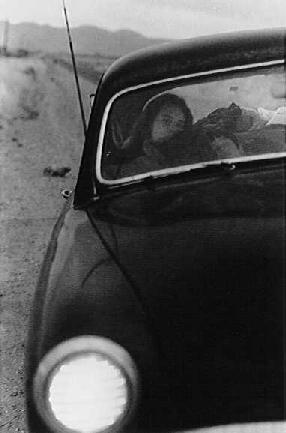
    Robert Frank
    U.S. 90, en route to Del Rio

    It’s especially fitting to acknowledge Shore’s work in relation to the 50th anniversary of Jack Kerouac’s book On the Road because it is part of that American impulse to take to the highway and chronicle what one finds there–both visually and psychologically. Kerouac is, of course, more closely associated with Robert Frank generationally and stylistically. With Shore the temperature is lower, the sense of movement through space slowed. Stream of consciousness has been replaced by a more systematic cataloging of facts and surfaces. Earnestness, while not absent, is tinged with irony and an astringent eye.

  • New York/Brooklyn

    Cars on Dean Street.

  • New York/Richard Pare


    Richard Pare’s photos at the Museum of Modern Art
    Views of Lenin’s tomb in Red Square, Moscow

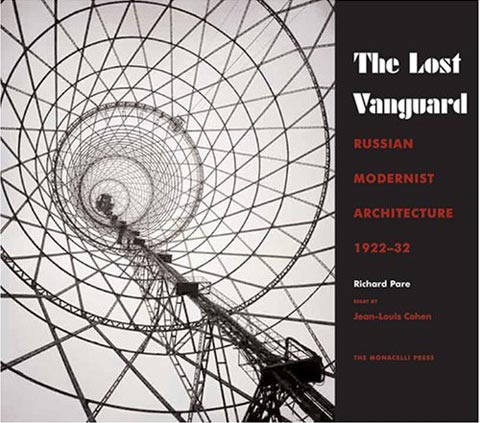
    Richard Pare’s photo documentation of early modernist architecture in Russia is currently on display at the Museum of Modern Art and in the book The Lost Vanguard, Russian Modernist Architecture, 1922-32. Pare is one of the finest architectural photographers I know, and I’ve always admired how he has figured out ways to pursue major personal projects without drowning in assignment work tailored for the glossy magazines.


    The Lost Vanguard book cover, Richard Pare

    I know Richard from Cooper Union, where he was one of my teachers. Shortly after graduating I began photographing the Lower East Side, and Richard bought a number of prints of that work for the Canadian Centre for Architecture. In those days he was, perhaps, more known for his work as a curator and collector. His scholarly book, Photography and Architecture: 1839-1939, highlights the work he acquired for the CCA. The only comparable book is Cervin Robinson’s Architecture Transformed: A History of the Photography of Buildings from 1839 to the Present.

    The thing about photographers like Richard Pare–and Cervin Robinson–is that they understand that sometimes it is best to remain nearly invisible and let the object dominate the image. Interestingly, despite such a self-effacing modus operandi, the vision of the photographer eventually emerges. It may not be as overt as what we are used to seeing, but style is, in my opinion, an overrated concept.

    Often, the critical point lies within the pursuit of a project or thematic idea. Pare, for instance, brings his intellectual curiosity and knowledge of architectural history to whatever he does. A project on the scale of the Russian vanguard required research, repeated trips–often under less than ideal circumstances–patience, and a good deal of doggedness. He sought out the remnants of the modernist movement that survived the Soviet years, and now, in many cases, lie neglected and threatened by real estate developers.


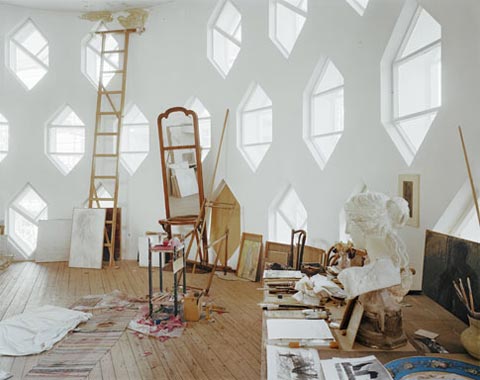
    Melnikov House interior, Konstantin Melnikov, 1927-31, Richard Pare

    The result is a photography exhibition (and book), although it is shown in the architecture department of MoMA. It is beautifully printed (with Ben Diep of Color Space Imaging) and well presented in the gallery. It is, of course, an exhibit about architecture, but I would urge one to see it as a photographic journey as well. Ultimately, it is the totality of the project that counts.

    On a personal note, I have always been fascinated by the short-lived Russian avant-garde in architecture and in the fine arts. It is sobering to realize that artistic expression can be effectively suppressed by ideological hysteria in its various forms. Back when I was working on my east/west border project I wrote–over in my musical life–a song about the end of the Soviet Union from the perspective of architects’ utopian dreams. Here’s the sound file: Cities on the Aerial Paths of Communication.

  • New York/Astoria

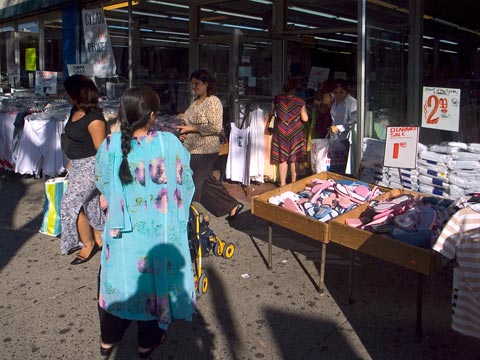
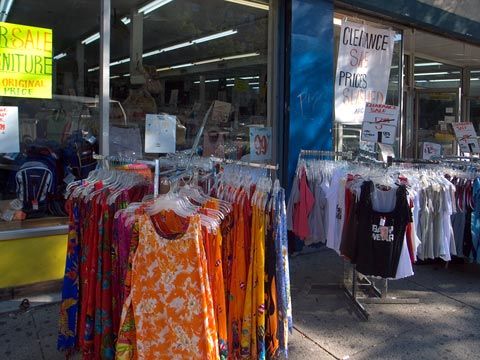
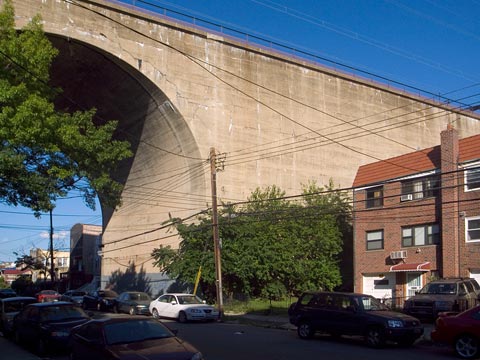
    Back in Astoria yesterday to photograph a couple of buildings with the 4×5 view camera. After I finished, I walked around two long blocks snapping pictures with my Ricoh digital.

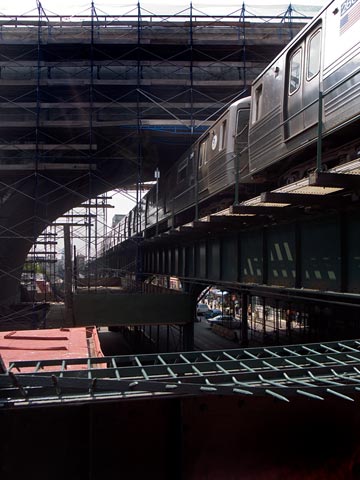
    Keep in mind that this is the end of the elevated N and W lines of the subway, but Manhattan is not more than 20 minutes away. Crossing above the elevated subway is the northeast corridor rail line on the massive Hell Gate bridge. This is a bustling shopping district with lots of discount stores and restaurants, particularly Greek, which is the dominant ethnic group in an otherwise diverse area. Middle Easterners in evidence as well. There are apartment buildings and row houses, but the architecture is small in scale. Catholic churches are the biggest structures.

    Here is my walk:

  • New York/Astoria


    Astoria, Queens

    The last group of buildings I needed to look at was at the end of the subway line in Astoria. Now everything to be revisited with the view camera.


    Astoria, Queens

  • New York/Amsterdam


    First Avenue, East Village

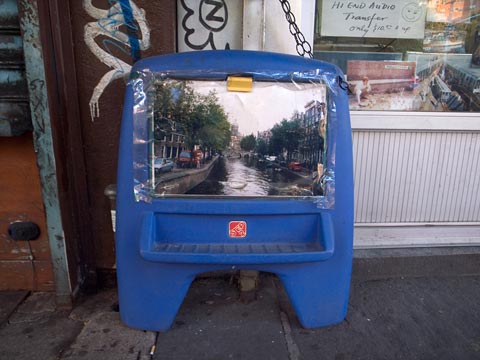
    A little bit of Amsterdam in New York.


    Midtown

    One more day of scouting buildings, then do it all over again with the view camera.

  • New York/Park Avenue


    East 40th and Park Avenue


    East 40th and Park Avenue

    Scouting more buildings around Midtown.

  • New York/LES

    Saturday and Sunday evenings I got out with the view camera on the Lower East Side. I worked into dark on Saturday taking a picture of the Blue Condo above the Essex Market against a bluish sky with a rising moon. On Ludlow I photographed a tenement building with a ground floor bar opened on the street. A poetry reading in a bookstore/cafe on Allen Street. A restaurant on Clinton Street. An open door with pool table in a bar on Houston. Last, the entrance to Katz’s Delicatessen with a saxophone player on the sidewalk. It’s difficult to know how any of these are going to come out. All were time exposures with people swirling around, and cars blurring through.

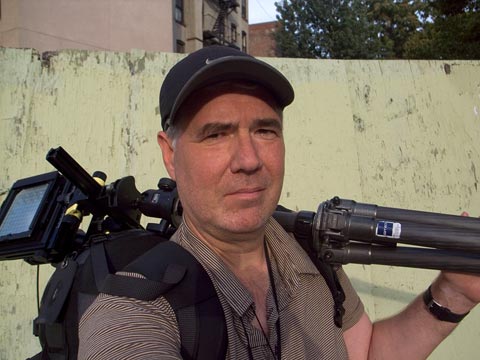
    Self-portrait with view camera, Houston Street and Second Avenue

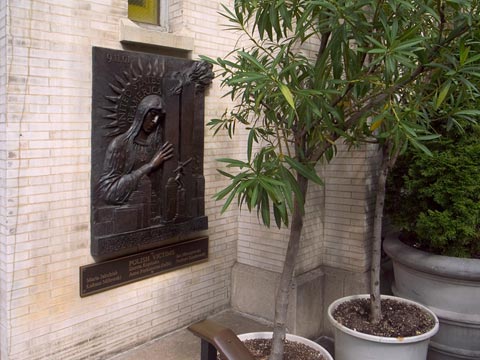
    Sunday, I began earlier with late afternoon sun still streaking between buildings and down streets. I decided to head for the Charlie Parker Jazz Festival taking place in Tompkins Square Park. Along the way I noticed the Polish 9/11 memorial in front of a church on East 7th Street. One of the more mawkish of such memorials.


    Polish 9/11 Memorial, East 7th Street

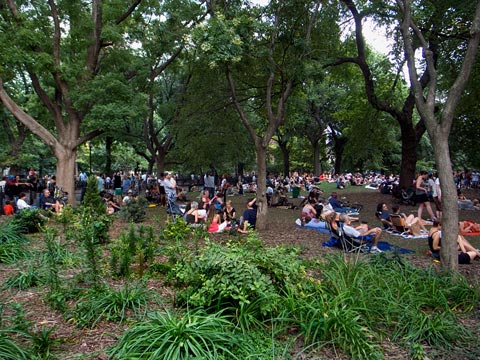
    In the park there were at least a couple of thousand people seated or standing in front of the stage as well as many who had spread out over the lawn further back. I did several photographs of the crowd, one looking toward the stage, two others of people arrayed on the grass between the trees. The music was great, and I listened for a while.

    Tompkins Square Park, Charlie Parker Jazz Festival

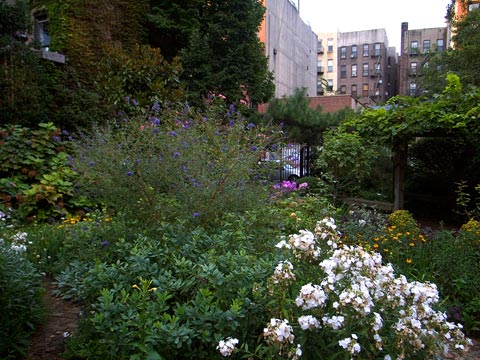
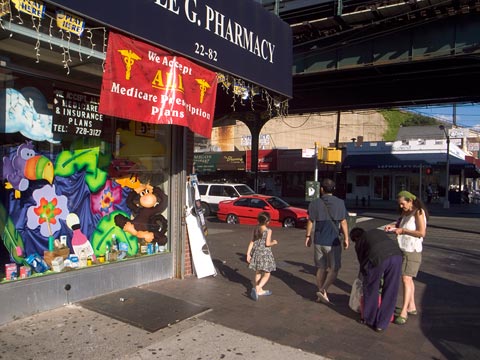
    Heading east I came across the 6 BC Garden, one of the most cultivated of the community gardens on the Lower East Side. It’s a quite a bit more designed than the others with pools, architectural structures, and well-tended paths. The tenements enclose the space all around.

    6 BC Garden, East 6th Street

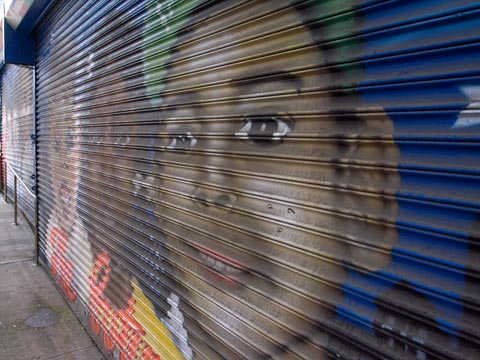
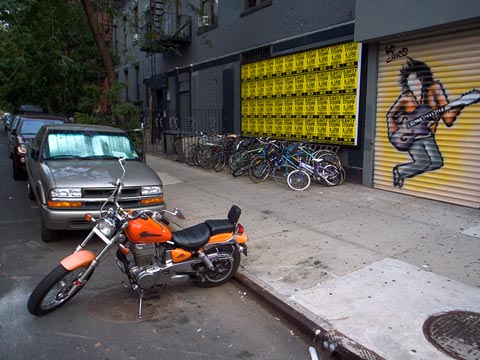
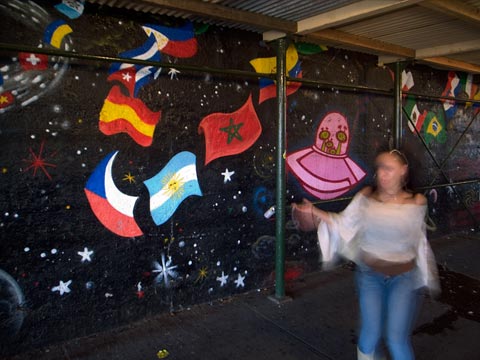
    Further east I did several pictures on or near Avenue C. Murals by Chico are everywhere in this area.


    Just off Avenue C


    East 7th Street and Avenue C

    I ended up on East 7th Street between C and D. This block was always one of the best maintained in what was once referred to as the war zone. Strong tenant organization and co-op ownership kept the buildings occupied during that period when everything around was burning or being abandoned. Now, the Flower Box Building, with loft-style apartments costing well over a million dollars, is coming to completion on what was one of the few empty lots on the block.


    East 7th Street between C and D

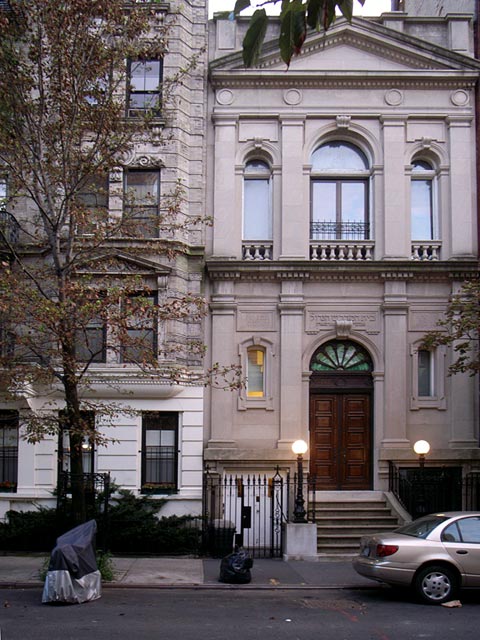
    I made a photograph of a series of stoops with decorative railings. Another of one of the housing project towers on Avenue D, and at dusk–heading back west–a synagogue and adjacent tenement.

  • New York/Around Town


    West 32nd Street
    Click here for larger rollover version

    Having finished shooting and printing the Civil War monuments project, I am now back to the 39 buildings I was photographing a few weeks ago. Actually, the 39 are done, but I’ve been given 20 more to do. So, I am all over town scouting ahead of bringing the 4×5 camera and assistant.

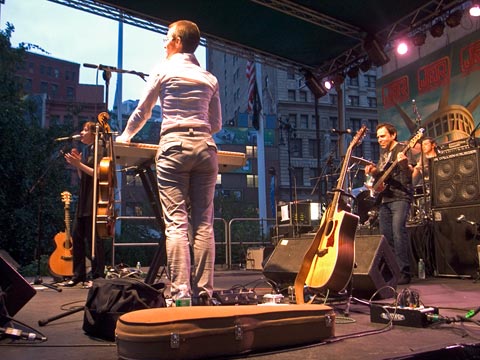
    In the evening I went downtown to see Suzanne Vega perform in City Hall Park as part of a weekend festival sponsored by J&R, the big music and electronics store. I hadn’t seen Suzanne since last fall when we were participants in a film festival in the Czech Republic. I was particularly keen on hearing her do the songs from the new album Beauty and Crime. Here’s a less than wonderful photo of her and the band taken from the side of the stage.


    Suzanne Vega and band (Mike Visceglia on bass) in City Hall Park

    I was particularly impressed with Zephyr and Angel’s Doorway, which benefit from the dirt and noise of live performance. Many of the new songs are placed in New York City, and touch on, or directly evoke the continuing presence of 9/11. And here we were, last night, one block away from ground zero. The flood lights of the site filled the sky beyond the stage where just a few days ago a fire in the partially deconstructed Deutsche Bank building killed two (more) firefighters.

    Suzanne ended her performance with the hits Luka and Tom’s Diner. I am forever connected to Tom’s Dineras some of you may know–and every time I hear it, I find myself momentarily awash in images and memories of all that has occurred since I came to this city in 1977.


    Here’s a video about the origin of Tom’s Diner.

  • New York/Lab


    Civil War test prints

    Spent most of yesterday and today in the lab working on my Civil War monuments and statues. Made 15 prints, one panorama eight feet long. Basically, I bring in my color corrected and cleaned up digital files on a portable hard drive. I load those onto the computer at the lab, and then start with a series of test prints. From there, the full sizes are printed. Inevitably, the prints aren’t exactly like the images on the monitor, so I adjust the files to get the results I want. The great thing about working here (Color Space Imaging) is that I can be in charge of the whole process from scanning to printing.

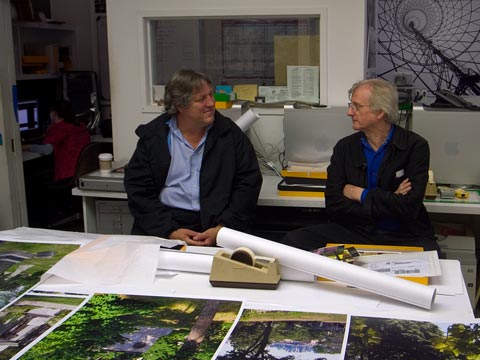
    Art Presson and Richard Pare at the lab

    Also printing today was Richard Pare who currently has an exhibition at MoMA of his photographs of early modern architecture in the former Soviet Union. Art Presson, who is putting together the Civil War exhibit at the Brooklyn Public Library came by to pick up the prints. I think he and I are both pretty happy with the images and the prints.