Author: admin

  • New York/Color Photography

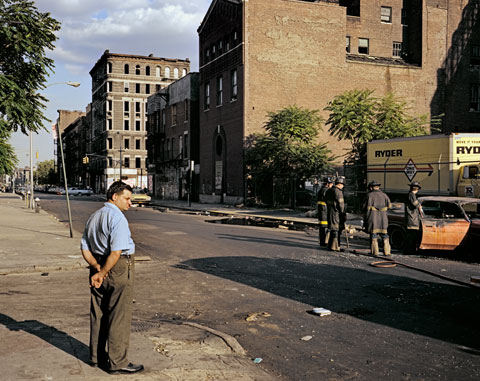
    In 1975 when I first went to art school (MICA in Baltimore) I was shooting exclusively in black and white. It was understood implicitly that fine art photographs were monochromatic–color was National Geographic and cigarette ads.

    I’d been interested in color for a couple of years going back to a single roll of slide film that I ran through my camera. I had glossy 8x10s made of two of those images. But the color photography class at MICA in those days was mostly a tedious print making exercise that I avoided. In 1976 I started shooting 35mm slide film (mostly Kodachrome), was hooked, and never went back. I left Baltimore for New York, and ended up at Cooper Union where I studied with Joel Meyerowitz. By the end of 1979 I had begun my first major project, (in color) photographing the Lower East Side.
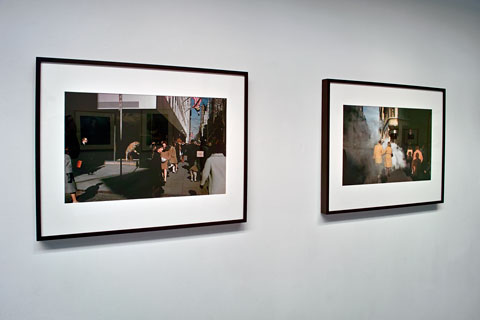

    Joel Meyerowitz images from When Color was New (digital)
    Julie Saul Gallery

    Meyerowitz was one of 20 photographers in When Color was New, an exhibition that just came down at Julie Saul Gallery in Chelsea. The exhibit, although modest in scope, covered many of the key players in what was a fairly small circle of people exploring color as a serious photographic medium. Until that time, photography was mostly relegated to the “photo ghetto,” as we called it, galleries that generally showed smallish black and white prints, and tended to favor “concerned photography” or still lifes and landscapes rendered in luscious tonalities. Plenty of good stuff in there, don’t get me wrong, but none of it cutting edge in my estimation. Light Gallery, in New York, was a notable exception, showing the most innovative work of the 1970s including color when it emerged toward the end of the decade.

    When Color was New covered the range of work done at the time including more conceptual work like John Pfahl’s as well as the multi-frame images of Jan Groover. Groover was a break out artist in the ’70s because her work was shown in a “real” gallery as opposed to a purely photographic house. What I like about these earlier constructed images by Pfahl and Groover is that you can see the artifice of the work unlike the many seamless Photoshop concoctions of the present.
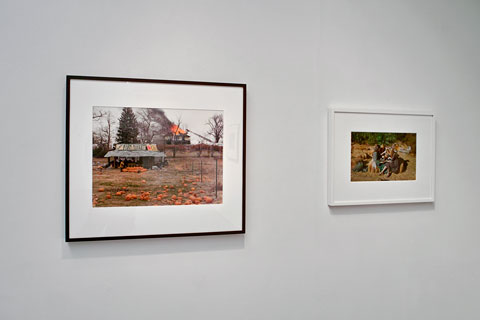

    Joel Sternfeld and Mitch Epstein images (digital)
    Julie Saul Gallery

    The show included two Meyerowitz street photographs–pictures that I was familiar with in the late 70s–vividly preserved as dye transfer prints. Dye transfers were expensive to produce, but were inherently stable pigment based prints unlike C-prints. But C-prints were possible to do yourself–I printed at a rental lab–and much of the early color work was done that way. The vintage C-prints in the show were, generally, faded and yellowed, which I suppose is acceptable from a historical collecting point of view. But it is not the way to view these previously vibrant images. It is now possible to go back to the original negatives, scan them, and achieve results that make vintage C-prints look like ancient artifacts. Even familiar images like Joel Sternfeld’s picture of the Space Shuttle or Martin Parr’s hot dog eaters, were shown faded and color shifted. These are artists who are very much alive and kicking.

    In no way to denigrate this enjoyable show, however, I think it’s time for a major survey exhibition on this important period of photography history. There are others, beyond the 20 photographers in the show who deserve inclusion–Len Jenshel and Jan Staller are two who come to mind–and I would hope my own work from that period might also find a spot.
  • New York/Waterfall

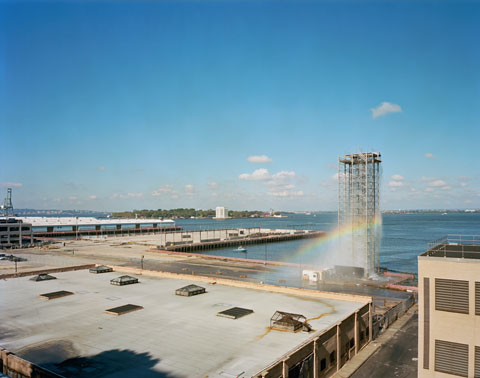
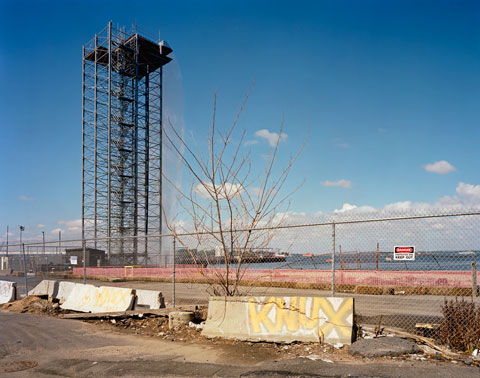
    I’ve written already about the New York Waterfalls by Olafur Eliasson, which will be coming down soon after a summer of pumping water up and over their steel scaffolds. I’m not sure this was great success as public art, but it obviously was good for the city from a tourism point of view. The water quantity–or lack of it–has been discussed. There is now concern about damage being done to trees in Brooklyn because of the constant spray of salt water. It is true, if you stand on the Promenade high above the harbor on a windy day, there is a mist of water in the air from the nearest waterfall.


    Waterfall, Brooklyn piers (4×5 film)
    © Brian Rose


    Waterfall, Brooklyn piers (4×5 film)
    © Brian Rose

    After spending a couple of days on the Brooklyn waterfront shooting for an assignment, seeing the Waterfalls mostly from behind, I’ve come to appreciate their erector set aspect, with the flow of water being a more ephemeral presence. Here are two photographs of the Brooklyn piers Waterfall–one from the Promenade, and one from the edge of the water, the scruffy area that will soon be transformed into a park.

  • New York/LES


    Delancey Street and Ludlow (digital)
    © Brian Rose

    As an architectural photographer, it is my job, to make buildings look good, and to elevate the work of the architect who designed them. That does not mean that I have to like everything I photograph. I understand better than most, how decent designs get crushed by value engineering and cost cutting. Mediocre buildings are not always first and foremost the fault of architects. Developers, builders, engineers, planners, municipal agencies, nimby activists, all can contribute to the watering down of design, even to the point of creating a bad building.


    Delancey Street and Ludlow (digital)
    © Brian Rose

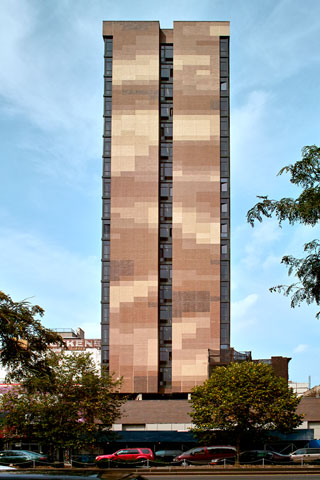
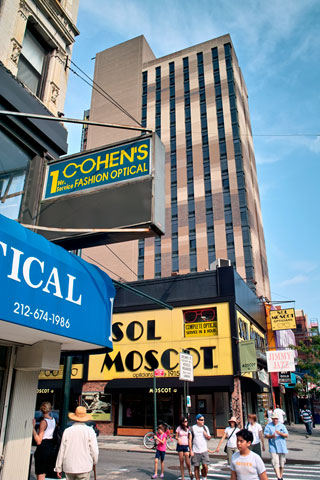
    So, I have no idea what the hell went wrong here, but I know bad when I see it. This deadening brick tower evokes a 1960s government office building in the downtown of a small regional city. Windows are apparently an expensive amenity to be avoided in this bunker-like box. Narrow slits will do. The south facing facade, especially, is largely closed off to the sunlight and view of the lower Manhattan skyline.


    Delancey Street and Orchard (digital)
    © Brian Rose

    And what to do with all the blank brick walls? I’ve seen stripes and banding, checkerboard patterns, colorful abstractions, but this is the first pixellated facade I’ve seen. Rendered in bland shades of café au lait.

    And who will occupy this wonderful edifice? Why the students of SVA (the School of Visual Arts), one of New York’s premier art and design colleges. As a dormitory it will serve as an object lesson in bad design and the destruction of the urban fabric.

    For the record, these are the culprits:

    Developer – Charles Blaichman
    Architect – Rawlings architects
    Tenant – SVA
    Commercial tenant – Bank of America (another branch bank!)


    Orchard Street (digital)
    © Brian Rose

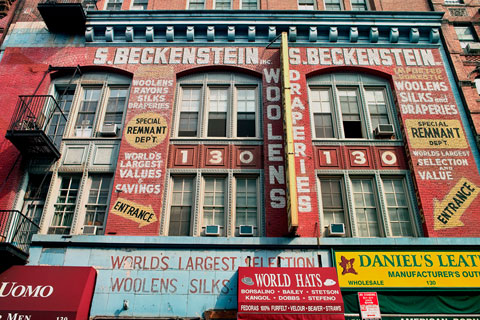
    Just around the corner from the SVA bunker, a surviving piece of the old Lower East Side.

  • New York/LES


    Delancey Street (digital)
    © Brian Rose

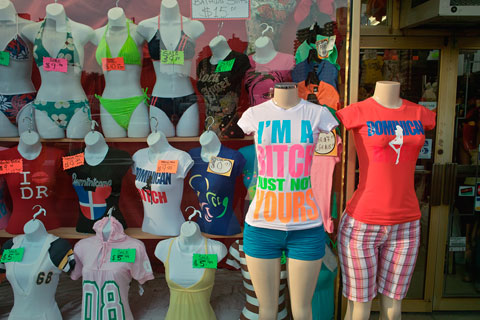
    Without comment.

  • New York/Alaska


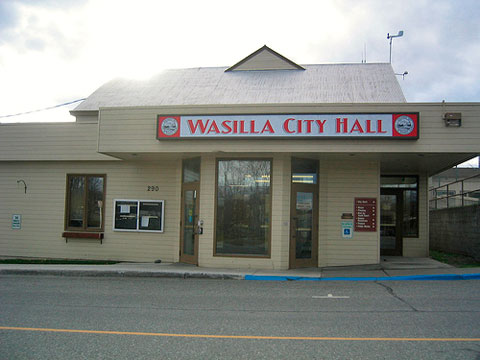
    Wasilla, Alaska (from Flickr)

    President Palin–America’s mayor/commander-in-chief.

  • New York/Williamsburg


    Williamsburg, Brooklyn
    © Brian Rose (digital)

    Without comment.

  • New York/LES


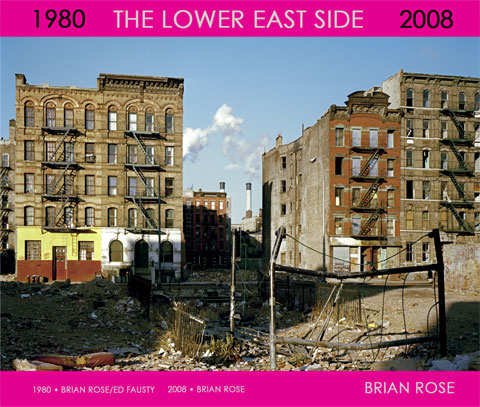
    Cover of Lower East Side book proposal
    © Brian Rose/Ed Fausty, 1980 (4×5 film)

    As I posted recently I have created a book proposal for my Lower East Side project. I have barely begun showing the book dummy around, and it could take–who knows how long?–before something becomes of this. So, in the meantime, I have put the entire book online. This will replace the previous Lower East Side web pages. Almost all the images are still here, though it is now necessary to step through the sequence in order. You can, however, hop around using the links to the text pages at the bottom. Click the cover above or go here:

    http://www.brianrose.com/lowereastside.htm

    Comments are welcome.

  • New York/A Cold War Relic


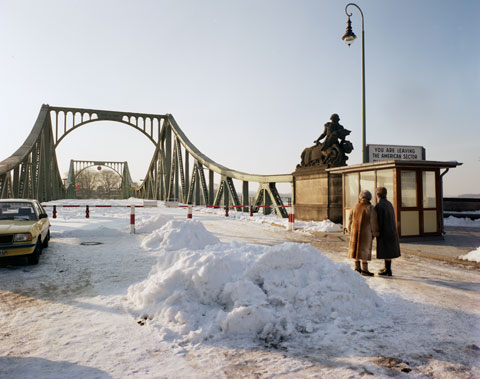
    Glienicke Bridge, Berlin • The site of many Cold War spy exchanges. • 1987
    © Brian Rose (4×5 film)

    It’s hard to believe that it has been almost 19 years since the opening of the Berlin Wall and the subsequent collapse of the Soviet Union. My photographs of the former Iron Curtain, while increasingly distant history, seem more relevant than ever with the present cooling of relations between the western powers and Russia.

    Today, I read in the Times, of the death of Wolfgang Vogel, one of the many shadowy figures of the Cold War–an East German lawyer trusted by both sides who arranged for the exchange of spies and dissidents across the border.

    From the Times:

    And in 1986, it was to Mr. Vogel that the United States turned to negotiate freedom for the imprisoned Soviet dissident Anatoly Shcharansky (later, as Natan Sharansky, a political leader in Israel). Included in an elaborately choreographed exchange of spies at the Glienicke Bridge because the Soviet authorities insisted that he was one, Mr. Sharansky exuberantly jumped into West Berlin over the border line painted on the deck.

    Vogel, as I understand it, lived opulently in East Germany, enriched by his sponsors on both sides of the Iron Curtain. After 1989 he was convicted of various financial improprieties, won on appeal, and lived out his life in a resort in the Bavarian Alps.

    He considered himself honorable in that he provided a service, helping thousands to reach freedom in the west. The East Germans needed a steam valve in their otherwise tightly sealed society, and they sought a means to bring in hard western currency. Vogel was the man for the job. He managed the human trade that bought freedom for the persecuted, while pocketing a fee for each transaction.

  • New York/The New Museum


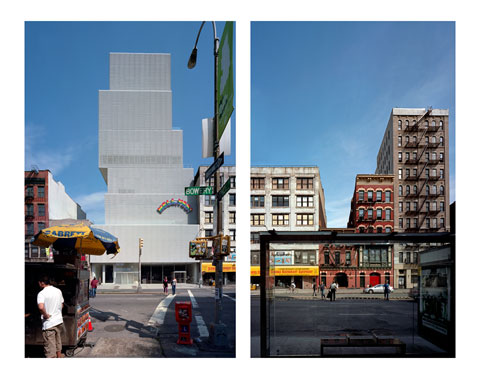
    The New Museum and scene along the Bowery (4×5 film montage)

    I’ve taken a few pictures that include the New Museum as part of my ongoing look at the Bowery at the Lower East Side. But this time I had a specific assignment to photograph the museum, especially as it relates to the immediate neighborhood.

    The obvious “best view” of the building from the street is to step back into Prince Street, which terminates perpendicular to the Bowery, to get a little distance from the tower, and show a bit of the street. I’ve also seen a nice evening view from atop a nearby building, and another one from across several rooftops. I’ve done that myself.

    But none of the pictures describes very well the way in which the intentionally misaligned stacked boxes mimic horizontally the varying vertical heights of the adjacent buildings. To do this I needed to maintain a frontal “elevation” to the facades from straight across the street. Shooting with a very wide lens didn’t work–too much distortion, and even with perspective correction, not enough of the feeling of a true elevation.

    So, I chose to use a medium wide lens on the 4×5 camera, framed horizontally, correcting perspective, and then doing a second frame above the first, this time tilting back to get everything in with plenty of sky to play with later in Photoshop. I repeated the same thing to the right of the museum. In putting the montage together on the computer the upper and lower frames stitched seamlessly pretty well, but I didn’t try to join together the left and right images. There were too many things going on between the two camera positions that prevented a seamless stitch.

    Anyway, I like the gap because there’s no attempt at hiding the artifice of the montage. The effect of a continuous street wall is maintained, nevertheless.

  • New York/High Line


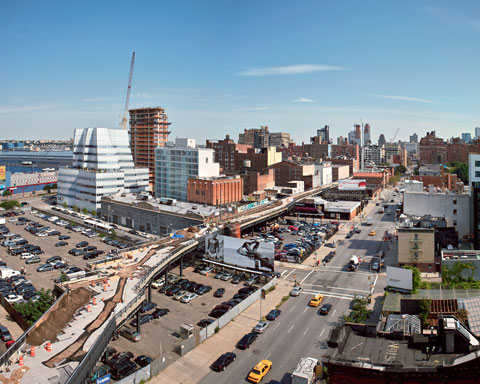
    The High Line (under construction) and Tenth Avenue
    IAC building by Frank Gehry at left

    © Brian Rose (digital)

    It amazes me how many people, even in New York, are unaware of the High Line, the former rail viaduct cutting through the west side of Manhattan from the West Village just below 14th Street up to 34th Street. After nearly three decades of disuse, the structure is being converted to an elevated park/promenade–one of the most brilliant additions to the urban landscape of New York ever.

    As a permanent piece of interactive architecture, it will change the way people see the city, and preserve a significant stretch of New York’s industrial infrastructure. Before the High Line was built in the early ’30s, Tenth Avenue was known as Death Avenue due to the fatalities caused by trains operating on surface rails in the center of the street. The High Line put the trains above the traffic and it operated until the decline of shipping and manufacturing along the west side of Manattan in the ’60s and ’70s led to its abandonment in 1980. Read more about it here.


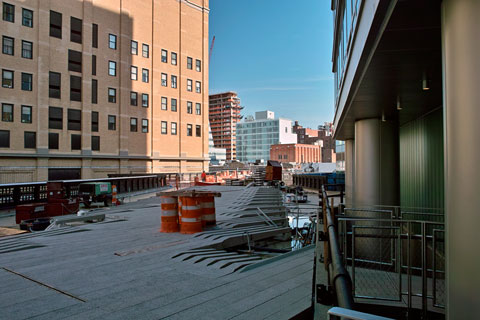
    The High Line as it snakes between buildings at 18th Street.
    © Brian Rose (digital)

    The High Line will combine a paved promenade with planting running alongside and emerging from the walkway, evoking the way in which nature flourished on the derelict structure. The design is the work of Field Operations (landscape architects) and Diller Scofidio + Renfro (architects).


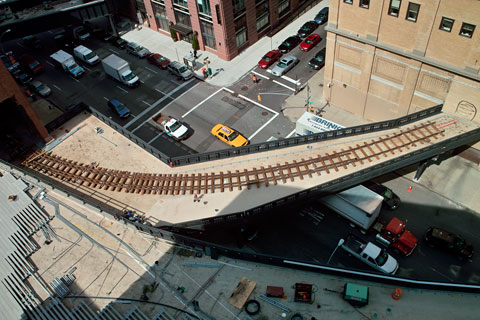
    A short stretch of the tracks that once ran the length of the High Line.
    © Brian Rose (digital)


    The High Line by Joel Sternfeld

    There are many people who are responsible for the saving and re-creation of the High Line, but from a photographer’s standpoint, of significant importance was the series of photos done by Joel Sternfeld. These beautiful large format images captured the imagination of many, and helped generate support for the project.

  • New York/Brooklyn Bridge


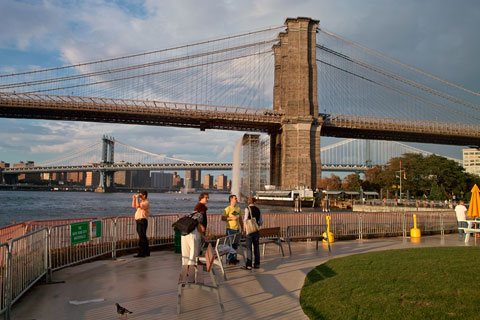
    Brooklyn Bridge, Manhattan Bridge, and one of the waterfalls by Olafur Eliasson.
    © Brian Rose (digital)

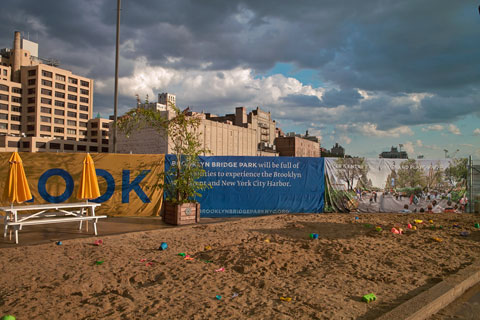
    I’m shooting for a Dutch real estate client, looking at the Brooklyn waterfront, the High Line, and the New Museum/Bowery neighborhood. My assistant Chris and I spent a long fairly arduous day in Brooklyn and Manhattan finishing up at Fulton Landing just under the Brooklyn Bridge on the Brooklyn side of the East River.

    As we approached the bridge the sky was split between a dark threatening storm cell and an expanse of mostly clear blue sky. I said to Chris, this is going to interesting, whereupon the storm unleashed itself on us and we took shelter. After 10 or 15 minutes of torrential rain, the sun broke through and the bridge and surrounding area was bathed in golden light.


    Future Brooklyn Bridge Park
    © Brian Rose (digital)

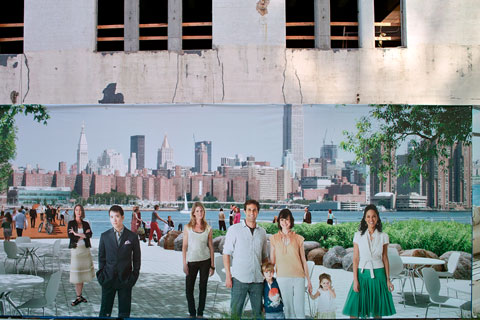
    The one picture is a fairly classic view of the bridges with one of Olafur Eliasson’s waterfalls. Not an altogether successful installation, but a tourist attraction, nevertheless. The second was made in a mini park created to promote the coming Brooklyn Bridge Park. I photographed the signage complete with the usual “happy people” that inhabit the renderings of architects.

  • New York/Tekserve


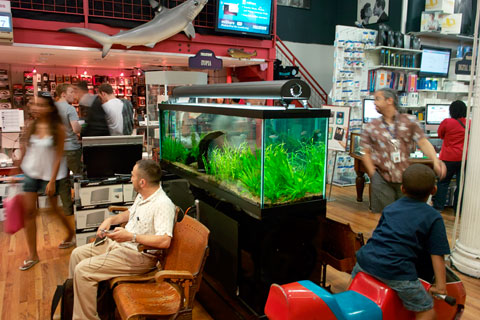
    Tekserve (digital)
    © Brian Rose

    Gurgling aquarium, mounted shark, wooden theater seats, kiddie ride, stressed out people. It has to be Tekserve, New York’s wild and wacky Macintosh repair shop. They sell stuff, too. It’s a pretty entertaining place, actually–especially when someone at the counter tells you that your laptop hard drive is dead and that it will cost thousands to recover the data. Are you backed up? I am.

  • New York/Tompkins Square Park


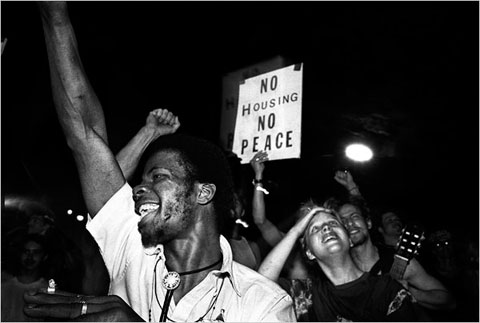
    East Village protest, 1989, Q. Sakamaki

    I have to admit being astonished to see the New York Times run no fewer than eight photographs from Q. Sakamaki’s new book “Tompkins Square Park.” This is a book about the tumultuous period during the late ’80s and early ’90s in the East Village. The black and white pictures of the showdown between squatters and activists on one side and the police on the other strike me as classic examples of what so often goes wrong with photo journalism. We as viewers are thrust into the action–whether protests, violent confrontations, or rock concerts–but are given little breathing room for a more considered view of things. History becomes rendered as a series of spasmodic incidents, character types, and visual clichés.

    It’s not that the things seen in Sakamaki’s photos didn’t happen, it’s that they happened to different people in different ways. The photographs and accompanying polemic do not offer the possibility of differing experiences of the same time and place.

    ***


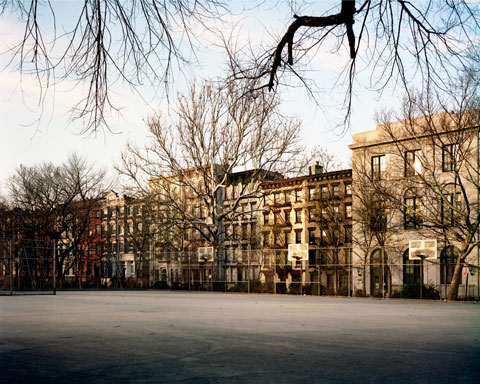
    Tompkins Square basketball courts, cold winter day, 1980
    © Rose/Fausty (4×5 film)

    I was a frequent user of the park in those days, playing basketball on the courts at the corner of Avenue B and 10th Street. We were a ragtag bunch of ex-high school stars, ex-college players, and even a few guys who played pro overseas. The basketball could be amazingly good at times, but ultimately nobody was tall enough, fast enough, or strong enough to escape life on the courts of Avenue B.

    The players were black and latino, many from the projects nearby, with a few white guys like me thrown in. And there was the incomparable Joe Ski, his last name shortened, I think, from an unpronounceable Polish appellation. Joe had the best jump shot I’ve ever seen. Not so much because his form was mechanically perfect, but because when any game was on the line, Joe would bury the winning shot. I guarded him a lot–we were both about 6’4″–and I gave him everything I had defensively. Joe’s favorite ploy was to draw me right into his jump shot–I’d go up in the air hanging all over him 20 feet from the bucket–he barely able to glimpse the rim–and somehow, miraculously, he would bang the damn thing in and walk off the court like it was the most routine thing in the world.

    There was another guy who hung out in the park in those days–his name has vanished from my brain–and he loved to watch us play basketball. I had no idea where he lived, what he did, how he survived, but I knew he wrote poetry, and he also loved to talk politics. One day we heard that our poet fan had died–of natural causes I believe–and a memorial was held on the following Saturday on the basketball court. So, we all stood there, a motley crew if there ever was one ranging from school dropouts from the projects to college grads like me. A friend read one of his poems, a starkly honest portrait of Joe Ski–a white man in a black man’s sport, too slow, not tall enough–but as magnificent a player as you’d ever see.

    The basketball players were mostly disdainful of the white anarchist types who inhabited Tompkins Square Park during the late ’80s. These were guys who grew up poor, worked hard, and in some cases, had just escaped becoming another Lower East Side statistic. Back in the late ’70s and early ’80s the park was often desolate, like much of the neighborhood around it. The squatters came later, after a lot of political activism had already secured buildings and gardens for the community–despite losing many battles–and acted like their cause was the only cause that mattered.

    ***


    E1st Street with the Cube Building in rear, 1980
    © Rose/Fausty (4×5 film)

    1988, the same year as the Tompkins Square riots, I was involved in a hard fought battle to save an abandoned building on the corner of Second Avenue and E1st Street. The city had proposed selling the Cube Building, as it was known, for a dollar to a private developer. As a member of the Cooper Square Committee, a housing advocacy group, I led the effort to get city approval and state funding to rehabilitate the building for 22 formerly homeless families. It was just one project on the Lower East Side–a drop in the bucket, perhaps–but for me a concrete triumph against the forces that others ranted, often impotently, about.

    We essentially suckered New York state into the deal claiming that it would cost about a million dollars to renovate the building, even though we knew it would likely take more. It ended up over 2 million dollars. But the state was eager, if not desperate, to give out funds earmarked for alleviating the mounting homeless problem, and we had a project ready to go.

    I remember well the critical moment when we met with state officials in the World Trade Center for final approval of our plans, such as they were. I was both terrified and sick with stomach flu at the meeting, which ended with state commitment to fund the project. Afterwards, I rushed home in a cab, feeling elated but increasingly ill, ordered the driver to stop, jumped out and collapsed on the street, throwing up on the Bowery at Houston Street, looking like just another of the hundreds of derelicts who inhabited the area at that time.

    ***


    Tompkins Square Park, jazz festival, 2007
    © Brian Rose (4×5 film)

    So, I cringe when I read this in the Times:

    “This book focuses on Tompkins Square Park as the symbol and stronghold of the anti-gentrification movement, the scene of one of the most important political and avant-garde movements in New York history,” Mr. Sakamaki writes in an introduction.

    There was no single overarching political and avant-garde movement in New York at that time. There were a great many different conflicting initiatives and struggles–there were wins and losses–and in the end, the wave of gentrification that swept over the East Village and the Lower East Side, especially after 9/11, was the result of far reaching forces extending beyond the microcosm of Tompkins Square Park that have transformed the whole city.

  • New York/Williamsburg


    Williamsburg, Brooklyn

    From the Williamsburg Bridge.


    Williamsburg, Brooklyn

    Typical Williamsburg scene.

  • New York/MoMA


    Home Delivery outside of MoMA (digital)

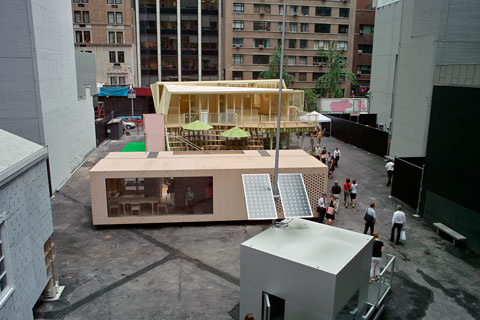
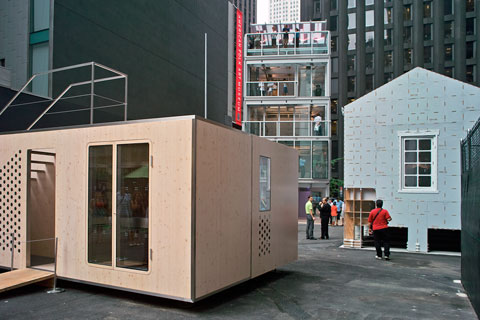
    The MoMA exhibition Home Delivery, Fabricating the Modern Dwelling continues outside on the asphalt vacant lot next door. This lot is the site of a proposed 75 floor tower designed by Jean Nouvel which the local community board rejected as out-of-scale with the neighborhood. The neighborhood being Midtown Manhattan, the greatest concentration of super tall buildings on the planet.


    Home Delivery outside of MoMA (digital)

    The collection of buildings plopped down temporarily next to MoMA is decidedly under scale for the neighborhood, ranging from a 76 square foot living cube to a mini skyscraper that required some exertion to reach the upper terrace. (Nothing for me with my sixth floor walk-up office in lower Manhattan.) The view of these odd little structures in the midst of New York’s skyscrapers is, well, endearing. But I can’t imagine the community board going for these either.

  • New York/MoMA


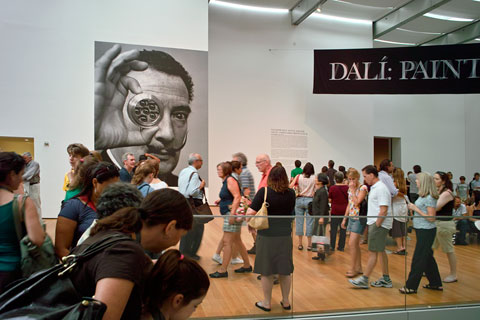
    The Dali exhibition at the Museum of Modern Art (digital)

    Continuing my visit to MoMA. I find it increasingly difficult to deal with the crowds of people in the museum, and though the building’s design has been generally hailed, I find it less comfortable than any of the museum’s previous incarnations. The circulation area where the escalators lead up and down is particularly crowded and even gloomy. I yearn for a more open transparent series of vertical movements, perhaps two or three, to somewhat disperse the crush of cultural consumers.


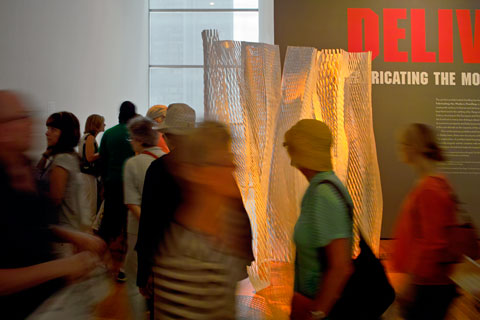
    Vector Wall by Reiser and Umemoto at MoMA (digital)

    At the top floor where I was going the crowd was thick as flies due to the popular Salvadore Dali exhibition, but the modular housing exhibition Home Delivery was heavily trafficked as well. I took a couple of pictures in the entry areas of both shows–Dali’s visage hovering above the flood of people–the diaphanous Vector Wall by Reiser and Umemoto glowing and undulating.

    Unfortunately, photographs were not allowed inside the Home Delivery exhibition, and so–the freedom to express myself as a photographer curtailed (for whatever good reason the museum may have)–I will refrain from talking about the contents inside. But on to the modular houses outside…

  • New York/MoMA


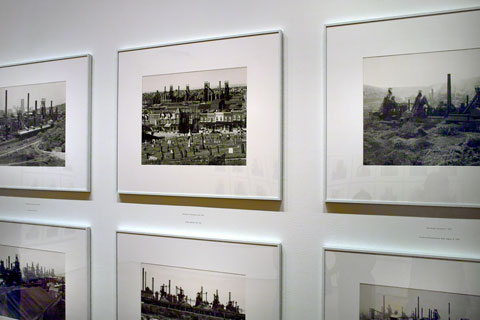
    Photographs by Bernd and Hilla Becher at MoMA (digital)

    I went to the Museum of Modern Art yesterday to see Home Delivery, the exhibit on pre-fabricated housing, but along the way, cruised through the photography galleries. I was dismayed to see yet another major Bernd and Hilla Becher exhibition, at least at first. Don’t misunderstand, I have always greatly admired their work and appreciated the dogged passion underneath their coolly conceptual approach to architecture and landscape. Sadly, Bernd Becher died last year.

    But no artists I can think of have been more overexposed in the past decade or so than the Bechers. Not only is their work featured in virtually every survey of recent photography, we are reminded constantly of all the photographers who have been influenced by them as teachers, notably the Germans Gursky, Ruff, and Struth. All worthy artists, I am particularly fond of Thomas Struth’s pictures. I just think it’s time for curators to move on.

    As I walked through the Becher exhibit, however, I found myself recalling why I like their work–despite its ubiquity–and was very happy to see two walls of images less rigorously centered on a particular building type where the landscape surrounding their objects of single-minded observation is allowed a greater role. There were two series, one which dealt with steel mills with the blast furnaces and attendant structures arrayed against the horizon.


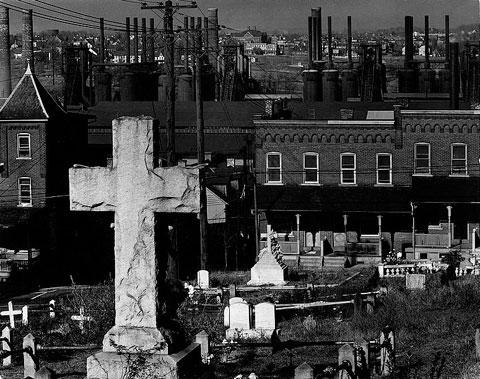
    Bethlehem, Pennsylvania, Walker Evans (1935)

    One scene in Bethlehem, Pennsylvania looked familiar–and then it flashed in my head. The same cemetery, row of houses, and distant factory were photographed in the 1930s by Walker Evans. The Bechers were undoubtedly aware of the quotation, and I was pleased to see them acknowledge this connection to photographic history and to one of the icons of landscape/documentary photography.

    But enough about the Bechers.

  • New York/The Bronx


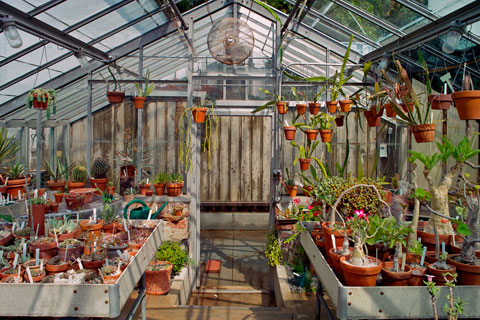
    Wave Hill greenhouse

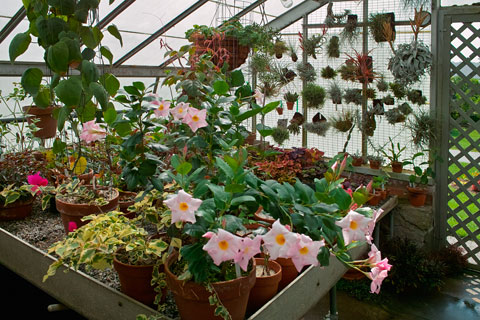
    Just a summer interlude. A visit to Wave Hill, an estate turned into public garden and cultural center. A showery day, we ducked in to the greenhouse to avoid some raindrops.


    Wave Hill greenhouse