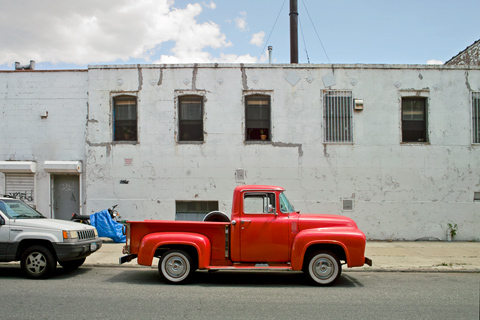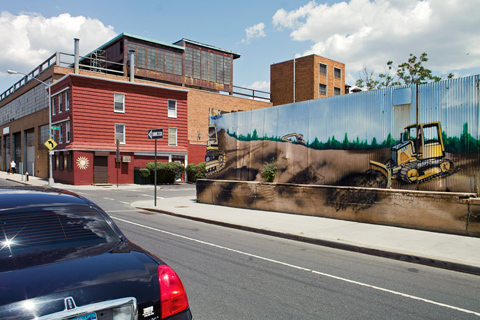
Williamsburg, Brooklyn — © Brian Rose
Without comment.
Williamsburg, Brooklyn — © Brian Rose
Without comment.
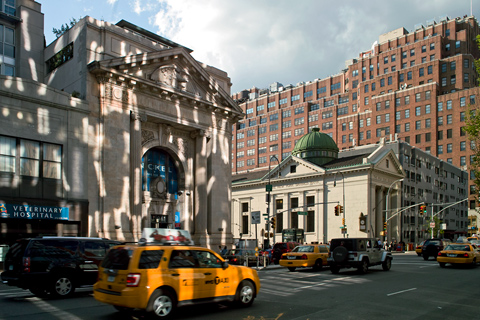
14th Street and 8th Avenue — © Brian Rose
Without comment.
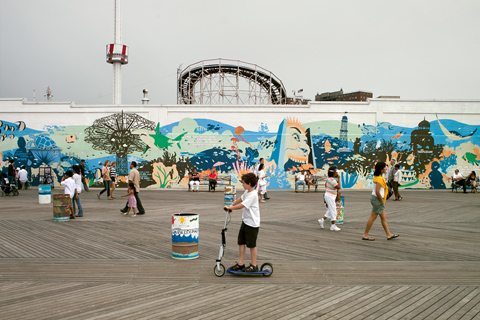
Coney Island boardwalk — © Brian Rose
It was a humid, though not particularly hot, day in Coney Island. Languid, drained of energy. Brendan rode the Cyclone with his uncle Willem visiting from the Netherlands. I declined. Took a few pictures around the roller coaster and up on the boardwalk. Had hot dogs at Nathan’s–boys with inflatable flag rifles playing. Showers moved in, and we retreated to the subway for the ride back home.
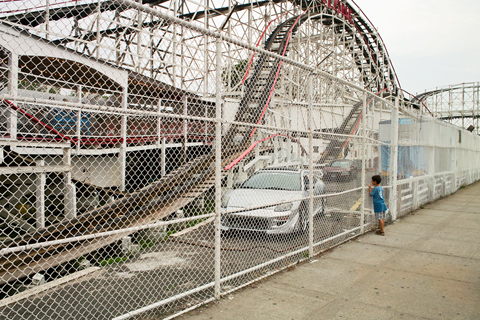
The Cyclone roller coaster — © Brian Rose
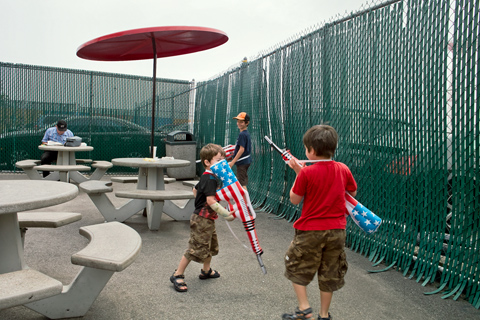
Nathan’s Hot Dog picnic tables — © Brian Rose
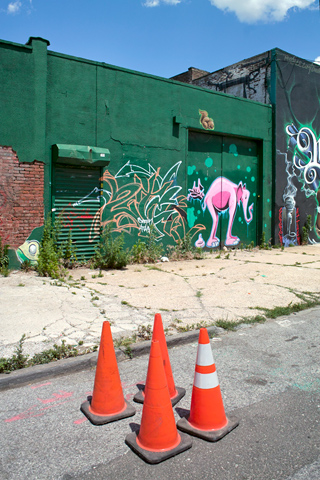
Williamsburg, Brooklyn — © Brian Rose
Not final until the acquisitions meeting in a few months, but I think I can safely report that the Museum of Modern Art is purchasing two of my prints. One from the Berlin: In From the Cold series, and one from Amsterdam On Edge.
Two very serious 4×5 pictures–unlike the orange cones and pink elephant above. But hey, can’t be serious all the time.
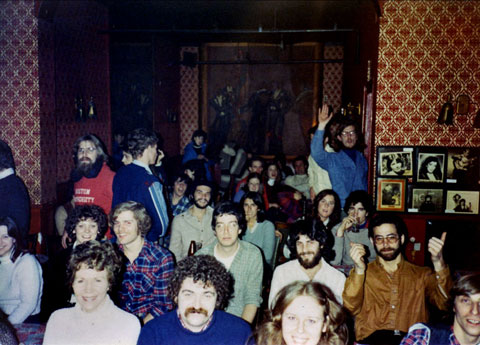
Folk City crowd in 1978 as seen from the stage — © Brian Rose
When I first arrived in New York in 1977 as a budding photographer and songwriter, I discovered Folk City, the club that was the center of the New York folk scene in the 60s. Bob Dylan, Joan Baez, Dave van Ronk, Phil Ochs and a host of others played the club and established its reputation. By the time I showed up looking for other songwriters and a chance to play, most of that older generation had moved on.
After playing the open mic (called the hoot) for a few weeks, and not hearing much to be inspired by, I began to wonder if the folk scene was permanently dead. One Monday at the hoot, while waiting for my number to come up, and my chance to perform two songs to a bored audience of other performers, a string of a dozen amazing songwriters went on stage and blew me away. One of them was Jack Hardy, the leader of the New York folk scene, and I recall that David Massengill and Rod MacDonald played as well. The inexplicable run of talent, I later discovered, was due to the fact that the hoot numbers were not exactly picked randomly, and once I became part of the Folk City family, I, too, benefited from the system.
The hoot numbers were distributed under the benevolent dictatorship of owner Mike Porco, who had started Folk City in 1960 at its original location on East 4th Street. Even after becoming a fixture of the Monday night hoot, Mike wasn’t sure I was ready for a gig –“you need a following”– but Jack persuaded him to let me play. So, my first gig was at Folk City, and I subsequently opened for a number of acts there, but never headlined. After Mike sold Folk City, I began to play at the Speak Easy, a falafel joint around the corner with a backroom performance space.
It’s been fifty years since Folk City was established. A couple of months ago, I was contacted by Bob Porco, Mike Porco’s grandson, about photographing an event he was organizing to celebrate the club’s anniversary. That event happened two nights ago, and the pictures that follow are random highlights from the show, a little skewed toward my generation of performers. The show took place in the basement of the last location of Folk City on West 3rd Street, a club now known as the Village Underground. Before the night was over, I was asked to play, and I took the stage and played my song Roll with the Wind (which I performed in my first gig at Folk City) accompanied by the incomparable Frank Christian and Mark Dann. I had a blast.
Check out these blogs:
http://www.folkcityatfifty.blogspot.com/
http://www.beachamjournal.com/journal/
http://ronolesko.blogspot.com/
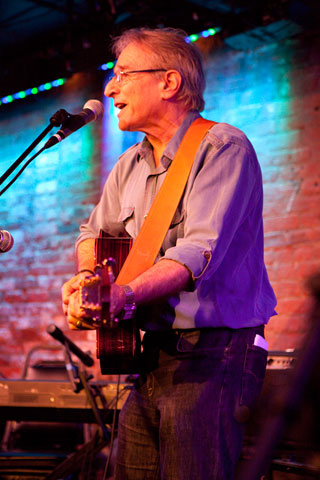
Happy Traum performing Dylan’s Buckets of Rain
— © Brian Rose
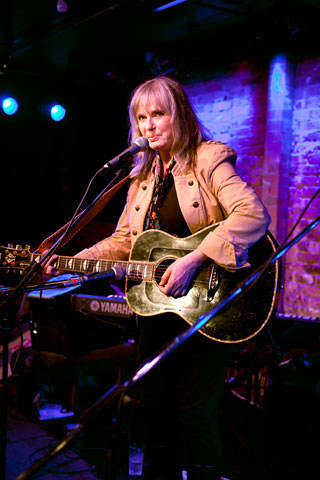
Sylvia Tyson performing her song You Were on My Mind
— © Brian Rose
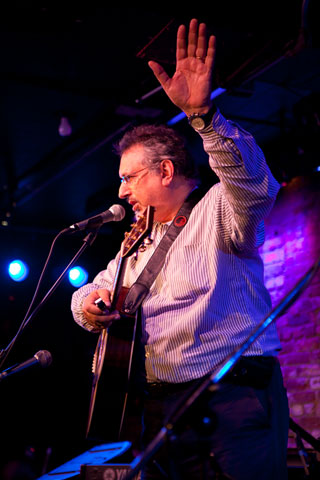
David Bromberg — © Brian Rose
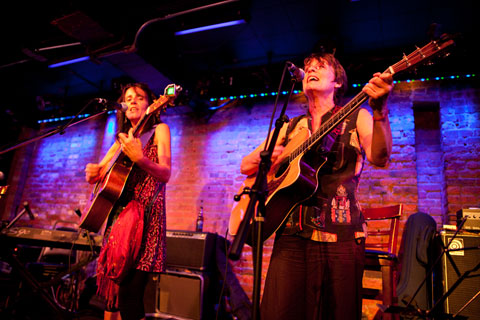
Suzzy and Terre Roche performing their song Face Down at Folk City
— © Brian Rose
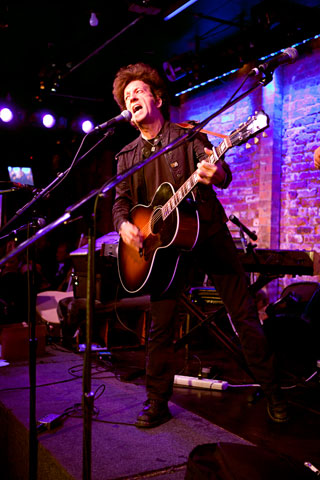
Willie Nile — © Brian Rose
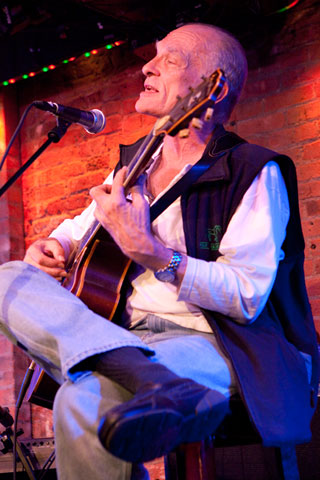
Erik Frandsen performing his song Unique New York
— © Brian Rose
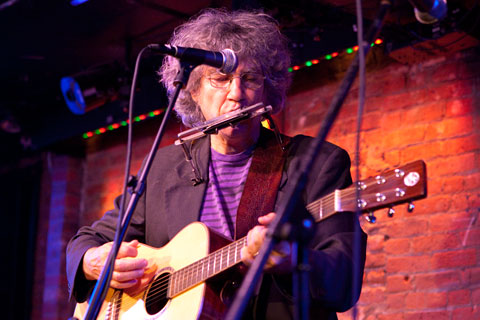
Rod MacDonald performing his song Amercan Jerusalem
— © Brian Rose
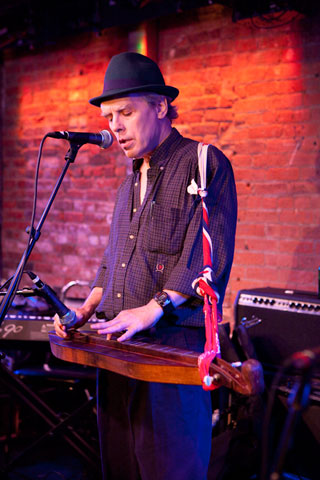
David Massengill performing his song On the Road to Fairfax County
— © Brian Rose
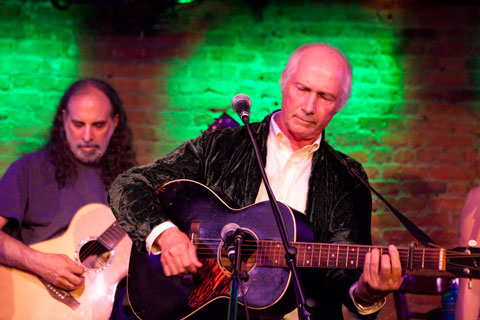
Jack Hardy with Mark Dann performing his song Go Tell the Savior
— © Brian Rose

The Bowery (4×5 film) — © Brian Rose
Events are typically presented in photography or TV as spontaneous despite the fact that they rarely are. Most events are staged and the image makers oblige the image controllers by taking camera positions given them, and picture editors tend to use images that meet certain expectations of what events are supposed to look like, staged or unfolding spontaneously. Movie makers further create expectations of how events are experienced, how events are supposed to look, by carefully constructing experience as multi-view bursts of overlapping time, close up, stylized, and packaged.
But that is not the way events are actually experienced, at least from my perspective. Things happen or develop off camera and only briefly intersect with my consciousness–or lens. The putative event is often at a distance, fleeting, barely apprehended, elusive to the eye. Eyewitnesses are notoriously unreliable. They see what they think they see in the confusion of real time, the chaos of unfolding visual signals, unordered, unedited, unmediated. The camera is a dull witted eye.
President Obama’s motorcade drove through the Lower East Side, and swept up the Bowery. It was a passing incident noted by some, not by others. Probably unknown to him, he drove right by Shepherd Fairey working on a mural on the same spot where one of Fairey’s famous hope portraits was painted during the presidential campaign. A small crowd formed at the corner of Houston and Bowery awaiting the arrival of Obama. The police were, on the one hand, relaxed and blasé, as is typical of authority in New York. But on the other hand, a police truck was cruising up and down Houston Street clipping bicycles off of poles, tossing them arrogantly and carelessly onto a pile of dozens of other potential–pipe bombs??
I set up my view camera on the Bowery a quarter of a block from the corner in the midst of restaurant supply workers hauling stuff around on the sidewalk while some architects were discussing work for the interior of an art gallery. The motorcade approached, signaled by a few whoops of police cars, a hovering helicopter, some flashing red lights. The black cars and SUVs rounded the corner, and for a few seconds everyone turned, froze, and stared. Within seconds the event was over, the prosaic flow of work on the Bowery resumed. The most famous person in the world was a few blocks up the street, out of sight out of mind.
History witnessed.
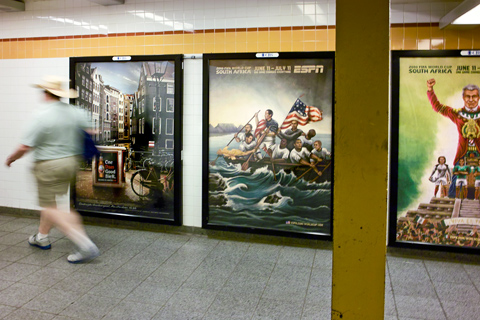
14th Street and 8th Avenue — © Brian Rose
Without comment.
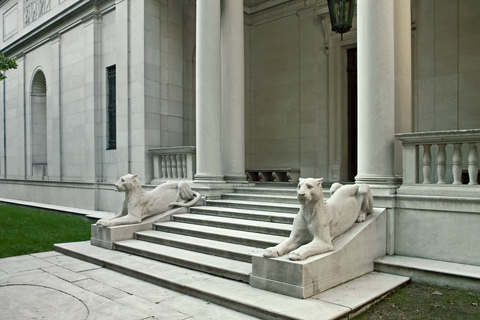
The Morgan Library, Sculptor Edward Clark Potter (1857-1923) — © Brian Rose
Everyone knows the majestic lions in front of the New York Public Library at Fifth Avenue and 42nd Street. Far less appreciated are these female lions guarding the steps of the Morgan Library on East 36th Street. Both sets of lions were carved by Edward Clark Potter, a sculptor known especially for his life-like depictions of animals.
I was in the Morgan to see an exhibition on romantic gardens curated by Betsy Barlow Rogers, the former head of the Central Park Conservancy. I worked for Betsy early in my career making photos of the park, which were used, in part, for fundraising purposes. I also did more utilitarian photographs for park publications and events. I was offered the job as first full time photographer of Central Park, which I turned down, as tempting as it was–I wanted to remain a free lance photographer. In retrospect it may not have been the best career decision, but it’s doubtful that I would ever have begun my Iron Curtain/Berlin Wall project had I taken the job.
While at the Morgan I also saw an exhibition on the influence of Palladio on American architecture–which was serendipitous since my son is doing a school project on Colonial American architecture. And I saw drawings by Albrecht Dürer including his famed Adam and Eve.
In the main library I saw an original manuscript of Magna Carta from 1217. Here’s a bit from the library’s press release:
One of the earliest original manuscripts of Magna Carta dating to 1217 goes on exhibition Wednesday, April 21, at The Morgan Library & Museum. This extremely rare and important document came to New York for a special event for Oxford University but could not be returned to Britain because of the disruption to air traffic caused by the recent volcanic ash cloud. The Bodleian Library generously offered the Morgan the opportunity to exhibit Magna Carta while new arrangements were being made to transport it back to England. The document is on view at the Morgan through May 30.
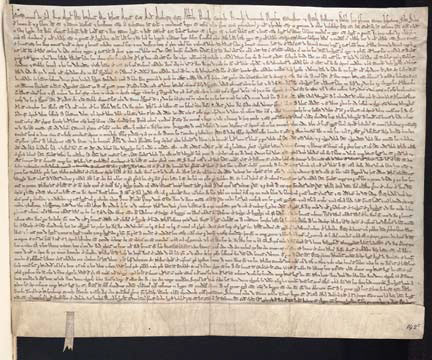
As I have noted elsewhere, there are those who would set aside many of the principles set forth in this document, which served as the foundation for the U.S. Constitution and Bill of Rights.
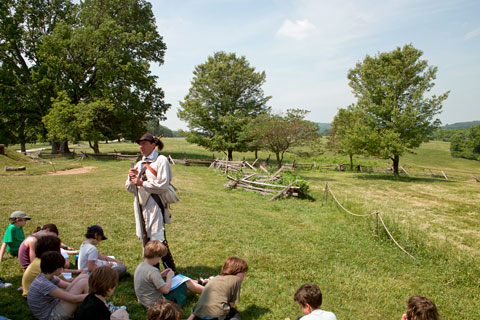
Valley Forge, Pennslvania — © Brian Rose
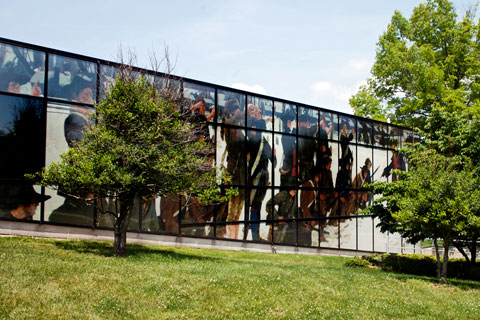
Valley Forge, Pennsylvania — © Brian Rose
The same morning my letter appeared in the New York Times (see post below), I accompanied my son’s 5th grade class on a field trip to Valley Forge. For me, it was a day of reflection on the values we pass on to our children, and the ongoing struggle to maintain the principles this country was founded upon. The distortion of these principles by people like John Yoo, who wrote the legal memos justifying the use of torture by the Bush/Cheney administration, shame the memory of those who suffered on this field in the winter of 1777.
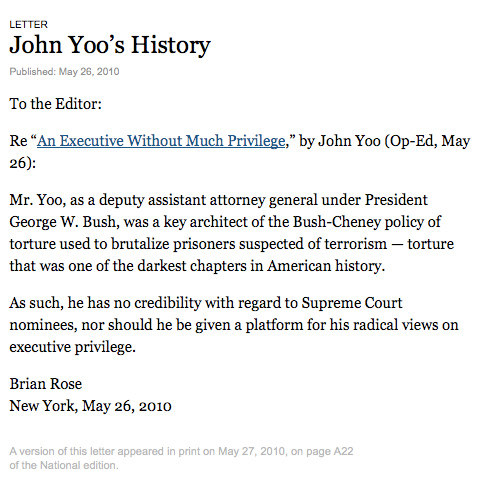
This morning at a cafe on Hudson Street in the West Village, I read John Yoo’s New York Times op-ed piece in which he casts doubts about Elena Kagan’s qualifications for the Supreme Court because of her apparent views about “circumscribed” executive power. I was dumbfounded that Yoo would be given nearly half the op-ed page of the Times. Instead of standing trial for war crimes along with Bush and Cheney, he is rewarded with a professorship at Berkeley, and writes books and opinion pieces.
So, I pulled out my iPhone and wrote the letter above. Within two hours I heard from the Times, and was asked to approve a couple of minor edits to the original text. I still don’t think they should have printed Yoo’s article, but I give the Times credit for at least acknowledging the elephant in the middle of the room with regard to Yoo’s damaged moral and intellectual credibility.
More photographs from my Amsterdam on Edge series made between 1992 and 2007.
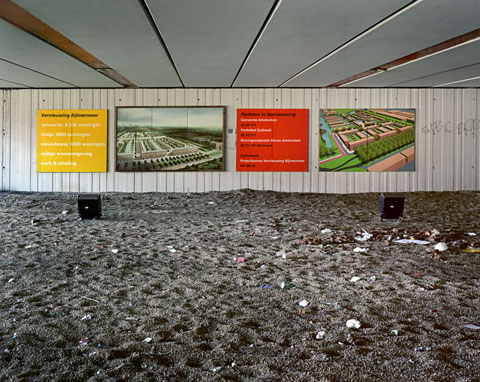
Amsterdam (4×5) — © Brian Rose
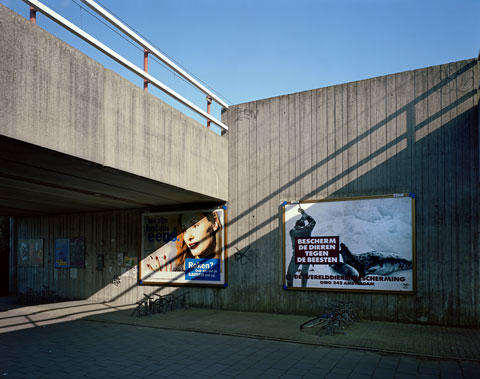
New plans for the Bijlmer, a troubled neighborhood built from scratch in the ’70s, in a passageway beneath a train viaduct.
Amsterdam (4×5 film) — © Brian Rose
In the south of Amsterdam alongside the same rail line, advertising signs convey social messages.
Amsterdam (4×5 film) — © Brian Rose
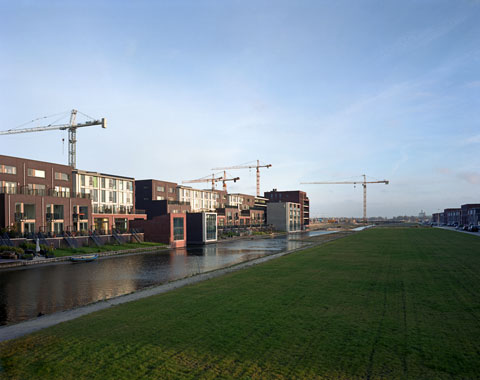
Ijburg, the latest new neighborhood in Amsterdam.
Cafe on W54th Street near 10th Avenue
Cafe on W54th Street near 10th Avenue
Without comment.
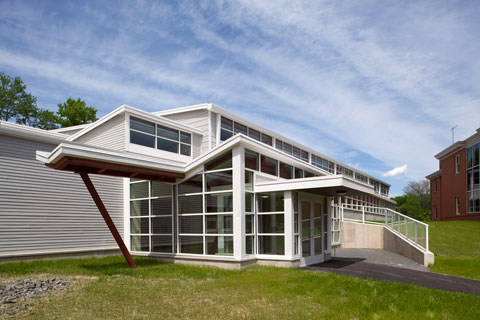
Princeton Charter School — © Brian Rose

Princeton Charter School — © Brian Rose
I finally got the files from last week’s photo shoot out the door–14 digital images of Princeton Charter School. This being Princeton, the school is pretty posh compared to my son’s public school building in the West Village of Manhattan. The new building contained a gym, black box theater, and art and music classrooms.
I did a number of shots at dusk and just after, but it almost didn’t happen. As magic hour approached, we were shooting in one of the classrooms when all the power in the building suddenly went down. The fire panels whined and error messages flashed, and my assistant and I tried pressing various buttons, but were flummoxed. I got the client on the phone who came rushing over–he lived nearby–and he somehow figured out the system and got the power up just in time for us to catch the fading daylight. (See photo above.) No matter how much you prepare for a shoot, there are always a million things that can go wrong.
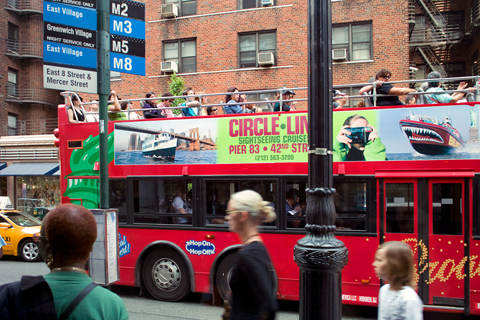
Greenwich Village — © Brian Rose
It’s nice weather and the open top red buses are full of tourists gawking at us like we’re wild animals in an African game park.
I was at the Museum of Modern Art today meeting with one of the curators. It went well–left my portfolio to be looked at further. Hope something good comes of it.
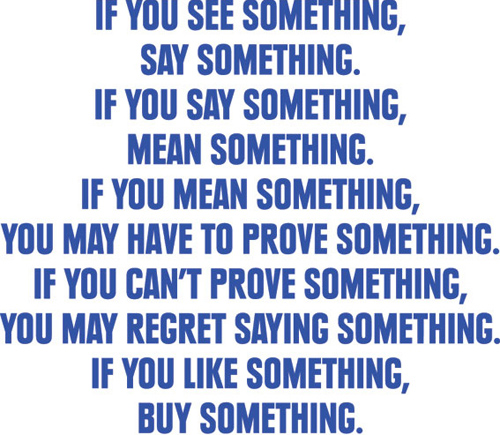
A few days ago I posted a musical response to the “if you see something say something” subways signs, which were recently written about in the New York Times. I thought my song was the ultimate retort, but yesterday, in the Times, actor Rick Moranis, came up with something–a really funny and brilliant something. Click on the image below for the full something.
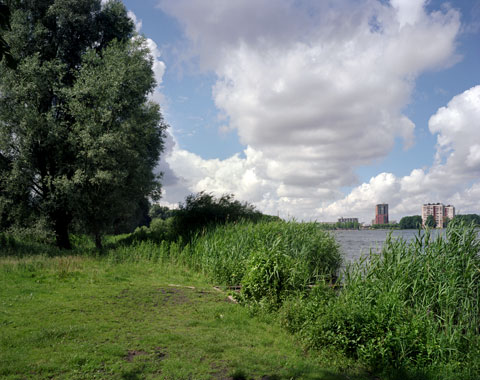
Sloterplas, Amsterdam (4×5 film) — © Brian Rose
Continuing with new scans of the Amsterdam On Edge project I did during the 15 years I lived in Amsterdam. The photographs were made mostly on the periphery of the city, or its rougher inner edges.
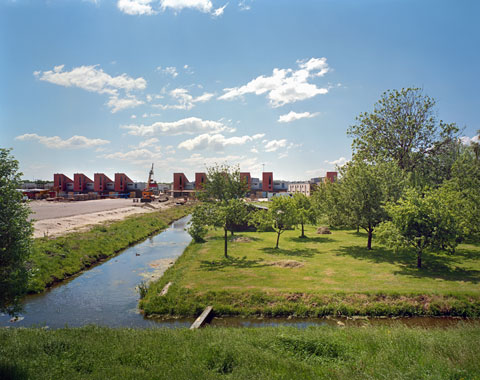
South of Amsterdam (4×5 film) — © Brian Rose
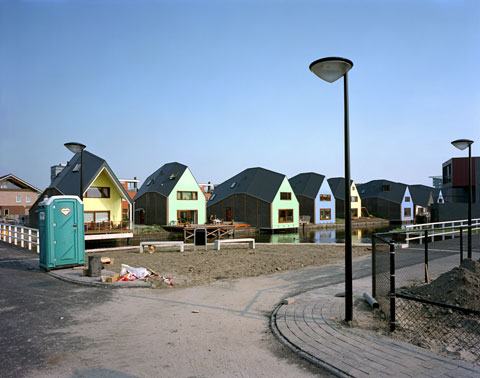
Almere (4×5 film) — © Brian Rose
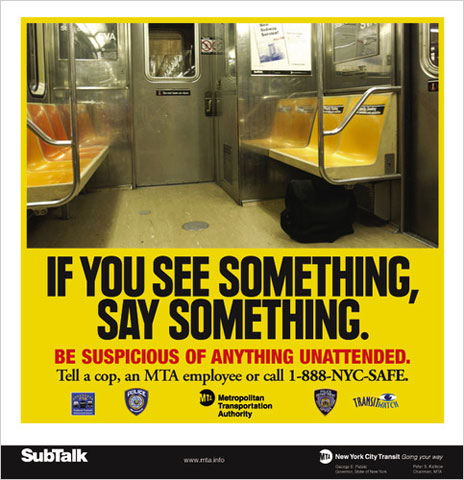
We’re all a bit jumpy here in New York since the discovery of an SUV in Times Square with a makeshift bomb in it, though it was a fairly crude device that had very little chance of working in the way it was intended. The ease with which something like this can be placed is unnerving, but the fact that people (a t-shirt vendor for one) responded alertly was gratifying.
In this morning’s New York Times there is an article about the phrase “If you see something, Say something,” which has become ubiquitous on ads in the subway system. The slogan was penned by Allen Kay of Korey Kay & Partners on assignment from the Transit Authority. It’s meant as an unintimidating prod, post 9/11, to stay watchful for potential terrorism. For many, however, the phrase, which has seeped into the consciousness of the city and beyond, is one more sign of a growing paranoia that is eating at our souls and our sense of confidence as a society.
Not long ago I wrote a song based on the phrase, played it once at Jack Hardy’s songwriters’ exchange, but have never recorded it. This morning, after reading the article, I pulled out a cheap microphone, fired up Garageband, and the result can be listened to here:
if you see something say something
the man in the coat looks uncomfortably hot
he prays from a book he rocks back and forth
the train rumbles through the rock blasted earth
eyes shift in sockets there’s a bulge in a pocket
ipods play private reveries
roll on roll on subterranean train
through the blind tunnel of fate
roll on roll on with a fearful freight
if you see something say something
before it’s too late
school kids swarm in and swing from the poles
a mariachi band plays besame mucho
a family from somewhere not anywhere near here
clings to their map of the world underground
ipods play private reveries
down in the glare air conditioned hades
fire and brimstone in an unattended package
each sudden lurch and with each random search
eyes pry deeper into unattended musings
ipods play private reveries
© Brian Rose
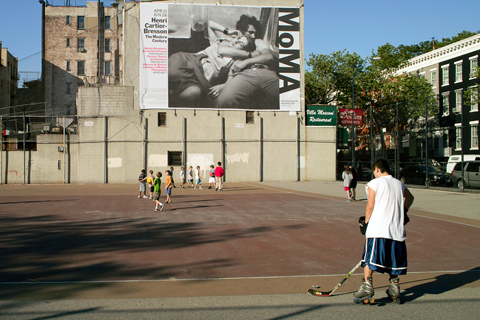
Houston Street and MacDougal — © Brian Rose
I saw the MoMA ad for the Cartier-Bresson show and began taking some snaps through the chainlink fence. Within seconds I was accosted by a man who requested/demanded that I stop photographing the children. I told him I was photographing the whole scene, not the kids in particular, and that I would not take any more pictures, because he had asked. As I began to walk away, a girl on the other side of the fence asked if I was “videoing” them, and I answered, “no, just still photos.” The man, presumably a teacher at a nearby private school, then admonished the girl for talking to me, saying “you know what we’ve said about people like that.”
I understand the concerns about protecting children from predators–I am, after all, the father of an 11 year old boy–but this is simply another example of the demonization of photographers. Had I wanted to surreptitiously photograph the kids, I could easily have done so without being noticed. Moreover, I was standing on a public street, and the students were using a public park, not even a private school playground, for recreation. A pattern of undue interest might well be considered worthy of some level of intervention. But simply taking photographs in a public place where kids are playing does not constitute suspicious behavior, and it is certainly not illegal.
More photos of children in public places:
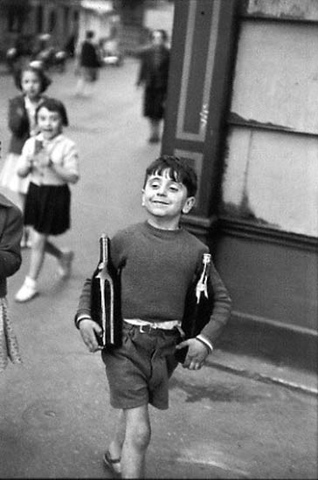
Photograph by Henri Cartier-Bresson
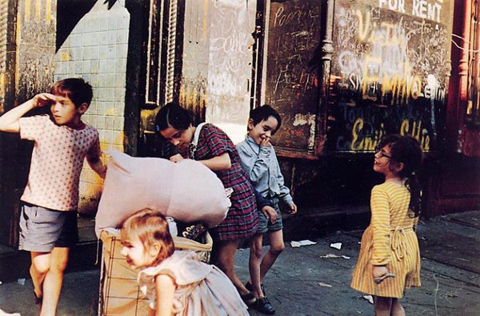
Photograph by Helen Levitt