Author: admin

  • New York/Lower Manhattan


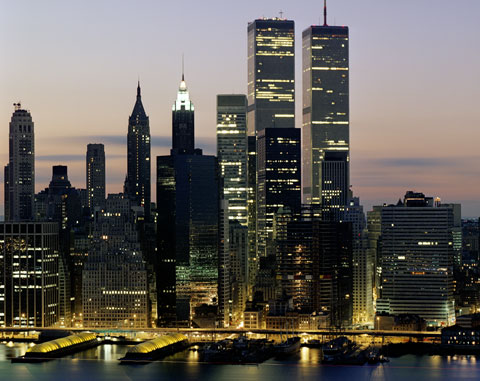
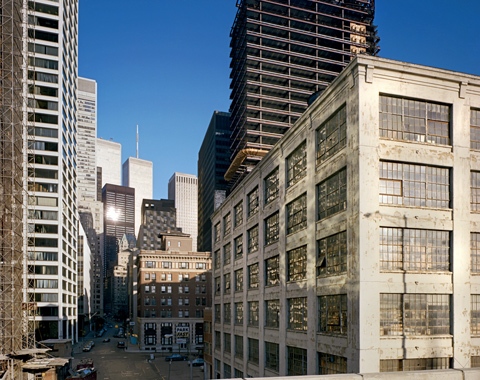
    Maiden Lane from the FDR Drive, 1981 — © Brian Rose/Ed Fausty
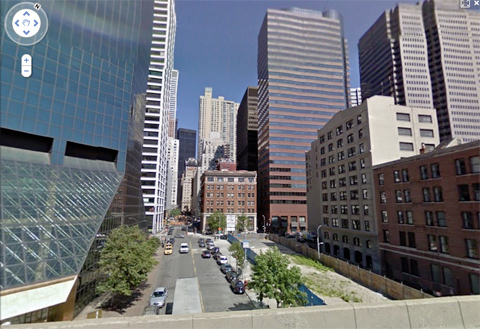

    Google street view of Maiden Lane from the FDR Drive

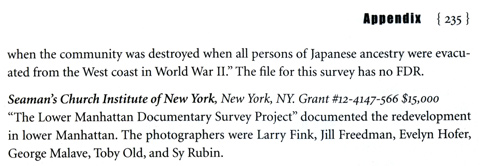
    In the previous post I began discussing Through the Lens of the City, NEA Photography Surveys of the 1970s by Mark Rice. From 1978 to 1981 the National Endowment for the Arts funded documentary photography projects around the country. I was a participant in the Lower Manhattan survey, which began in 1981. In the appendix of the book is a list of all the surveys, but my name (and Ed Fausty’s) is not included among the photographers doing the New York project.

    The quick explanation is that one of the original participants, Evelyn Hofer, was unable to take part–for reasons I can’t recall. Although my memory is fuzzy, I believe that Sy Rubin, another of the photographers, asked me and Ed Fausty to step in. Sy, who at that time ran the Midtown Y photography gallery–an important gallery and photographer’s clubhouse–knew us from the Lower East Side project, and was one of the organizers of the Lower Manhattan survey. I am only one of many photographers mentored by Sy Rubin, a man of great generosity with a discerning eye. Sy Rubin died a few years ago.

    The Lower Manhattan survey project was eventually exhibited in 1984 at Federal Hall on Wall Street. I have not been able to find much about it on the internet, but here is an article that ran in the New York Times–and proof that Ed Fausty and I were indeed included:

    It is interesting that Lower Manhattan is described in the article as humming with activity, “more so recently – when it seems never to shut down – than in past years when keyed to office hours.” It is true that artists had moved into many of the smaller commercial structures of the area, but compared to the present, the Financial District was desolate after hours and on weekends. Moreover, there are no longer any “musty, narrow byways.” Narrow streets, yes–one of the pleasures of walking the area is retracing the original Dutch layout of New Amsterdam. But musty, no. The picture above was taken from the roadway of the FDR Drive on a Sunday morning. Try doing that now.
  • New York/Lower Manhattan


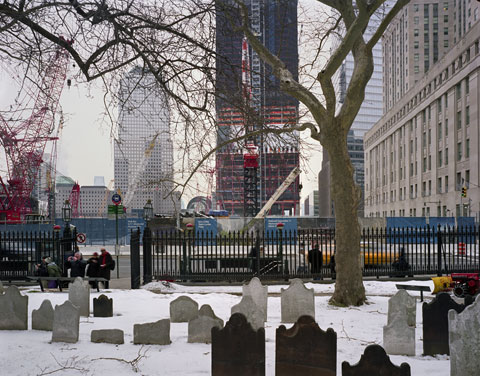
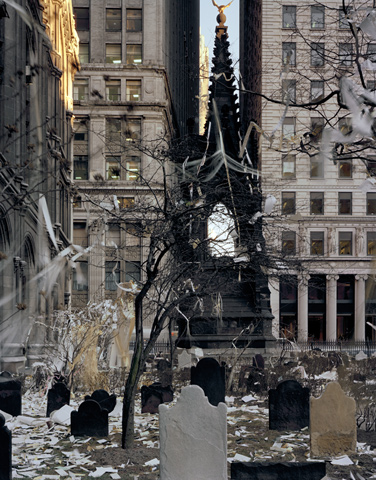
    Trinity churchyard (4×5 film) — © Brian Rose

    The images of the World Trade Center recently posted were not made as a specific project to photograph the Twin Towers and the WTC complex. They come from a more comprehensive look at Lower Manhattan that I did with Ed Fausty in 1981 and 1982. Ed and I–after the Lower East Side project–were asked to participate in a photographic survey sponsored by the Seaman’s Church Institute and funded by the National Endowment for the Arts. We began working together, as we had previously, but eventually finished the project separately.

    The image above of the Trinity churchyard on Broadway–made in early 1981–was taken shortly after a ticker tape parade welcoming home the diplomats held hostage in Iran in the wake of the Iranian revolution. It should be noted that events presently unfolding in Egypt echo that event. An authoritarian government stands on the brink while millions demonstrate in the street. In Iran the widely unified opposition to the Shah gave rise to the religious extremism of the Ayatollahs. There is hope that things will turn out better in Egypt.

    Since digging into my Lower Manhattan archive I’ve been doing a little research on how that project came about. I came across a book published in 2005 called Through the Lens of the City, NEA Photography Surveys of the 1970s. It’s written by Mark Rice, a historian, and tells the story of the short-lived grant program intended to produce a portrait of American urban life. I recall doing the project without a great deal of background knowledge on how my work, and the five other photographers involved, fit into the bigger scheme. This book will fill in the gaps.

    I will comment more once I’ve read further, but first, let’s look at the appendix for a list of all the projects.

    Uh-oh.

    No Brian Rose or Ed Fausty. Down the memory hole again. To be continued…

  • New York/Williamsburg


    Berry Street and N7th, Williamsburg, Brooklyn — © Brian Rose

    Had a very pleasant visit with Yancey Richardson, the photo gallery owner.

    Met with folks from the Lower East Side BID (business improvement district). Productive discussion about a possible LES exhibition.

  • New York/Winter


    Williamsburg, Brooklyn — © Brian Rose


    Crosby and Prince Street — © Brian Rose

    Without comment.

  • New York/WTC


    Twin Towers — © Brian Rose

    I’ve put a lot more work into WTC, adding four new images and replacing a digital image with one from 4×5 film. One image is out. I’ve fine tuned the text and added a conclusion that goes opposite a 1978 image of the Twin Towers reflected in a pool of water. I think the book now has a much stronger last section.

    Here is the new book.

    Here is the concluding text:

    Reflection

    In bringing this narrative to a close I find myself equipped only with the most recent and tentative images, not yet resonant with the past.  I circle ground zero with my camera dodging the drift of tourists who have made it a place of pilgrimage.

    It seems sometimes, disconcertingly, that I am in the business of photographing things that precipitously cease to exist—the Berlin Wall, the Twin Towers.

    New York moves forward, new towers rise, and a new generation claims the old neighborhoods. The rapidity of change rattles even the newcomers who feel history slipping through their fingers as they fumble for their keys.

    Here is New York. E.B. White wrote about the city in another time of great anxiety: The sublest change in New York is something people don’t speak much about but that is in everyone’s mind. The city, for the first time in its long history, is destructible. We who live here know that all too well.

    Let us then look back at what is gone–reflected towers in a pool of water. Philippe Petit on a slender wire. The names. The faces. Rising steel. The beginning of what comes after.

  • New York/WTC


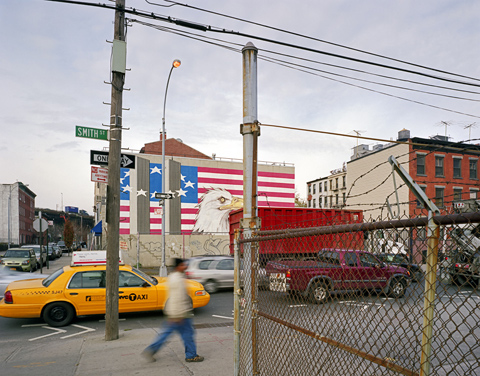
    Smith Street, Brooklyn (4×5 film) — © Brian Rose

    I finally got the film back from the subway trip to Smith Street in the area near the Gowanus Canal. The image in WTC was from my small digital camera–the one above is from a 4×5 negative. Several pictures I took there are usable, but I think I will stick with this view.


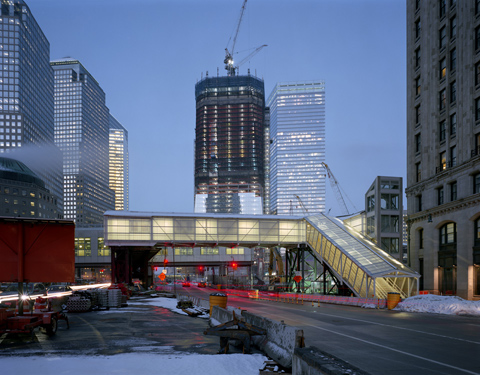
    West Street (4×5 film) — © Brian Rose

    This is the 4×5 version of an image posted earlier show 1 WTC and 7 WTC in the center.


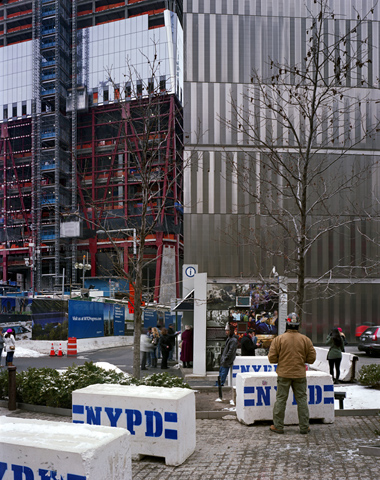
    Info kiosk with 1 and 7 WTC (4×5 film) — © Brian Rose

    I will update my WTC book with the images above and the two below. I’ve felt that the series needed strengthening near the end. These should do the trick.

    At this point, unless something unexpected happens with a publisher, I am planning on putting this book out on Blurb in two sizes–the full size 11×13 hardcover and an 8×10 hard and softcover. The smaller books will sell for $45 to $55 as opposed to $100 plus for the larger size. From an aesthetic standpoint, the 11×13 best conveys the monumental nature of the subject, but the small book will look good, too. All three of my self-produced books will be available in the 8×10 format including Time and Space on the Lower East Side and Berlin: In from the Cold.

    I’ll post a new link to the updated book once it’s ready. Link here.

  • New York/Ground Zero


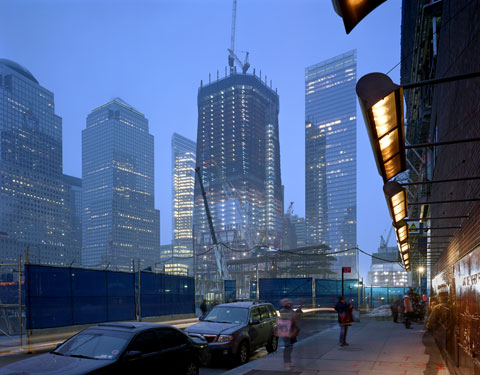
    Greenwich Street, Fireman’s Memorial  (4×5 film) — © Brian Rose


    Church Street, St. Paul’s Chapel Churchyard (4×5 film) — © Brian Rose

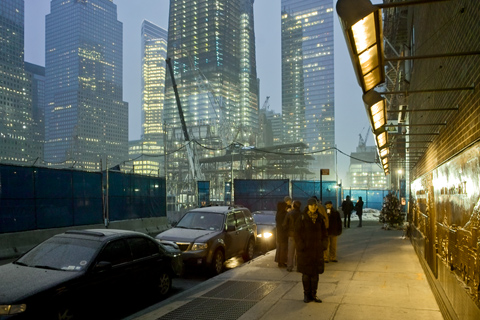
    Earlier this week I picked up the film from my two days of shooting around ground zero. So these are scans of 4×5 film. Despite difficult snowy conditions, and a 30 second exposure for the evening shot, both negatives are razor sharp. The tall building at center of both images is One World Trade Center. The sweeping view of the site made next to the Fireman’s Memorial was, until a few weeks ago, blocked by the remnants of the Deutsche Bank building behind the blue fence to the left. I’m very pleased with these images and intend to work them into the WTC book. Stay tuned for several more images.

    It’s taken me a while to get these up because I had jury duty–two days on call–didn’t get picked. A jury of your peers in Manhattan can be a pretty rarefied group. A hundred of us were taken into a courtroom for jury selection and 18 were interviewed by the prosecution and defense attorney. You were asked to respond to basic questions about career, education, and family. 17 of the 18 in that first group had college degrees. Many had masters degrees. The jury was selected before I had a chance to be interviewed. It was an armed robbery.


  • New York/The Bowery


    The Bowery — © Brian Rose

    Sign of the times.

  • New York/Harlem


    Lexington Avenue and 103rd Street — © Brian Rose

    A few photos taken while walking back to the subway after visiting with Sean Corcoran, the photography curator at the Museum of the City of New York. I was at the museum to show him my WTC book and discuss with him publishing and exhibition possibilities. The museum is already committed to showing work relating to the Twin Towers by Camilo Jose Vergara. My previous publisher, Princeton Architectural Press, also cited a book they did ten years ago with Vergara as a reason for passing on my book.

    With regard to the museum, I can’t exactly complain given that I only put together my book about a month ago, and I am grateful to Sean Corcoran for his ongoing enthusiastic support. There are other exhibition options. But it’s hard for me to run up against Vergara twice, however accidentally, since I do not consider our work very closely related. There is, superficially, the documentation of places over long periods of time, such as the work he has done in Harlem and other low income neighborhoods, but that’s as far as it goes.

    Vergara works primarily with a small camera, repeatedly visiting the same locations and views, measuring change in a cumulative brick by brick process. He is as much sociologist as photographer.


    Lexington Avenue between 103rd and 104th Streets — © Brian Rose


    Lexington Avenue between 103rd and 104th Streets — © Brian Rose

    The projects I’ve done came about more organically in most cases, starting out in a limited scope, and then becoming multi-phased explorations. My Iron Curtain work, for instance, began as a single trip along the former borderline, but turned into a near life-long journey, an investigation of the landscape connected to larger geopolitical developments. WTC is comprised of a number of discreet, sometimes overlapping, series of images made over the course of 32 years. I think of the book as the visual equivalent of  a musical composition in which the theme is tentatively introduced in the opening, and then, in steps, develops narratively and dynamically. Both the Iron Curtain and WTC projects end up as meditations on things that no longer exist, structures of symbolic import, that remain held in memory, both personal and collectively.

    At this point it looks unlikely that WTC will get published other than as a Blurb book available at a relatively high price. The photo books that will get published will mostly reprise, painfully–sometimes gratuitously–images of exploding planes, collapsing buildings, the heroes in the pit.  My book takes a longer view. Maybe it will reach a larger public after the dust of that day clears, yet again.

  • New York/Morning


    The Bowery — © Brian Rose

    A reflective moment in the morning.

  • New York/Enough

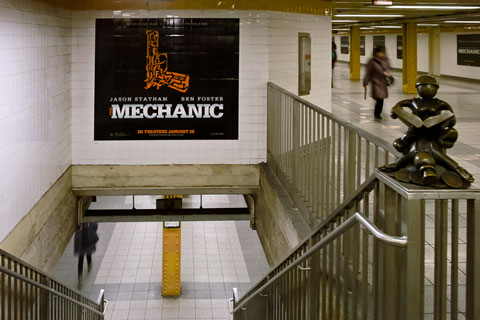
    We are awash in gun imagery from Sarah Palin’s congressional crosshairs to the latest Hollywood movie Mechanic. The slogan along the top reads:

    Someone has to fix the problems.

    ENOUGH.

    ***

    While I was talking this photograph an MTA employee walked by and in a stern voice said “You can’t take pictures down here!” I said, “Yes I can.” He just continued walking, but had he stopped I would have been happy to point him to:

    Section 1050.9

    Restricted areas and activities.

    3. Photography, filming or video recording in any facility or conveyance is permitted except that ancillary equipment such as lights, reflectors or tripods may not be used. Members of the press holding valid identification issued by the New York City Police Department are hereby authorized to use necessary ancillary equipment. All photographic activity must be conducted in accordance with the provisions of this Part.

    MTA NYC – Rules of Conduct

  • New York/WTC


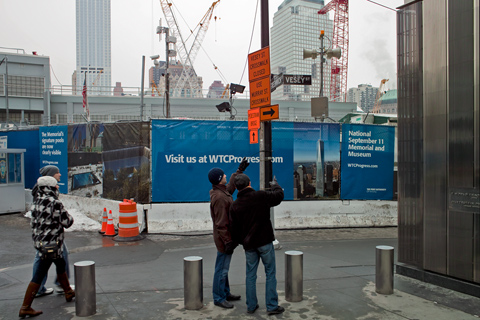
    Vesey Street — © Brian Rose

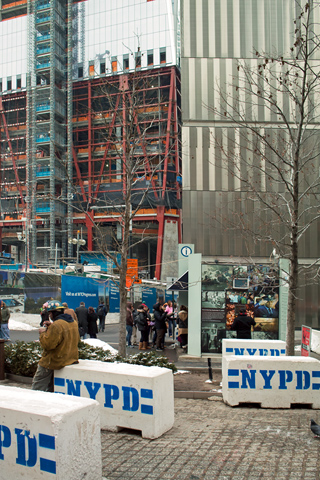
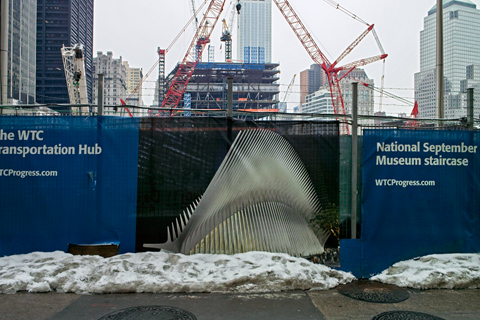
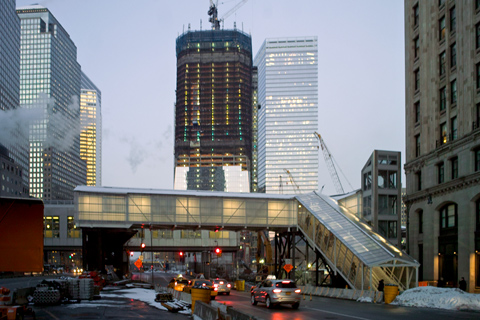
    I went back to the WTC site yesterday and spent much of the day there–mostly in three spots. It was a cold cloudy day with snow occasionally falling. Conditions like that make using the view camera difficult, but it was not so extreme as to be unmanageable. I started out in the area around the Path Train station adjacent to 7 WTC, the one element of the new World Trade Center already completed. Tourists milled about an info kiosk, looked at the various renderings and photos plastered to construction fencing, and craned their necks up at 1 WTC, now more than 50 stories high.


    Information Kiosk — © Brian Rose


    Transportation Center rendering, Vesey Street — © Brian Rose


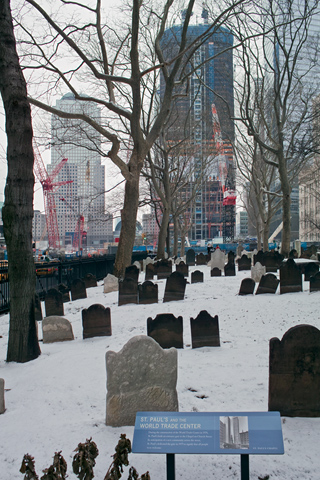
    St. Paul’s churchyard — © Brian Rose

    St. Paul’s Chapel survived 9/11 relatively unscathed including the historic gravestones in its churchyard. The sign at the bottom of the photo above shows the spire of the church situated between the former Twin Towers. I did several photographs in the churchyard and then headed back to my studio to warm up and get more film.


    Fireman’s Memorial, Greenwich Street — © Brian Rose

    When I returned to ground zero the snow had picked up. I did several views in the area around the Fireman’s Memorial. The Deutsche Bank building, which has taken almost ten years to demolish, is now down to the last floor, opening up a panoramic vista of skyscrapers including 1 WTC going up at center of the photo above. I made this iamge by holding my digital camera against the top of the view camera. The exposures with the 4×5 were in the 15 seconds to 1 minute range. Could be snow on the lens, so we’ll see how things turn out when I get the film back.

    I am hoping that a few of these images can be incorporated into the WTC book bringing the narrative up to 2011.

  • New York/WTC


    West Street — © Brian Rose

    I went downtown this afternoon just after a light snowfall. It was cold, but tolerable and not overly windy. I did several shots with the view camera, one similar to the image above. 1 WTC is now over 50 floors up–almost as high as the adjacent 7 WTC. Visually double the height, and add a spire. That’s how tall this building will be when completed.

    I may go back tomorrow. The Deutsche Bank building, which was damaged on 9/11, is now down to its last floor or two. It has taken this long because of a series of delays caused by the discovery of human remains, complicated asbestos removal, an accident, and a fatal fire. The building’s absence opens up new vistas on the overall site and removes a curse–if you believe such things–from ground zero.

    My WTC book proposal will be reviewed by a publisher next week. Keep your fingers crossed–if you believe such things. See the book here.

  • New York/WTC


    Lower Manhattan Skyline, 1982 (4×5 film) — © Brian Rose and Ed Fausty

    This is lower Manhattan at its most heroic and romantic seen from the upper floor of a building in Brooklyn Heights. Since 1982, several bulky buildings have blocked up the foreground and obscured the thin spires of the early 20th century–and of course, the Twin Towers are gone. 1 World Trade Center is about 50 floors up now, and soon it will begin to rise above everything else.

    After receiving a hardcopy version of WTC, my new book proposal concerning the World Trade Center, I decided to make a few changes. Text smaller, a few sequence tweaks, and a new end piece. I also created a text page opposite the image of the Deutsche Bank building, a cursed structure if ever there was one, only now about to fully demolished. It needed some explication.

    I am reaching out to everyone I can about the book. I have some very good contacts, but limited. I need someone to come through for me on this. Otherwise, I’m not sure how this book will see the light of day.

    The new version of WTC can be previewed here.

  • New York/Mohonk


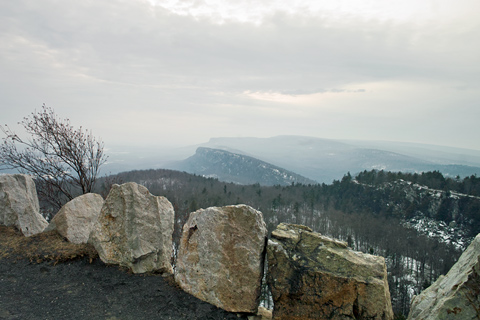
    The Shawangunk Ridge from Skytop — © Brian Rose

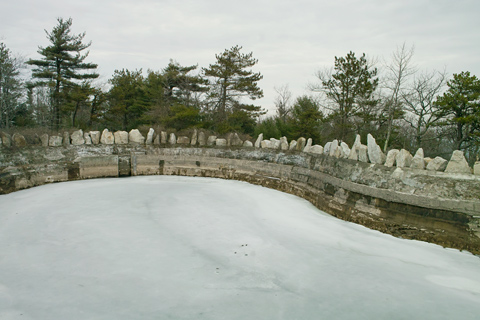
    Here are a few more photographs of the Mohonk Preserve just west of New Paltz, New York about two hours north of New York City. It’s amazing that such a landscape exists so close to one of world’s largest cities. Stay at the Mohonk Mountain House if you’ve got a few bucks to spare. It’s expensive, but refreshingly unhip, even a bit frayed at the edges. The hotel architecture is fairytale eclectic–turreted castle here, Swiss chalet there. The grounds are dotted with small pavilions nestled on rocky outcroppings, a throwback to the 19th century concept of the romantic landscape.


    Skytop Reservoir — © Brian Rose


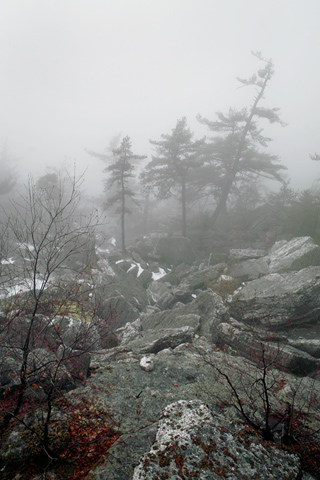
    Mohonk Preserve — © Brian Rose

  • New York/Mohonk


    Mohonk Preserve, New Paltz, New York — © Brian Rose

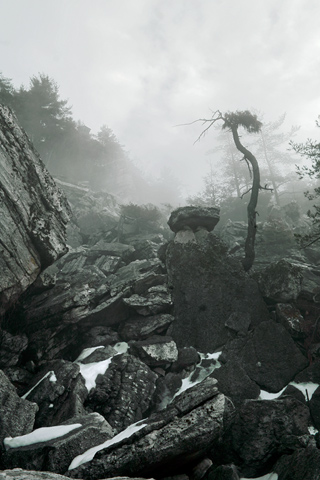
    I spent the New Year’s weekend Upstate with Renée and Brendan. We hiked and did a little cross country skiing. I began reading Let the Great World Spin by Colum McCann. This morning the snowy ground and warm temperatures created a swirling fog that plunged us into a colorless world as we walked the trails of the Mohonk Preserve near New Paltz, New York.

  • New York/Lower East Side


    E12th Street, 2003  (4×5 film) — © Brian Rose

    From my World Trade Center book, WTC. Preview available here.

    Happy New Year!

  • New York/Lower East Side


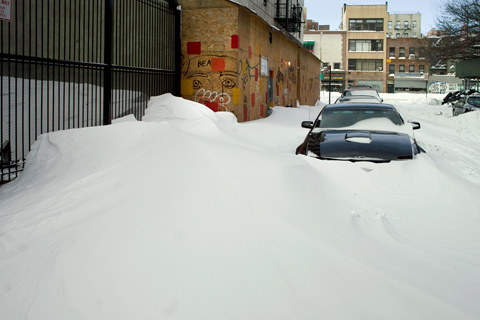
    Stanton Street — © Brian Rose

    Digging out today.

    Please visit Reciprocity Failure for a few comments on one of my photographs. And take a look at my proposed World Trade Center book here. Let me know what you think.


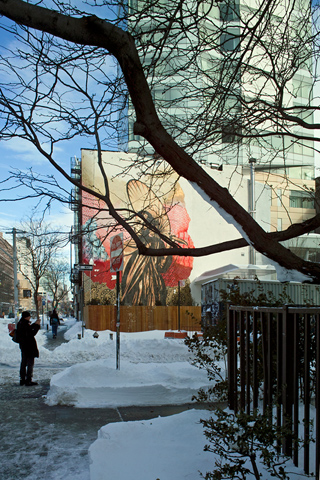
    Third Avenue and E5th Street — © Brian Rose

    Shepard Fairey mural on the Cooper Square Hotel.