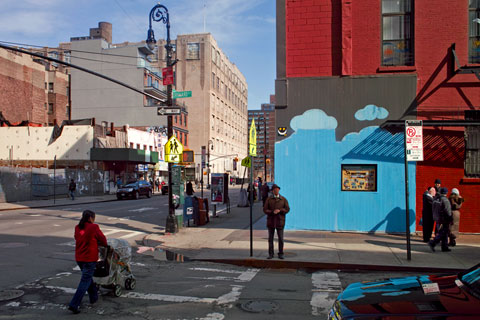
Author: admin

  • New York/Lower East Side


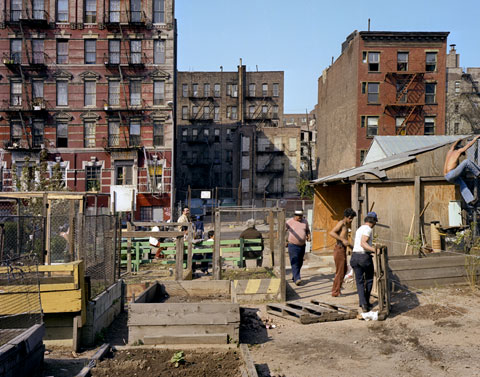
    E12th Street, 1980 (4×5 film) — © Brian Rose/Ed Fausty

    While working on a grant application having to do with urban farming and gardens I went back to my archive of unscanned Lower East Side photographs from 1980. I found one of a garden on E12th Street that I liked–taken on an early spring day it shows a number of people working. It’s interesting to note that the gardeners appear mostly Latino, which runs counter to my assumption that the urban gardening movement on the Lower East Side was largely a white middle class undertaking. This garden, by the way, still exists on E12th Street between Avenue A and B.

    When I did my library slide talk a month ago, I was asked by someone in the audience how many photographs I had from 1980, suggesting that they should be preserved for the historical record–including pictures that were left out of the book. There are several hundred.  I do think the entire project should be scanned, and eventually made available to the public.

    My exhibition of 14 LES photographs is still up at the Lower East Side Visitor Center at 49 Orchard Street. The next exhibition there begins on May 14th, so I will leave my prints up for a couple more weeks. If anyone is interested in purchasing one or more of the mounted exhibition prints, please get in touch. I am offering them at a favorable price.


  • New York/Around Town


    Cowgirl, a restaurant on Hudson Street, Greenwich Village — © Brian Rose


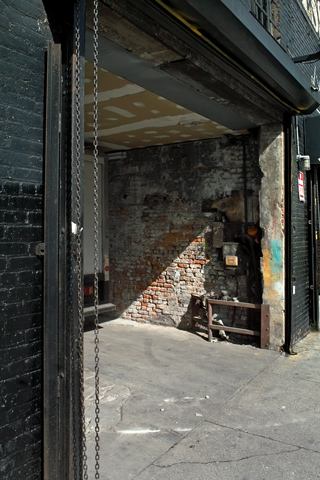
    126 Front, Dumbo, Brooklyn — © Brian Rose


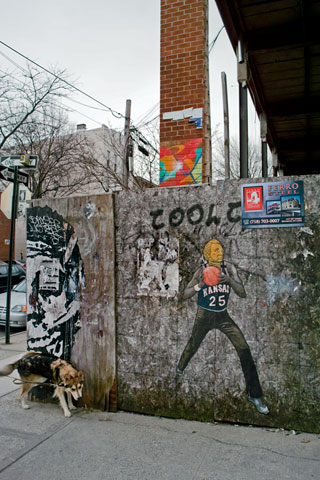
    117 Metropolitan Avenue, Williamsburg, Brooklyn — © Brian Rose

    Without comment.

  • New York/Hudson Square


    Hudson Street — © Brian Rose

    Have been working on another grant application–this time with the Design Trust for Public Space. They have commissioned photographers in the past to explore different aspects of the urban landscape. This year the theme is “five borough farm,” a project to survey and document urban agriculture around the city. The stipend is only $5,000, but one is also assured of an exhibition and publication. Just one photographer selected. I’d be perfect for this.

    Last night I went to the Rattlestick Playwrights Theater in Greenwich Village to see Suzanne Vega perform her musical play “Carson McCullers Talks About Love.” Years ago, Suzanne worked up a monologue based on the character of the author Carson McCullers–one of several female personalities that she has been drawn to, or taken inspiration from. It was, at that time, a minor but affecting performance.  She has now developed the idea into an ambitious portrayal of the writer with songs and music co-written with Duncan Sheik. The songs exhibit many of the familiar melodic and lyrical qualities of earlier Vega music; some are complete stand-alone songs; others are intended more to support the narrative of the play. At least that’s my take on hearing them for the first time.

    Suzanne assumes the character of Carson McCullers, with whom she shares a striking resemblance. She walks on stage as herself, gives a short introduction, and then dons a wig and removes her makeup at a mirror to better resemble the tomboyish McCullers. Like her earlier McCullers performance, it is essentially a monologue, but now there is occasional verbal interplay with a pianist and guitarist who remain on stage throughout the play.

    It is not necessary to have read Carson McCullers to appreciate the play, though it certainly doesn’t hurt to be familiar with her work and that of other mid-century American authors who she came in contact with, or compares herself to. One song, in fact, is full of boasts about how she, McCullers, is better than Harper Lee. Although there is sadness and tragedy in McCullers’ personal story, Vega portrays her with a good deal of feisty wit and bravado.

    For Suzanne, doing this play is a labor of love, beautifully realized, bestowed upon the audience.

  • New York/Williamsburg


    Williamsburg, Brooklyn — © Brian Rose

    Without comment.

    Update: I just read the shocking news that Tim Hetherington was killed in Libya covering the uprising against the Qaddafi government. I have written about Hetherington a couple of times, someone I hailed as expanding the concept of photojournalism with his still photography and video. Two other photographers, Chris Hondros and Guy Martin were seriously injured in the same incident.

    Here is the New York Times article.

    My post about Hetherington here.

    Latest news is that Chris Hondros has died.

  • New York/Union Square


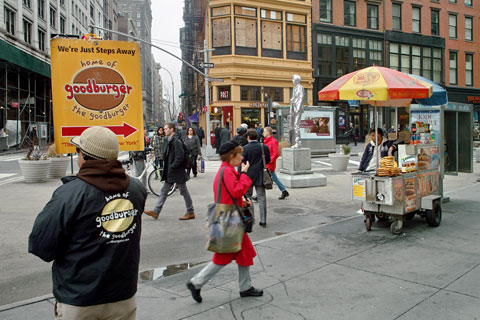
    The Andy Monument, Broadway at Union Square Park — © Brian Rose

    Union Square Park is home to some of the finest sculptures in New York City. These are mostly traditional likenesses of important historical figures like George Washington, Abraham Lincoln, Marquis De Lafayette, and Mahatma Gandhi. The Lafayette statue was made by Frédéric-Auguste Bartholdi (1834–1904), who also designed the Statue of Liberty  in New York Harbor. Although the park is often associated with the labor movement because it has frequently been the location of parades and political rallies, the name comes from the “union” of two major streets, Broadway and the Bowery Road, now called 4th Avenue. In the days after the attack on the World Trade Center in 2001, Union Square, in the plaza surrounding the Washington equestrian sculpture, became the site of one of the largest spontaneous memorials in the city.

    The area around the park has gone through many ups and downs over the years, but in the 1970s it was considerably less vibrant economically than today. I remember the park in the late 70s as one big open air drug bazar, and few people who lived and worked around Union Square stepped foot in it. As is often the case in New York, however, depressed circumstances create opportunities for others. Artists, ever nomadic, found the lofts around the park cheap and spacious. One of them was Andy Warhol, the Pop Art icon of the era.  He and his “Factory” located on Union Square, became  a nexus of art, fashion, music, and commerce.


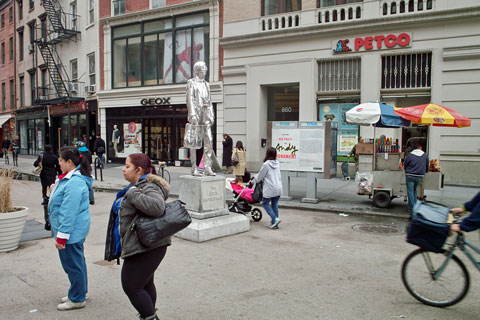
    The Andy Monument, Broadway at Union Square Park — © Brian Rose

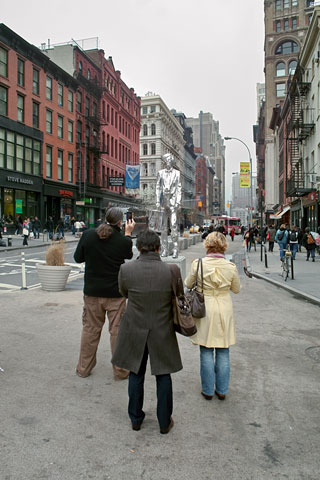
    It is appropriate, therefore, that a statue be erected to the real and mythic Andy at the confluence of two of New York’s earliest and most important highways. As I came across the chrome Andy Monument the other day on a silvery gray day, the statue seemed almost ethereal in the mist and drizzle. Unlike the other bronze statues in Union Square, which express solidity and historical weight, Andy floats vaguely, aloofly, above the throngs of shoppers and office workers passing by.


    The Andy Monument, Broadway at Union Square Park — © Brian Rose

    The sculpture is by Rob Pruitt and is sponsored by the Public Art Fund. Pruitt says:

    Like so many other artists and performers and people who don’t fit in because they’re gay or otherwise different, Andy moved here to become who he was, to fulfill his dreams and make it big. He still represents that courage and that possibility. That’s why I came to New York, and that’s what my Andy Monument is about.

    I took pictures for about five minutes. Most people walked on past, of course, but many stopped to make snapshots or read the adjacent text. It’s rare for a public sculpture to engage the public (fancy that) as much as this one does. Too bad that it is here only until October.

  • New York/Williamsburg


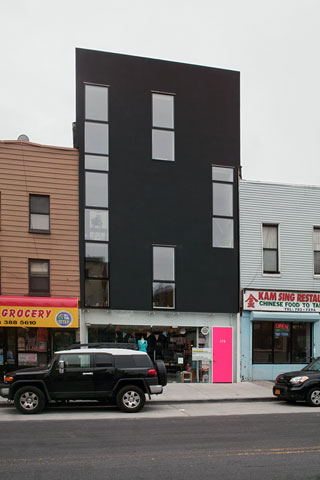
    Grand Street, Williamsburg, Brooklyn — © Brian Rose

    A new building from local firm Loading Dock 5. Despite the many mega housing projects in Williamsburg, the best architecture is often found in small infill projects like this one. The windows echo the off-the-shelf frames of the two aluminum sided houses on either side. A glimpse of the light filled interior can be seen through the tall vertical window.


  • New York/The Bowery


    Cafe on the Bowery — © Brian Rose

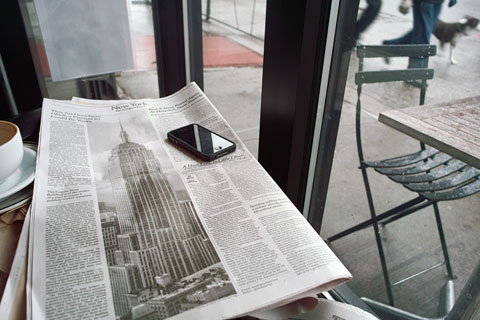
    An article about the Empire State Building, built during the Great Depression, it was once referred to as the Empty State Building because of the high vacancy rate. Nice to see an architectural view used so prominently in the paper. It looks a lot better here graphically rendered in black and white than it does in color on the NYT website–wrong time of day and hazy looking.

  • New York/Lower East Side


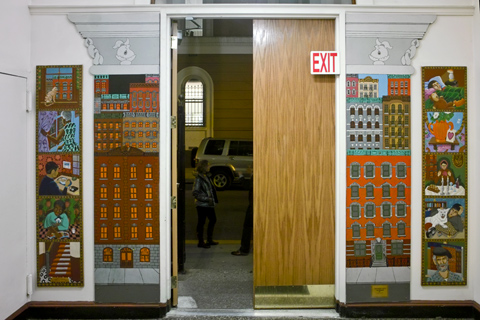
    University Settlement, Eldridge Street — © Brian Rose

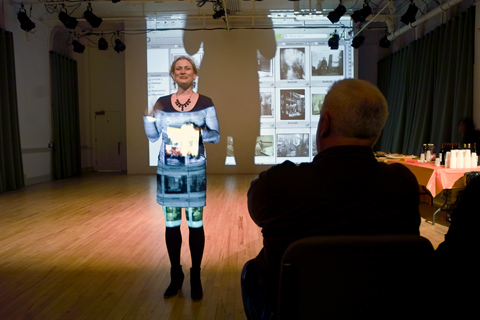
    Saturday evening I went to the University Settlement for a slide presentation, which I thought was going to deal in part with the Lower East Side. It did begin with historic photographs of the neighborhood by important photographers like Jacob Riis and Berenice Abbott, but the contemporary work shown was from other places–four dyspeptic views of the dark side of American society–post Katrina New Orleans, foreclosure misery in Florida and Cleveland, Indian poverty at Pine Ridge, and a fashion show for women in prison. The program included Alan Chin, Brenda Ann Kenneally, Andrew Lichtenstein,  and Anthony Suau.


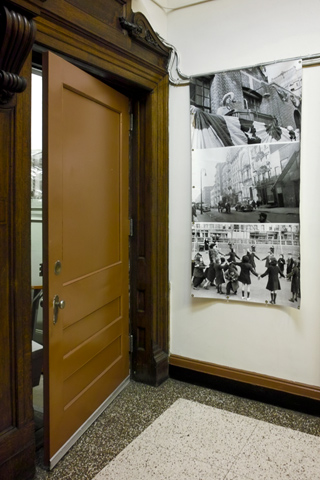
    University Settlement — © Brian Rose


    University Settlement slide presentation — © Brian Rose


    Photograph by Anthony Suau

    One of the photographs shown by Anthony Suau depicts a Cleveland sheriff carrying out an eviction. It was the winner of the World Press Photo of the Year in 2008. One website compares this image to the famous Eddie Adams street execution photograph from Vietnam. The assumption is that warfare has come to the streets and homes of America. To me, the photograph is more ambiguous–a police officer stepping through a house strewn with trash, fearful that danger lies beyond the next door. We know it is an eviction, but we know little else of the circumstances. There are different possible scenarios. The larger issue of what led to foreclosures across the United States is the back story, not the immediate one of a fearful step forward by an officer with his gun drawn.

    All of the subjects presented by the five photographers are serious, non trivial areas of inquiry, and I was impressed with the skill and commitment of the photographers, but ultimately I have grown so weary of this kind of you-are-there photojournalism that I can barely look at it any more. Surely this is the opposite of the reaction desired. The idea is to expose injustice and shock viewers into action. I am afraid that most people, like myself, tend to look away. The historical Lower East Side pictures were shown as inspiration and motivation for the slides to follow. The biggest difference between the older work and theirs is the difference between showing and telling. Modern photojournalism tends to more openly interpose the photographer between the story and the viewer.

    That said, however, I don’t have a new paradigm of photojournalism to offer, and I am aware of the limitations of what I do, which is also a kind of photography that seeks to address social issues, if in a more round about manner. All I can say is that I am, and have been, searching for a way that is more inclusive and acknowledges the complexity of issues and the inherent difficulties in conveying visual meaning.


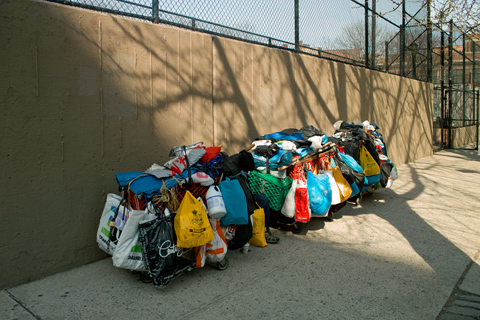
    Clarkson Street, the West Village — © Brian Rose

    In the photograph above–taken yesterday–there is a person just barely visible in the midst of the shopping carts and bags. What is the meaning or value of this kind of photograph? The sharp sun and shadows, the colorful plastic bags, the crazy incongruity. I do not expect every picture to answer the questions raised, but over the course of my work, I do hope that some threads of meaning become recognizable, some justification emerges, for what is inherently an exploitative enterprise.

    Just before going to the University Settlement event I was pleased to meet Kristin Ellington of the multi-media firm Funny Garbage. We talked about the Lower East Side, my photographs, and her interest in creating a website dealing with the neighborhood, history and the present. I am looking forward  to seeing her  project take shape.


  • New York/Williamsburg


    Berry Street, Williamsburg — © Brian Rose

    A very nice post about one of my Lower East Side photographs from 1980.

  • New York/Wyoming


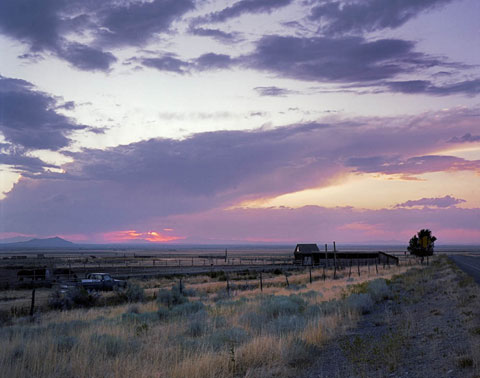
    Somewhere in Wyoming, 1981 (4×5 film) — © Brian Rose

    First some disappointing news. My application for a grant from the Graham Foundation to photograph the New Religious Landscape, a project focused on Megachurches and their surrounding areas was unsuccessful. At this point, it is just about impossible for me to take on ambitious projects like this without external funding.

    I’ve spent the last two days writing an article for a special edition of the Fast Folk magazine dedicated to Jack Hardy, the late songwriter. Scroll down for earlier posts on Hardy. It is basically the story of my relationship with Jack from 1977 to 1984 during which time we hung out in Greenwich Village folk clubs,, traveled across country together and established the Fast Folk, a monthly LP/magazine of the latest songs from our weekly songwriters meetings. I may post the article here later, but I don’t want to preempt the Fast Folk, which will be available online–probably through the Smithsonian Folkways record label. Stay tuned for that.

    The photograph above was taken while driving with Hardy through Wyoming in 1981. There are many other pictures from that trip, and none have ever been printed. A slight light leak in my view camera caused streaking on about half of the images making them near impossible to print–the old way in the darkroom. The defect is easily remedied with Photoshop. So, stay tuned for a series of images taken all over the United States in the early ’80s.

  • New York/Williamsburg


    N5th Street, Williamsburg, Brooklyn — © Brian Rose

    Without comment.

  • New York/Lower East Side


    Chrystie Street — © Brian Rose

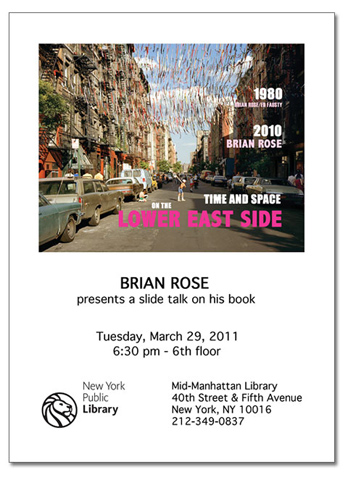
    My slide talk went well last night at the Mid-Manhattan library. I heard there were 58 people in the audience. Ed Fausty who did the 1980 Lower East Side photographs with me was there and participated in the Q&A. I sold a few books, and talked with lots of people afterward.

    I stepped through Time and Space on the Lower East Side reading most of the text pieces and adding a few additional comments here and there. Since I was showing the images one at a time, some of the connections between images–on facing pages in the book–were not so easily made. I don’t mean actual before/after pairs, which are obvious enough, but other less direct relationships. But it was my choice to fill the screen with large single images rather than show pairs at a smaller size.

    Here is a review of the slide talk.

    ***

    Today I am recording one of Jack Hardy’s songs for a special project dedicated to the late songwriter. Jack died a couple of weeks ago–a great shock to all of us in the folk songwriting community in New York and elsewhere. Jack and I founded the Fast Folk back in 1981 with the intention of getting new songs on the street quickly while still fresh. I will write more about the Fast Folk in the future. Tomorrow there will be a memorial event:

    Jack Hardy Memorial Gathering in New York City: There will be an evening of song in memory of Jack, hosted by David Massengill, on March 31st, 2011. It will be at the Christopher Street Coffee House, in St. John’s Lutheran Church, at 81 Christopher Street. There is more information on the Christopher Street Coffee House web site

    A number of YouTube videos of Jack Hardy performances have been added recently including this one from the 50th anniversary of the former Village folk club Folk City. It was the last time I saw Jack perform on stage. I was doing still photographs for the event and that’s the back of my head interfering with some of the video–sorry. This is Jack at his best surrounded by terrific musicians including Kirk Siee on bass, Mark Dann on guitar, and Lisa Gutkin on violin. Jack’s daughters Morgan and Miranda sing harmonies, and midway through, Terre Roche joins them.

    And here’s a video of Suzanne Vega visiting the songwriters’ exchange at Jack Hardy’s apartment on Houston Street. I wasn’t there that day, but I see several familiar faces–Tim Robinson, Frank Tedesso, and Erik Frandsen–three of the best songwriters around.

  • New York/The Bowery


    The Bowery — © Brian Rose

    The corner of Prince and Bowery. I was juggling a couple of grocery bags and hailing a cab. A woman yelled “Nice picture!” and snapped a variation of same with her cellphone.

  • New York/Colonial Williamsburg

    Last weekend I went to AIPAD, the giant photography dealer’s fair at the Armory on Park Avenue. I don’t have any particular opinion about what I saw–a lot of photographs–no trends spotted. Not enough time or energy to think critically about such a dizzying display of dreck to pearls. Primary observation: more galleries present and a number from outside New York. Business seems to be picking up. So far, it’s not helping me.

    Afterward, I dashed uptown to the Guggenheim to meet my sister who was visiting from San Francisco. We wanted to see a video installation by Omer Fast who in 2005 made a piece dealing with Williamsburg, Virginia, the restored colonial capitol, and where we grew up.

    From the 2008 Whitney Biennial:

    In Godville (2005), a 51-minute, two-channel color video, historical reenactors at the Colonial Williamsburg living-history museum in Virginia describe their eighteenth-century characters’ lives and their personal lives in ways that seem interchangeable. Fast splices the reenacted and real biographies together, often word-by-word, into a rambling narrative that is as aurally fluent as it is temporally dissonant. The work tells the story of a town in America whose residents are unmoored, floating somewhere between the past and the present, between revolution and reenactment, between fiction and life.
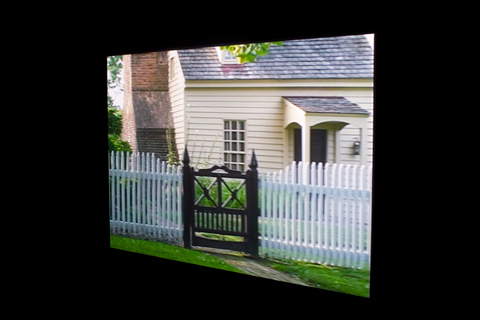

    Godville by Omer Fast — seen at the Guggenheim Museum — © Brian Rose

    Both my sister and I played roles in the open air museum of Colonial Williamsburg. I was part of the fife and drum corps, a professional musical group that performed regularly for visitors as well as for presidents and dignitaries. My sister was a costumed ticket taker, and later a costumed sweeper hostess at the nearby Busch Gardens “old Europe” theme park. A sweeper hostess, as I understand it, picked up trash and chatted with tourists.

    I found the film fascinating, though unsure about its ultimate message. I liked the idea of intercutting between real and fictional, and in the process blurring the lines. I have made photographs of the architecture of Colonial Williamsburg, and was particularly interested in the juxtaposition of views of the historic structures and contemporary suburban neighborhoods. Confusing, however, was that many of the contemporary architectural and landscape images shown were not made in Williamsburg, but in unidentified generic locations.  Some of the images included mountains and scenes from the west, which I presume was intended to allude to larger American mythological themes.
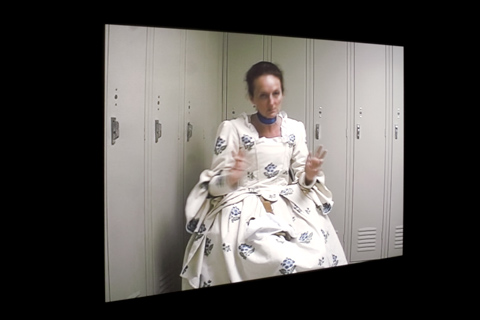

    Godville by Omer Fast — seen at the Guggenheim Museum — © Brian Rose

    Three costumed reenactors spoke either in character or from their real life experiences. Some of the time they were shown speaking uninterrupted, other times their words were chopped up and reconnected. The depiction of these people–and their words–is extremely manipulative, but I can’t say that they were shown unsympathetically or portrayed unfavorably. It is, however, a highly problematic approach. Knowing what I know about art and media, I would be very wary of participating in such an enterprise.
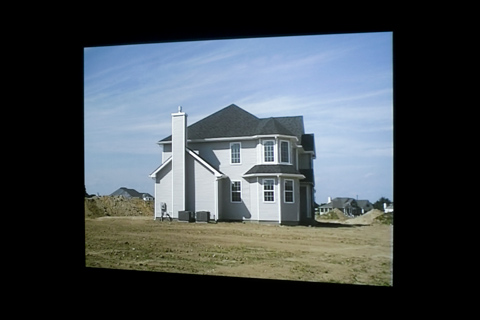

    Godville by Omer Fast — seen at the Guggenheim Museum — © Brian Rose

    In so many ways Colonial Williamsburg is an easy mark. It is easy to see it as kitsch and a distortion of American history. Too easy. There is lots of room for critical analysis, but unfortunately most of it to date has been facile. Omer Fast’s Godville, despite my reservations, is worth seeing and thinking about. Not that many people visiting the Guggenheim are doing that. In the hour that I spent watching the video in the museum on a busy Sunday afternoon, not one person gave it more than a minute’s attention.
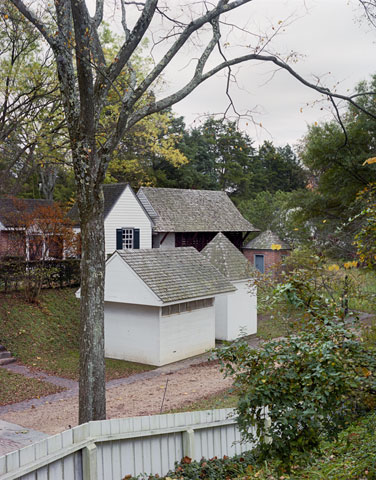

    Colonial Williamsburg outbuildings  (4×5 film) — © Brian Rose

    Which brings me to my own work dealing with Williamsburg. A number of years ago I photographed the outbuildings and surrounding gardens behind the main buildings. The pictures deal with the structures as architectural vocabulary filtered through modern interpretation and context. On the one hand they reveal the complex dichotomy of old and new, and on the other hand they are what they are–formally composed, often beautiful, collections of little buildings, fences, and trees.

    Since it appears I will be continuing to go down to Williamsburg in the future–my father still lives there, and my mother may return there soon, I am thinking I should revisit the project. The idea I have is to photograph some of the new urbanist communities that have been developed outside of the restored area–places that recycle the architectural and urban planning vocabulary of the past–and juxtapose those pictures with the ones I have taken of the outbuildings and dependencies of Colonial Williamsburg.
  • New York/Spring


    Williamsburg, Brooklyn — © Brian Rose

  • New York/Broadway


    Broadway, Greenwich Village — © Brian Rose

    Without comment.

  • New York/Lower East Side

    The reception at the Lower East Side Visitor Center went well. A mixture of invited guests and people passing through as part of Third Thursdays, a once a month evening when the galleries in the neighborhood stay open later. The prints look great on the wall, and they will be up through April 21. Drop in at 54 Orchard Street, ground floor.

    Next up is my slide talk at the Mid-Manhattan library on March 29. I will be presenting Time and Space on the Lower East Side, and I am hoping that Ed Fausty, who I collaborated with on the 1980 photographs, will be present. Ed is working on an exhibition and catalog for a beautiful series of photographs on the landscape and night sky. Unlike anything anybody else has done. I’ll write about it once it’s up.

    The following photos were snapped yesterday on my way to and from my LES  exhibit.


    Orchard and Grand Streets — © Brian Rose


    Delancey Street — © Brian Rose


    Eldridge Street — © Brian Rose